

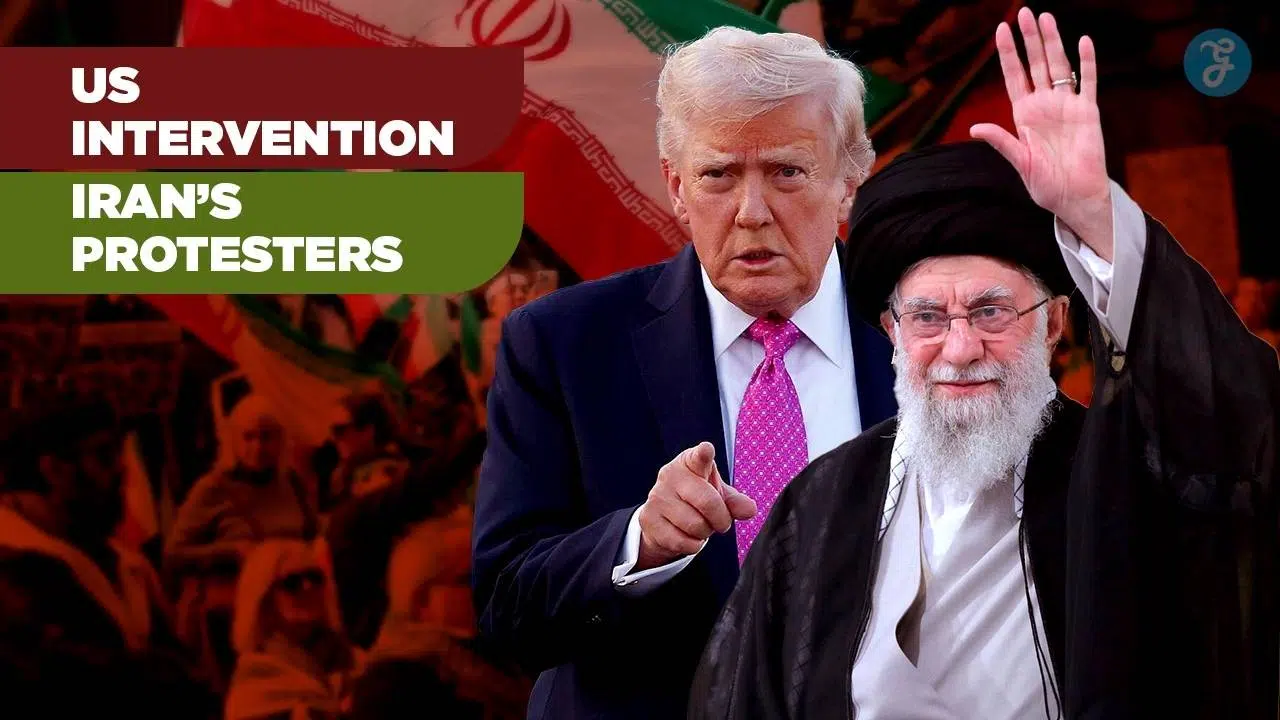
The debate over US Intervention in Iran 2026 began not with a bang, but with a sudden, suffocating silence. The digital heartbeat of a nation simply stopped. It wasn’t the throttling of bandwidth we witnessed in 2019, nor the sporadic outages of 2022. This was a severance, a calculated, “kill switch” event where the Islamic Republic decoupled its internal National Information Network from the global internet. For 88 million people, the world went dark. But in the corridors of Washington and the safe houses of Tehran, a new, far more dangerous game began.
While American policymakers frame their response as a humanitarian rescue, a “Digital Dunkirk” powered by smuggled Starlink terminals and aggressive rhetoric, the reality on the ground is far murkier. We are witnessing a geopolitical paradox that will define the next decade of the Middle East: The very intervention designed to save Iran’s protesters is being weaponized by the regime to crush them.
The Sound of Silence
To understand the stakes, one must understand the silence. When the blackout hit, it didn’t just stop Instagram stories or Telegram channels; it halted the coordination of a revolution. Families could not check on loved ones. Businesses, already teetering on the edge of bankruptcy, froze. The Iran Internet Blackout of 2026 was not a tactical maneuver; it was a strategic siege.
For the protesters, a coalition of bankrupt “Bazaaris” (merchants), unemployed university graduates, and an enraged working class, the blackout was a signal that the regime was preparing for a massacre. In previous uprisings, the smartphone was the shield; footage of brutality was the only thing holding back the full weight of the IRGC’s violence. Without that digital witness, the streets of Isfahan and Mashhad became kill zones.
Into this void stepped the United States. President Trump, freshly returned to the Oval Office, declared that “Help is on the way,” initiating a policy that combines the “Maximum Pressure” economic strangulation of the past with a new, aggressive “Maximum Connection” tech warfare. But by explicitly linking the survival of the protest movement to American power, Washington may have inadvertently handed the Supreme Leader the one thing he lacked: a credible narrative of foreign invasion.
The Perfect Storm: Why 2026 is Different
This explosion of unrest did not happen in a vacuum. It is the direct result of a “Butterfly Effect” triggered thousands of miles away. The economic collapse that sent Iranians to the streets in late December 2025 can be traced back to the capture of Venezuelan President Nicolás Maduro in January 2026.
For years, Tehran and Caracas survived on a “resistance economy” of swaps, Iranian technicians, and gasoline for Venezuelan gold and heavy crude. When the US severed that lifeline, the shockwave hit Tehran instantly. The Rial, already battered, lost nearly 50% of its value in weeks. Inflation soared past 60%, turning the simple act of buying bread into a daily humiliation.
Furthermore, the regime is politically isolated. The “Axis of Resistance” that once projected Iranian power across the Levant is fractured. With Bashar al-Assad gone and Hezbollah weakened, the Mullahs are cornered. And as history shows, a cornered regime is the most dangerous kind.
The Economic Triggers of the 2026 Uprising
| Indicator | 2024 Status | Jan 2026 Status | Impact on Daily Life |
| Currency (Rial) | ~600,000 per USD | ~1,200,000 per USD | Savings evaporated; the middle class pushed into poverty. |
| Inflation Rate | 40-45% | >60% | Price of staples (bread, rice) doubles overnight. |
| Oil Exports | ~1.5m bpd (China/Grey Market) | <800k bpd | Drastic cut in government subsidies for fuel and food. |
| Allies | Strong (Syria, Proxies) | Weak/Fractured | The regime perceives an existential threat from within and without. |
Edge One: The Lifeline [Why Intervention is Necessary]
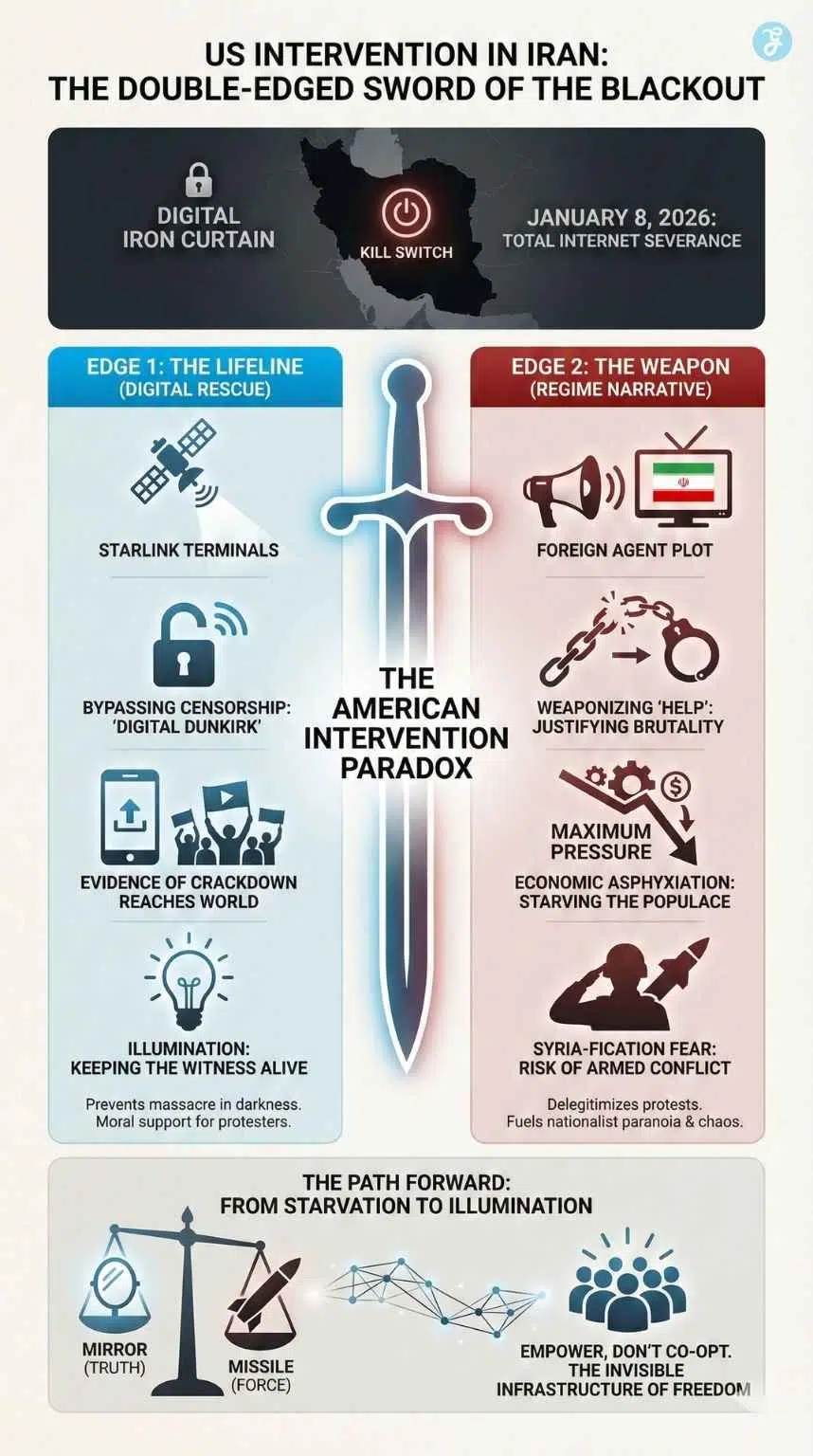
The argument for US intervention is compelling, moral, and technically sound. Without the Starlink Iran Protests initiative, the Iranian people would be fighting in total darkness.
The regime has spent billions building the “National Information Network” (NIN), a sanitized, domestic intranet that mimics the web but allows for total surveillance. When the global internet was cut on January 8, the NIN remained active, allowing the government to function while the people were silenced. This is where the “Tech War” becomes the only war that matters.
The Architecture of Isolation: How the ‘Halal Net’ Works
It is a mistake to view the blackout as a simple disconnection. The regime has not pulled the plug; it has instituted a form of “Digital Apartheid.” Under the National Information Network (NIN), internet access is now tiered. Government officials, banks, and loyalist militias operate on a “White List” with filtered access to the global web, while the general populace is trapped in the “Green Layer”, a sealed intranet of domestic apps for ride-hailing, banking, and state media.
This bifurcation is enforced by Chinese-supplied Deep Packet Inspection (DPI) boxes installed at the country’s three main internet gateways. These tools don’t just block websites; they inspect the “envelope” of every data packet, allowing the regime to throttle encrypted traffic (like WhatsApp) to unusable speeds without shutting down the network entirely. This allows the economy to limp along while the revolution is suffocated in a digital vacuum.
The Digital Dunkirk
Smuggling operations, often moving through the treacherous mountain passes of Iraqi Kurdistan, have brought thousands of Starlink terminals into the country. These devices are not just modems; they are lighthouses. They bypass the state-controlled telecommunications infrastructure entirely, beaming data directly to satellites and back, rendering the regime’s “kill switch” useless for those lucky enough to access them.
The impact is tangible. We have seen footage, grainy, shaky, but undeniable, leaking out of Karaj and Tabriz. We see the security forces firing into crowds. We see the defiance of women burning hijabs. This footage, uploaded via Starlink, is the only reason the international community knows the scale of the crackdown. Without it, the death toll, currently estimated by rights groups at over 45 confirmed, with thousands unconfirmed, would be a state secret.
The “Maximum Pressure” campaign, revitalized by the Trump administration, argues that economic asphyxiation is the only way to break the regime’s war chest. By sanctioning the “architects of repression”, the judges, the prison wardens, the cyber-police, the US is attempting to raise the cost of loyalty. If the regime cannot pay its Basij militia, the thinking goes, the enforcers will eventually defect.
The $2,000 Tax on Freedom
The arrival of Starlink terminals is being hailed as a miracle, but on the streets of Tehran, it is a miracle with a price tag. Smugglers moving units across the Zagros mountains from Iraq are currently charging up to $2,000 USD per terminal, roughly 20 times the average monthly salary of an Iranian teacher.
This creates a dangerous dynamic: “Internet Freedom” is fast becoming a luxury good. The wealthy districts of North Tehran can afford to stay online, while the working-class neighborhoods of the south, where the protests are fiercest, remain dark. The regime has seized on this inequality, using it to frame the Starlink users not as freedom fighters, but as out-of-touch elites collaborating with foreign powers.
Furthermore, the IRGC has begun deploying GPS Spoofing and Ku-band flooding from mobile trucks to jam these expensive lifelines, turning the purchase of a terminal into a high-stakes gamble with a family’s life savings.
Edge Two: The Weapon [Why Intervention is Dangerous]
However, there is a second, sharper edge to this sword. The regime knows it cannot win a technical war against Silicon Valley. Instead, it has shifted the battlefield to the psychological realm, using the very fact of US support to weaponize patriotism.
The “Foreign Agent” Narrative
State media in Tehran is currently running a 24-hour propaganda loop. They broadcast President Trump’s tweets, “We are locked and loaded”, alongside images of seized Starlink terminals and US flags. The narrative is simple and, to a paranoid population, historically resonant: These are not protesters; these are foot soldiers of a US invasion.
By explicitly endorsing the protests, Washington allows the regime to paint legitimate economic grievances as a foreign plot. This is crucial because of the “Fence-Sitters”, the millions of Iranians who despise the theocracy but fear civil war even more.
The Ghost of Syria
The US Intervention in Iran 2026 is viewed by many Iranians through the lens of their neighbors. They look at Iraq post-2003; they look at Syria post-2011. They see that “regime change,” when facilitated by external powers, often leads not to democracy, but to anarchy.
When the US threatens military strikes on nuclear facilities, a threat that has hovered since the June 2025 skirmishes, it terrifies the very middle class the opposition needs to win over. The fear is that the protests will morph into an armed insurgency, backed by Western weapons, turning Iran into a deeper, bloodier Syria. The regime plays on this fear masterfully, presenting itself as the only barrier between order and chaos.
Why ‘Maximum Pressure’ Misses the Target
The tragedy of the renewed “Maximum Pressure” campaign is that it targets an economy the IRGC has already exited. While the bazaari merchant cannot import rice or medicine due to banking restrictions, the Revolutionary Guards operate a parallel “Shadow Economy” immune to US Treasury designations.
Intelligence indicates the IRGC is using a technique known as “Burst Activity”, rapidly registering shell companies in jurisdictions like Gambia and Madagascar to move oil and procure hardware before Western regulators catch up. They have built a resistance economy that feeds the security state while the formal economy collapses around the citizenry. In this context, broad sanctions act as a tax on the innocent, deepening the poverty that fuels the protests while leaving the regime’s war chest surprisingly intact.
The Double-Edged Sword of US Policy
| US Action | Intended Outcome | Regime Counter-Narrative / Unintended Consequence |
| Supplying Starlink | Break the censorship wall; allow free flow of info. | “Cyber-invasion” proof; justification for total NIN lockdown and house raids. |
| “Maximum Pressure” | Bankrupt the regime; force concessions. | Starves the population; it erodes the middle class needed to lead a transition. |
| Military Threats | Deter violence against protesters. | Rallies nationalist sentiment; delegitimizes protesters as “traitors.” |
| Public Support | Moral boost for the opposition. | Used as evidence of a “Western Coup,” alienating cautious reformists. |
The “Syria-fication” Risk: A Warning from History
The trajectory of the 2026 uprising is alarming. As the blackout drags on, the nature of the resistance is changing. Deprived of peaceful means of communication and organization, fringe elements are becoming more radical. There are reports of attacks on police stations and arms depots in the border provinces.
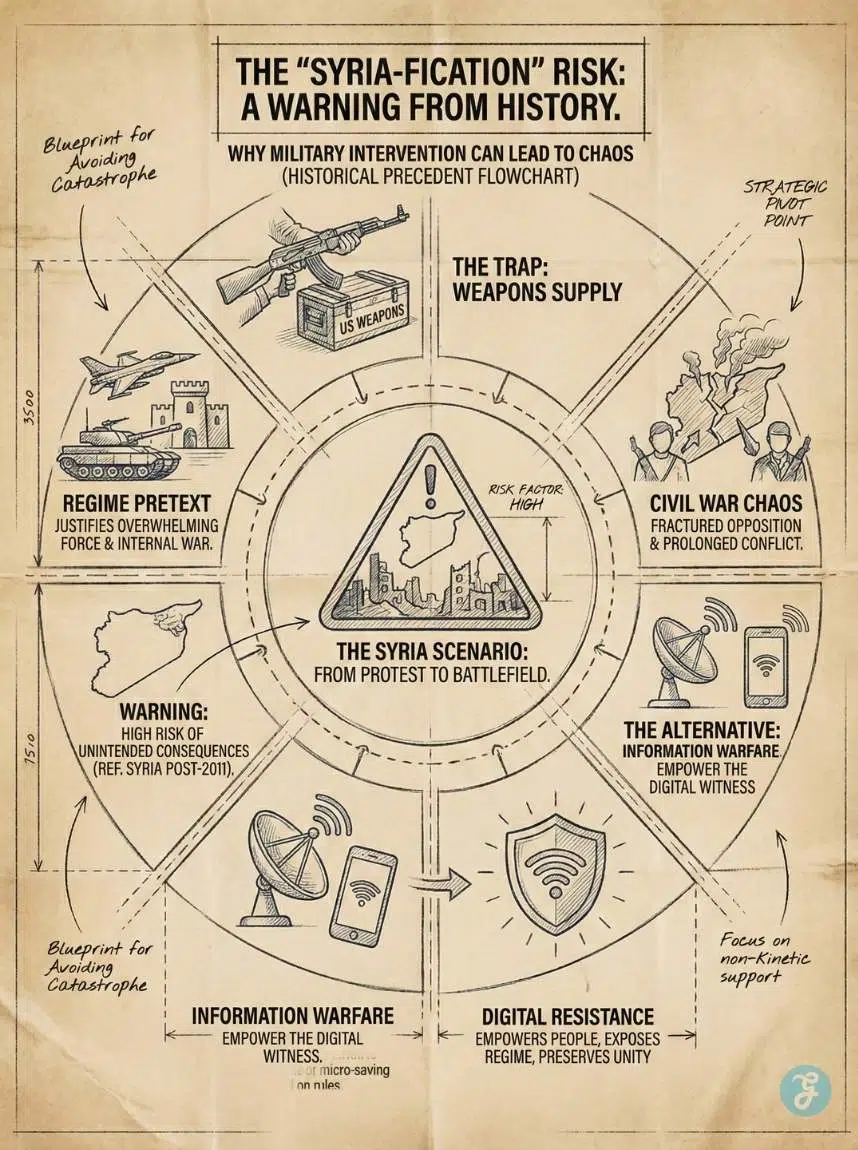
This is the “Syria-fication” trap. If the US responds to regime violence by supplying weapons rather than just internet access, it crosses a rubicon. The moment an American rifle is found in the hands of a protester, the regime will have the pretext it needs to deploy its heavy weaponry, artillery, and air power against its own cities, just as Assad did.
The National Information Network is designed to facilitate this internal war. It allows the military to communicate while the population is deaf and blind. The US must be incredibly careful not to fall into the trap of escalating the conflict militarily, where the regime has the advantage, rather than keeping it focused on the information space, where the people have the advantage.
Future Scenarios: The Road Ahead
As we look toward the spring of 2026, three scenarios emerge from the fog of the blackout:
- The North Korea Model: The regime succeeds in hermetically sealing the country. The internet becomes a memory. Iran survives as a disconnected, militarized fortress, trading only with fellow pariahs, its population trapped in a digital 1990s.
- The Collapse: The economic pressure becomes too great. The security forces, unpaid and demoralized, refuse to shoot. The cracks in the elite widen, leading to a palace coup or a chaotic transition.
- The Civil War: The most terrifying option. The protesters arm themselves. The US gets drawn in to protect “safe zones.” The country fractures along ethnic lines (Kurds, Baluchis, Azeris), and the region burns.
The Pivot: From Starvation to Illumination
The United States cannot “save” Iran. Every time it has tried to engineer the politics of Tehran, from the coup of 1953 to the revolution of 1979 to today, it has left scars that complicate the present. But that does not mean it should do nothing. The US Intervention in Iran 2026 must be recalibrated. It must pivot from the blunt force of broad economic sanctions that punish the poor, to the precision scalpel of “Information Intervention.”
The goal should not be to starve the regime, but to illuminate it. Washington must understand that the most revolutionary weapon in a totalitarian state is not a missile, but a mirror. The strategy must shift entirely to maintaining the digital lifeline without attaching political strings. If the US can keep the lights on without casting its own shadow over the movement, there is a chance for a homegrown, authentic Iranian future.
The Final Verdict: The Mirror, Not the Missile
When an Iranian girl stands on a utility box, waving her white headscarf in defiance, she needs to know that the world is watching. She needs the internet. She needs the truth. She does not need a Marine landing force, nor does she need her struggle to be co-opted by American political rhetoric.
The Starlink terminals are a start, but they are fragile. The real challenge is to maintain the flow of information without tainting the source. If the intervention becomes the story, the regime will win, and the silence will return, this time, forever. The US must ensure that its involvement remains the invisible infrastructure of freedom, rather than the visible hand of a foreign power.























