Managing Gen Alpha interns is often less about skill gaps and more about the disconnect between how they learn and how many workplaces still train. Today’s youngest interns are entering professional environments shaped by speed, transparency, and constant digital interaction, while many organizations continue to rely on outdated onboarding and mentorship methods.
Managing Gen Alpha Interns: What Leaders Need To Know is ultimately about creating a work culture that feels fast, fair, and authentic without lowering expectations. The most effective approach is simple: build clarity into a repeatable system and use technology to support coaching in ways that are structured, helpful, and focused.
This guide breaks down who Generation Alpha is, the early challenges leaders encounter, and the practical Leadership, Mentorship, Engagement, and Communication strategies that help interns develop into confident, high-performing teammates.
Who is Gen Alpha and Why They Matter

Generation Alpha generally refers to people born from 2010 to 2025, though you will see slightly different ranges depending on the source.
That timing matters in the US because Gen Alpha is already at the edge of the workforce: in 2026, the oldest are about 16. Your “intern” may be a high school student, a dual-enrollment student, or a first-time worker who needs structure as much as flexibility.
Britannica notes that Gen Alpha is often described as the first generation to grow up with streaming, portable digital devices, and widespread remote learning as normal parts of childhood. That early digital immersion changes how they communicate, how they build confidence, and how quickly they expect tools to work.
- Plan internships as an early-career on-ramp: assume you are teaching basic workplace habits (calendar discipline, escalation, documentation), not just task execution.
- Design roles around observable outcomes: a finished asset, a documented process, a shipped internal page, a tested workflow, not “helping the team.”
- Build guardrails for minors: treat scheduling, safety training, and supervision as part of your Workforce Strategy, not admin overhead.
- Make purpose visible: show how one intern task connects to a customer, a colleague, or a measurable business result.
Key Characteristics of Gen Alpha
Gen Alpha grew up online, so they tend to learn by watching, trying, and iterating in public. Managing Gen Alpha interns works best when you pair clear expectations with short feedback loops and the right Collaboration tools.
Pew Research Center’s 2024 teen survey found that 95% of US teens ages 13 to 17 have access to a smartphone at home, and 88% have access to a desktop or laptop computer. Use that reality to design Communication that is mobile-friendly and easy to scan.
| Workplace need | What many Gen Alpha interns expect | Leader move |
|---|---|---|
| Fast alignment | Short, visual explanations | Write a one-page brief with examples, then review it live in 10 minutes |
| Clear standards | Immediate signals of “good” vs “not yet” | Show 2 strong examples and 1 common miss, then share a simple rubric |
| Belonging | Inclusion in real work | Give an owner role on one small project, with a defined finish line |
| Trust | Authentic, direct feedback | Use short weekly check-ins, with specific next steps |
Digital fluency and immersion
They grew up with AI features, voice search, short-form video, and collaboration apps that feel instant. Many also build content on platforms like TikTok and YouTube, and they are comfortable moving between text, video, and visuals.
If your workplace still relies on long email threads and giant slide decks, you will feel friction fast. Shift training to short modules, then let them practice with a real deliverable.
- Use AI to reduce busywork: Microsoft Copilot in Teams can summarize key discussion points and suggest action items, which helps interns who are still learning how to take usable notes.
- Capture learning while it happens: Notion added AI meeting notes that can capture and summarize conversations, so your intern can focus on understanding, not transcription.
- Set tech boundaries early: define which tools are approved, what data is off-limits, and where work artifacts must live.
- Make “how we work” visible: give them a single source of truth for tasks, owners, and deadlines, such as a shared board or checklist.
They expect tech, and they bring new ways to use it.
Social and environmental consciousness
Gen Alpha candidates pay attention to ethics, safety, inclusion, and environmental impact. They also notice gaps between what a company says and what a team does day-to-day.
In its 2019 statement on corporate purpose, Business Roundtable emphasized commitments to customers, employees, suppliers, communities, and shareholders. Interns may not quote it, but they will test you on the same idea: do you invest in people and act like values are operational?
- Turn values into proof: show one internal example of fairness in action, such as transparent pay bands for internships, clear evaluation criteria, or a published code of conduct.
- Give them a purpose lens: add a “who benefits” line to every intern brief (customer, teammate, community, risk reduction).
- Invite questions safely: create an approved channel for raising concerns without punishment, and respond with facts and follow-through.
Desire for purpose and authenticity
They want work that feels real, not performative. If an internship feels like endless busywork, you will lose Engagement even if the intern is polite and capable.
A practical approach is to offer autonomy inside a clear frame: you define the outcome and constraints, then you let them shape the method.
- Write a mission for the internship: one sentence that explains what the intern will learn and what the team will gain.
- Ship something weekly: a small deliverable every week builds momentum, confidence, and Professional Development.
- Use “show me” goals: instead of “learn our product,” ask for “a two-minute walkthrough video” or “a one-page FAQ draft.”
Challenges in Managing Gen Alpha Interns
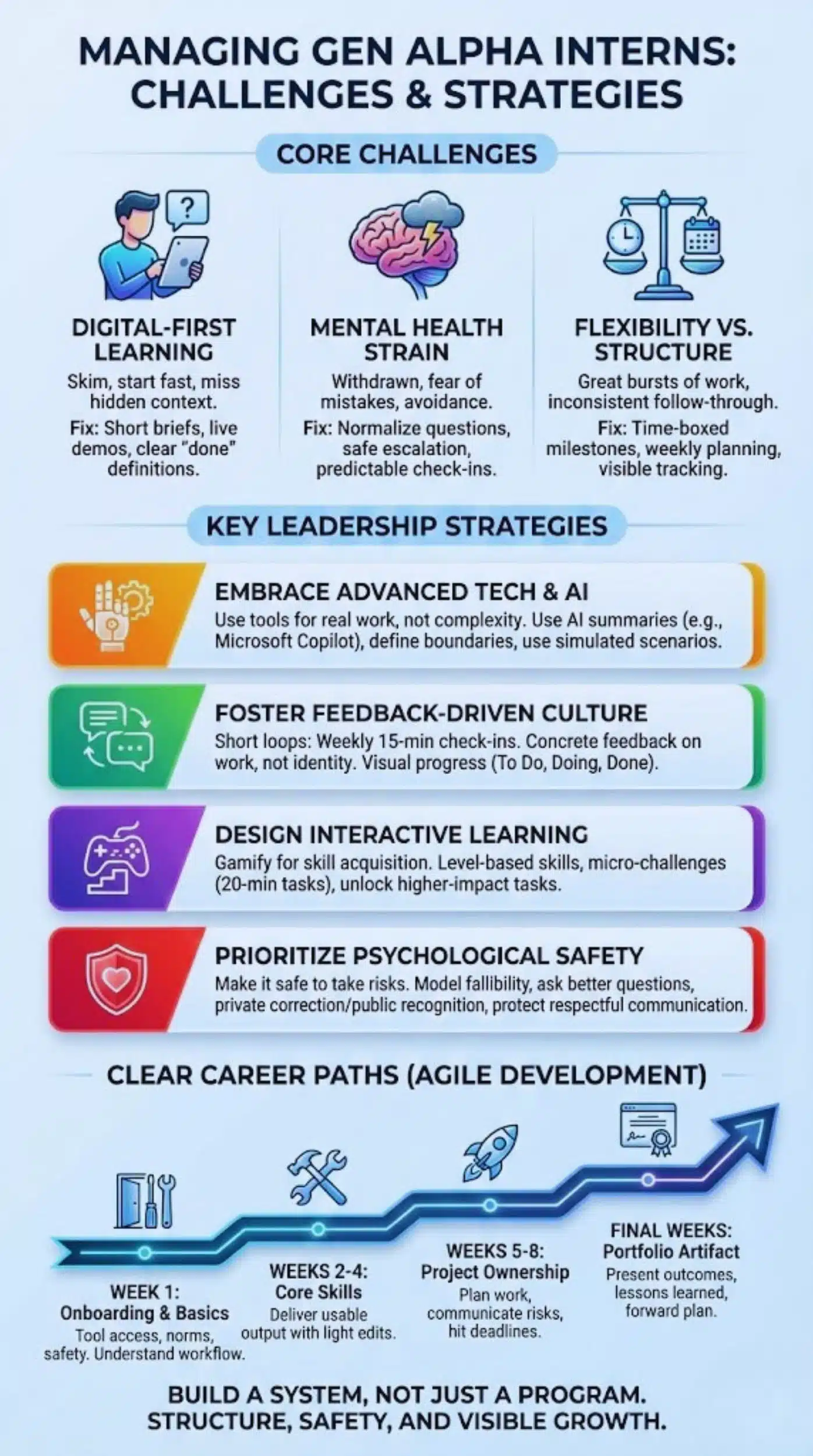
Managing Gen Alpha interns brings a predictable set of challenges: digital-first habits, a higher need for psychological safety, and a strong preference for flexibility. None of those are bad, but they require a clearer Strategy than many internship programs have today.
| Challenge | What it looks like | Fix that works |
|---|---|---|
| Digital-first learning style | They skim, start fast, and miss hidden context | Use short briefs, live demos, and a definition of “done” |
| Mental health strain | Withdrawn behavior, fear of mistakes, avoidance | Normalize questions, create safe escalation paths, set predictable check-ins |
| Flexibility vs structure | Great bursts of work, inconsistent follow-through | Time-boxed milestones, weekly planning, visible task tracking |
Adapting to their digital-first mindset
Digital natives often learn best through short cycles: watch, try, correct, repeat. Long, passive training can feel disconnected from real work.
To bridge Generational differences, treat onboarding like a product experience. Remove friction and make the next action obvious.
- Replace the “big orientation” with a 5-day ramp: one topic per day (tools, people, process, quality, safety).
- Teach escalation explicitly: when to ask a peer, when to ask a manager, and what details to include.
- Use a standard update format: “Done, Next, Blocked” keeps Communication tight without micromanaging.
- Make meetings teachable: assign a role like timekeeper, notes owner, or recap writer.
Addressing mental health concerns
You cannot coach performance well if an intern feels unsafe, isolated, or chronically stressed. This is not abstract: CDC reporting from the 2023 Youth Risk Behavior Survey showed 39.7% of US high school students experienced persistent feelings of sadness or hopelessness, and 20.4% seriously considered attempting suicide.
Leader takeaway: psychological safety is a productivity system. If interns fear embarrassment, they hide mistakes, and small problems become expensive ones.
- Make support easy to find: include mental health resources in the intern welcome packet and repeat them in the first week.
- Train managers on early signals: missed deadlines, sudden silence, and perfectionism can be stress flags.
- Use predictable check-ins: a short weekly 1:1 reduces anxiety because the next chance to ask for help is always close.
- Set boundaries on “always on” expectations: define response times and offline hours so interns can maintain balance.
Balancing flexibility with structure
Flexibility can improve Engagement, but interns still need clear structure. In the US, structure also protects you legally when interns are minors.
The US Department of Labor’s child labor rules under the Fair Labor Standards Act limit 14- and 15-year-olds to working outside school hours, no more than 3 hours on a school day, no more than 18 hours in a school week, and only between 7 a.m. and 7 p.m. (extended to 9 p.m. from June 1 through Labor Day).
| Intern age | Scheduling reality (nonagricultural work) | How to design the internship |
|---|---|---|
| 14 to 15 | Hour limits and time-of-day limits apply | Use short shifts, tight scopes, and daily “definition of done” checklists |
| 16 to 17 | Federal law does not limit hours, but hazardous job limits still apply | Use milestone-based work with weekly reviews and safety training up front |
| 18+ | You can structure like a standard internship | Use role-based expectations, stretch projects, and career-path mapping |
- Build guardrails into the calendar: publish work hours, break expectations, and a “no messages after” rule for the team.
- Use milestones, not mood: define two to four measurable outcomes for the internship, then track progress visibly.
- Document supervision: assign a primary mentor and a backup, so interns always know where to go.
Strategies for Managing Gen Alpha Interns: What Leaders Need To Know
The best Strategy is not to “be more fun.” It is to build a system where interns can move fast without getting lost.
That system needs four pieces: modern tools, tight feedback loops, psychological safety, and a visible path for Development.
- Tools: reduce friction in communication, note-taking, and task tracking.
- Feedback: make coaching frequent, specific, and easy to act on.
- Safety: create an environment where interns can ask questions early.
- Growth: connect tasks to skill gains and a career pathway.
Embrace advanced technology and AI tools
Choose tools that help interns do real work, not tools that add complexity. A simple rule helps: if the tool does not reduce cycle time or reduce confusion, it is not an intern tool.
Walmart’s VR training case study with Strivr reported a 96% reduction in training time for a specific operational rollout, moving from 8 hours to 15 minutes. The point is not that every internship needs VR, it is that immersive, scenario-based training can compress learning dramatically when you choose the right moment.
- Use AI for summaries and action items: tools like Microsoft Copilot in Teams can help interns leave meetings with clear next steps.
- Use simulated scenarios for high-risk moments: role-play customer calls, incident response, or handoffs before you put interns in live situations.
- Define AI boundaries: specify what data can be pasted into an AI tool, what must never leave your systems, and what needs manager review.
Foster a feedback-driven culture with real-time insights
Gen Alpha interns do best with short loops: they try, they get feedback, they try again. This is Mentoring as a workflow, not a speech.
- Run weekly 15-minute check-ins: one win, one miss, one next step.
- Keep feedback concrete: point to the exact sentence, screenshot, or moment, then show the improvement.
- Separate “quality” from “identity”: criticize the work, not the person, and always include a path to fix it.
- Make progress visible: a simple board with “To do, Doing, Done” improves follow-through.
Design gamified and interactive learning opportunities
Gamification works when it reinforces real performance, not when it turns work into noise. The goal is faster skill acquisition and better retention.
- Use level-based skills: Level 1 is “can do with help,” Level 2 is “can do alone,” Level 3 is “can teach it.”
- Add micro-challenges: a 20-minute task with a clear rubric, then a short review.
- Let interns earn trust: unlock higher-impact tasks only after quality is consistent.
- Reward learning behaviors: clean documentation, clear handoffs, and smart questions should count as wins.
Prioritize psychological safety and well-being
Psychological safety is not softness. It is how you keep mistakes small and learning fast.
Amy Edmondson’s 1999 research defined psychological safety as a shared belief that the team is safe for interpersonal risk-taking. Use that definition as a Leadership standard: if interns cannot raise a hand early, you will pay for it later.
- Model fallibility: say “I missed that” when you do, so interns learn that honesty is expected.
- Ask better questions: “What part feels unclear?” beats “Do you get it?”
- Protect respectful Communication: no pile-ons, no sarcasm as feedback, no public shaming.
- Use private correction, public recognition: it builds confidence and Work culture quickly.
Provide clear career paths with agile development plans
Interns stay engaged when they can see growth. If they cannot, they mentally treat the internship as temporary labor, not a career step.
| Timeframe | What the intern should gain | What you should observe |
|---|---|---|
| Week 1 | Tool access, norms, safety, task basics | They can explain the workflow and find the right documents |
| Weeks 2 to 4 | One core skill at working level | They deliver a usable output with light edits |
| Weeks 5 to 8 | Ownership of a small project | They plan work, communicate risks, and hit deadlines |
| Final weeks | Portfolio-ready proof of Development | They can present outcomes, lessons learned, and next steps |
- Make the pathway visible: “If you do A and B well, you earn C.”
- Give a portfolio artifact: a case study, a dashboard, a documented process, or a publishable internal asset.
- Close with a forward plan: recommend courses, projects, and roles that match their strengths.
Building Cross-Generational Workplaces
Most intern problems are not “young people problems.” They are clarity problems that show up faster with Digital natives.
When you build Transparency into your Collaboration habits, you help every generation work better, not just Gen Alpha.
Encourage reverse mentoring and collaboration
Reverse mentoring is one of the fastest ways to reduce friction across Generational differences, especially around tools, communication norms, and expectations.
As described in multiple leadership retrospectives, Jack Welch popularized reverse mentoring at General Electric in 1999 by pairing senior leaders with younger employees to learn internet skills. Treat that origin story as a reminder: learning should flow both ways.
- Run reverse mentoring in 30-minute sessions with one topic and one takeaway.
- Pair interns with a senior buddy for tech workflows, while seniors teach judgment and context.
- Create joint projects where interns lead on tools and seniors lead on decision quality.
- Set a simple success metric for each pairing, such as time saved, fewer rework loops, or faster onboarding.
- Protect psychological safety in every session, questions should be welcomed and never mocked.
- Pilot with a small cohort, then expand after you see consistent outcomes.
Promote diversity, equity, and inclusion in teams
Gen Alpha expects fairness to be operational. If your workplace says “we value inclusion,” your processes should prove it through consistent standards.
- Standardize intern work: same rubric, same feedback cadence, same access to information.
- Make opportunities visible: publish how interns get stretch projects and who approves them.
- Use inclusive meeting habits: rotate who speaks first, and invite input from quieter voices.
- Audit your language: replace vague criticism with specific, teachable feedback.
Benefits of Effectively Managing Gen Alpha Interns

When leaders manage Gen Alpha interns well, teams get more than extra hands. You gain a stronger pipeline, faster internal learning, and a healthier work culture.
| Benefit | What you will notice | What to measure |
|---|---|---|
| Enhanced innovation | Fresh ideas, faster experimentation | Cycle time, number of iterations, adoption of new workflows |
| Stronger adaptability | Better tool usage and quicker pivots | Time to onboard, time to ship, fewer process bottlenecks |
| Improved talent retention | More interns want to return | Offer acceptance, return rate, referrals to peers |
Enhanced innovation and creativity
Gen Alpha interns are often comfortable with multimedia and quick prototyping. If you give them clear constraints, they can generate options fast.
- Assign “two versions” tasks: two headlines, two layouts, two onboarding drafts, then review what works and why.
- Use content creation as real work: internal docs, help articles, demo videos, and FAQ updates compound value.
- Let them teach a tool: a short internal session builds confidence and speeds up team adoption.
Stronger organizational adaptability
The early 2020s trained younger cohorts to adapt quickly to shifting rules, tools, and constraints. You can turn that into an advantage by giving interns small ownership zones with clear boundaries.
Assign tech-led projects, support Collaboration across generations, and keep priorities visible so they can adjust without guesswork.
Improved long-term talent retention
Retention starts during the internship. If interns experience strong Mentorship, fair standards, and visible Development, they are more likely to see your company as a place to grow.
In a 2025 compensation guide, NACE reported the average hourly wage for bachelor’s degree level interns at $23.04. Pay is not the only factor, but fair compensation removes a common barrier and signals respect.
- Make growth explicit: show what “great” looks like in week 2, week 6, and week 10.
- End with a decision conversation: ask what they want next, then share what you can offer.
- Keep the relationship warm: a short post-internship check-in can protect your future hiring pipeline.
Final Thoughts
Leaders who succeed with Gen Alpha focus on clarity, fast feedback, and a work culture that rewards learning. Managing Gen Alpha Interns: What Leaders Need To Know is simple to say and harder to do, but the playbook is consistent: modern tools, strong Mentoring, psychological safety, and visible Development. Do that well, and you will improve Engagement today while building a stronger Workforce for tomorrow.