Have you heard the buzz lately? For decades, fusion energy felt like a distant sci-fi dream, but 2025 changed the conversation entirely. With groundbreaking on commercial plants and record-smashing almost monthly, we are no longer just hoping for star power on Earth; we are building it. You might be wondering, “Is this finally real?”
The short answer is yes. In April 2025, the National Ignition Facility (NIF) stunned the world again by producing 8.6 megajoules of energy from a single laser shot, more than four times the energy they put in. Meanwhile, private companies like Helion Energy started construction on actual power plants in Washington state.
I’m going to walk you through exactly where we stand today in 2026, from the record-breaking physics to the incredible machines coming online right now. So grab a coffee, and let’s explore how we are finally bottling the sun.
What is Fusion Energy?
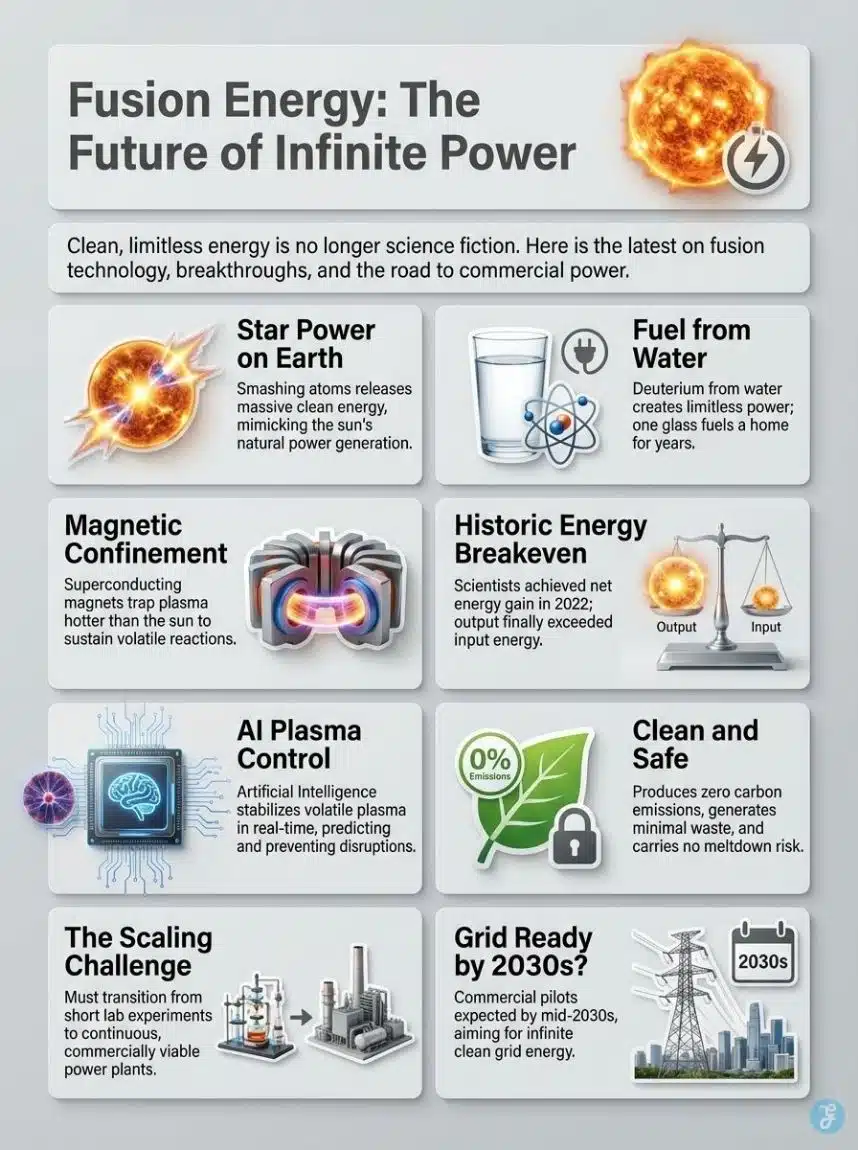
Before we look at the new records, let’s get on the same page about what fusion actually is. Simply put, fusion is the process of smashing two light atoms together to form a heavier one. It is the exact same engine that powers our Sun.
When these atoms fuse, they release a massive burst of energy. Unlike burning coal or splitting atoms (fission), this process doesn’t leave behind long-lived radioactive waste or carbon smoke. It uses isotopes found in seawater, making it a fuel source that could virtually last forever.
But here is the catch that has stumped scientists for years: to make this happen, you need temperatures hotter than the center of the Sun, over 100 million degrees Celsius. At that heat, matter turns into “plasma,” a soup of charged particles that is incredibly hard to hold onto. If the plasma touches the walls of the machine, it cools down instantly, and the reaction stops. This is why fusion is so safe; if anything breaks, the process just dies out. There is no risk of a meltdown.
Key Mechanisms of Fusion Energy
Making fusion work is a balancing act. You need to heat the fuel, squeeze it tight, and hold it there long enough for the magic to happen. Scientists track this progress using a specific formula.
Lawson Criterion and the Triple Product
You can think of the “Triple Product” as the scorecard for fusion success. It measures three vital numbers: the density of the fuel, the temperature of the plasma, and the “confinement time” (how long you can keep the heat trapped). If you get these three numbers high enough, you hit the Lawson Criterion, where the reaction becomes self-sustaining.
In 2024 and 2025, we saw massive leaps in this area. The National Ignition Facility (NIF) didn’t just inch past the line; they sprinted past it with their 8.6 megajoule shot. By squeezing the fuel capsule to extreme densities for a fraction of a second, they proved that you can get significantly more energy out than you put in.
Plasma Behavior and Confinement
Controlling 100-million-degree jelly is just as hard as it sounds. The plasma wants to wiggle, expand, and crash into the walls. To stop this, engineers use powerful magnetic fields to shape the plasma into a donut (in machines called tokamaks) or crush it with lasers.
Artificial Intelligence has become the secret weapon here. In May 2024, Google DeepMind released “TORAX,” an open-source simulator that helps scientists predict plasma behavior. It uses reinforcement learning to adjust the magnetic coils thousands of times per second, catching “tearing modes” (a type of instability) before they can ruin the experiment. It is like having a superhuman pilot flying the reactor.
Energy Capture Techniques
Once you make the heat, you have to catch it. This is where the “breeding blanket” comes in. The walls of the reactor are lined with special materials, often containing lithium. When the fusion reaction shoots out high-energy neutrons, these blankets absorb the energy and turn it into heat.
That heat boils water (or another coolant) to spin a turbine, just like a standard power plant. However, some newer players are changing the game. Helion Energy, for instance, skips the steam turbine entirely. Their “Polaris” machine captures electricity directly from the magnetic field of the pulsing plasma, which is a much more efficient way to get electrons onto the grid.
Fusion Fuels and Reactions
Not all fusion is created equal. Different fuels burn at different temperatures and release different amounts of energy. Here are the three main recipes scientists are cooking with.
Deuterium-Tritium (D-T) Reaction
This is the most common approach because it is the “easiest” to ignite. You take Deuterium (found in water) and Tritium (made from lithium) and smash them together. It burns at about 100 million degrees Celsius.
The biggest milestone for D-T happened recently at the JET lab in the UK. In their final run in early 2024, they set a world record by producing 69 megajoules of fusion energy over five seconds. It proved that we can sustain high-power fusion on a timeline that matters.
Deuterium and Helium-3
If D-T is the standard gas, Helium-3 is the premium fuel. It is rare on Earth but abundant on the Moon. The advantage? It produces far fewer neutrons, meaning the reactor doesn’t get as radioactive, and it’s easier to turn the energy directly into electricity.
Helion Energy is the big name betting on this fuel. They are synthesizing their own Helium-3 by fusing Deuterium atoms first. This “D-He3” reaction is harder to start than D-T, but the payoff is a cleaner, simpler power plant design that doesn’t need a massive steam turbine.
Proton-Boron-11 Fusion
This is the “Holy Grail” within the Holy Grail. It uses hydrogen (protons) and Boron-11, a common mineral found in Borax. The reaction produces almost zero neutrons, just three benign helium atoms (alpha particles).
“Proton-Boron fusion is the dream because the fuel is cheap, abundant, and the reaction is completely aneutronic, no radioactive waste handling required.”
The challenge? You need temperatures of over 3 billion degrees Celsius. Companies like TAE Technologies and HB11 Energy are using particle accelerators and high-powered lasers to try to crack this code, aiming for a truly clean energy future.
Current Methods of Fusion Energy Production
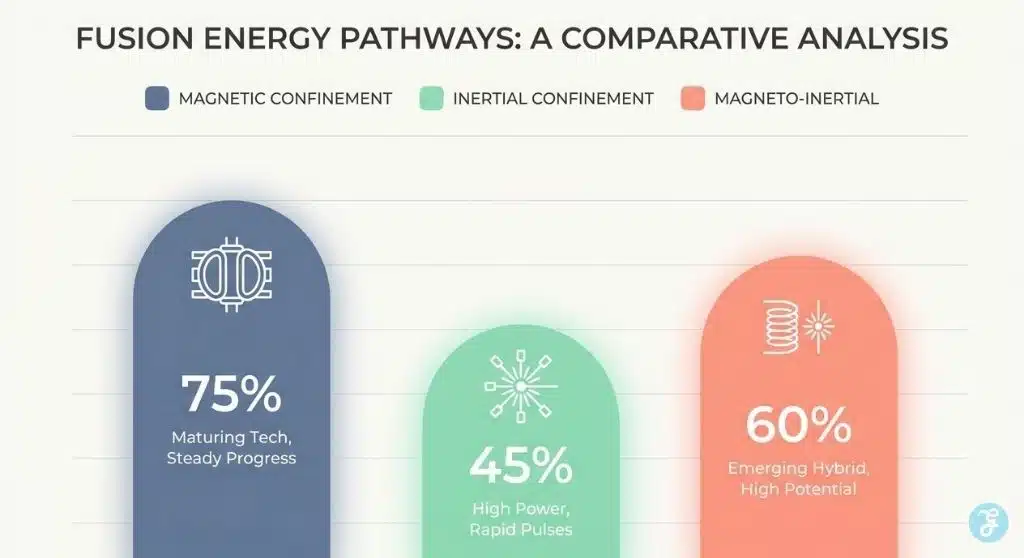
There isn’t just one way to build a star. Engineers are racing with different designs, each with its own pros and cons. To help you compare them, here is a breakdown of the top contenders.
| Method | How It Works | Key Players |
|---|---|---|
| Magnetic Confinement (Tokamak) | Uses giant magnets to hold plasma in a donut shape. Best for steady, long-term burns. | ITER (France), Commonwealth Fusion Systems (USA), KSTAR (Korea) |
| Inertial Confinement (Laser) | Uses lasers to crush a fuel pellet instantly. Creates pulses of energy like an engine. | National Ignition Facility (USA), Xcimer Energy |
| Magneto-Inertial (Hybrid) | Squeezes plasma clouds with magnetic fields. A mix of both approaches. | Helion Energy, Zap Energy |
Magnetic Confinement Fusion
This is the most mature technology. You build a “magnetic bottle” to hold the plasma. The biggest project on Earth, ITER in France, is using this method. However, in July 2024, ITER announced a major timeline update, shifting its full Deuterium-Tritium operations to 2039. They also decided to switch their internal walls from Beryllium to Tungsten to better handle the heat.
On the private side, Commonwealth Fusion Systems (CFS) is moving much faster. Their SPARC reactor in Massachusetts is being assembled throughout 2025 and 2026, using revolutionary high-temperature superconducting magnets to shrink the power plant size dramatically.
Inertial Confinement Fusion
Instead of a continuous burn, think of this like a combustion engine: tiny explosions happening again and again. The National Ignition Facility (NIF) in California is the king of this method. Their lasers zap a tiny gold cylinder, creating X-rays that crush a fuel pellet.
In April 2025, NIF set a stunning record by generating 8.6 megajoules of yield. This proved that “ignition” (getting more energy out than in) isn’t a fluke; it is repeatable. Startups like Xcimer Energy and Longview Fusion are now working to take this science and turn it into a power plant that can fire these targets ten times a second.
Inertial Electrostatic Confinement
This is a simpler approach, often called a “fusor.” It uses electric fields (grids) to pull ions into the center of a sphere. It was invented by Philo Farnsworth (who also invented TV!) in the 1960s.
While hobbyists love these for making neutrons in their garages, they haven’t produced net energy yet. However, companies like SHINE Technologies use this concept today to produce medical isotopes, proving that even “non-power” fusion has immense value for society right now.
Emerging Non-Thermonuclear Approaches
Some teams are throwing the rulebook out the window. Zap Energy uses a “Z-pinch,” where the electric current inside the plasma creates its own magnetic cage, removing the need for expensive external magnets. They are testing their “Century” platform in 2026.
Avalanche Energy is another fascinating group; they are building “micro-fusion” reactors that are small enough to hold in your hands. Their “Orbitron” uses electrostatic fields to trap ions, aiming for modular power packs that you could one day deploy on trucks or spacecraft.
Role of Advanced Materials

Building a sun on Earth creates conditions that would melt almost anything. That is why materials science is just as important as physics.
Superconducting Materials for Magnets
The old way of making magnets required massive cooling systems and huge coils. The new game-changer is Rare Earth Barium Copper Oxide (REBCO). This “high-temperature” superconductor comes in thin tapes, like cassette tapes, and can carry massive currents.
Commonwealth Fusion Systems used this material to build a 20-tesla magnet, the strongest of its kind, which is the heart of their SPARC reactor. This innovation allows them to build a reactor 40 times smaller than ITER but with similar power potential.
Plasma-Wall Surface Conditions
When plasma touches a wall, it is like a blowtorch hitting an ice cube. You need a material that can survive the heat and not pollute the fuel. For years, scientists debated using carbon or beryllium.
The debate was effectively settled in 2024 when ITER decided to switch its “first wall” to Tungsten. Tungsten has the highest melting point of any metal (over 3,400°C). KSTAR in Korea also upgraded to a Tungsten divertor recently, which helped them set their 2024 record of holding 100-million-degree plasma for 48 seconds.
Material Selection for Safety and Durability
It’s not just heat; it’s radiation. The neutrons from fusion can make steel brittle over time. Engineers are now developing “low-activation” steels like EUROFER97 that don’t stay radioactive for long.
In 2025, researchers at the UK Atomic Energy Authority opened a new facility specifically to blast materials with neutrons, testing which alloys can survive a 30-year power plant lifespan. Finding these “forever materials” is the final engineering hurdle to commercial power.
Recent Innovations in Fusion Energy
The last few years have been a whirlwind of “firsts.” Technology from other fields, like computing and aerospace, is accelerating fusion faster than ever before.
High-Temperature Superconducting Magnets
We touched on this, but it bears repeating: HTS magnets are the key to commercial fusion. Before these tapes, reactors had to be building-sized. Now, they can be factory-sized.
Tokamak Energy in the UK is also pushing this tech, building magnets that can operate at slightly warmer temperatures (liquid nitrogen range) rather than near absolute zero. This reduces the cooling cost significantly, making the electricity cheaper for you and me.
AI and Machine Learning in Plasma Control
I mentioned Google DeepMind earlier, but the integration of AI goes even deeper. In 2024, researchers at Princeton used AI to predict “tearing mode” instabilities 300 milliseconds before they happened.
That might sound fast, but for a computer, it is an eternity. It gives the magnets enough time to adjust and smooth out the plasma. This turns a wild, crashing reaction into a stable, boring one, which is exactly what you want for a power plant.
Spinning Fusion Fuel for Efficiency
Here is a simple trick: spin the fuel. Just like a spinning top is more stable than a still one, spinning plasma holds its heat better. The University of Maryland and other labs have found that “centrifugal mirrors” can stabilize the fuel naturally.
This “shear flow” stops the plasma from buckling. It is a physical hack that improves efficiency without needing extra power, and newer designs like the C-2W machine from TAE Technologies rely heavily on keeping things spinning to reach those billion-degree targets.
Updates on Fusion Research Milestones
If you haven’t checked the news since 2023, you have missed a lot. The pace is accelerating wildly.
Advances in Tokamak Design
Korea’s KSTAR reactor, often called the “Artificial Sun,” is crushing records. In early 2024, it maintained 100 million degrees for 48 seconds. Their goal is 300 seconds by 2026, a duration where the plasma is effectively running in “steady state.”
Meanwhile, the Joint European Torus (JET) signed off with a mic drop in 2024, setting that 69-megajoule energy record. It proved that Deuterium-Tritium fuel behaves exactly as our models predicted, giving the green light for future machines like SPARC and ITER.
Progress in Stellarators
Stellarators are the twisty, complex cousins of tokamaks. They are harder to build but naturally more stable. The Wendelstein 7-X in Germany has been the leader here.
In recent campaigns, they achieved energy turnovers of 1.3 gigajoules, holding hot plasma for eight minutes. New startups like Type One Energy are now using 3D printing and AI to build these complex twisted shapes much cheaper, aiming to bring the stellarator into the commercial race.
Developments in Private-Public Partnerships
The government isn’t just watching anymore; they are writing checks. In 2024, the U.S. government signed the ADVANCE Act, which officially defined fusion regulation differently from nuclear fission. This was a massive win for the industry, ensuring that fusion plants won’t be bogged down by irrelevant red tape.
We also saw the launch of the Milestone-Based Fusion Development Program, where the Department of Energy pays companies like Helion and CFS when they hit specific technical goals. It is the same model that helped SpaceX succeed, and it is now driving fusion forward.
Challenges in Fusion Energy Development
We have plenty of good news, but I want to be real with you: this is still incredibly hard. There are three big hurdles left to clear.
Achieving Sustainable Net Energy Gain
NIF proved we can get “gain” from the fuel (Scientific Breakeven). But for a power plant, we need “Engineering Breakeven.” This means the reactor produces more energy than the entire facility consumes, lasers, cooling, lights, and all.
Current lasers are only about 1-2% efficient. To make money, we need drivers that are 10-20% efficient. Companies are working on diode-pumped solid-state lasers and better capacitors to bridge this gap, but we aren’t there yet.
Managing Plasma Instabilities
Even with AI, plasma is unpredictable. A “disruption” can dump all the energy into the wall in a millisecond, melting components. While we are getting better at predicting them, we need to prove we can run a machine for months without a single major crash.
This reliability is what utility companies care about. They need boring, steady power, not exciting science experiments. Proving 99.9% uptime is the next big challenge for the pilot plants being built today.
Scaling for Commercial Use
Building one reactor is science; building 500 is logistics. We need a supply chain. Right now, there isn’t enough Tritium in the world to start more than a few reactors.
We also need to manufacture thousands of miles of HTS tape and specialized tungsten tiles. The industry is currently building these factories from scratch. It is a “chicken and egg” problem: suppliers wait for orders, but fusion companies wait for funding.
Environmental and Safety Considerations
People often hear “nuclear” and worry. But fusion is fundamentally different from the nuclear power you know.
Zero Emissions and Sustainable Energy Potential
Fusion is the ultimate clean energy. It emits zero carbon. A gigawatt-class fusion plant would save millions of tons of CO2 compared to coal.
More importantly, it is energy-dense. A bathtub of water and the lithium from a laptop battery could provide your lifetime energy needs. This density means we disturb less land for mining and building than almost any other energy source.
Tritium Management and Containment
Tritium is radioactive hydrogen. It is not highly dangerous externally, but you don’t want to inhale it or let it leak into groundwater. The good news is that it has a short half-life (12 years).
Fusion plants are designed with multiple containment layers. Because the fuel is made inside the reactor (bred from lithium), there is never a large stockpile of radioactive fuel sitting around. If a leak occurs, the amount released is tiny compared to a fission plant accident.
Radioactive Waste and Accident Scenarios
Here is the best part: no meltdown is physically possible. If power is cut, the plasma cools and vanishes in seconds. It can’t burn without the containment system actively working.
Regarding waste, the internal components do get radioactive, but only for about 100 years. Compare that to the 10,000+ years spent fueling traditional nuclear plants. After a century, the materials can be recycled or disposed of safely, making it a much smaller burden for future generations.
Economics and Global Implications
Follow the money, and you will see that the world is betting big on fusion.
Costs of Fusion Development
According to the 2025 Global Fusion Industry Report, cumulative private investment has surpassed $10 billion. While ITER’s cost has ballooned past $22 billion, private companies are aiming much lower.
Helion and CFS target power plants that cost significantly less to build than traditional nuclear plants. If they can hit a target of $60-$80 per megawatt-hour, they will be competitive with natural gas, changing the energy market forever.
International Collaboration and Geopolitical Importance
Energy is power, literally and politically. Countries know that whoever controls fusion controls the future economy. China is spending roughly $1.5 billion a year on its fusion program, aiming to beat the West.
However, collaboration remains strong. The US, UK, EU, Japan, and Korea are sharing data constantly. In an era of energy insecurity, fusion offers a way for every nation to be energy independent, removing the need to fight over oil pipelines or coal reserves.
Advantages of Fusion Energy
Why go through all this trouble? Because the payoff is unmatched.
- Fuel Abundance: Deuterium is in every drop of seawater. Lithium is common in the Earth’s crust. We have enough fuel for millions of years.
- Baseload Power: Unlike solar or wind, fusion works at night, in winter, and during calm weather. It is the perfect partner to renewables.
- Safety: No meltdowns, no proliferation risks, and minimal waste. It is the kind of nuclear power you could theoretically build near a city.
When you stack these up against the alternatives, fusion is the only source that checks every single box: clean, safe, reliable, and abundant.
Future Outlook for Fusion Energy
So, when can you plug your house into a fusion reactor?
Expected Timeline for Commercial Deployment
The timelines have shifted from “decades away” to “years away.” Helion Energy has signed a contract with Microsoft to provide fusion electricity to the grid starting in 2028. That is just around the corner.
Commonwealth Fusion Systems has also signed a deal with Google to supply 200 megawatts of power in the early 2030s. While delays are always possible in engineering, the fact that tech giants are writing contracts with penalty clauses shows they believe the tech is real.
Innovations Driving Faster Progress
We are seeing a convergence of technologies. High-speed computing, AI control, 3D printing, and new superconductors are all maturing at the same time. This is speeding up design cycles from years to months.
In 2025, we saw “digital twins”, virtual replicas of reactors, which allow engineers to test millions of scenarios before building a single part. This fails-fast approach is saving billions of dollars and years of trial and error.
Potential Role in Global Energy Transition
Fusion won’t replace solar and wind; it will support them. The future grid will likely be a mix: cheap renewables for the bulk of the day, and fusion providing the steady, “always-on” power that data centers and factories need.
By 2040, fusion could be the primary replacement for coal and gas plants, allowing us to finally turn off the fossil fuel tap without turning off the lights.
Final Words
We have covered a lot, from the 100-million-degree plasmas of the KSTAR reactor to the concrete being poured right now for commercial plants in Washington. The era of “fusion is 30 years away” is officially over. We are now in the engineering phase.
The Lawson criteria have been met. The magnets are strong enough. The government has cleared the regulatory path. All that remains is to finish the build.
If you are excited about a future with clean, limitless energy, keep an eye on the news in 2026. With SPARC turning on and Helion pushing for 2028, we are about to witness history.