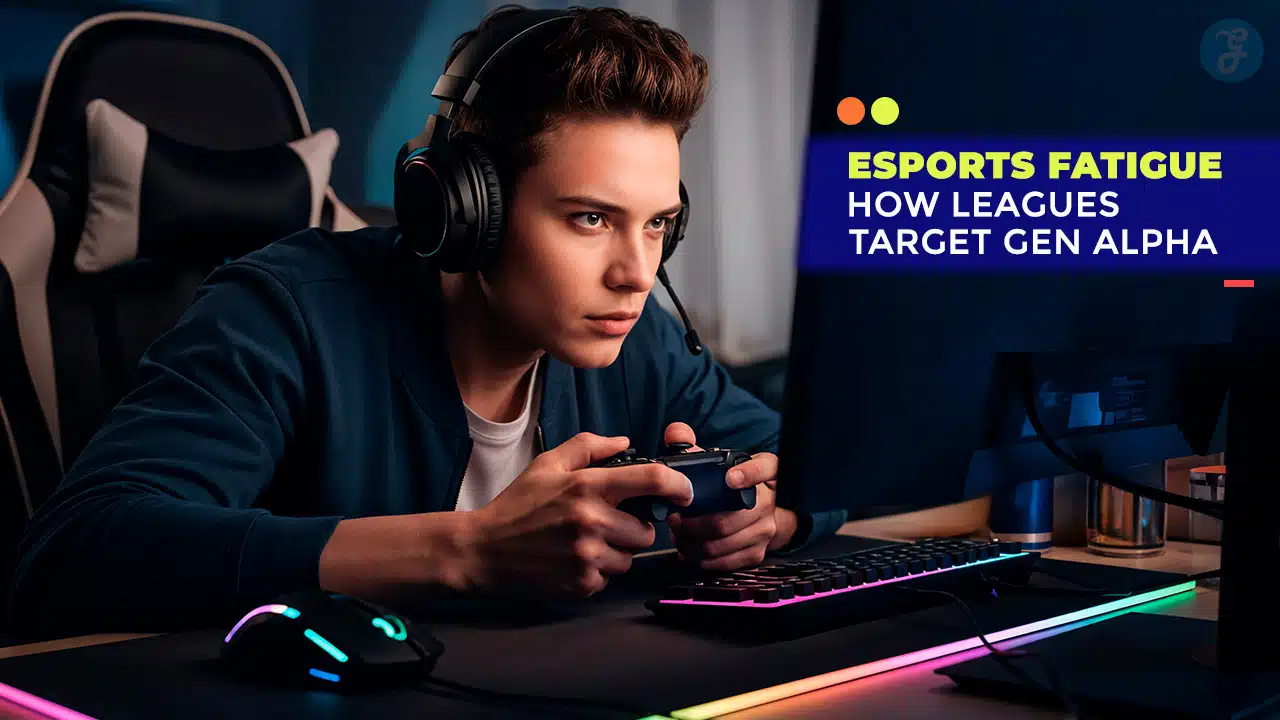
You know how even the most loyal esports fans will tap out when a broadcast feels like homework. Esports Fatigue: How Leagues Are Reinventing Viewership For Gen Alpha is really a story about attention, not passion. I see this pattern a lot while editing tech and gaming coverage across global teams: the product is strong, but the packaging is stuck in the last decade.
This guide breaks down what esports fatigue looks like, why Gen Alpha watches differently, and the practical format and platform moves leagues are using to pull viewers back in.
Use it as a checklist for sharper broadcasts, better retention, and less wasted effort.
Inside Esports Fatigue
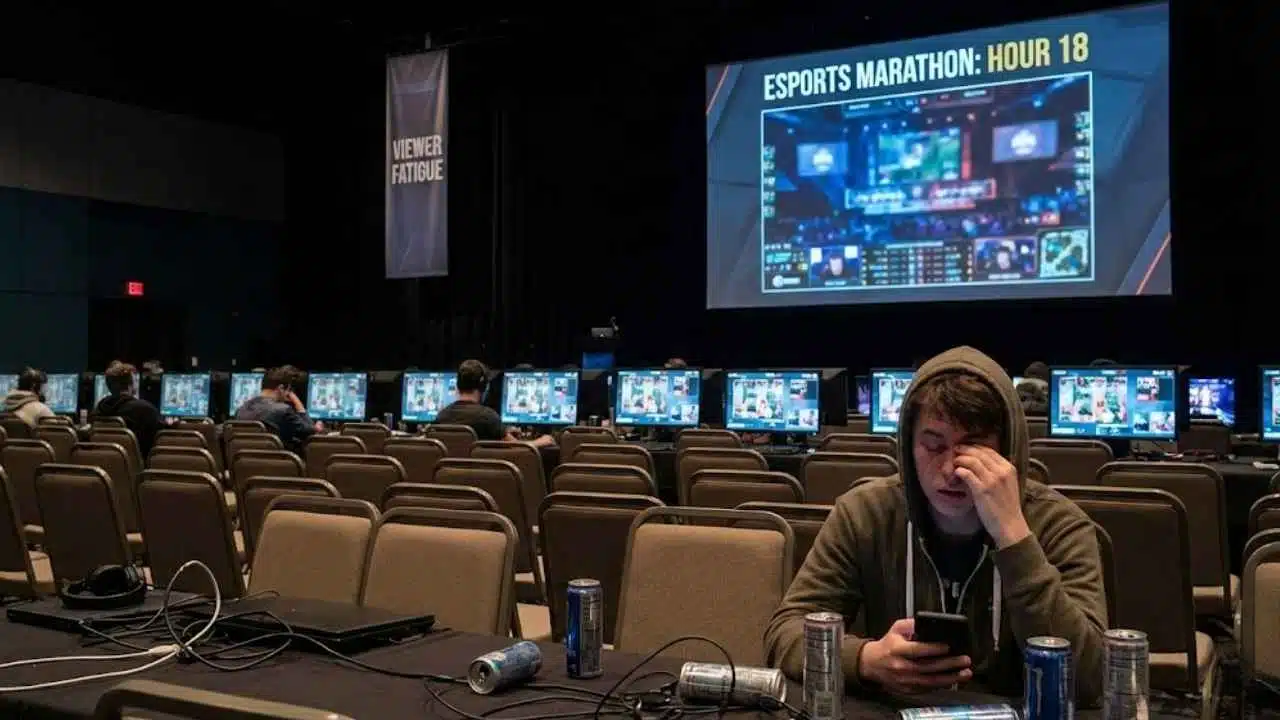
Esports fatigue shows up when watching starts to feel repetitive, too long, or too demanding. Viewers do not dislike the game, they dislike the time cost and the lack of payoff.
For leagues, this is a format and distribution problem. If your tournament requires a four-hour commitment just to reach the match people care about, you lose casual viewers first, then you start losing your core.
What is Esports Fatigue?
Viewer interest drops when streams run too long, leagues must change format.
Esports fatigue is the moment a viewer thinks, “I’ll catch highlights later,” and then never comes back for the live show. It is driven by long schedules, predictable pacing, and too many “must-watch” moments stacked together.
In the U.S., this problem gets sharper because young audiences are already spread across video-first platforms. Pew Research Center’s 2025 teen fact sheet reports that nine-in-ten U.S. teens use YouTube, and 73% say they use it daily.
Action step: treat the live broadcast as the “premium edition.” Make it faster, more interactive, and easier to rejoin after a break.
- Define the promise early: say what matters in the next 10 minutes.
- Build re-entry points: quick recaps after pauses, not long desk segments.
- End with a payoff: a final segment that feels like a conclusion, not a fade-out.
Key factors contributing to viewer fatigue
Fatigue is not one issue. It is a stack of small frictions that add up until viewers stop showing up.
- Too much “always on” content: endless updates, drops, and constant live coverage flatten the excitement. Build scarcity by using clear “must-watch windows” instead of streaming everything.
- Reward loops that feel mandatory: if viewers believe they must watch live for loot, patch reveals, or limited-time rewards, the experience turns into obligation. Offer earned rewards through multiple paths, including highlights and replays.
- Weak boundaries for younger viewers: Gen Alpha often watches in bursts across devices. If your content assumes long, uninterrupted sessions, you will lose them. Design your broadcast for stop-and-start viewing.
- Chat overload: high-volume chat can feel like noise. Use pinned prompts, timed polls, and moderated “moments” to turn chat into a feature instead of a distraction.
- Policy and compliance pressure: once you add interactive features for younger audiences, you are closer to privacy rules than many teams expect. The Federal Trade Commission’s COPPA guidance is clear that you must not collect personal information from kids under 13 without verifiable parental consent.
- Same format, different day: repetitive desk segments, predictable ad breaks, and copy-paste rundowns teach viewers they can skip live and miss nothing. Rotate formats by day, not just by season.
- Too many simultaneous storylines: if viewers need deep context to care, casual fans get locked out. Pick one primary narrative per match block and repeat it consistently.
The Role of Gen Alpha in Esports Viewership
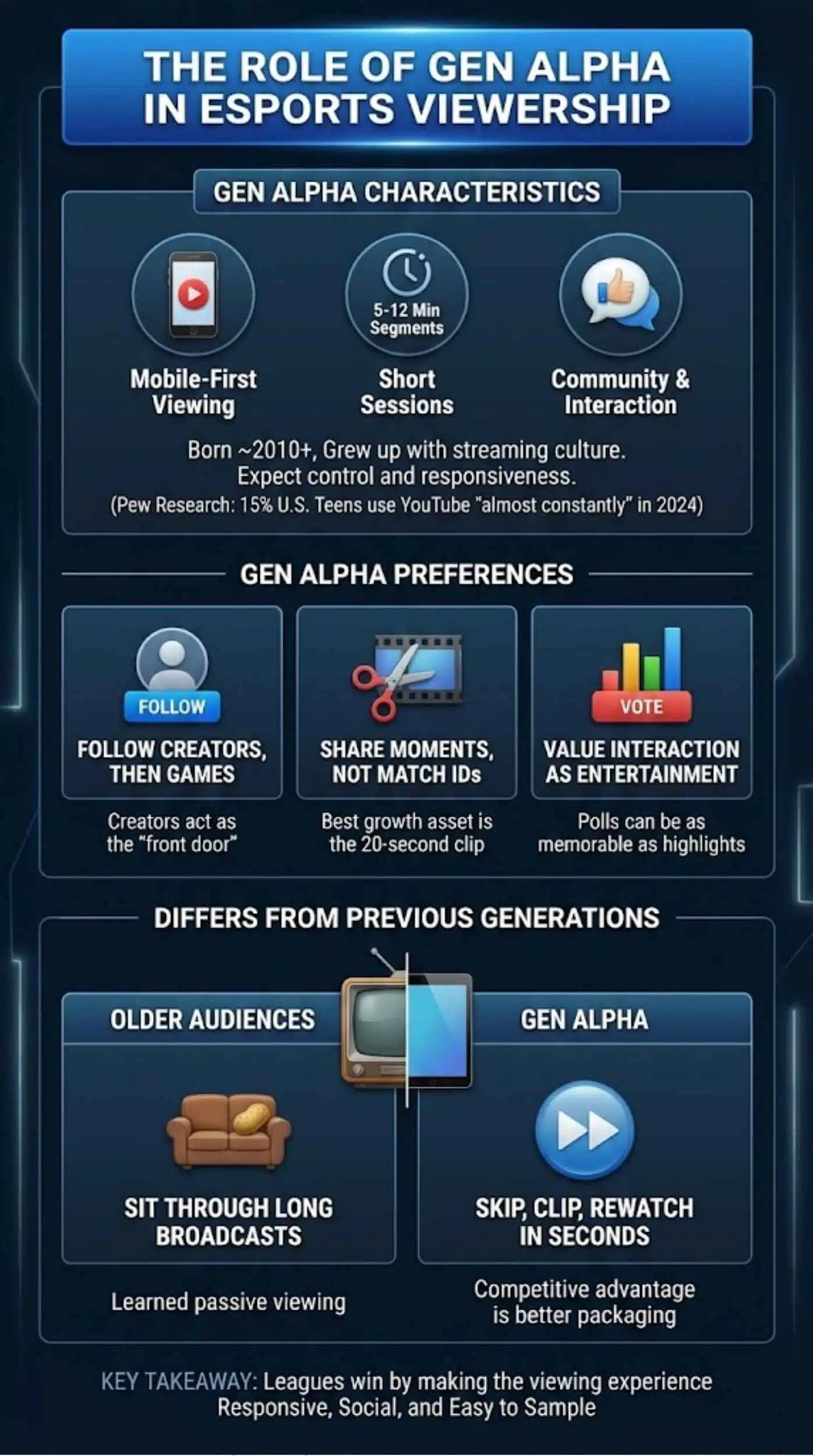
Gen Alpha is commonly used to describe kids born around 2010 and later. They did not “adopt” streaming culture, they grew up inside it.
That means leagues cannot rely on legacy sports pacing. You win by making the viewing experience feel responsive, social, and easy to sample.
Characteristics of Gen Alpha as an audience
Gen Alpha expects control. They want to choose the angle, the creator, the pace, and the moment to share.
To stay grounded in U.S. behavior, start with what teens do today. Pew Research Center’s 2024 survey of U.S. teens found 15% say they use YouTube “almost constantly,” and TikTok daily use is also high.
Turn that into production choices:
- Assume mobile-first viewing: make key visuals readable on a small screen and avoid tiny stat blocks.
- Build for short sessions: design segments that feel complete in 5 to 12 minutes.
- Make community visible: on-screen prompts, creator callouts, and viewer-vote moments matter more than polished desk talk.
- Reward participation, not just presence: polls, predictions, and mini-challenges keep attention active.
They expect games and community, not passive viewing.
How their preferences differ from previous generations
Older audiences learned to sit through long broadcasts because that was how media worked. Gen Alpha learns fast that they can skip, clip, and rewatch in seconds.
So the competitive advantage is not “more content.” It is better packaging.
- They follow people, then games: creators often act as the “front door” to a league.
- They share moments, not match IDs: your best growth asset is the 20-second clip that explains itself.
- They value interaction as entertainment: a good poll can be as memorable as a highlight.
Esports Fatigue: How Leagues Are Reinventing Viewership For Gen Alpha
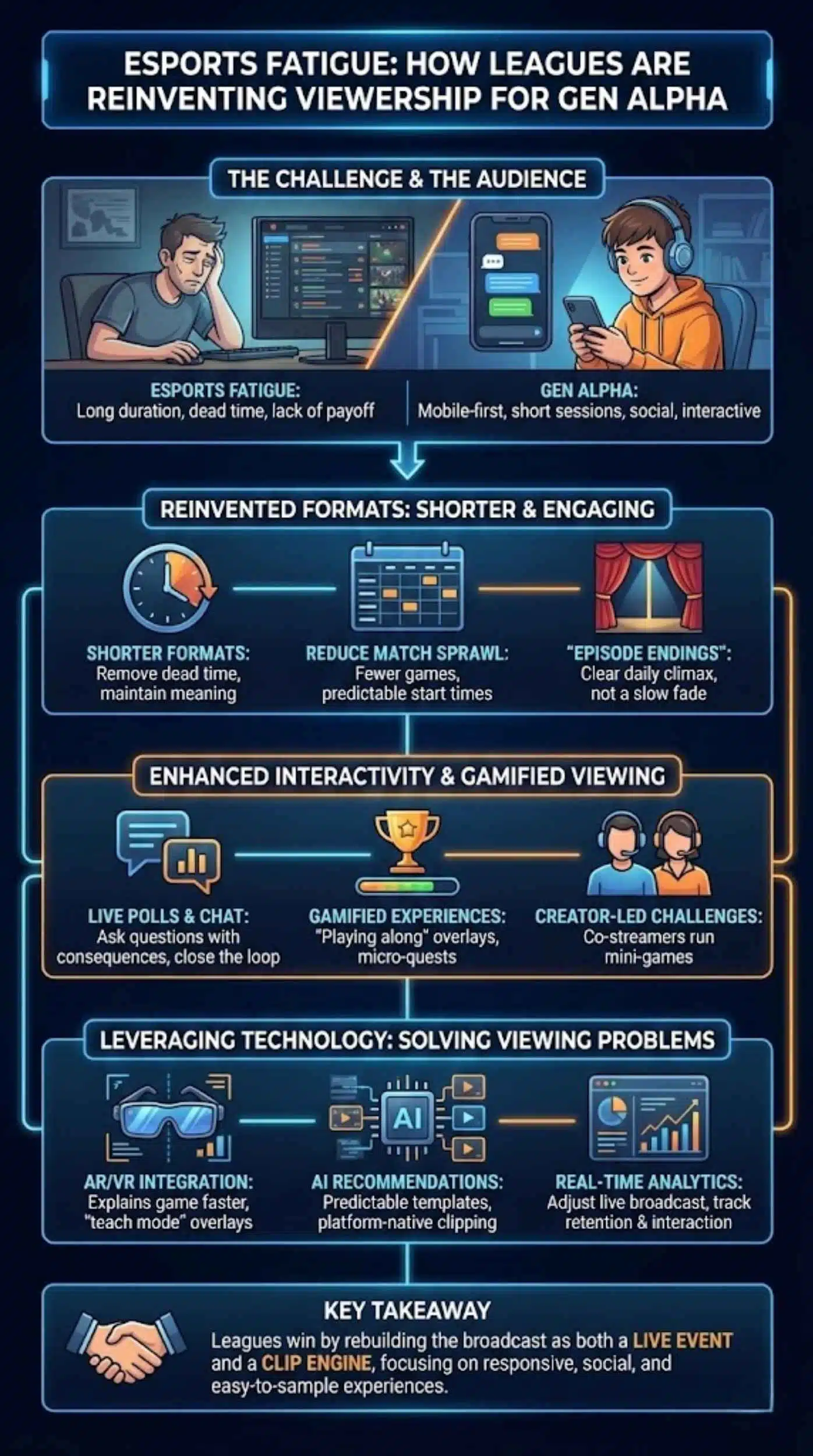
Leagues are not fixing fatigue with one trick. The strongest changes combine format, creators, and platform-native interaction.
Think of it as rebuilding the broadcast so it works as both a live event and a clip engine.
Shorter and more engaging tournaments
Shorter formats work when they still feel meaningful. The goal is not to remove competition, it is to remove dead time.
A practical example is Riot’s Americas restructure for League of Legends in 2025, which introduced split-based pacing and experimented with formats like Fearless Draft. It is a reminder that format is a lever, not a tradition.
When you need proof that big numbers still follow smart packaging, Esports Charts reported League of Legends Worlds 2024 hit a peak of about 6.94 million viewers (excluding Chinese platforms).
Production moves that reduce fatigue without shrinking the story:
- Use “episode endings”: end each day with a clear climax, not a slow fade.
- Reduce match sprawl: fewer games per day, more predictable start times.
- Bring stakes forward: do not hide your best match behind hours of filler.
Enhanced interactivity through live chats and polls
If viewers already have a chat window open, you should treat it like part of the product. The simplest upgrade is asking better questions at the right moments.
Twitch’s developer documentation explains that polls can offer 2 to 5 choices, and viewers can vote for free, with optional Channel Points voting depending on how the poll is set up. That is a clean way to turn passive watching into a tiny commitment.
Keep your interactivity focused:
- One poll per key phase: draft, halftime, match point.
- Ask questions with consequences: “Which player do we highlight next?” beats “Who will win?”
- Close the loop on-screen: show results and act on them fast.
On YouTube Live, newer interaction tools like Live Q&A help organize viewer questions, which makes it easier to run controlled engagement instead of drowning in chat.
Gamified viewing experiences
Gamified viewing works best when it sits on top of the match, not beside it. The viewer should feel like they are “playing along,” even if they never leave the stream.
Twitch’s own positioning is direct: Extensions are interactive video overlays and panels integrated with the live stream. That matters because Extensions let you place mini-interactions where attention already is.
In the U.S., you can also see how creator-plus-competition hybrids pull big live engagement. The Fortnite FNCS Pro-Am event in Los Angeles on May 10, 2025 drew a peak of 643,995 viewers and ran for nearly five hours, blending pro play with creator energy, as reported by TheWrap.
To apply this without rebuilding your whole league:
- Run “micro-quests”: predict the first objective, guess the MVP, vote the next replay.
- Use creator-led challenges: a co-streamer can run the mini-game while your main feed stays clean.
- Offer visible progression: badges, streaks, or simple “you participated” acknowledgments.
Leveraging Technology to Reinvent Viewership
Tech should not be used because it looks futuristic. It should be used because it solves a viewing problem: confusion, boredom, or friction.
The best tech choices make the match easier to follow and easier to share.
Augmented reality (AR) and virtual reality (VR) integration
AR earns its place when it explains the game faster than commentary can. Think: projected zones, live player paths, and simple “what just happened” graphics.
For a sense of scale, the Honor of Kings KPL 2025 Grand Finals set a Guinness World Record with 62,196 attendees, per a November 2025 announcement distributed by PR Newswire. Big in-venue spectacle raises the bar for what viewers expect on-screen, too.
Practical uses you can deploy without stadium budgets:
- AR-style telestration: draw paths and zones during replays, not only in pregame.
- “Teach mode” overlays: optional, simple explanations for new viewers watching with friends.
- Camera discipline: keep overlays readable on mobile and avoid clutter.
VR is still niche for mass viewership, but you can borrow the idea: create “watch party spaces” that feel social, even on a flat screen.
Personalized content recommendations using AI
Recommendation systems reward clarity. If your clips are hard to label, the algorithm and the viewer both struggle.
Build your highlight pipeline around predictable templates:
- Three lengths per moment: 15 to 30 seconds, 60 to 90 seconds, and a 3 to 5 minute recap.
- One idea per clip: one fight, one call, one decision, one reaction.
- Repeatable naming: player, team, moment type, match stage.
Also use platform-native clipping. YouTube’s Clips feature lets viewers select a 5 to 60 second portion to share, which helps your broadcast turn into distribution without extra editing work.
Real-time data analytics for better engagement
Real-time analytics should change what you do while the show is live, not only what you report later. Watch where viewers drop, then shorten or move that segment.
At the market level, Stream Hatchet reported that in 2024 co-streaming represented about 45% of all esports viewership. That is a strong signal that “one official feed” is no longer the full product.
Use analytics in three loops:
- Minute-by-minute retention: identify the two biggest drop-off points and fix them first.
- Interaction rate: measure polls, chat spikes, and clip creation per segment.
- Creator contribution: track which co-streamers actually lift total viewing, not just shift it.
The Rise of User-Generated Content in Esports
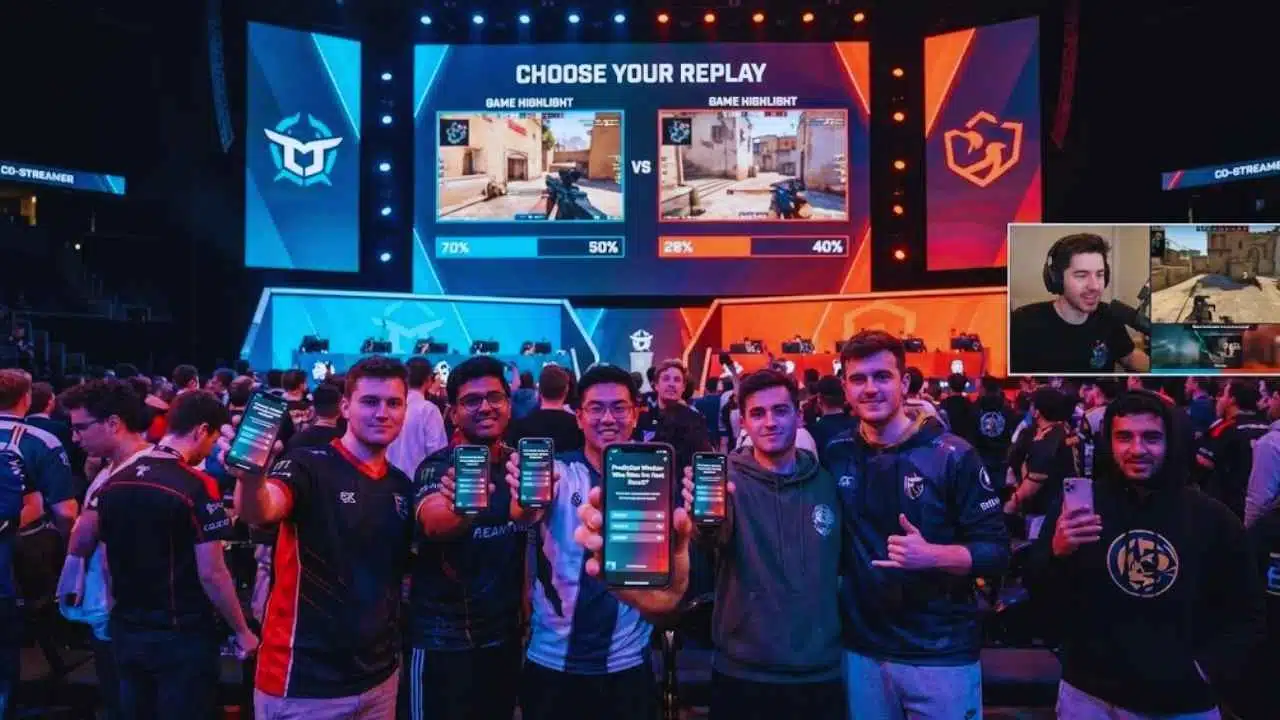
User-generated content is not a side effect anymore. It is part of the distribution plan, especially for Gen Alpha.
If your league does not make fan clipping easy and safe, someone else will still do it, and you will lose the chance to guide the story.
Minigames and challenges within streaming platforms
Minigames do not need to be complicated. A well-timed prediction, a two-minute trivia prompt, or an on-screen vote can keep viewers present.
On Twitch, Extensions can live as overlays, panels, or components. That gives leagues room to experiment without rebuilding the main broadcast.
Simple challenge formats that work:
- Prediction windows: open for 30 to 60 seconds, then close and show the lock-in.
- “Choose the replay” votes: let viewers pick which moment gets broken down.
- Chat call-and-response: short prompts tied to a key in-game event.
Community-driven storytelling in gaming events
Community storytelling is how Gen Alpha turns a tournament into identity. They remix it, meme it, and retell it through creators.
Your job is to feed that engine with usable pieces: behind-the-scenes clips, short player explainers, and clean audio reactions.
| Story asset | What it does for the audience | How a league should package it |
| Player origin story | Makes a name memorable fast | One-minute “who is this” video with one signature trait |
| Team comms moment | Shows pressure and trust | Clean subtitles, one decision, one outcome |
| Creator recap | Pulls in a new fan segment | Officially supported co-stream recap kits and match notes |
Fostering a Sustainable Esports Ecosystem
Fatigue is not only a content issue. It is also a sustainability issue for players, creators, and young audiences.
If the ecosystem trains everyone to be online all the time, you get short-term spikes and long-term burnout.
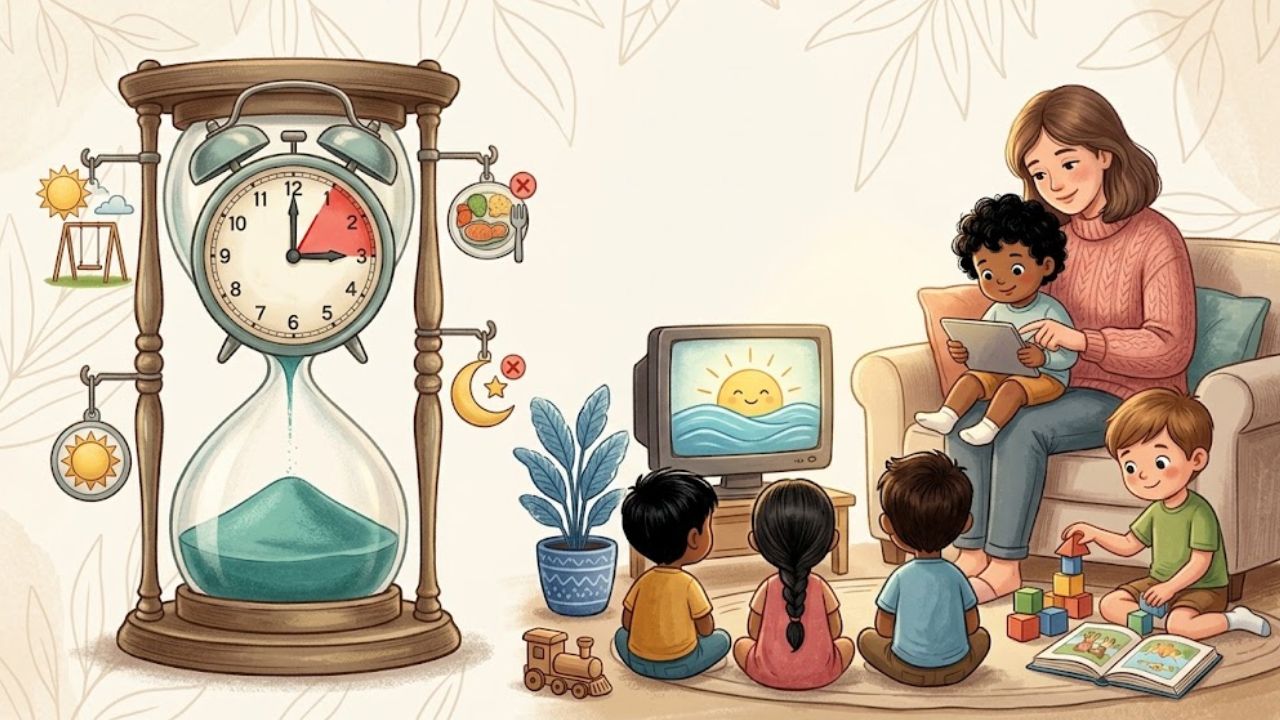
Balancing entertainment with mental well-being
Gen Alpha’s relationship with screens is a live policy topic, not just a parenting debate. Jonathan Haidt’s 2024 book The Anxious Generation helped push this into mainstream discussion by linking heavy phone-based childhoods to rising anxiety and weaker offline social development.
In January 2026, reporting around new guidance from the American Academy of Pediatrics argued that screen time limits alone are not enough, and called for more meaningful engagement and stronger plaFor leagues, the practical path is to design healthier defaults:
- Publish clear schedules: predictable start times reduce “always on” checking.
- Build planned breaks: normalize stepping away without missing everything.
- Create recap-first coverage: make it easy to watch later without feeling behind.
Partnering with creators and influencers
Creators are not just marketing. They are distribution, explanation, and community management in one.
Stream Hatchet’s reporting on 2024 trends highlighted how major co-streamers such as Ibai, Gaules, and Caedrel drove massive hours watched through creator-led coverage. In practice, that means your “broadcast team” now includes people outside your studio.
Make creator partnerships safer and more effective:
- Give them a co-stream kit: storylines, player notes, and clean highlight timestamps.
- Set brand boundaries upfront: avoid sponsor conflicts and messy mid-event rules.
- Reward the right behavior: prioritize creators who explain, not only react.
- Use co-streaming to fight fatigue: multiple voices make long events feel shorter.
Final Thoughts
Esports Fatigue: How Leagues Are Reinventing Viewership For Gen Alpha comes down to a simple shift, stop treating the broadcast like a marathon people owe you, and start treating it like a product that must earn every minute.
Shorter formats, smart co-streaming, and platform-native interaction can lift viewership without diluting competition.
The leagues that win next will protect attention and well-being while still delivering fandom-worthy moments.