When analyzing the Dominica vs Vanuatu citizenship processing time 2026, investors are discovering that the gap between brochure promises and operational reality has widened significantly. For years, the industry thrived on the promise of “90-day approvals,” but a new era of international oversight has fundamentally altered these timelines.
In 2026, “speed” in the CBI world is no longer a premium product feature; it is often a red flag for risk. This article provides an unvarnished look at the actual timelines you should plan for, the new regulatory bottlenecks that define the 2026 landscape, and why patience is now the most valuable currency for global investors.
The End of the “Pay-to-Skip” Era
We have entered what industry experts now call the “Post-Regulation Era” of citizenship by investment. The turning point occurred between 2024 and 2025, when intense pressure from the European Union, the United Kingdom, and the United States forced a complete overhaul of Caribbean CBI protocols.
The days of paying an extra “accelerated processing fee” to skip to the front of the due diligence queue are effectively over in Dominica. While Vanuatu remains outside the Caribbean regulatory framework, its “fast-track” status has come at a severe cost to its passport’s global mobility. Investors who rely on outdated marketing materials are finding themselves stuck in bureaucratic limbo for months, often missing critical travel deadlines or business opportunities. The reality of 2026 is no longer defined by how fast a government wants to process your file, but by how rigorously international regulators demand they check it.
Vanuatu: The Only True “Fast” Option [With a Major Catch]
Located in the South Pacific, Vanuatu has historically positioned its Capital Investment Immigration Plan (CIIP) as the fastest route to a second citizenship globally. In 2026, this claim remains technically true, but the context surrounding that speed has changed fundamentally.
The 45-Day Promise vs. The 3-Month Reality
Marketing materials for Vanuatu still often cite a processing time of 45 to 60 days. While some exceptionally straightforward cases might still meet this window, the realistic timeline for most applicants in 2026 is closer to 2 to 3 months.
Vanuatu is faster than its Caribbean counterparts primarily because its due diligence process is less multi-layered. Unlike Dominica, which now relies heavily on external, international investigative firms based in the UK or US, much of Vanuatu’s vetting is conducted via its internal Financial Intelligence Unit (FIU).
The FIU check is designed to ensure funds are not derived from illicit activities and that the applicant has no criminal background or Interpol flags. While efficient, even this process faces delays in 2026 due to increased global banking scrutiny. If an applicant’s source of funds is complex, for example, involving significant cryptocurrency holdings or business interests in high-risk jurisdictions, the FIU stage often stretches from two weeks to six weeks as they request additional documentation.
Vanuatu Processing Snapshot [2026]
| Feature | Marketing Claim | 2026 Reality |
| FIU Pre-Check | 7 Days | 14 – 21 Days |
| Citizenship Approval | 45 Days | 60 – 90 Days |
| Key Variable | Government efficiency | Complexity of banking/crypto records |
The Price of Speed: Why Faster Isn’t Better in 2026
If Vanuatu can process applications in under three months, why isn’t it the undisputed market leader? The answer lies in the profound trade-off between speed and utility.
The very “fast-track” nature of Vanuatu’s vetting process was cited as a primary concern by the European Commission when it made the decision to suspend visa-free Schengen access for Vanuatu passport holders. The EU concluded that the speed at which passports were granted did not allow for sufficient security screening, posing a potential risk to European borders.
In 2026, this suspension remains the defining characteristic of the Vanuatu program. Investors must understand that they are buying speed, but they are sacrificing European mobility. The Vanuatu passport remains a viable tool for specific purposes, such as tax neutrality, visa-free travel within Oceania and parts of Asia, or simply having an immediate “Plan B” document, but it is no longer a solution for visa-free business travel to Paris, Frankfurt, or Rome.
If your primary goal is immediate possession of a second passport and you have no need for European travel, Vanuatu remains the only game in town. But this speed is directly correlated to its reduced global standing.
Dominica: Why the “3-Month” Window is Dead
For nearly a decade, the Commonwealth of Dominica offered perhaps the best balance of cost, reputation, and processing speed in the Caribbean. It was common for applicants to receive approvals within 90 to 120 days. In 2026, relying on that timeline is a strategic error.
The New Normal: 6 to 9 Months
It is crucial to state clearly: There is no official “fast-track” option for Dominica in 2026 that allows you to bypass standard due diligence.
Previously, applicants could pay higher government fees for “accelerated processing,” which essentially meant the government would prioritize their file’s administrative handling. However, under new agreements signed with the US Treasury and overseen by the newly empowered regional body, ECCIRA (Eastern Caribbean Citizenship by Investment Regulatory Authority), these accelerated lanes have been effectively dismantled to ensure a level playing field of rigorous vetting.
For planning purposes in 2026, a realistic, conservative timeline for Dominica is 6 to 9 months from submission of the file to the physical receipt of the passport. Agents promising anything under six months are likely relying on outdated data or hoping for a “best-case scenario” that rarely occurs in the current regulatory climate.
The Three New Bottlenecks in 2026
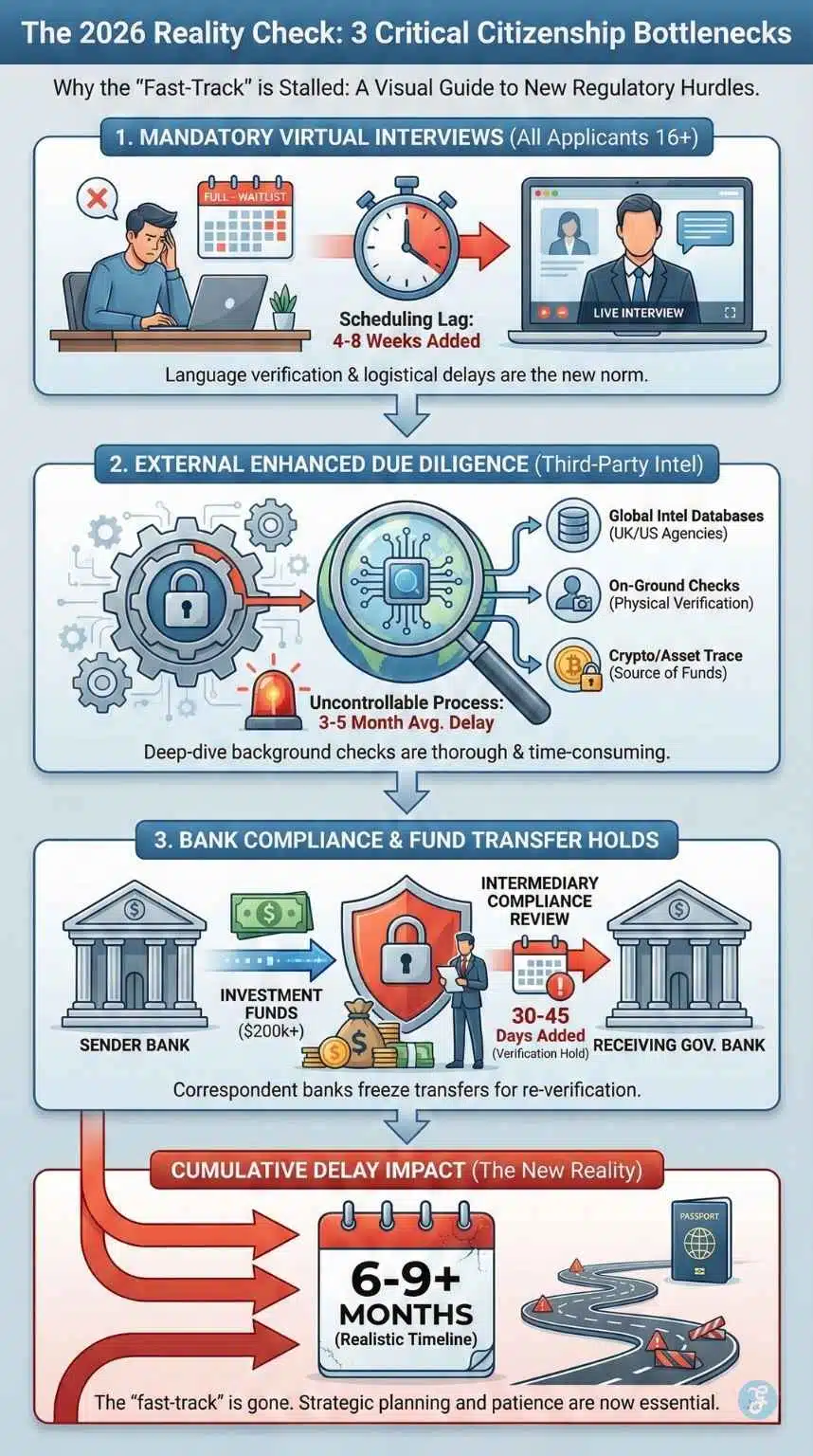
The extended timeline for Dominica is not due to government laziness. It is the result of three distinct layers of enhanced scrutiny that have become mandatory.
Mandatory Virtual Interviews
As of late 2024 and fully implemented in 2025–2026, every applicant aged 16 and over applying for Dominica citizenship must undergo a mandatory virtual interview. This is a significant logistical hurdle that did not exist previously.
- The Bottleneck: The sheer volume of applicants versus the available slots for government-appointed interviewers creates a backlog. Coordinating interviews across different time zones, often requiring translators, adds significant friction.
- The Impact: After your file passes initial document review, you may wait 4 to 8 weeks just to secure an interview slot. The application cannot progress to final approval until this interview is successfully completed and reviewed.
External Enhanced Due Diligence (EDD)
While local due diligence still occurs, the decisive factor in 2026 is the “Enhanced Due Diligence” conducted by third-party specialist firms located mostly in the UK and the USA. These are intelligence-gathering entities used by top-tier financial institutions and governments.
- The Bottleneck: The Dominica Citizenship by Investment Unit (CBIU) has no control over the speed of these external firms. These firms conduct deep-dive background checks on the ground in the applicant’s country of origin and residence, verifying business footprints, reputational history, and political connections.
- The Impact: If the external firm is overloaded, or if they hit a snag verifying a document in a bureaucracy-heavy country, the process stalls. The CBIU cannot approve the file until the external report comes back “green.” This stage alone now averages 3 to 5 months.
Bank Compliance and Fund Transfer Delays
Perhaps the most frustrating bottleneck occurs after you have already been approved. Once you receive your letter of approval in principle, you must transfer the investment funds (a minimum of $200,000 plus fees starting in 2026).
- The Bottleneck: Global correspondent banks are under immense pressure to prevent money laundering. When they see a large transfer earmarked for a “Citizenship by Investment” program, it triggers an automatic, intense compliance review by the intermediary banks handling the transaction before the money even reaches Dominica.
- The Impact: It is common in 2026 for funds to be held up by intermediary banks for 30 to 45 days while they demand re-verification of the Source of Funds (SoF). Your final Certificate of Naturalization cannot be issued until the funds officially clear into the government’s account.
Decoding the Mandatory Interview: What Are They Asking?
The introduction of mandatory interviews for Dominica (and across the Caribbean) is not merely a scheduling hurdle; it is a forensic verification tool. In 2026, this interview is the primary stage where applications fall apart, not because the applicant is a criminal, but because of inconsistencies.
Understanding the nature of this interaction is vital. It is not a ceremonial “welcome” chat. It is a structured compliance session conducted by third-party specialists or senior government officers.
The “Discrepancy Trap”
The interviewers have your entire application file open in front of them. Their goal is to cross-reference your spoken answers with the written documentation. Common areas of scrutiny include:
- Transaction Granularity: You may be asked to explain a specific bank transfer from three years ago that was flagged in your Source of Funds report. An inability to recall details of large transfers can be flagged as “suspicious opacity.”
- Business Operations: If you are the owner of a company, expect specific questions about your supply chain, major clients, or recent turnover. This is to verify that the business is a genuine operating entity and not a shell company used for laundering.
- Connection to Hostile States: If you have previous travel history or business dealings in sanctioned jurisdictions (even if legal), you will be drilled on the nature of those relationships.
The Language Factor
The interview also serves as an unspoken language proficiency test. While you are allowed a translator, the interviewer is assessing your credibility. Long pauses, coaching by lawyers off-camera (which is strictly prohibited and grounds for immediate termination of the call), or vagueness can trigger a secondary, deeper round of due diligence, adding another 4–6 weeks to your timeline.
Comparative Data: Vanuatu vs. Dominica Timeline Breakdown
To help manage expectations, the following table contrasts the advertised timelines often seen in marketing versus the on-the-ground reality for new applications filed in 2026.
The 2026 Reality Check:
| Feature | Dominica (Caribbean) | Vanuatu (Oceania) |
| Old Marketing Timeline | 3 – 4 Months | 1 – 1.5 Months |
| Realistic 2026 Timeline | 6 – 9 Months | 2 – 3 Months |
| Mandatory Interview? | Yes (Virtual, ages 16+) | No |
| Primary Delay Factor | External US/UK Due Diligence & Scheduling Interviews | Financial Intelligence Unit (FIU) queries on banking |
| Schengen (EU) Access | Yes (Visa-Free) | No (Suspended/Visa Required) |
| Investment Cost Floor | $200,000 USD (Strictly enforced) | ~$130,000 USD (Varies by agent) |
| Utility Profile | Long-term travel mobility and asset protection. | Immediate “Plan B” documentation; speed over utility. |
The “Hidden” Delays Agents Won’t Tell You
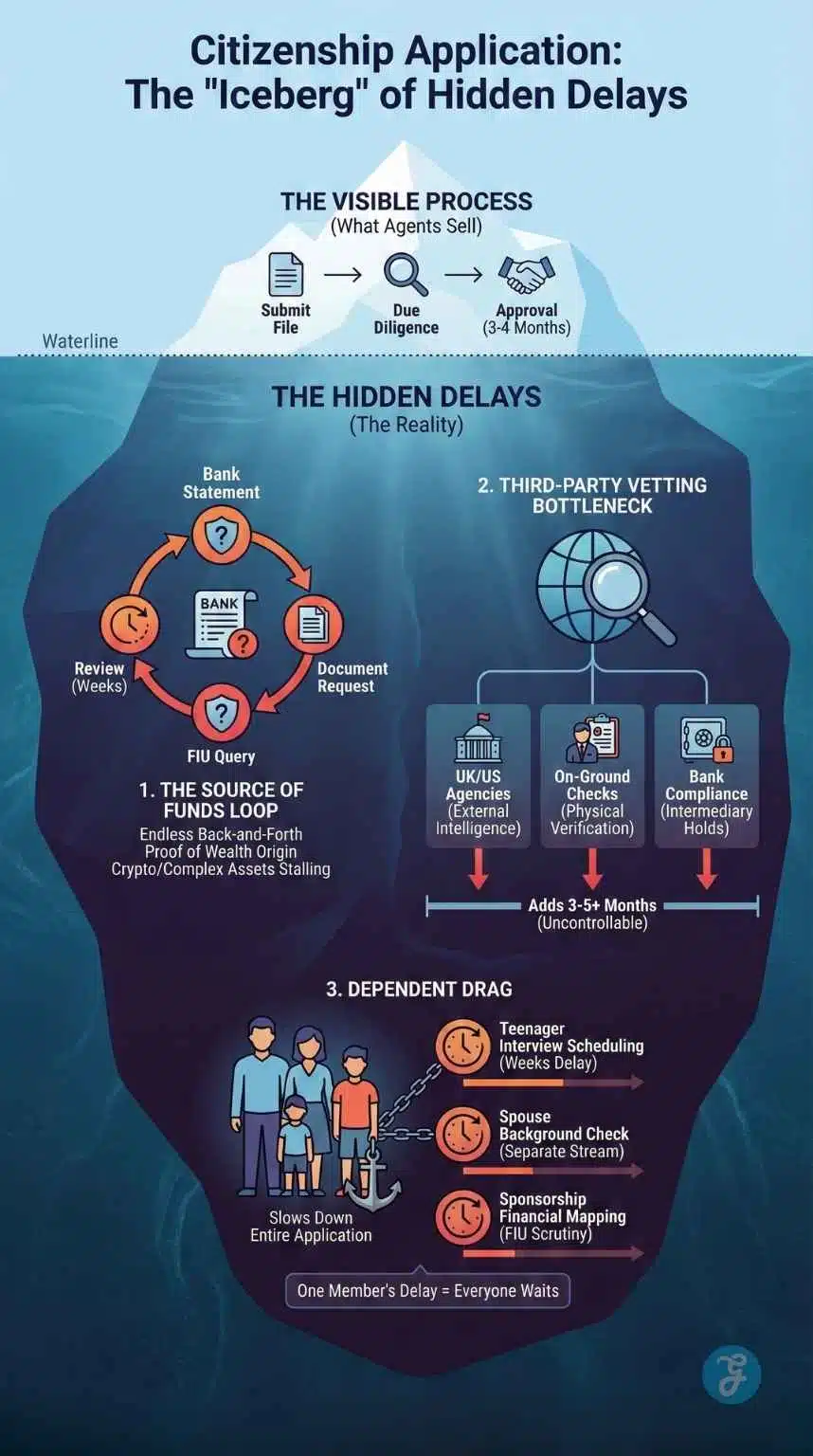
Beyond the official steps, there are applicant-driven factors that frequently derail the timeline. In 2026, the margin for error in your application file is zero.
The “Source of Funds” Loop
The number one reason for agonizing delays and outright rejections remains inadequate Source of Funds (SoF) documentation. In the current climate, simply showing a bank statement with $200,000 is insufficient. You must prove the origin of that wealth dating back years.
If your wealth is derived from inheritance, you need probate documents. If it is from business dividends, you need audited company accounts. If it is from cryptocurrency, this is a major friction point in 2026. You must provide a granular trail of transactions from fiat-to-crypto on regulated exchanges, showing wallets and acquisition dates.
The “loop” occurs when the due diligence officers request clarification. You provide a document, they review it for two weeks, decide it’s insufficient, and ask for another. This back-and-forth can easily add three months to the process before the file is even accepted for formal review.
The ECCIRA Factor
The establishment of the Eastern Caribbean Citizenship by Investment Regulatory Authority (ECCIRA) is a positive long-term development for the integrity of Caribbean passports, but in the short term, it slows everything down.
ECCIRA’s mandate is to harmonize standards across the region. This means Dominica cannot unilaterally decide to “push through” a wealthy applicant to beat out neighboring St. Kitts or Grenada. ECCIRA conducts audits and ensures that if an applicant is rejected by one island for security reasons, they cannot simply apply to another. This shared information framework adds another layer of administrative cross-checking to every application.
The “Dependent Drag”: How Family Composition Slows the Clock
Most advertised processing times assume a single applicant with a straightforward background. However, the majority of investors in 2026 are applying as families. It is critical to understand the concept of “Dependent Drag.”
In the current regulatory environment, the entire application moves at the speed of its slowest member.
- The “16+” Factor: Any dependent child aged 16 or older is now subject to the same level of rigorous due diligence and mandatory interviewing as the main applicant. If your 19-year-old son studying in London is slow to schedule his interview, or if his separate background check hits a snag due to a student visa issue, the entire family’s file is paused. You cannot “partial approve” the main applicant while waiting for the child.
- Spousal Vetting: Spouses often have different financial footprints. If a spouse has independent business interests or holds a passport from a different country than the main applicant, the external due diligence firms must run a completely separate investigation stream.
- The “Sponsorship” Link: If you are sponsoring siblings or parents, the financial mapping becomes exponentially more complex. The government must verify that your funds are sufficient to support them indefinitely, not just pay the application fees. This often triggers additional rounds of questions from the Financial Intelligence Unit (FIU), specifically regarding the transfer of wealth between family members.
Strategic Tip: If speed is the absolute priority, some investors in 2026 choose to apply as a single applicant first to secure the passport, and then add dependents post-approval. While this is more expensive in terms of total fees, it decouples the main applicant from potential “dependent drag.”
Strategic Planning for Investors in 2026
Given the realities of the Dominica vs Vanuatu citizenship processing time 2026, investors need to approach the process strategically rather than hoping for a quick fix.
Reverse Engineer Your Timeline
If you have a hard deadline for when you need your new passport, for example, a child starting university in Europe in September, or a planned business expansion in Q4, you must work backward using conservative estimates.
If you need a Dominica passport in hand by December 2026, you should aim to have your complete file submitted to your agent no later than May 2026. Waiting until August, hoping for a “3-month miracle,” will almost certainly lead to disappointment.
Red Flags: How to Spot a “Fast-Track” Scam
Because genuine fast-track options have largely evaporated, the market is ripe for bad actors promising what they cannot deliver. In 2026, be highly skeptical of the following:
- Guaranteed Dates: Any agent guaranteeing approval in under 4 months for a Caribbean program is misleading you.
- “Special” Relationships: Agents claiming they have a “back channel” to government ministers to speed up your application. This is now highly illegal under new anti-corruption frameworks supervised by ECCIRA.
- Discounted Prices: The Caribbean nations have signed a legally binding agreement establishing a minimum investment threshold of $200,000 USD. Any offer below this amount is likely a non-compliant financing scheme that could lead to your citizenship being revoked later when audits occur.
The Silent Killer: Biometric Data Sharing & Previous Refusals
In 2026, the Caribbean CIPs are no longer information silos. They are integrated into the JRCC (Joint Regional Communications Centre), which shares real-time biometric data with border agencies in the US, UK, Canada, and the EU.
This integration has created an automatic disqualification protocol that many applicants overlook until it is too late: The Visa Refusal Rule.
If you have ever been denied a visa to a country with which Dominica (or any Caribbean nation) has a visa-free treaty, specifically the UK or the Schengen Zone, you are legally barred from applying for citizenship until you successfully overturn that refusal.
- The Myth: “I’ll just get a new passport, and they won’t know I was rejected for a UK tourist visa five years ago.”
- The 2026 Reality: This is impossible. Your fingerprints are permanently linked to that refusal in the international database. When you apply for citizenship, the first step is a biometric sweep. A hit on a previous undeclared visa refusal will result in an instant rejection for “material omission.”
Unscrupulous agents may tell you to “try anyway” to collect their processing fees. In 2026, this is a waste of capital. If you have a standing visa refusal from the EU or UK, you must resolve it with those immigration authorities before submitting a Caribbean file. There is no “fast track” around biometric data.
Final Thought: Speed is a Depreciating Asset
The landscape of economic citizenship has matured. In 2026, the question is no longer “How fast can I get it?” but rather “How robust is the vetting process that protects the value of the document I am buying?”
Vanuatu remains the answer for emergency speed, provided you accept its limitations regarding European travel. Dominica remains a superior choice for long-term global mobility, but it now requires a significant investment of both capital and patience. When evaluating the Dominica vs Vanuatu citizenship processing time 2026, understand that a longer processing time is not necessarily a failure of the system; it is often proof that the system is working hard to maintain the international legitimacy that makes the passport valuable in the first place.