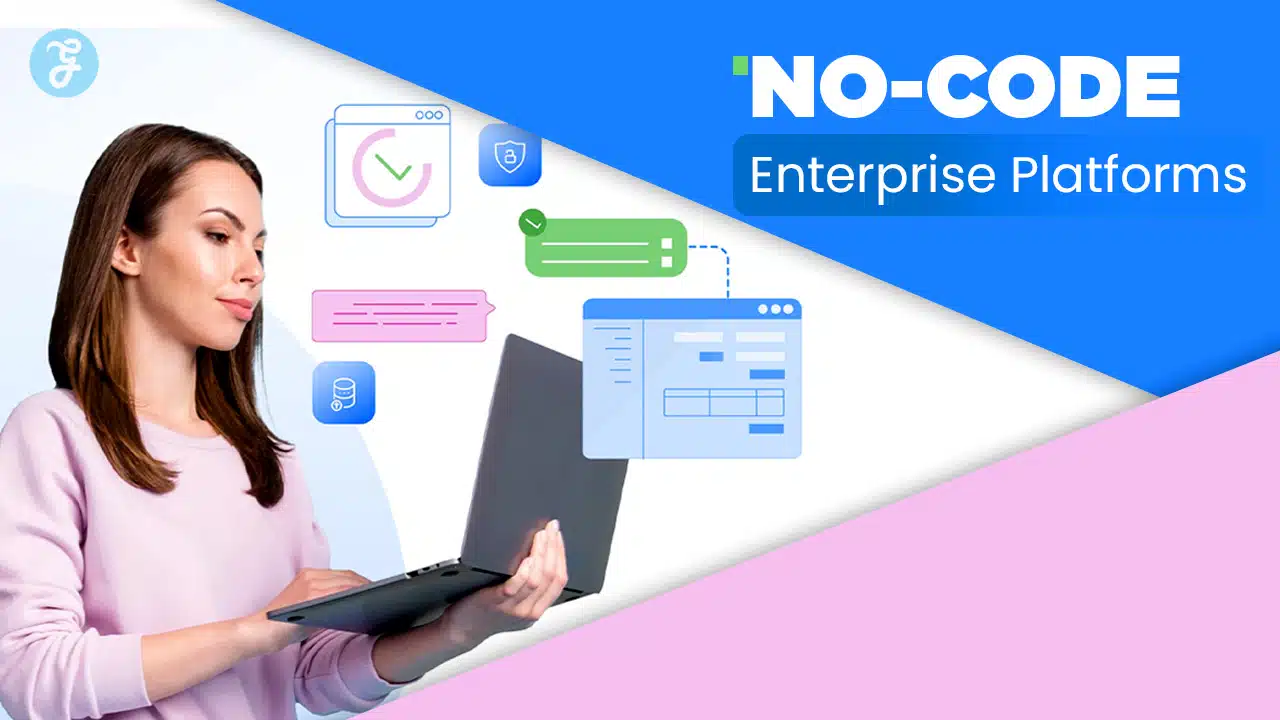
The debate is over. As we settle into 2026, the question is no longer if organizations should adopt no-code tools, but how deeply they can integrate them into their core infrastructure. For years, skepticism plagued the movement. CIOs and IT leaders viewed No-Code for Enterprise as a solution strictly for “toy apps”—simple forms, internal dashboards, or marketing landing pages. Serious software, they argued, required serious code.
However, the landscape of 2026 looks radically different. Driven by a global developer shortage that is projected to reach over 85 million unfilled roles by 2030, and fueled by the explosive integration of Generative AI, no-code platforms have matured into sophisticated ecosystems. They are no longer just drag-and-drop builders; they are intelligent orchestration layers capable of handling complex logic, massive datasets, and enterprise-grade security protocols. The convergence of AI agents and visual development has birthed a new era where “vibe coding”—creating software through natural language prompts—is becoming a standard workflow in Fortune 500 companies.
This analysis explores whether No-Code for Enterprise has finally crossed the chasm from experimental utility to a robust, scalable foundation for modern business.
The State of No-Code in 2026: From Prototype to Production
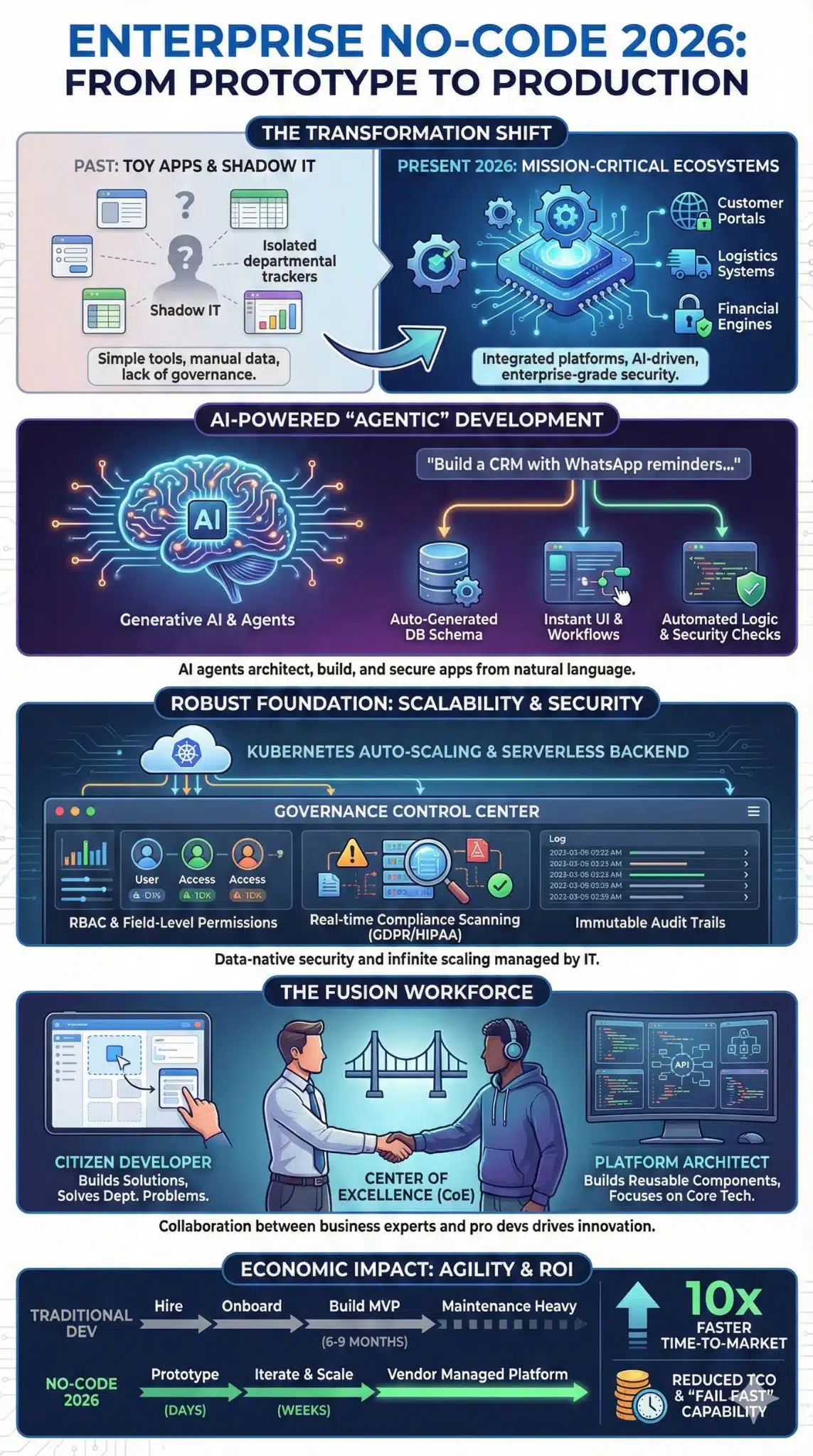
The shift in 2026 is defined by the migration of no-code apps from the periphery to the core. In the early 2020s, a large enterprise might have used Airtable or Bubble for a departmental tracker. Today, those same platforms—along with enterprise giants like Microsoft Power Platform, OutSystems, and Unqork—are powering mission-critical customer portals, logistics routing systems, and financial compliance engines.
Market data validates this transition. The global low-code/no-code market is on a trajectory to exceed $100 billion by 2030, but the significant inflection point occurred in late 2025. Gartner’s prediction that No-Code for Enterprise usage would dominate new application delivery has materialized. We are seeing large organizations maintain thousands of active no-code applications, managed not by a sprawling IT department, but by “fusion teams”—collaborative units of business experts and technical leads.
The definition of “developer” has fundamentally expanded. In 2026, the ratio of citizen developers (business technologists) to professional software engineers is approaching 4:1. This democratization allows domain experts—HR directors, Supply Chain managers, Financial analysts—to build solutions that solve their specific problems without waiting months for IT resource allocation. However, this volume brings complexity. The challenge in 2026 isn’t building the app; it’s managing the ecosystem of thousands of apps to ensure they don’t become technical debt.
Adoption & Growth Statistics (2026 Perspective)
| Metric | 2021-2022 Baseline | 2026 Status | Impact on Enterprise |
| New Apps Using No-Code | < 25% | 75% | No-code is the default; custom code is the exception. |
| Target User Base | Dept. Heads / Startups | Fortune 500 Core Teams | Shift from shadow IT to strategic IT alignment. |
| Dev Time Reduction | 20-30% | 90% | Agility allows weekly/daily release cycles. |
| Market Valuation | ~$15 Billion | >$65 Billion (Projected) | Massive investment in platform consolidation. |
| Citizen Developers | Experimental | 41% of Employees | “Business Technologist” is now a standard job skill. |
AI & No-Code Convergence: The Rise of “Agentic” Development
Perhaps the single biggest catalyst for the maturity of No-Code for Enterprise in 2026 is Artificial Intelligence. In previous years, “No-Code” meant visually mapping out logic flows—a process that still required “computational thinking.” If a user didn’t understand loops or boolean logic, they hit a wall.
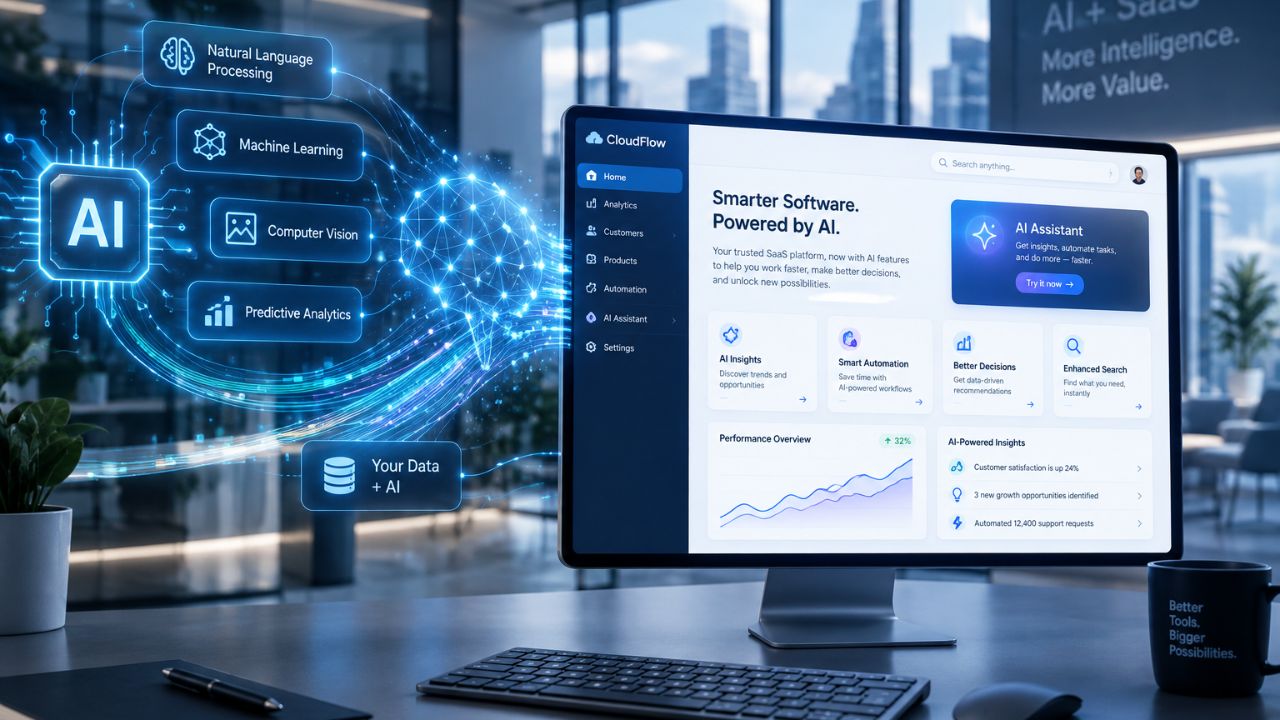
In 2026, Generative AI has lowered that barrier to near zero. Platforms now feature “Prompt-to-App” capabilities where a user types, “Build a CRM for a dental clinic that sends WhatsApp reminders 24 hours before an appointment and tracks insurance claims,” and the system constructs the database schema, the frontend UI, and the automation workflows instantly.
This is “Agentic Development.” AI agents don’t just write code; they act as architects. They suggest optimizations, flag potential security vulnerabilities in the logic, and even auto-generate documentation. For the enterprise, this means the “blank page problem” is solved. A business analyst can generate a functional prototype in minutes, allowing the professional development team to focus solely on refinement and integration. This synergy has effectively killed the notion that no-code is “rigid.” If a platform lacks a specific feature, the AI can often write a custom code snippet (in Python or JavaScript) to bridge the gap, seamlessly embedding it into the visual workflow.
AI Features Transforming Enterprise No-Code
| Feature | 2024 Capability | 2026 Capability |
| App Generation | Skeleton/Template generation. | Full-Stack Construction: DB, UI, and Logic from a single prompt. |
| Logic Building | Manual drag-and-drop of nodes. | Conversational Logic: “If inventory < 10, email supplier” (AI builds the flow). |
| Data Cleaning | Manual spreadsheet formatting. | Auto-normalization: AI detects errors and formats data on import. |
| Custom Extensions | Required a pro developer. | AI Code Gen: AI writes and injects custom scripts for edge cases. |
| Testing | Manual user testing. | Autonomous Agents: AI “users” test the app to find bugs before deployment. |
Enterprise-Grade Scalability & Security: Addressing the Skeptics
The loudest criticism of No-Code for Enterprise has historically been scalability and security. “Can it handle 10 million records? Is it SOC2 compliant? What if the vendor goes bankrupt?” In 2026, these concerns have been largely addressed through architectural maturity and consolidation.
Modern enterprise no-code platforms now run on Kubernetes-based architectures that auto-scale. They are no longer limited by shared database constraints that plagued early tools. A no-code application in 2026 can process millions of transactions per day without latency, leveraging serverless backends that are invisible to the creator but powerful enough for the CIO.
Security has evolved from a checklist item to a “Data-Native” feature. In 2026, governance is baked into the platform layer. IT departments utilize “Control Centers” that give them visibility into every app built by every employee. They can set global policies (e.g., “No app can export PII data to an external email address”) that are enforced programmatically. If a citizen developer tries to build a non-compliant workflow, the platform blocks it automatically. This shift to Governed Citizen Development allows innovation to flourish without exposing the enterprise to data breaches or regulatory fines.
Security & Governance Standards in 2026
| Security Layer | Description | Enterprise Benefit |
| Role-Based Access (RBAC) | Granular permissions down to the field level. | Ensures interns don’t see CEO-level data. |
| Automated Compliance | Real-time scanning for GDPR/HIPAA/CCPA violations. | Reduces legal risk; prevents accidental data leaks. |
| Sandbox Environments | distinct Dev, Stage, and Prod environments. | Prevents breaking live apps; mimics pro-dev lifecycles. |
| Audit Trails | Immutable logs of every record change and user action. | Essential for financial and healthcare audits. |
| Vendor Independence | Ability to export code/data or run on-premise (rare but possible). | Mitigates “Vendor Lock-in” risk for critical apps. |
The Citizen Developer Revolution vs. Professional Developers
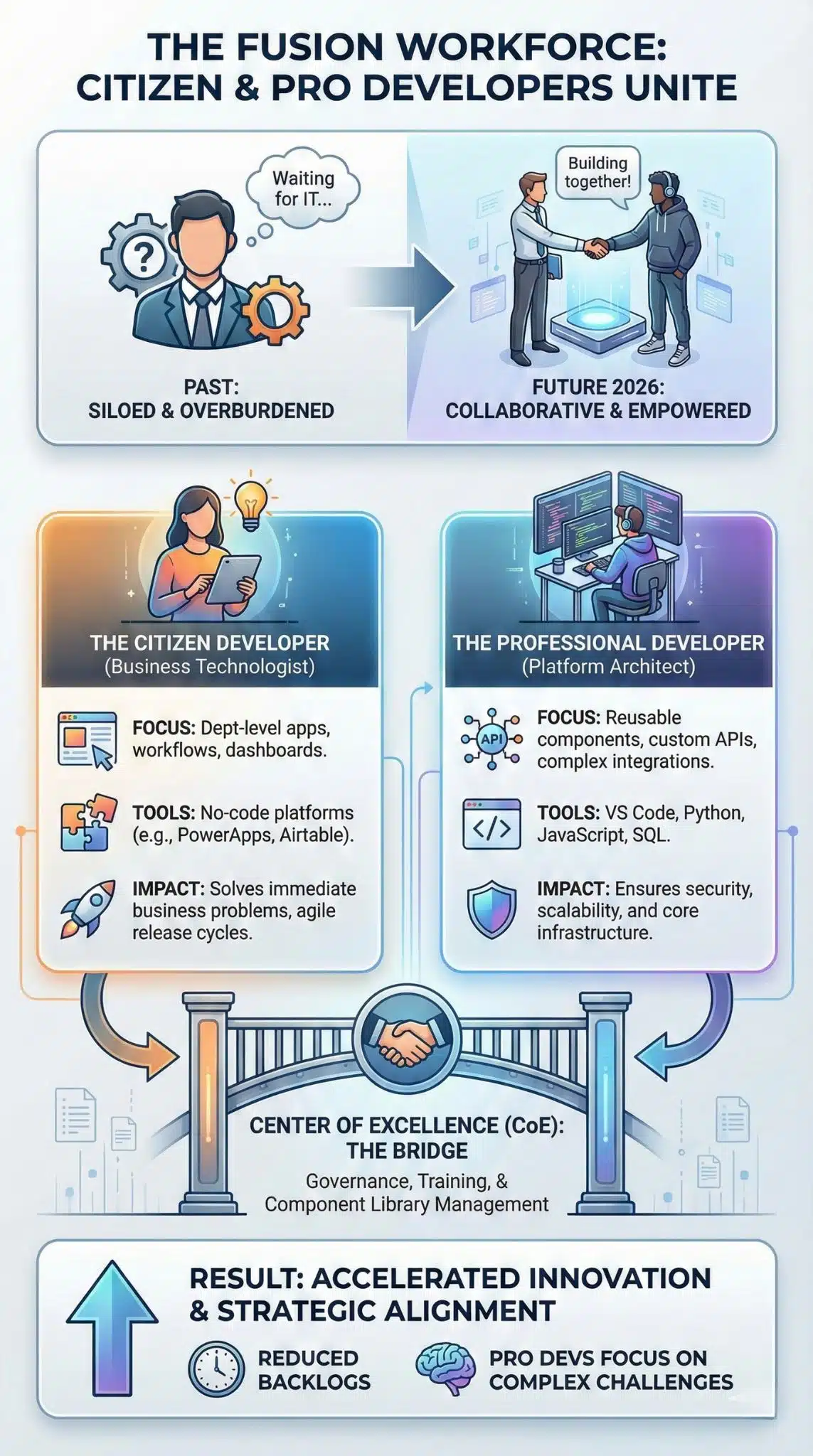
A common misconception was that No-Code for Enterprise would replace software engineers. The reality of 2026 is that it has liberated them. Professional developers are no longer bogged down by ticket backlogs requesting minor text changes or simple CRUD (Create, Read, Update, Delete) applications. Those are now handled by the business units themselves.
Instead, professional developers have transitioned into the roles of “Platform Architects” and “Component Builders.” They build the complex, reusable modules—such as a custom authentication service or a proprietary algorithm wrapper—that citizen developers then drag and drop into their applications. This “Fusion Team” model is the standard for high-performing organizations.
However, friction remains. The cultural shift requires training. Organizations that simply hand out licenses without training face “app sprawl”—a chaotic landscape of thousands of abandoned or duplicative apps. Successful enterprises in 2026 have established Centers of Excellence (CoE): dedicated internal teams that train employees, vet applications, and maintain the component library. The CoE acts as the bridge between the agility of no-code and the rigor of traditional IT.
Roles in the No-Code Ecosystem
| Role | Responsibility in 2026 | Tools Used |
| Citizen Developer | Builds dept-level apps, workflows, and dashboards. | Bubble, PowerApps, Zapier, Airtable. |
| Pro Developer | Builds APIs, custom widgets, and complex integrations. | VS Code, Python, JavaScript, SQL. |
| IT Admin / CoE Lead | Governs security, manages users, monitors app health. | Platform Admin Consoles, Datadog, Splunk. |
| Business Analyst | Translates business needs into app architecture. | Miro, Figma (often integrated into No-Code tools). |
Cost Analysis: No-Code vs. Traditional Development in 2026
The economic argument for No-Code for Enterprise is irrefutable in 2026. Traditional development is expensive not just in salaries, but in opportunity cost. The time it takes to hire a team, onboard them, and build an MVP (Minimum Viable Product) often spans 6 to 9 months. With no-code, that timeline compresses to weeks.
The Total Cost of Ownership (TCO) equation has shifted. While no-code platforms often carry high licensing fees (per-user pricing remains a point of contention), the reduction in maintenance costs offsets the bill. In traditional dev, “keeping the lights on”—patching servers, updating libraries, fixing minor UI bugs—consumes 50% of engineering time. In a SaaS no-code environment, the vendor handles the infrastructure.
Furthermore, the “fail fast” capability saves millions. In 2026, enterprises prototype ideas in days. If an app doesn’t gain traction, it is deleted with zero sunk cost in engineering hours. If it succeeds, it is scaled. This agility is the primary driver of ROI, allowing companies to respond to market changes instantly.
Cost & Efficiency Comparison
| Cost Factor | Traditional Development | No-Code Development | ROI Impact |
| Initial Build Time | 4-9 Months | 2-6 Weeks | 10x Faster Time-to-Market |
| Staffing Costs | High (Requires Senior Engineers) | Moderate (Business Users + Lead Dev) | Lower Barrier to Entry |
| Maintenance | High (Server patching, dependency updates) | Low (Vendor managed platform) | Reduced IT Burden |
| Tech Debt | Accumulates in legacy code. | Accumulates in unused apps (Sprawl). | Manageable via Governance |
| Scalability Cost | Linear (More users = more infrastructure management) | Step-function (Higher tier licensing) | Predictable OpEx |
Final Thoughts
As we look toward the latter half of the decade, No-Code for Enterprise has proven its worth. It is finally powerful enough. The concerns regarding scalability and security, while still relevant, are now managed risks rather than deal-breakers. The technology has matured from a tool for “shadow IT” into a pillar of “strategic IT.”
The enterprise of 2026 does not choose between code and no-code; it chooses composability. It builds a tech stack where data flows freely between bespoke high-performance systems and agile no-code interfaces. The organizations that win are those that empower their workforce to build their own solutions while maintaining the guardrails that keep the enterprise secure.
If your organization is still debating the validity of no-code in 2026, you aren’t just behind the curve—you are running a relay race with a static baton while your competitors are riding high-speed trains. The tools are ready. The question is: Are you?