The promise of early Web3 gaming—that anyone could quit their job to “play video games for a living”—has been exposed as one of the most damaging narratives in crypto history. By late 2025, the industry had completed a painful but necessary “Great Reset.” The collapse of first-generation “Play-to-Earn” (P2E) titles, which relied on hyperinflationary token emissions to attract users, forced developers to confront a harsh reality: an economy that relies on new entrants to pay existing players is not a game economy; it is a Ponzi structure.
As we move through 2026, the landscape of Sustainable Web3 Gaming Economics looks radically different. The focus has shifted from extraction to engagement. Studios are no longer selling the dream of easy income but are building complex, closed-loop economies where value is generated through entertainment, asset utility, and external revenue streams. This analysis explores the technical and economic pivots defining this new era, from “Real Yield” distribution to the rise of “Invisible Web3.”
1. The Anatomy of Failure: Why First-Gen P2E Collapsed
The “Death Spiral” Mechanics
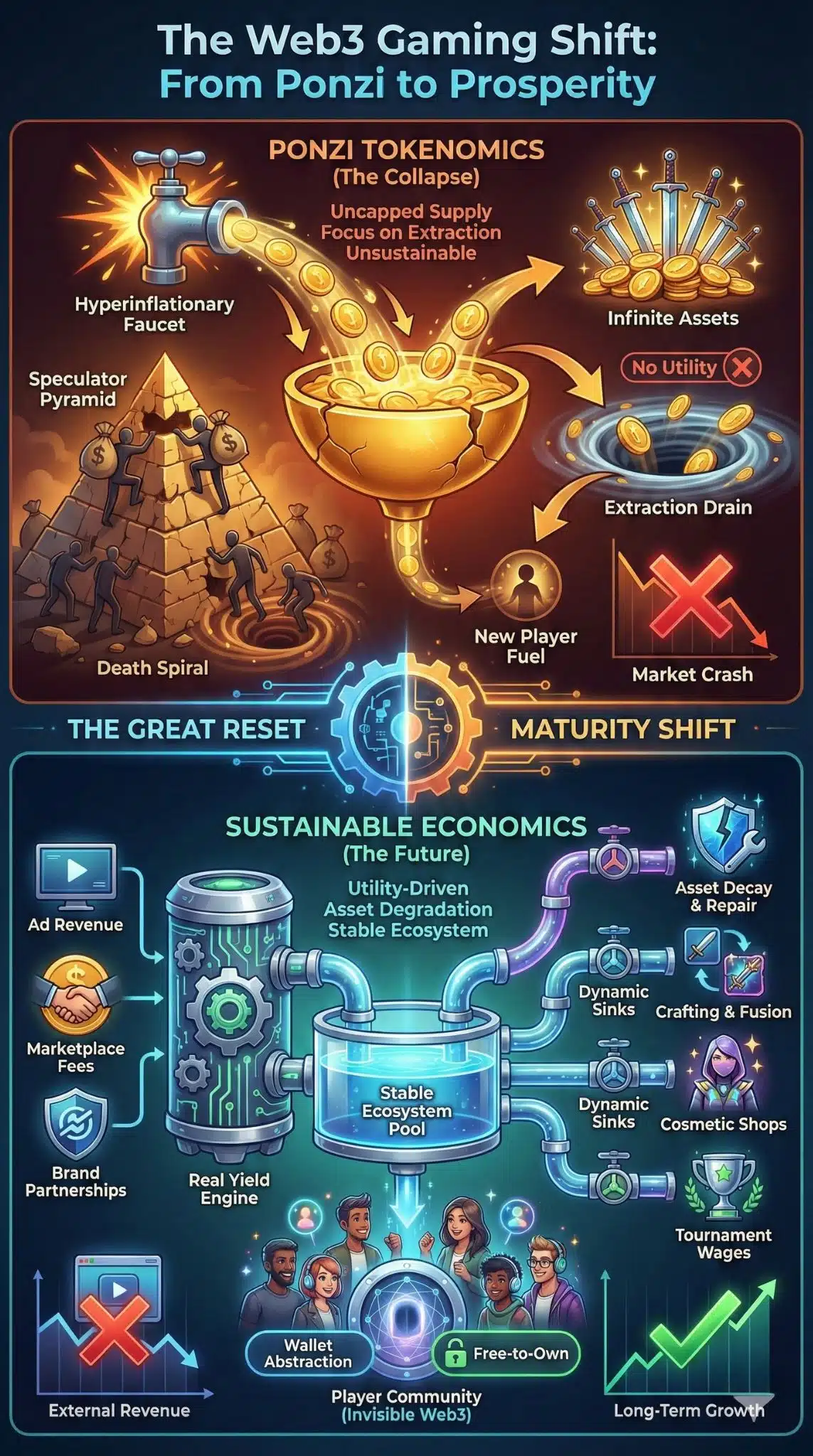
To build the future, we must understand the failures of the past. The industry standard from 2021 to 2024 was the “Dual-Token Model,” consisting of a fixed-supply governance token and an uncapped utility token. This created a perverse incentive structure. Players were not “gamers” but “farmers,” optimizing their gameplay to extract the maximum amount of utility tokens to dump on the market daily.
When market sentiment turned bearish, the “Death Spiral” was inevitable. As token prices dropped, farmers fled, leaving behind an oversupply of assets (NFTs) that had no utility without the financial incentive. In 2026, we categorize this as a failure of Demand Sinks. There was no reason to hold the token other than to sell it.
The Shift from Ponzi to Sustainability
| Feature | First-Gen P2E (2021-2024) | Sustainable Era (2026+) |
| Primary Player Goal | ROI / Income Extraction | Entertainment / Status / Skill |
| Token Model | Uncapped, Hyperinflationary | Deflationary / Real Yield |
| Revenue Source | New Player Deposits (Ponzi-like) | Skins, Battle Passes, Ad Revenue, IP |
| Asset Lifespan | Infinite (Assets never break) | Finite (Assets degrade/require upkeep) |
| Market Stability | Highly Volatile (Boom/Bust) | Stabilized by Treasury Buybacks |
2. The Era of “Real Yield” and External Revenue
Decoupling Rewards from Inflation
The most significant economic shift in 2026 is the adoption of Real Yield. In the old model, games rewarded players by printing more of their own native token. This is akin to a central bank printing money to pay citizens—it devalues the currency.
Modern Sustainable Web3 Gaming Economics rely on “Real Yield” mechanisms. Studios generate revenue from external sources—traditional ad networks, brand partnerships, merchandise, and marketplace transaction fees (in ETH or USDC). A portion of this actual profit is then redistributed to the most active players or tournament winners. This ensures that the economy does not rely on the token price going up forever; it relies on the game being a successful business.
Sources of “Real Yield” Revenue
| Revenue Stream | Description | Economic Impact |
| Marketplace Tax | 2-5% fee on all P2P trades. | Removes tokens from circulation (Burn) or funds treasury. |
| Ad Monetization | Non-intrusive ads for F2P players. | Brings external fiat liquidity into the crypto ecosystem. |
| UGC Royalties | Fees from user-generated skins/maps. | Incentivizes creators while taxing consumption. |
| E-Sports Tickets | Entry fees for high-stakes tournaments. | Redistributes wealth from the “many” to the “skilled few.” |
3. Engineering Scarcity: The “Asset Degradation” Mechanic
Solving the NFT Inflation Problem
One of the overlooked flaws of early games like Axie Infinity was that digital assets lived forever. Once you minted a sword or a character, it existed permanently, leading to an eventual oversupply that crashed prices. Physical economies work because things break—cars need repairs, clothes wear out.
In 2026, top-tier titles like Off The Grid and Eve Online’s Web3 expansions have implemented aggressive Asset Degradation (or “Entropy”). High-level items now have a “durability” score. As they are used in battle, they lose stats. Players must spend tokens (the “sink”) or burn other NFTs to repair them. If an item reaches zero durability, it is burned permanently. This creates a constant, natural demand for resources and stabilizes the economy.
Types of Token & Asset Sinks
| Sink Type | Mechanism | Why It Works |
| Repair Costs | Spending tokens to fix degraded gear. | Creates recurring maintenance costs for “Whales.” |
| Breeding/Fusion | Burning 2 items + tokens to create 1 better item. | Reduces total NFT supply while burning tokens. |
| Cosmetic Prestige | High-cost skins with zero gameplay advantage. | Allows heavy spenders to “flex” without breaking game balance. |
| Gacha/RNG | Paying for a chance at rare loot. | Highly effective deflationary tool (removes massive liquidity). |
| Guild Taxation | Guilds tax members to upgrade land/HQ. | Encourages collective resource pooling and burning. |
4. The “Invisible Web3” and Mass Onboarding
Removing the “Crypto” from Crypto Games
For Sustainable Web3 Gaming Economics to work, the player base must expand beyond crypto-natives. The solution in 2026 is “Invisible Web3”. Using Account Abstraction (ERC-4337) and social logins, players now create accounts using Gmail or Apple ID. A wallet is generated in the background, but the user never sees a seed phrase.
Gas fees are subsidized by the developer (Paymasters) or paid via credit card subscriptions. Players only interact with the blockchain layer when they decide to “eject” an item to a secondary marketplace to sell it. This “Free-to-Own” (F2O) model mirrors the user experience of Fortnite or Roblox, removing the technological friction that previously stifled adoption.
Friction Reduction in 2026
| User Journey Step | Old Method (2022) | New Method (2026) |
| Sign Up | Install MetaMask, save 12 words. | “Log in with Google” (Wallet invisible). |
| First Asset | Buy expensive NFT ($200+) to start. | Free starter character (Soulbound/Non-tradable). |
| Transactions | Approve every move + pay Gas fees. | Gas-less session keys (Sign once per session). |
| Cash Out | Complex bridge to CEX. | In-app fiat off-ramp (Stripe/PayPal integration). |
5. AI-Driven Economic Balancing
The End of Static Economies
Human economists cannot react fast enough to a crashing game economy. In 2026, we are seeing the rise of AI-driven Economic Balancing. These systems monitor the “faucet” (rewards given) and the “sink” (tokens spent) in real-time.
If the AI detects that inflation is rising too fast (too many players earning), it can dynamically adjust the drop rates of loot, increase repair costs, or trigger special “gold sink” events to drain liquidity. This creates a “breathing economy” that self-corrects before a death spiral can occur.
AI Roles in Game Economics
| AI Function | Action | Goal |
| Dynamic Drop Rates | Lowers legendary drop rates if supply is high. | Maintains rarity and market value. |
| Bot Detection | Analyzes behavior to ban extraction bots. | Prevents non-human value extraction. |
| Personalized Shops | Offers specific sinks to specific player types. | Maximizes spending from “Whales.” |
| Inflation Alert | Triggers server-wide “Tax” events. | Burns excess currency during surpluses. |
Final Thoughts
The transition to Sustainable Web3 Gaming Economics represents the industrial maturity of the sector. The “Wild West” days of 2021, characterized by ponzi-nomics and speculation, have been regulated and innovated out of existence.
In 2026, the winning formula is clear: Game First, Crypto Second. Blockchain is no longer the selling point; it is merely the backend infrastructure that guarantees digital property rights. By implementing Real Yield, Asset Degradation, and Invisible Web3 tech, studios have finally built economies that can survive the test of time. The future isn’t about playing to earn a living; it’s about owning the value you create while having fun.