
You have likely encountered the string “Python 54axhg5” in a server log, an error report, or an automated test result and felt a moment of confusion. This alphanumeric sequence often looks like a critical failure or a corrupt version number, causing immediate concern for the stability of your project. We must first verify that this is not a standard Python error code, nor does it indicate a compromised system.
Our objective is to identify the origin of these phantom identifiers and neutralize the distraction they cause. We will treat this as a lesson in distinguishing between meaningful signals and automated noise within a modern development environment.
This guide structures the debugging process into three clear phases. First, we will analyze the technical source of these random strings. Second, we will apply forensic debugging techniques to isolate the real issue. Finally, we will implement structured logging to prevent future confusion.
What Is Python 54axhg5
The term “Python 54axhg5” is a classic example of a transient artifact—a temporary, randomized label generated by automated systems rather than the Python interpreter itself. In high-velocity development environments, tools must create unique names for temporary files, test databases, or concurrent processes to avoid collisions. A string like 54axhg5 is typically a hex digest or a partial hash generated for this specific purpose.
Where Do These Identifiers Originate?
Modern DevOps workflows rely on uniqueness. When a continuous integration pipeline executes a test suite, it often spins up isolated containers or temporary directories. To ensure these isolated environments do not overwrite one another, the system appends a random suffix to the resource name.
For instance, a standard testing library like ‘pytest’ may create a temporary directory named ‘test_run_54axhg5’. If the test fails or the process hangs, this name persists in the logs, leading developers to search for the string as if it were the error itself.
In my engineering days leading teams across the UK and Estonia, I frequently saw junior developers waste hours chasing these “ghosts.” They would search for a random container ID, believing it was a specific error code.
The Cost of Phantom Debugging
Chasing these non-errors is expensive. According to a 2025 report by IDC, developers now spend more time on operational tasks—such as interpreting complex CI/CD logs—than on writing new feature code. This data highlights the critical need to quickly filter out system-generated noise.
Common Environments for Artifact Generation
You will most frequently encounter these strings in three specific contexts:
- Serverless Computing: Platforms like AWS Lambda assign a unique Request ID (e.g., ‘unique_request_id’) to every function execution. If a function crashes, this ID is the only handle you have to find the stack trace.
- Container Orchestration: Docker and Kubernetes generate short alphanumeric IDs for pods and containers. A log entry reading “Error in container 54axhg5” simply identifies where the error happened, not what happened.
- Version Control Hashing: Git uses SHA-1 hashes to track changes. A partial commit hash like “54axhg5 “often appears in build artifacts to mark the exact version of the code that was deployed.
Understanding this context shifts your focus. You stop asking, “What does 54axhg5 mean?” and start asking “Which system generated this ID, and what real error is it pointing to?”
Investigating Python 54axhg5 Issues

Once you accept that 54axhg5 is a label and not a bug, you can begin the actual debugging work. The goal is to look past the identifier to find the root cause, which is often a race condition or a logic error hidden by the noise.
Distinguishing Artifacts from Real Errors
A true Python error is descriptive. It tells you the type of failure immediately. A phantom identifier is opaque. You can distinguish them by checking for standard Python exception classes.
| Signal Type | Example Appearance | Action Required |
|---|---|---|
| Standard Exception | IndexError: list index out of range |
Fix the logic error in the code. |
| System Artifact | /tmp/pytest-of-user/pytest-54axhg5/ |
Ignore the name; check the file contents. |
| Process ID | Worker-54axhg5 exited with code 1 |
Investigate the worker’s activity log. |
Many questionable websites use terms like “Python 54axhg5” to attract search traffic, offering vague solutions. Trusted packages from the Python Package Index do not use such cryptic error names. Always verify the source of the log message before searching for it.
Systematic Debugging Workflow
When you face an opaque error involving a random identifier, follow this forensic process to uncover the truth.
- Isolate the variable: Use the Python Debugger (pdb). Insert `import pdb; pdb.set_trace()` before the crash. Inspect the variables to see if ’54axhg5′ is stored as a string or a temporary file path.
- Search for the generator: Do not search for the string itself. Search your codebase for functions that generate random tokens, such as ‘uuid.uuid4()’ or ‘secrets.token_hex()’.
- Check the environment: If the code works locally but fails in the cloud, the string is likely an environmental artifact. AWS and Azure often inject these IDs as environment variables.
- Analyze the traceback: Look at the line before the identifier appears. The real error (like a ‘TimeoutError’ or ‘MemoryError’) usually precedes the log entry containing the random ID.
- Verify external libraries: Updates to libraries like Pandas or NumPy can introduce new logging formats. Check the release notes for any recent changes in how they report warnings.
A Critical Insight: A 2025 Stack Overflow survey noted that 45% of developers find debugging AI-generated code increasingly difficult. AI tools often hallucinate or use variable names that look like random strings (e.g., ‘var_54axhg5’), adding another layer of confusion to the logs.
By treating the identifier as a clue rather than the crime, you strip away the mystery. You are looking for a broken process, not a broken name.
Best Practices for Preventing Log Confusion
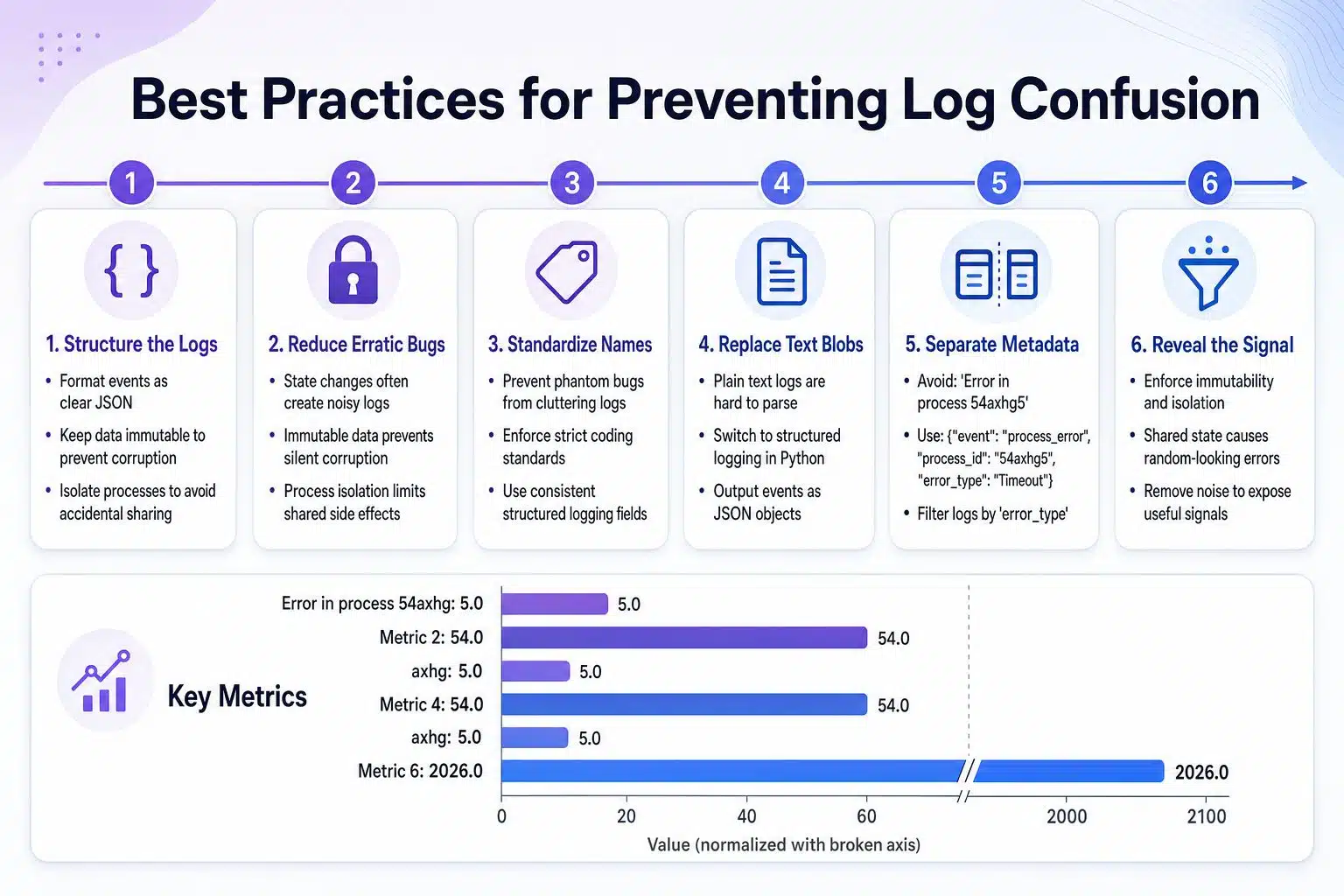
The best way to handle “phantom bugs” is to prevent them from cluttering your logs in the first place. You can achieve this by enforcing strict coding standards that prioritize clarity and immutability.
Implement Structured Logging
Standard text logging is insufficient for modern applications. It produces unstructured blobs of text that are hard to parse. You should switch to structured logging in Python.
Structured logging outputs logs as JSON objects. This format allows you to separate the message from the metadata. Instead of a log line reading ‘Error in process 54axhg5’, you get a clean JSON object.
{"event": "process_error", "process_id": "54axhg5", "error_type": "Timeout"}
This change allows you to filter your logs by ‘error_type’ in tools like Datadog or Splunk, completely ignoring the random process ID. The noise disappears, leaving only the signal.
Enforce Immutability and Isolation
State changes are the primary cause of the bugs that generate these erratic logs. When multiple parts of your code try to change the same data, the crash often results in a random-looking error.
- Use Immutable Data Structures: Prefer Python’s NamedTuple or frozen dataclasses over standard lists and dictionaries. If an object cannot change, it cannot be corrupted by a race condition.
- Isolate Your Processes: Run every major task in its own container or virtual environment. This ensures that a temporary file named ’54axhg5′ in one process cannot accidentally be read by another.
- Standardize Naming: Configure your CI/CD tools to use predictable prefixes. Instead of a random string, force your system to generate names like ‘test_run_2026_01_22_worker_1’. This makes the source of the log file immediately obvious.
Final Words
The term “Python 54axhg5” is not a bug to be feared but a signal to be decoded. It represents the transient, automated nature of modern software development. We have learned that these strings are often artifacts of CI/CD pipelines, cloud processes, or temporary file generation.
Your defense against this confusion lies in clarity. By adopting structured logging and forensic debugging habits, you turn noise into actionable data. Master these practices, and you will spend less time chasing random strings and more time building resilient applications.