The Green Tech Revolution is not a future concept anymore. It is already reshaping how we browse, stream, store data, and upgrade devices. It is also changing what companies build, how they power infrastructure, and how consumers judge value.
Digital life can feel weightless, but it is not. Every message travels through networks. Every photo sits on a server. Every app update triggers compute, downloads, and device wear. Behind the screen, the digital world depends on electricity, cooling, minerals, shipping, and manufacturing.
Eco-innovation steps in where digital convenience creates hidden costs. It focuses on fewer emissions per click, longer device lifespans, smarter materials, and real end-of-life systems. This matters because “green” is no longer a niche preference. It is becoming a design requirement.
This pillar guide breaks down the most important eco-innovation shifts shaping modern digital life. You will see what is already working, what is still experimental, and how to spot progress that is real.
The Hidden Environmental Cost Of Our Digital Lives
Most people think about climate impact in terms of cars, flights, and factories. Fewer people think about servers, code, and upgrade cycles. Yet your digital habits connect directly to physical systems.
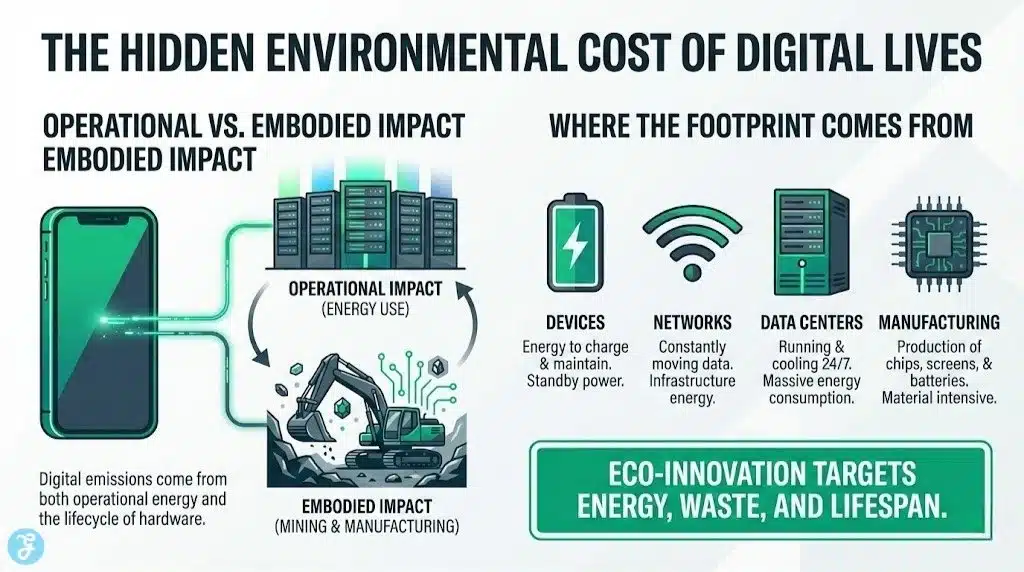
Digital emissions come from two main buckets. The first is operational energy, which includes electricity used by devices, networks, and data centers. The second is embodied impact, which includes the mining, manufacturing, and shipping required to build hardware.
Where The Digital Footprint Comes From
A typical digital experience relies on:
- Devices that require energy to charge and maintain
- Networks that move data constantly
- Data centers that run and cool servers 24/7
- Manufacturing systems that produce chips, screens, and batteries
Even small design decisions can multiply impact at scale. A heavier website forces millions of devices to process more code and move more data. A short software support window pushes consumers toward replacements.
Why E-Waste Keeps Growing
E-waste is not only a trash problem. It is a business model problem. Many products become “obsolete” while still functional because repairs are difficult, batteries degrade, and software support ends.
Here are common drivers:
- Sealed components that raise repair costs
- Proprietary parts and restricted diagnostics
- Frequent “minor” upgrades that reset buying cycles
- Marketing that frames new features as necessities
The most climate-friendly device is often the one you keep using. Eco-innovation tries to make that choice easier and more normal.
What Eco-Innovation Means In Digital Life
Eco-innovation is not a single technology. It is a mindset backed by measurable outcomes.
It typically targets:
- Lower energy per digital service
- Less material waste through better design
- Longer product life through repair and support
- Better reuse and recycling through circular systems
The Green Tech Revolution becomes real when these improvements scale across products, platforms, and infrastructure.
Carbon Capture Tech: Can Giant Vacuums Really Suck CO2 Out Of The Sky
Direct air capture, often shortened to DAC, tries to remove carbon dioxide directly from ambient air. Many people call it “giant vacuums” because large fans pull air through capture units. The idea sounds simple, but the engineering and economics are complex.
DAC matters because some emissions remain hard to eliminate. Aviation, cement, steel, and certain chemical processes will likely need long-term carbon removal options. Still, DAC only helps if it supports deep emission cuts rather than replacing them.
How DAC Works In Plain Terms
Most DAC systems follow a similar cycle:
- Fans move air through a capture material
- A sorbent binds with CO2 molecules
- Heat or pressure releases the captured CO2
- The CO2 gets compressed and transported
- The CO2 gets stored or used in controlled ways
This approach captures CO2 that is already dispersed in the atmosphere. That is why it requires more energy than capturing CO2 from concentrated industrial sources.
DAC Benefits And Limits
DAC can help when you need verified removal. It can also support “net-zero” accounting for emissions that truly cannot be eliminated.
It has clear limits too:
- It does not replace cutting fossil fuel use
- It needs clean energy to avoid canceling its benefits
- It requires strong measurement, reporting, and verification
- It depends on storage capacity and long-term monitoring
If DAC grows without guardrails, it risks becoming a distraction. If it grows with strict standards and clean power, it can support broader climate goals.
DAC And The Digital Economy
It might not feel connected, but DAC relates to digital life in two ways. First, large-scale DAC needs monitoring, verification, and data systems. Second, digital businesses increasingly face pressure to address emissions they cannot reduce quickly.
The Green Tech Revolution will likely include a mix of prevention and removal. DAC belongs in the “removal” toolbox, but it works best when prevention does most of the work.
Green Cloud Computing: Why Your Data Center’s Carbon Footprint Matters
The cloud is a physical industry. It runs on buildings filled with servers, network gear, cooling systems, and backup power. When you store photos, stream music, or use AI tools, you rely on that infrastructure.
Cloud impact depends on energy sources, efficiency, and hardware lifecycles. It also depends on how software uses compute. A bloated service can waste energy even if the data center runs on low-carbon power.
What Drives Cloud Emissions
Cloud emissions commonly come from:
- Electricity to run servers and storage
- Electricity and water for cooling
- Backup generators and power conditioning
- Construction and replacement of hardware
Some of these emissions are visible through electricity bills. Others are embedded in supply chains that users never see.
What “Green Cloud” Actually Looks Like
“Green cloud” is not a slogan. It is a set of engineering and operational decisions.
It often includes:
- Higher server utilization to reduce idle machines
- Efficient hardware with modern chips and power management
- Advanced cooling designs that reduce energy needs
- Workload scheduling that runs compute when grids are cleaner
- Regional placement decisions that reduce carbon intensity
A green cloud strategy also includes demand discipline. The cleanest compute is the compute you do not run.
A Practical Cloud Hygiene Table
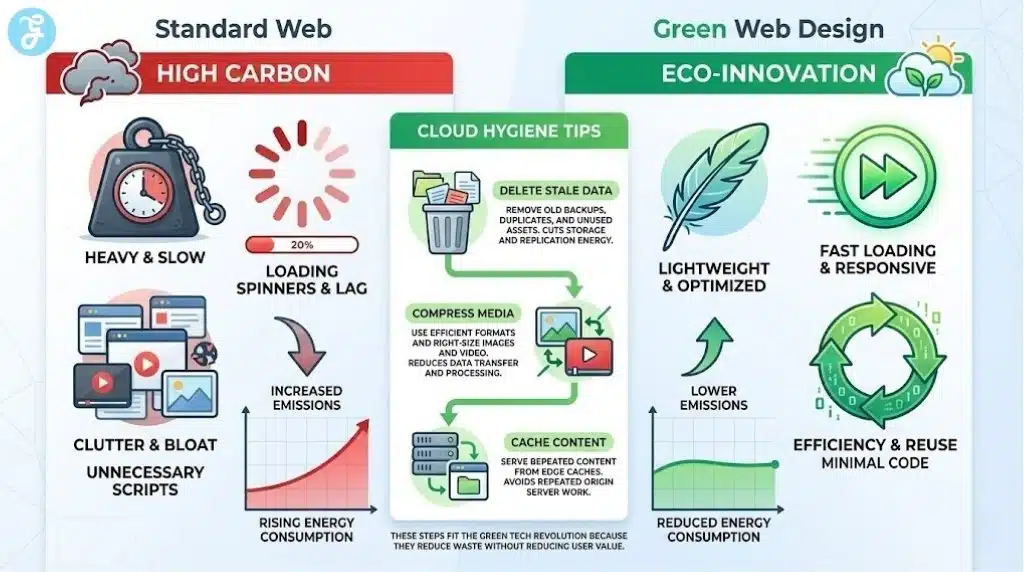
Below is a simple view of actions that reduce cloud waste, and why they matter.
| Action | What You Do | Why It Reduces Impact |
| Delete stale data | Remove old backups, duplicates, and unused assets | Cuts storage and replication energy |
| Compress media | Use efficient formats and right-size images and video | Reduces data transfer and processing |
| Cache content | Serve repeated content from edge caches | Avoids repeated origin server work |
| Reduce background jobs | Stop always-on services that do little work | Shrinks idle compute |
| Audit third-party scripts | Remove unnecessary trackers and heavy SDKs | Reduces network calls and CPU load |
These steps fit the Green Tech Revolution because they reduce waste without reducing user value.
Green Web Design: How To Build A Low-Carbon Website
The web can be efficient, but many websites are built like heavy apps. They load multiple tracking scripts, autoplay media, and oversized images. This increases energy use across millions of visits.
Low-carbon websites typically feel better to use. They load faster, behave more smoothly, and consume less mobile data. Good green web design often matches good user experience.
Why Website Weight Matters
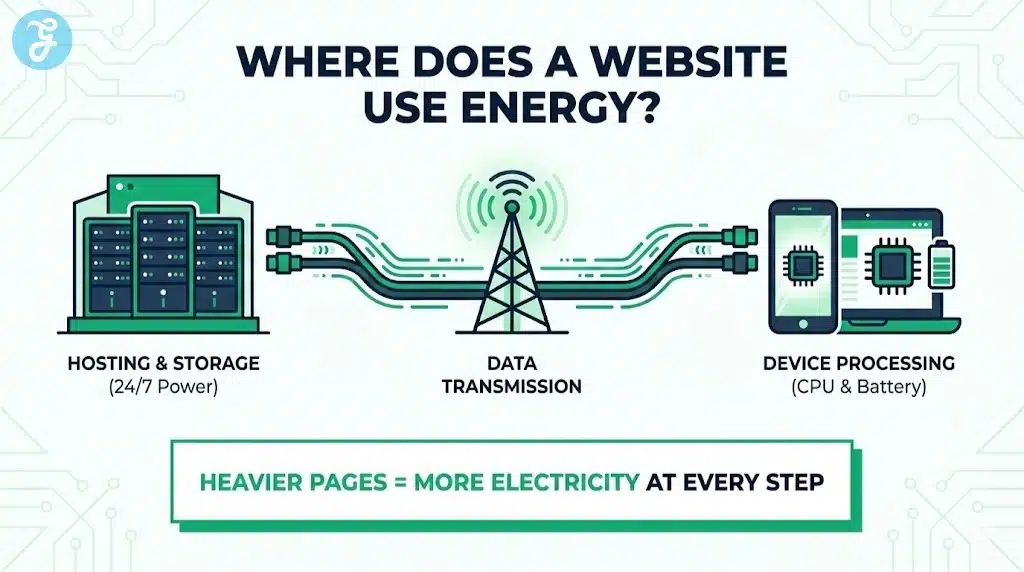
When a page is heavy:
- Devices use more CPU and battery
- Networks transmit more data
- Servers handle more requests and larger payloads
- Users wait longer and bounce more often
At scale, small optimizations create large wins.
A Balanced Low-Carbon Web Checklist
You asked for variation, so here is a mixed approach. First, a short paragraph on strategy, then a compact list.
Start with the “big rocks.” Reduce page weight, reduce scripts, and reduce repeated work. After that, polish images, fonts, and caching.
Key changes that often deliver the biggest improvements:
- Serve responsive images in modern formats
- Avoid autoplay media and unnecessary animations
- Limit third-party scripts and tracking tags
- Keep font files minimal and reuse system fonts where possible
- Use caching and a content delivery network wisely
- Reduce page complexity and remove unused code
Why Search Engines Often Favor Efficient Pages
Search engines want pages that load quickly and satisfy users. When users stay longer and interact more, performance and usability signals often improve. That does not mean “green” automatically ranks, but efficiency supports the same goals.
The Green Tech Revolution in web design rewards teams that build faster pages with less waste and more clarity.
Smart Homes, Green Planet: IoT Devices That Actually Reduce Your Energy Bill
Smart home technology can cut energy waste, but it can also add more gadgets that burn standby power and become e-waste quickly. The difference comes down to purpose and longevity.
If a device reduces heating and cooling waste, it usually pays off. If it exists mainly for novelty, it often does not.
What Makes An IoT Device Truly “Green”
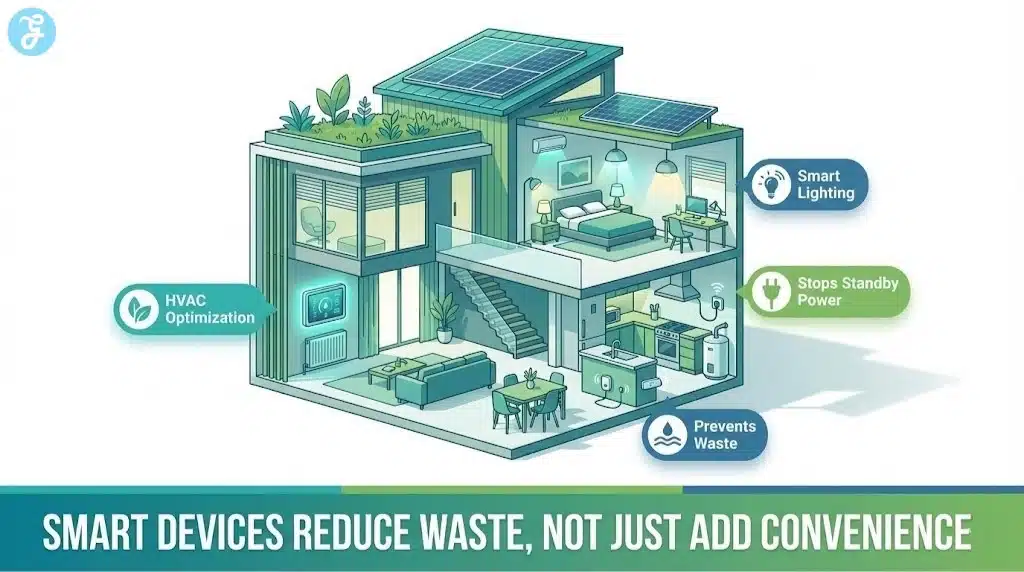
A useful smart device does at least one of the following:
- Reduces energy use by optimizing behavior
- Prevents waste, such as leaks or overuse
- Extends the life of systems through monitoring and maintenance
- Replaces multiple devices instead of adding more
It should also last. A smart device that loses support in two years creates more waste than it saves.
IoT Devices With Strong Real-World Payoff
Here is a short, practical list that tends to deliver savings in many homes:
- Smart thermostats that adjust schedules and occupancy patterns
- Smart plugs that cut standby power on entertainment and office gear
- Leak detectors that prevent water loss and costly damage
- Energy monitors that expose hidden high-draw devices
- Smart lighting that reduces overuse in low-traffic areas
A Quick Comparison Table For Buyers
| Device Type | Typical Benefit | Watch Out For |
| Smart thermostat | Lower heating and cooling waste | Poor setup can reduce savings |
| Smart plugs | Cuts standby power | Too many plugs become clutter |
| Leak sensors | Prevents water waste and damage | Cloud dependence and app lock-in |
| Energy monitor | Finds waste and guides upgrades | Data accuracy varies by model |
| Smart lighting | Reduces overuse | Cheap bulbs may fail early |
Smart homes can support the Green Tech Revolution when they reduce waste and avoid disposable gadget cycles.
Water Tech Innovations: AI-Driven Desalination And Smart Leak Detection
Water systems face rising pressure from drought, population growth, and aging infrastructure. Water also links directly to energy because treatment and pumping consume electricity.
Eco-innovation in water focuses on efficiency first. It tries to stop leakage and improve management before expanding supply.
Smart Leak Detection And Predictive Maintenance
Modern leak detection can use acoustic sensors, pressure signals, and machine learning models. These systems spot anomalies that humans might miss, especially in large networks.
In cities with aging pipes, even a modest reduction in leakage can save huge volumes of water. It also saves the energy used to treat and pump that water.
AI In Desalination
Desalination can be essential in water-stressed regions, but it often requires significant energy. AI can improve efficiency by optimizing membrane performance and predicting maintenance needs.
It can also improve reliability. When systems fail, they waste energy and reduce supply. Predictive maintenance helps operators act earlier and avoid major breakdowns.
The Green Tech Revolution in water technology will likely reward solutions that reduce waste first, then expand supply with cleaner energy.
Sustainable 3D Printing: Using Algae And Recycled Plastic To Build The Future
3D printing can reduce waste by producing parts on demand and minimizing scrap. It can also shorten supply chains by enabling local manufacturing. Still, it is not automatically sustainable.
Sustainability depends on materials, energy use, failure rates, and what the printed object replaces. Printing a disposable plastic novelty does not support eco-innovation. Printing a durable replacement part that extends a product’s life often does.
When 3D Printing Supports Sustainability
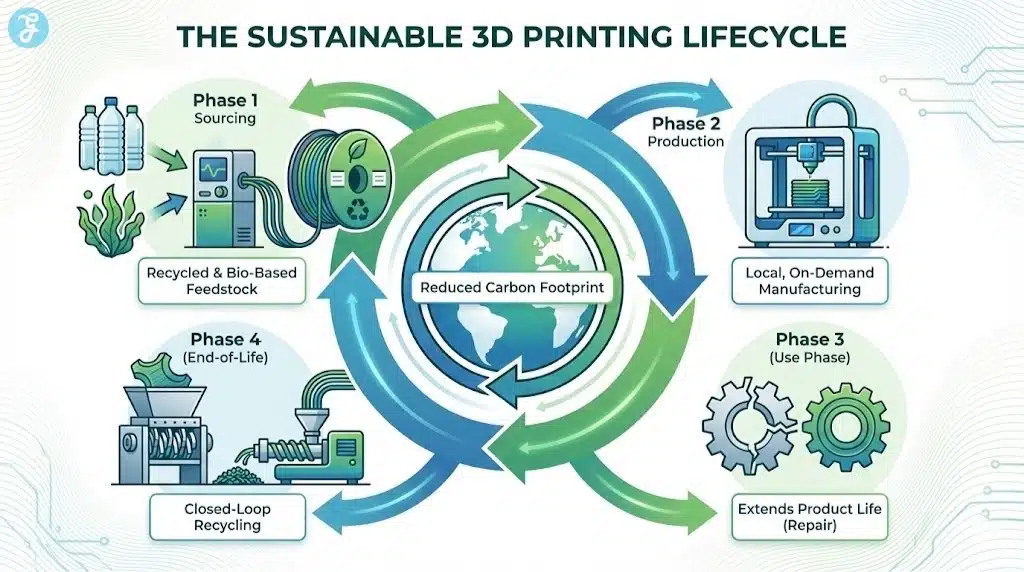
3D printing is more sustainable when it:
- Replaces shipping with local production
- Produces only what is needed, when needed
- Enables repair by printing parts that are hard to source
- Uses recycled or bio-based materials responsibly
Algae-Based Materials And Bio-Composites
Algae-based and bio-composite materials have potential. They can reduce dependence on virgin petroleum plastics and add renewable inputs.
But buyers should look at durability and end-of-life reality. A “bio” label is not enough. If an object breaks quickly or cannot be recovered, the net benefit shrinks.
Recycled Plastic Filaments And Closed-Loop Printing
Recycled filaments can turn waste into feedstock. Some systems even reprocess failed prints into new material.
That can work well, but quality control matters. Poorly processed recycled filament can create more failed prints, which increases waste and energy use.
By this point in the article, the Green Tech Revolution shows a pattern. The best solutions reduce waste while protecting performance and longevity.
Lab-Grown Everything: From Diamonds To Leather
Lab-grown products are expanding beyond food and into materials, fashion, and luxury. The goal is not only “cruelty-free.” It is often traceability, controlled production, and reduced extraction.
Still, sustainability depends on inputs. A lab-grown product powered by high-carbon electricity may not outperform conventional alternatives. The best outcomes come from clean energy and efficient processes.
Lab-Grown Diamonds And The Supply Chain Question
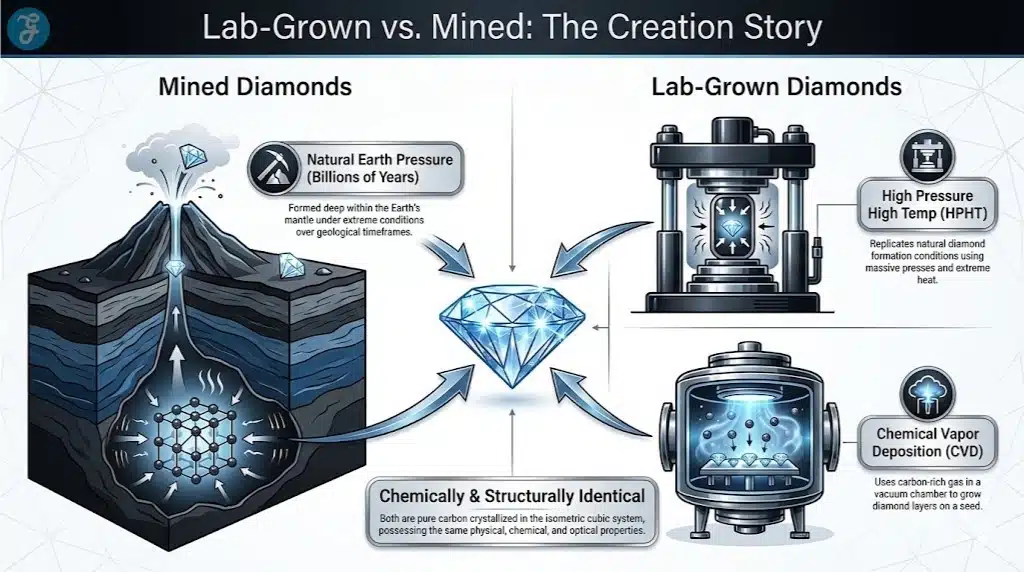
Lab-grown diamonds are chemically and structurally diamonds. Their advantage often involves supply chain transparency and reduced demand for mining.
The net impact depends on production energy, transportation, and market behavior. If lab-grown diamonds increase total consumption, some benefits can fade. If they replace mined demand, they can reduce extraction pressure.
Biofabricated Leather And Next-Gen Alternatives
New alternatives include mycelium-based materials, cultured collagen, and plant-based composites. Some aim for biodegradability. Others aim for leather-like durability.
A durable product that lasts longer can be the greener outcome, even if it is not fully biodegradable. Longevity often beats novelty.
A Buyer Framework For Cruelty-Free Luxuries
Use this short framework when evaluating lab-grown and alternative materials:
- Durability and long-term wear
- Repair potential, including reconditioning
- Transparency about production inputs
- Realistic end-of-life pathways
This mindset aligns with the Green Tech Revolution because it focuses on measurable outcomes rather than labels.
Biodegradable Electronics: The Science Behind Vanishing Circuit Boards
Biodegradable electronics, sometimes called transient electronics, aim to create devices that break down safely after use. This field targets use cases where electronics have short lifespans and cause disproportionate waste.
It is still early. Most consumer electronics cannot vanish safely without sacrificing performance. But specific applications show promise.
What “Biodegradable” Can Mean In Electronics
Researchers explore different components, including:
- Substrates made from biodegradable polymers
- Conductive inks with less persistent materials
- Water-soluble structures for specialized devices
- Biocompatible sensors for medical monitoring
The goal is controlled breakdown, not accidental decay.
Where It Can Make Sense First
Biodegradable electronics fit best where you want temporary function:
- Medical sensors used for short-term monitoring
- Agricultural sensors used for a single growing season
- Packaging sensors used for short supply-chain windows
These applications avoid the durability requirements of phones and laptops.
The Key Tradeoffs
The biggest barriers include moisture sensitivity, reliability, and scaling. Even when materials break down safely, production costs can remain high.
Still, this area matters because it forces a new question. What if electronics do not need to exist forever to be useful? That question sits at the edge of the Green Tech Revolution.
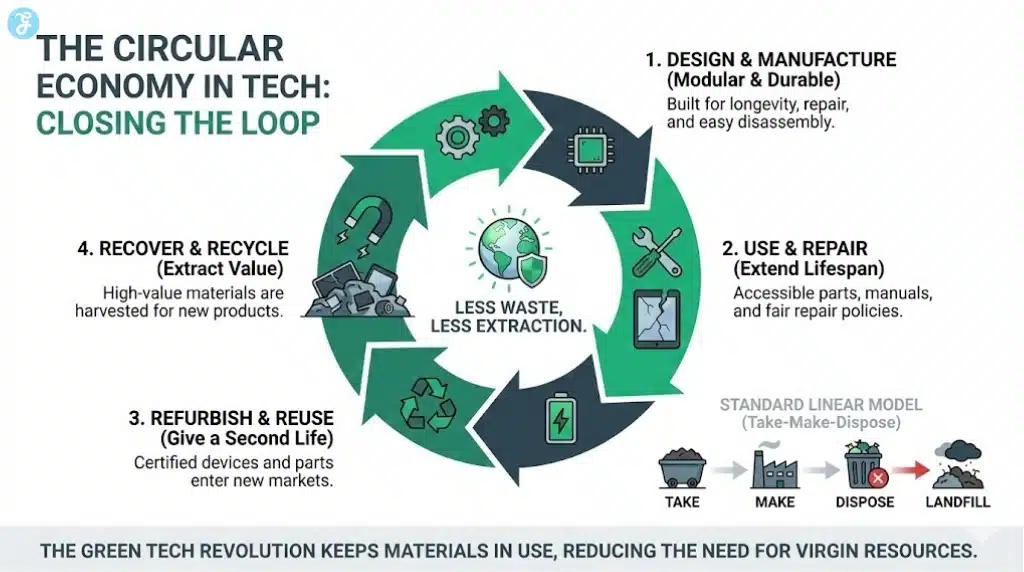
The Circular Economy In Tech: Companies That Buy Back Your Broken Gadgets
The circular economy tries to keep products and materials in use longer. Instead of a straight line from extraction to landfill, it aims for loops that preserve value.
In tech, circularity can reduce e-waste and cut demand for new materials. It can also create new markets for refurbished devices, parts harvesting, and repair services.
What Circular Tech Models Look Like
Common circular strategies include:
- Buyback and trade-in programs
- Certified refurbished sales channels
- Modular designs with replaceable parts
- Repair programs that keep products in service
- Recycling systems that recover high-value materials
Not all buyback programs are equal. Some prioritize resale and parts recovery. Others use trade-ins mostly as a sales lever.
How To Judge A Buyback Program Without Guessing
Here is a simple table to separate strong circular programs from weak ones.
| Signal | Strong Circular Program | Weak Circular Program |
| Transparency | Explains refurbishment and recycling paths | Uses vague claims like “eco-friendly disposal” |
| Repair support | Provides parts and service options | Pushes upgrades and discourages repair |
| Data handling | Clear data wipe and verification | Unclear policies and limited proof |
| Longevity focus | Resells and supports second-life devices | Treats trade-ins as a discount machine |
| Material recovery | Uses credible recovery channels | Offers no detail on recovery outcomes |
Circular models support the Green Tech Revolution when they extend device life and reduce virgin material demand.
The Right To Repair: How Legislation Is Killing Planned Obsolescence
Right to Repair is one of the most direct ways to reduce e-waste. It shifts power back to consumers and independent repair providers.
When products become easier to fix, they stay in use longer. That reduces new manufacturing demand, which often drives a large share of a device’s lifecycle impact.
What Right To Repair Typically Changes
Right to Repair policies often target practical barriers, such as:
- Access to spare parts at fair prices
- Access to repair manuals and diagnostic tools
- Limits on software locks that block repairs
- Support for independent repair shops
- Longer product support expectations
Why Planned Obsolescence Thrived
Planned obsolescence often succeeds because it hides behind convenience. Sealed batteries and proprietary parts can look like “sleek design.” Short update windows can look like “fast innovation.”
But the effect is predictable. Consumers replace devices more often than necessary, and e-waste grows.
Why Repair Changes The Economics
Repairability reduces the total cost of ownership. It also increases the resale value of products that can be maintained.
For households, the Green Tech Revolution becomes tangible when a battery swap costs less than a new phone, and when parts are available without friction.
Eco-Friendly Smartphones: Sustainable Phone Brands To Watch In 2026
The phrase “eco-friendly smartphone” often gets misused. Packaging alone does not make a phone sustainable. A phone becomes more sustainable when it lasts longer, stays secure through updates, and can be repaired affordably.
The best sustainability move for many consumers is to keep their current phone longer. But when replacement is necessary, eco-innovation can improve outcomes.
What A Sustainable Smartphone Should Deliver
A truly improved smartphone experience often includes:
- Long security updates and OS support
- Affordable battery service or replaceable battery design
- Repairable screens, ports, and buttons
- Recycled materials used meaningfully, not symbolically
- Trade-in and refurbishment pathways that extend device life
A Simple Evaluation Table For 2026 Watchlists
Use this table as a scoring guide when comparing brands and models.
| Category | What Good Looks Like | Why It Matters |
| Repairability | Parts available, reasonable labor, clear documentation | Extends lifespan and reduces e-waste |
| Software support | Long update policy with a strong track record | Keeps devices secure and usable |
| Battery service | Affordable replacement and strong battery health tools | Prevents early replacement |
| Material transparency | Clear sourcing and reporting | Reduces hidden supply chain harm |
| Circular programs | Refurbishment and resale, not just recycling | Preserves value and reduces mining demand |
A sustainable phone is not perfect. It is simply a better long-term choice than a disposable one.
EV Battery Recycling: The Next Trillion-Dollar Industry Explained
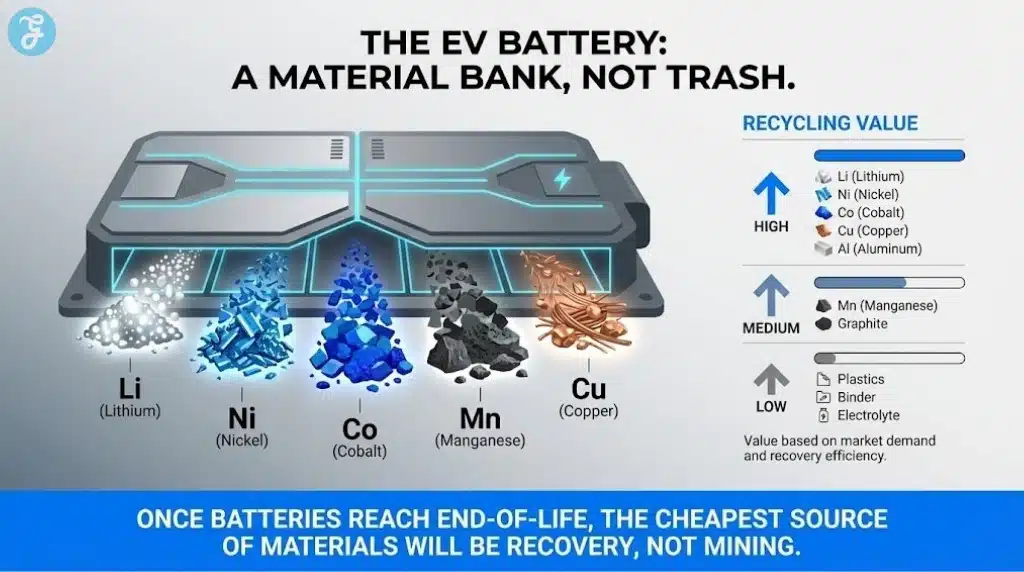
As electric vehicles scale, batteries become a central sustainability focus. Batteries contain valuable materials, and recycling can reduce the need for new extraction. It can also create domestic supply chains and reduce market volatility.
Battery recycling is not a side industry. It is becoming part of the core EV ecosystem.
Why Battery Recycling Is Becoming Essential
Battery demand is rising fast, and so is material pressure. Recycling helps by:
- Recovering valuable metals and reducing mining demand
- Lowering lifecycle emissions for new battery production
- Reducing waste and improving safety at end-of-life
- Stabilizing supply chains for critical materials
How Battery Recycling Works At A High Level
Recycling methods vary, but most processes involve:
- Disassembling packs into manageable components
- Separating materials mechanically
- Using chemical steps to recover usable metals
- Refining recovered materials for manufacturing reuse
Some systems also explore direct recycling approaches that preserve more material structure. The industry continues to evolve.
Second-Life Batteries And Grid Storage
Before recycling, many batteries can serve a second life in stationary storage. That can support renewable energy by smoothing supply and demand.
Second-life systems can delay recycling until the battery truly reaches end-of-life. This fits the Green Tech Revolution because it keeps material value in use longer.
What Comes Next: How To Choose Green Tech Without Falling For Greenwashing
Green claims are everywhere now. Some reflect real progress. Others rely on vague language and small changes that distract from bigger problems.
You do not need perfect information to make better choices. You need a consistent way to judge value and longevity.
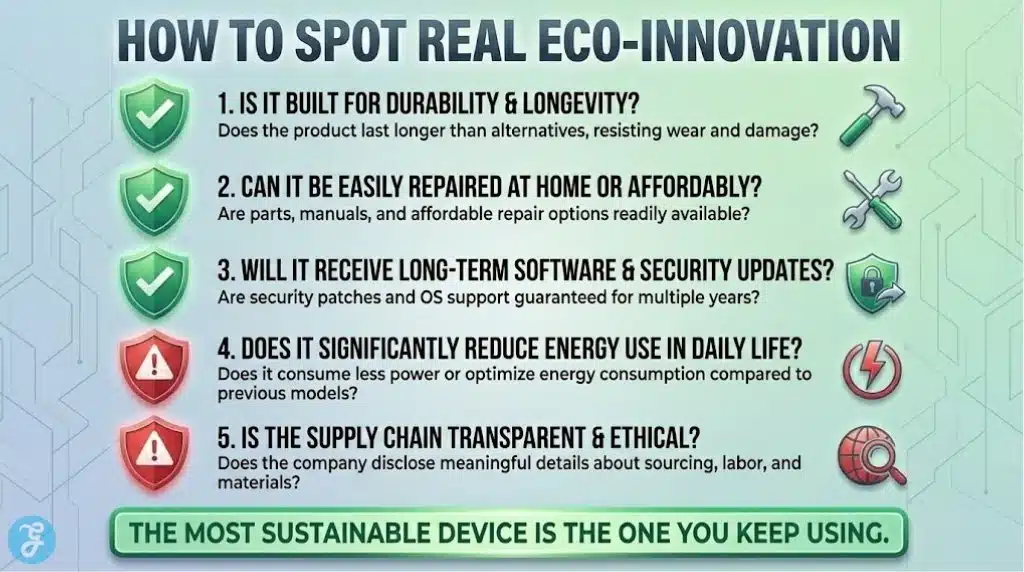
A Practical Buyer Scorecard
Ask these questions before buying or upgrading:
- Will this product last longer than alternatives
- Can I repair it easily and affordably
- Will it receive security updates for years
- Does it reduce energy use in daily life
- Does the company disclose meaningful supply chain details
- Is there a real pathway for reuse, refurbishment, or recovery
If a product fails most of these questions, its “green” branding likely does not matter.
The Pattern Behind The Green Tech Revolution
Across web design, cloud infrastructure, devices, and materials, the same pattern repeats. The best eco-innovation reduces waste, protects performance, and extends life.
That is why the Green Tech Revolution is not a single invention. It is a shift in how products get designed, sold, supported, and recovered.
Ending Thoughts
The Green Tech Revolution is already shaping your digital life, whether you notice it or not. It shows up in efficient websites that load faster. It shows up in smarter cloud operations that reduce wasted compute. It shows up in repair rights that extend device life, and in circular programs that keep gadgets out of landfills.
The biggest change is not a flashy gadget. It is a new standard. Companies increasingly need to prove efficiency, longevity, and end-of-life responsibility. Consumers increasingly reward products that last and systems that reduce waste.
If you want to participate in eco-innovation without guesswork, keep the focus simple. Buy fewer devices. Keep them longer. Repair when possible. Choose efficient services. Support brands and policies that fight disposable design. That is how the digital world becomes lighter, cleaner, and more sustainable.