The US 75-Country Immigrant Visa Pause 2026 is the centerpiece of a massive, multi-tiered overhaul of the American immigration system that began on January 1, 2026. This “Immigration Reset” represents a shift from a vetting system focused on individual threat to one focused on national economic risk and data-sharing compliance.
For the 75 affected nations, including major partners like Bangladesh, Nigeria, and Pakistan, the path to the United States has transitioned from a backlog to a total blockade.
This analysis provides a comprehensive look at the legal mechanisms, the socioeconomic triggers in states like Minnesota, and the specific hurdles, such as the new $15,000 security bonds, that define the 2026 immigration landscape.
Key Takeaways: The 2026 US Visa Reset
- The 75-Country Pause: Effective January 21, 2026, the U.S. has indefinitely suspended Immigrant Visa (Green Card) issuance for 75 nations (including Bangladesh and Pakistan) to review “Public Charge” risks.
- The 19-Nation Ban: A separate, stricter total ban on both immigrant and non-immigrant visas for 19 countries (e.g., Afghanistan, Syria, Somalia) due to national security and vetting failures.
- The “Minnesota Trigger”: This policy was accelerated by massive welfare fraud investigations in Minnesota, leading to a new “Economic Self-Sufficiency” mandate.
- Security Bonds: Temporary visitors from these nations may now be required to post a refundable $5,000 to $15,000 bond via Pay.gov to ensure they do not use public benefits.
- Diversity Visa Crisis: Winners of the DV-2026 lottery from affected countries face a “death sentence” for their applications due to the strict September 30, 2026, deadline.
- Dual Nationality: Applicants with a second passport from a non-listed country are exempt from the pause.
The Dawn of the “Self-Sufficiency” Era
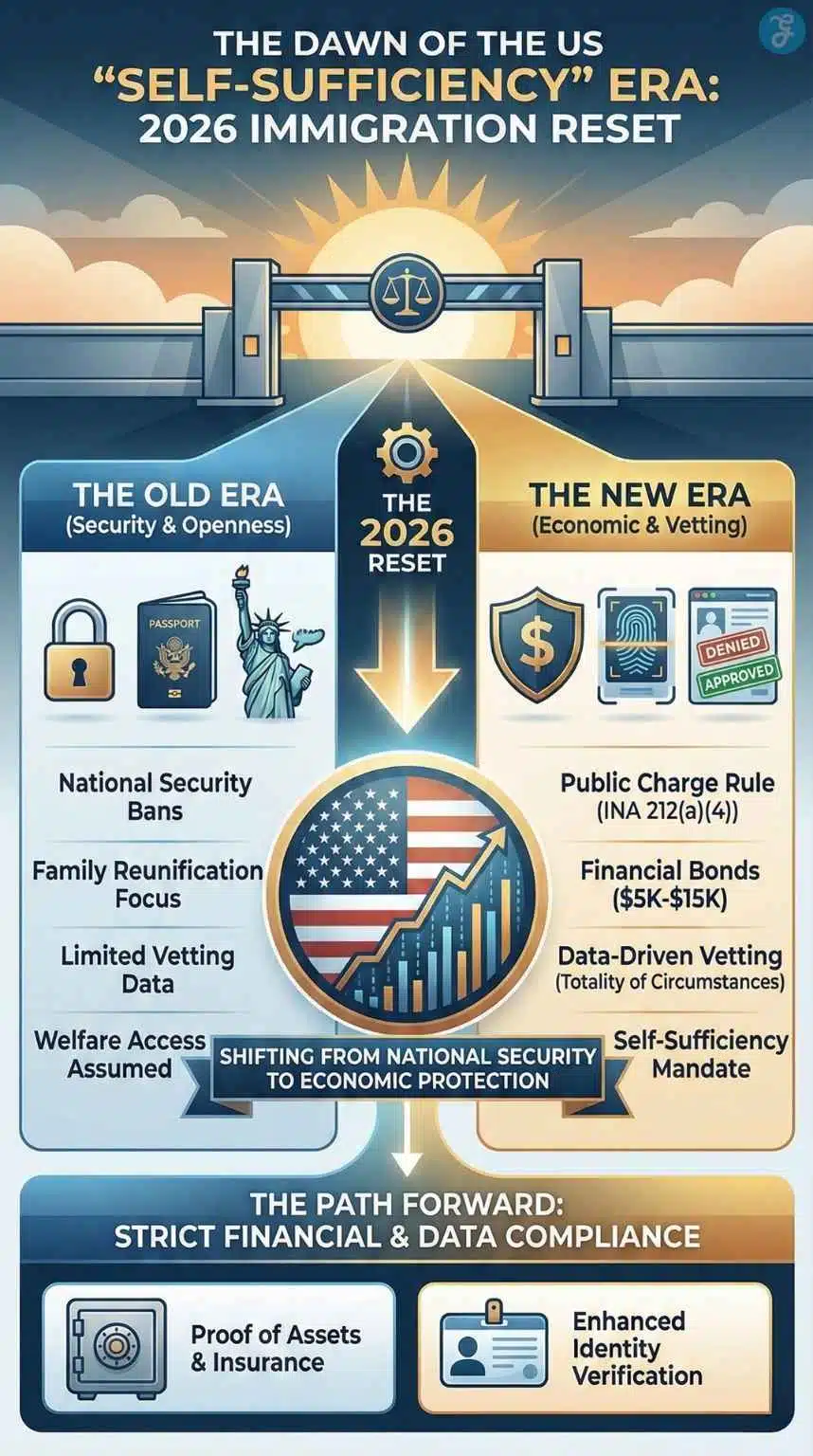
The 2026 immigration policy is governed by the principle of “American Self-Sufficiency.” Unlike previous bans that focused on counter-terrorism, the current reset is an economic mandate. The administration argues that the “Public Charge” framework, a century-old law, must be used as a blunt instrument to prevent foreign nationals from utilizing the American social safety net.
On January 14, 2026, the Department of State (DOS) announced that it would pause the issuance of immigrant visas for 75 countries deemed “high-risk” for public benefits usage. This move effectively stops all Green Card processing for these nations while a “comprehensive review” of vetting procedures is conducted.
Categorizing the Chaos: The “19” vs. The “75”
It is vital to distinguish between the two overlapping policies currently in effect.
The 19-Nation Full Ban [PP 10998]
Effective January 1, 2026, Presidential Proclamation 10998 fully suspends both immigrant and non-immigrant entry for 19 countries.
- Core Countries: Afghanistan, Burma, Burkina Faso, Chad, Republic of the Congo, Equatorial Guinea, Eritrea, Haiti, Iran, Laos, Libya, Mali, Niger, Sierra Leone, Somalia, South Sudan, Sudan, Syria, and Yemen.
- Reasoning: National security and a lack of reliable identity-management data.
The 75-Country Immigrant Visa Pause
Effective January 21, 2026, this policy pauses only Immigrant Visas for 75 countries.
- Target: Family-sponsored, employment-based, and Diversity Visa (DV) applicants.
- Exemptions: Dual nationals using a passport from a non-listed country are exempt.
Deep Dive: The “Public Charge” Rationale
The legal backbone of the 75-country pause is Section 212(a)(4) of the Immigration and Nationality Act.
The “Minnesota Trigger” and Fraud Scandals
The political momentum for this policy was accelerated by massive fraud cases in Minnesota during 2025. Investigations into the “Feeding Our Future” program and “Housing Stabilization Services” (HSS) revealed that billions in taxpayer dollars were siphoned through sophisticated networks, some with alleged ties to overseas entities. The administration used these domestic scandals to argue that certain immigrant populations are “systemically predisposed” to welfare dependency, justifying a blanket pause on their respective countries.
Total Circumstances Vetting
Consular officers are now instructed to apply a “totality of the circumstances” test, looking at:
- English Proficiency: Inability to speak English is now a “heavy negative factor.”
- Health and Age: Applicants over 60 or those with chronic conditions are facing near-automatic holds.
- Credit History: Some consulates are reportedly requesting international credit reports.
The “Minnesota Fraud” Fact-Check
While the 2026 policy is framed as a general economic safeguard, it was specifically triggered by three massive fraud investigations in Minnesota:
- The “Feeding Our Future” Expansion: Federal prosecutors discovered that a pandemic-era food program was exploited to funnel nearly $250 million to individuals with ties to East African nations.
- Housing Stabilization Services (HSS) Scam: A 2025 audit found that the HSS program, which was supposed to cost $2.6 million, ballooned to over $120 million due to “fraud tourism,” where non-residents registered as providers to loot the system.
- The Al-Shabaab Link Allegations: In late 2025, the administration alleged that a portion of these defrauded funds reached overseas militant groups. While the DOJ has not provided direct evidence in court, this “Security-Welfare Nexus” is being used as the primary legal justification for suspending immigrant visas.
The $100,000 H-1B Barrier and “Project Firewall”
While the 75-country pause targets family-based immigrants, the administration has simultaneously erected a financial wall against high-skilled workers.
- The New Fee: As of late 2025, any new H-1B petition for a worker currently outside the U.S. requires a $100,000 “Visa Integrity Fee.” This has effectively priced out small businesses and non-profits, leaving only the largest tech giants able to recruit from the 75 listed nations.
- Project Firewall: The EEOC and Department of Labor have launched “Project Firewall,” a joint enforcement initiative designed to ensure U.S.-born workers are prioritized over visa holders. In 2026, companies face intense audits if they choose to sponsor a foreign national from a “paused” country over a qualified American candidate.
The Global Impact: Regional Breakdown
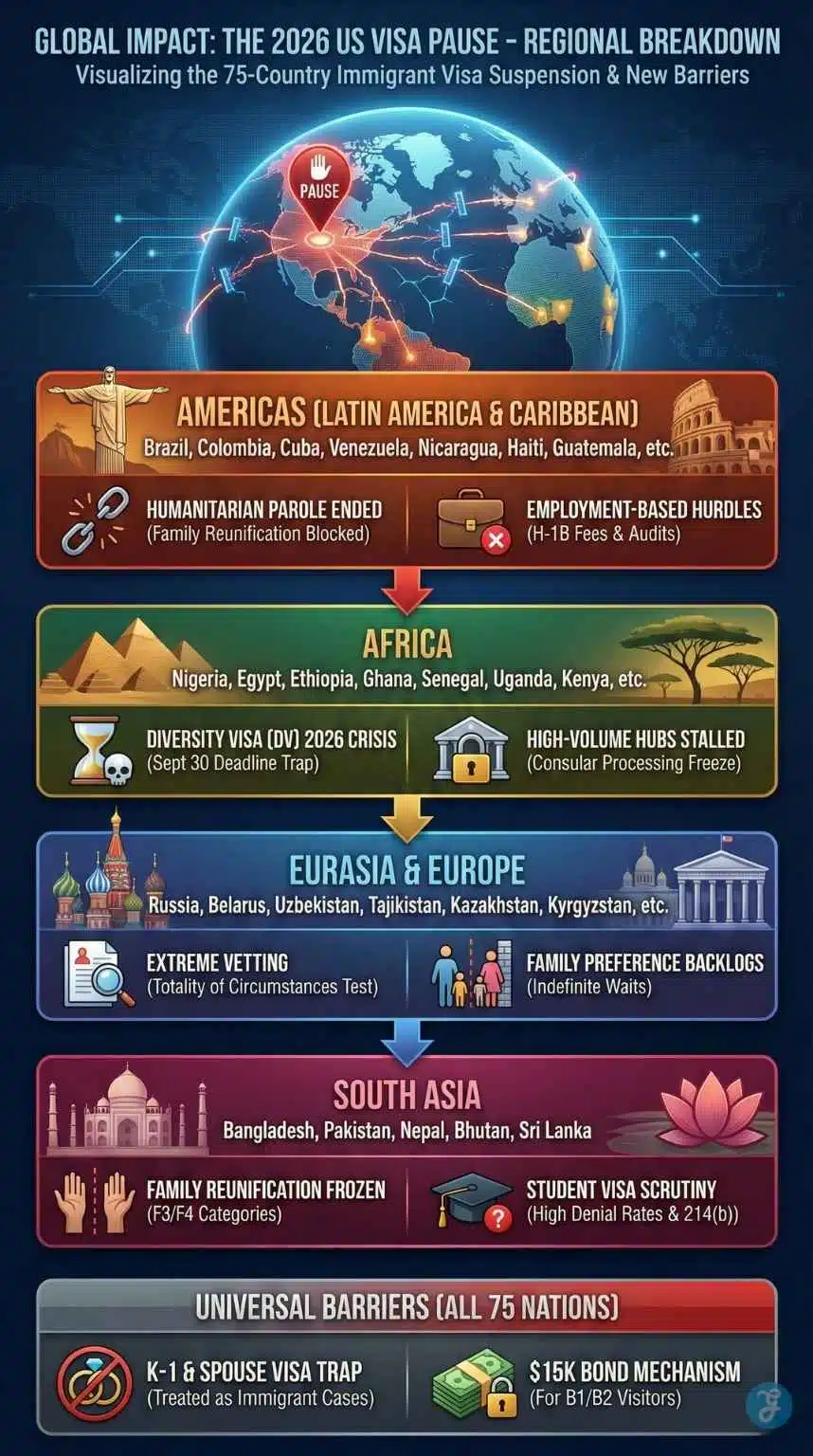
The “75-Country Pause” has geographically diverse targets.
| Region | Primary Countries Impacted |
| South Asia | Bangladesh, Pakistan, Nepal, Bhutan, Sri Lanka |
| Africa | Nigeria, Egypt, Ethiopia, Ghana, Senegal, Uganda |
| Eurasia | Russia, Belarus, Uzbekistan, Tajikistan, Kazakhstan |
| Americas | Brazil, Colombia, Cuba, Venezuela, Nicaragua |
The “K-1 and Spouse Visa” Trap
Even though the policy is framed as an “Immigrant Visa Pause,” it includes K-1 Fiancé(e) visas because they are intended for permanent residence. This has left thousands of American citizens unable to bring their partners to the U.S., with cases held in “Administrative Processing” indefinitely.
A major point of confusion has been whether family-based petitions are safe. The State Department clarified that:
- Fiancé(e) Visas (K-1): Although technically “non-immigrant,” K-1 visas are included in the pause because they lead directly to permanent residency (Green Cards).
- Immediate Relative (Spouse/Parent) Visas: These are officially paused for the 75 countries. Even if an interview is conducted, the consulate is prohibited from “printing or releasing” the visa until the review is completed.
- The “Finish Line” Hold: This policy catches applicants at the very end of their journey, meaning many who have already sold their homes or quit their jobs in anticipation of moving are now stranded.
The Humanitarian Freeze: Refugees and Parole
The 2026 Reset has not only paused visas but has nearly dismantled the U.S. humanitarian infrastructure.
- Refugee Resettlement: For Fiscal Year 2026, the administration has shifted almost the entire refugee quota to specific “aligned” groups, leaving millions of displaced persons from the 75-country list (such as Sudanese and Rohingya refugees) with zero pathway to the U.S.
- Termination of Parole: The Family Reunification Parole (FRP) programs for Colombia, El Salvador, Guatemala, and Honduras were officially terminated in January 2026. This ends the “lawful alternative” to border crossing for these nations, forcing families who were mid-process back into uncertainty.
Legal Gray Areas: “Pause” vs. “Refusal”
The 2026 Reset utilizes Section 221(g) of the INA to avoid legal challenges. By labeling the pause as “Administrative Processing,” the government avoids issuing a final “Refusal” (214b), which would give applicants more standing in court.
The Diversity Visa 2026 Crisis
For winners of the DV-2026 Lottery, this pause is a “death sentence.” Statutory law requires these visas to be issued by September 30, 2026. If the “review” of the 75 countries lasts past this date, tens of thousands of winners will lose their chance forever, as the law provides no mechanism for rollover.
If you are a national of one of the 75 countries on the “Pause” list, the next few months are critical. Following these steps can help protect your legal standing while the “Public Charge Review” continues.
- Do Not Skip Your Interview: Even though visas are not being “printed,” the State Department has explicitly stated that interviews will continue. Attending your interview is vital to ensure your file remains active. If you skip it, your case may be marked as “abandoned,” which is much harder to fix later.
- Strengthen Your Affidavit of Support (I-864): The 2026 “totality of circumstances” test is much harsher. Ensure your joint sponsor’s income is well above the federal poverty guidelines. Provide clear, recent evidence of liquid assets, such as savings accounts or stocks, rather than just property.
- The “Dual Nationality” Escape: If you hold a second passport from a country not on the 75-country list (e.g., a Bangladeshi national who also holds a British or Canadian passport), you should present that passport at your interview. Dual nationals are exempt from the pause if they use a non-listed travel document.
- For B1/B2 Travelers – Prepare for the Bond: If you are traveling for business or tourism, do not pay any “visa bond” until instructed by a consular officer. Official payments are only made through Pay.gov. Be wary of third-party scams claiming they can “guarantee” a lower bond amount.
- Adjustment of Status (AOS): If you are already inside the U.S. and are a national of a listed country, consider filing for Adjustment of Status (Form I-485) immediately. This pause primarily targets “consular processing” (applicants outside the U.S.). Applying from within the U.S. may bypass the current freeze.
The $15,000 Bond Mechanism [Form I-352]
For the 75 “at-risk” countries, the administration has implemented a tiered Public Charge Bond for temporary visitors.
- How it Works: Consular officers determine a bond amount of $5,000, $10,000, or $15,000 based on the applicant’s age, health, and income.
- The Process: Payments must be made via Pay.gov (the U.S. Treasury’s portal) and linked to DHS Form I-352.
- Refund Policy: The bond is only refundable once the individual leaves the U.S. and proves they did not utilize any “means-tested” benefits during their stay.
Litigation Status: The “January 31” Deadline
For those looking to fight the pause, the legal window is closing fast.
- The “IMMpact” Lawsuit: A coalition of immigration firms has filed a massive federal lawsuit challenging the 75-country pause. They are seeking a Preliminary Injunction to force the State Department to resume visa printing.
- Critical Deadline: Applicants have until January 31, 2026, to join the plaintiff list for the first wave of litigation. Inclusion in the lawsuit may be the only way for Diversity Visa 2026 winners to “freeze” their eligibility before the September fiscal year deadline kills their chances.
Global Retaliation and “Visa Wars”
The 2026 Reset has not gone unanswered. Nations such as Mali and Venezuela have already implemented reciprocal “Entry Taxes” and bonds for U.S. citizens. Analysts warn that this “Visa War” could severely disrupt global trade and the travel industry, specifically affecting U.S. energy companies operating in Africa and the Middle East.
The “2026 Reset” has already triggered international pushback.
- Mali’s Retaliation: In a direct “tit-for-tat” move, the government of Mali has imposed a $10,000 Visa Bond on U.S. citizens entering for tourism or business.
- The Pacific Stand: Nations like Fiji and Tonga (included in the 75-country list) have expressed diplomatic outrage, with Fiji’s Prime Minister stating that while they respect U.S. law, the “blanket punishment” harms legitimate students and seasonal workers.
The Economic Forecast: “Negative Net Migration”
For the first time in over half a century, the United States is projected to see negative net migration in 2026.
- GDP Dampening: Economic reports from January 2026 suggest that the reduction in migration will weaken consumer spending by an estimated $60–$110 billion over the next two years.
- Labor Force Contraction: With the 75-country pause and the H-1B $100,000 fee, the growth of the U.S. labor force has stalled. Industries such as healthcare and scientific research, which rely heavily on international talent, are forecasting a “innovation deficit” starting in the second half of 2026.
Final Words: A New Border for the Digital Age
The US 75-Country Immigrant Visa Pause 2026 is more than a temporary measure; it is a fundamental re-engineering of who is allowed to call America home. By shifting the burden of proof to the applicant’s financial standing and their home country’s data infrastructure, the U.S. has effectively ended the era of “open” legal immigration for a large portion of the developing world.