By 2026, the novelty of 3D printed housing has begun to settle into a practical reality. You’ve likely seen the viral videos: a robotic gantry nozzle piping out layers of concrete like gray frosting, promising a house in twenty-four hours for a fraction of the cost. But as the industry matures, the gap between the marketing hype and the on-the-ground reality is becoming clearer.
Is a 3D printed homes truly “affordable”? That depends entirely on your definition. If you are looking at the cost of the printed shell versus a stick-framed wall, the math is compelling. However, if you are looking for a “turnkey” price—meaning a home you can actually sleep in, with plumbing, windows, and a roof—the savings are more nuanced.
Similarly, “eco-friendly” is not a guaranteed label. While the reduction in construction waste is undeniable, the environmental footprint heavily depends on the material mix (specifically cement content), the home’s thermal design, and its operational energy performance.
This guide cuts through the noise to provide a clear 2026 snapshot. We will break down realistic cost ranges, perform a sustainability reality check, and help you decide if this construction method aligns with your budget and values today.
Where 3D-Printed Housing Actually Stands
The industry has moved beyond the “experimental prototype” phase into early mass adoption. However, it is crucial to understand what you are actually buying when you sign a contract for a 3D printed home in 2026.
What “3D printed home” usually means in 2026
When we talk about a 3D printed house, we are almost never talking about a structure that is 100% printed from foundation to chimney. In 2026, a “3D printed home” typically refers to a hybrid construction model.
The printed portion is the vertical wall system—the interior and exterior shells. This replaces the wood framing, drywall, and siding of a traditional build. However, the rest of the home relies on conventional construction methods. The foundation is usually a standard slab; the roof is trussed and shingled by human carpenters; windows, doors, plumbing (MEP), and electrical wiring are installed by licensed tradespeople just as they would be in a wood-framed house. Understanding this distinction is vital to managing cost expectations.
What changed recently (scale + communities)
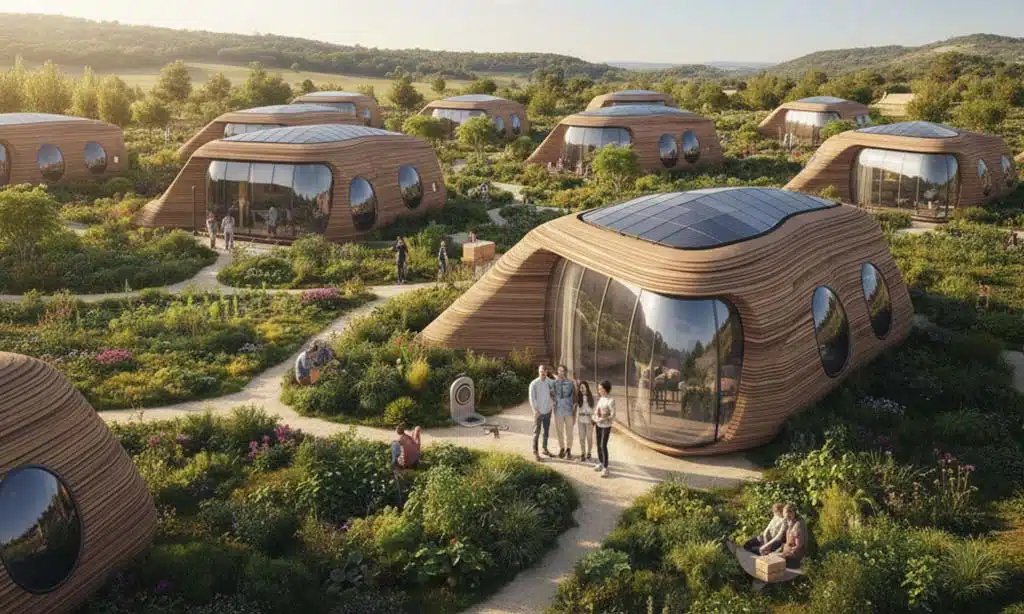
The biggest shift from 2024 to 2026 has been the move from single, novelty Accessory Dwelling Units (ADUs) to neighborhood-scale developments. We are now seeing entire subdivisions where the robotic printers move from lot to lot, creating efficiencies of scale.
This “fleet” approach has allowed developers to offer a wider range of price points. It is no longer just about luxury desert retreats or subsidized affordable housing pilots; there is now a “middle market” emerging. By standardizing designs and printing multiple units in sequence, builders have streamlined the logistics that previously kept costs high, making the technology viable for a broader segment of homebuyers.
Are 3D Printed Homes Affordable in 2026?
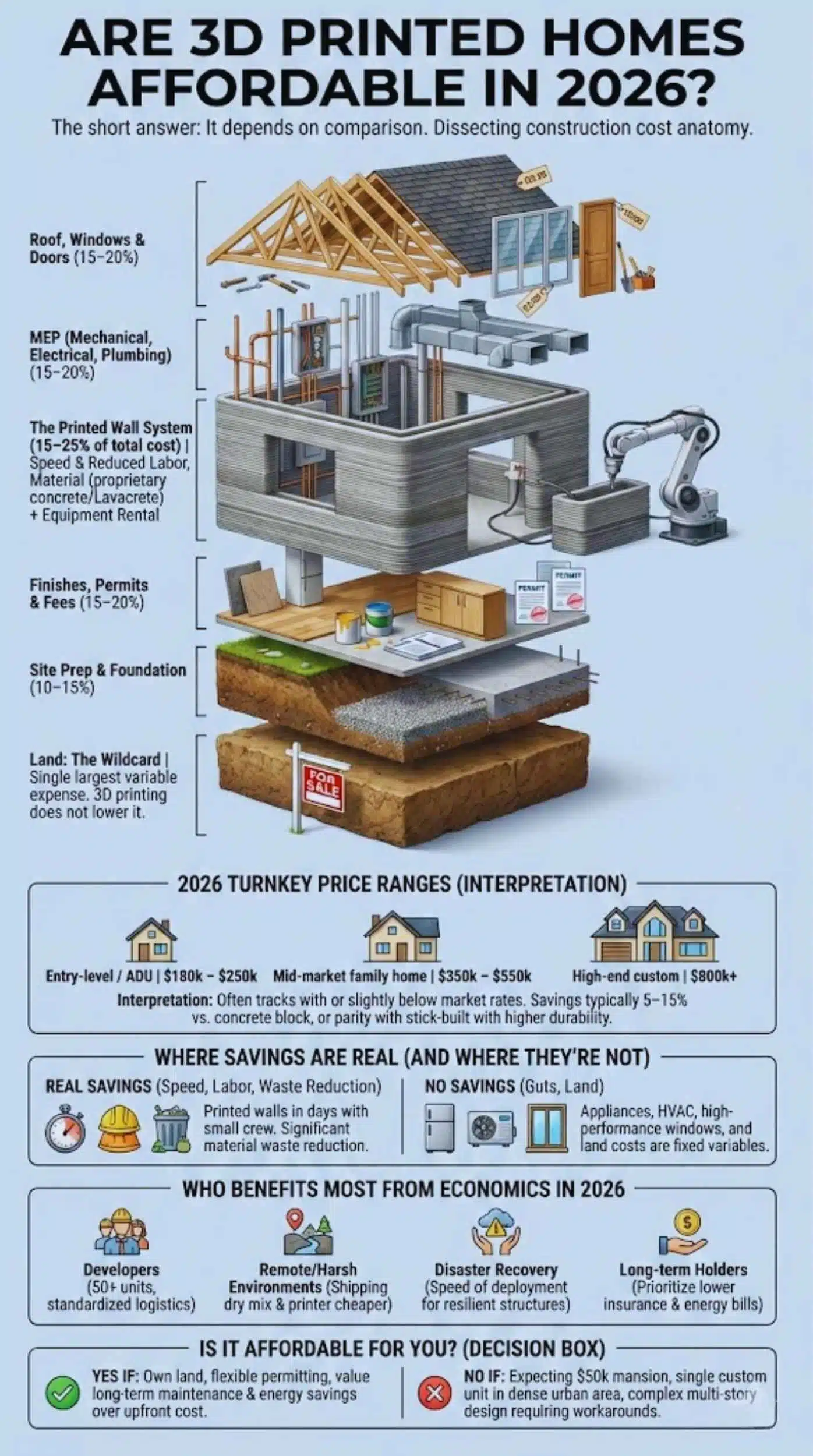
The short answer is: “It depends on what you are comparing it to.” To understand affordability, we must dissect the anatomy of construction costs.
Real cost components (shell vs fully finished vs land)
To see where the savings lie, you have to look at the budget breakdown. A typical cost framework for a 3D printed home looks like this:
- The Printed Wall System (15–25% of total cost): This is the “3D printed” portion. It covers the material (proprietary concrete mixes or Lavacrete) and the equipment rental/operation. This is where the technology shines, offering speed and reduced labor.
- Site Prep & Foundation (10–15%): Excavation, grading, and pouring the slab. This cost is virtually identical to traditional construction.
- Roof, Windows & Doors (15–20%): Standard materials and labor. No cost advantage here.
- MEP (Mechanical, Electrical, Plumbing) (15–20%): These systems must be integrated into the printed walls. While design advancements have made this smoother, the cost of copper, PVC, and skilled labor remains market rate.
- Finishes, Permits & Fees (15–20%): Cabinetry, flooring, painting, and local impact fees.
- Land: The wildcard. In many markets, land acquisition is the single largest expense, and 3D printing does nothing to lower it.
2026 price ranges you can cite (and how to interpret them)
In 2026, we generally see turnkey prices for 3D printed homes ranging widely based on location.
- Entry-level / ADU: $180,000 – $250,000 (depending heavily on permitting fees and size).
- Mid-market family home (1,500–2,000 sq ft): $350,000 – $550,000.
- High-end custom: $800,000+.
Interpretation: These numbers often track closely with, or slightly below, market rates for new construction in the same area. The “50% cheaper” claims of the past have largely been debunked for fully finished homes. Instead, look for savings in the 5–15% range compared to equivalent concrete block construction, or parity with stick-built homes but with higher durability.
Where savings are real (and where they’re not)
- Real Savings: The biggest financial wins come from speed and labor reduction. A printer can build the wall system in days with a crew of three, whereas framing requires a larger crew for weeks. There is also a significant reduction in material waste (no cut-off lumber studs or drywall scraps).
- No Savings: You do not save money on the “guts” of the house. Appliances, HVAC units, high-performance windows, and land costs are fixed market variables. If land in your area is expensive, a cheaper wall system won’t drastically change your mortgage.
Who benefits most from the economics in 2026
The economics favor specific scenarios:
- Developers: Those building 50+ units benefit massively from the speed and standardized logistics.
- Remote/Harsh Environments: In areas where shipping lumber is expensive or labor is scarce, the logistics of shipping dry mix and a printer can be cheaper.
- Disaster Recovery: The speed of deployment for resilient structures makes this ideal for rebuilding after fires or hurricanes.
- Long-term Holders: Buyers who prioritize lower insurance premiums and energy bills (durability/efficiency) over upfront rock-bottom prices.
Is it Affordable for YOU?
- YES IF: You own the land already, permitting in your area is flexible, and you value long-term savings on maintenance and energy over immediate upfront dirt-cheap pricing.
- NO IF: You are expecting a $50,000 turnkey mansion, you are building a single custom unit in a dense urban center with strict aesthetic zoning, or you need a complex, multi-story design that requires expensive structural engineering workarounds.
Are 3D Printed Homes Really Eco-Friendly?
Sustainability is often touted as a primary benefit, but it requires a closer look at the materials used.
The biggest sustainability win: construction waste + precision
Traditional wood framing is a “subtractive” process in many ways—you cut lumber to size and throw away the ends. You cut drywall and bin the scraps. Construction and demolition waste is a massive global issue.
3D printing is an additive process. You only use the material you need. The printer deposits concrete exactly where the digital file dictates, resulting in near-zero waste for the structural shell. This precision is a genuine, verified environmental win.
The biggest sustainability concern: cement/embodied carbon
The elephant in the room is cement. Most 3D printing “inks” are cementitious mortars. Cement production is responsible for roughly 8% of global CO2 emissions. If a 3D printed home uses significantly more cement than a concrete-block home to achieve structural stability, its “embodied carbon” (the carbon footprint of making the building) can be high.
However, 2026 has seen progress. We are seeing “lower-cement” mixes that utilize fly ash, slag, or other supplementary cementitious materials (SCMs) to offset carbon. Emerging “cement-free” geopolymer mixes are also entering the market, though they remain more expensive.
What a fair comparison looks like (LCA basics)
To honestly evaluate eco-friendliness, you need a Life Cycle Assessment (LCA). This measures impact from “cradle to gate” (manufacturing) and “gate to grave” (disposal).
- The Check: While the material (concrete) has higher embodied carbon per pound than wood, the efficiency (using less of it) and the longevity (it lasts longer) help balance the equation.
- The Trend: Recent LCAs suggest that while a printed wall may have higher initial carbon than a timber wall, the gap closes when you factor in the lack of drywall, siding, and insulation materials needed in traditional builds.
Operational efficiency: insulation, thermal mass, airtightness
A home’s eco-footprint isn’t just about how it was built, but how it runs. 3D printed walls offer high thermal mass, meaning they hold temperature well, smoothing out spikes in heat and cold.
- Insulation: Most printed walls are double-walled with a cavity in the middle. If this cavity is filled with high-performance foam or cellulose insulation, the R-value can exceed improved code standards.
- Airtightness: Because the walls are printed as a continuous bead, they are inherently airtight, reducing drafts and lowering HVAC loads.
Eco Scorecard
- Waste: A+ (Excellent reduction)
- Embodied Carbon: C to B- (improving, but cement is still heavy)
- Operational Energy: A- (High potential for efficiency)
- Durability: A (Long lifespan equals less rebuilding)
Durability, Safety, and Code Compliance in 2026
How long do 3D printed homes last?
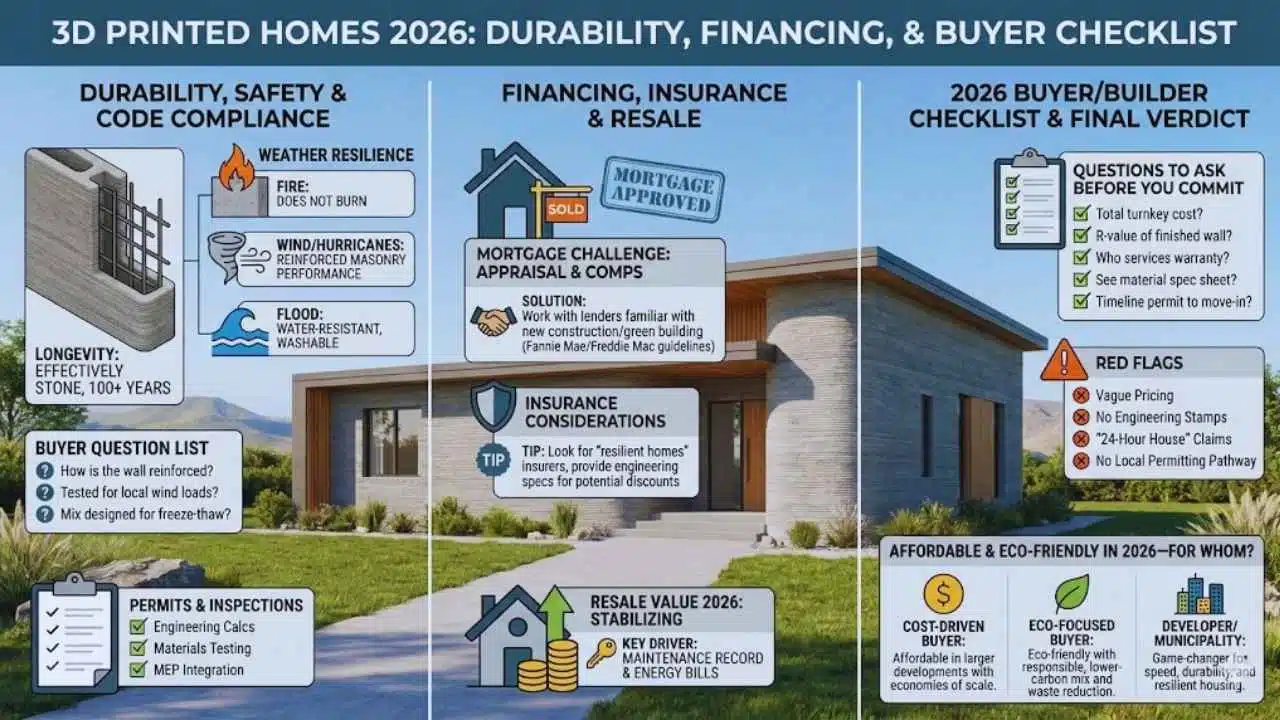
The printed portion of these homes is effectively stone. Unlike wood, it does not rot, it does not get eaten by termites, and it does not mold when wet. While wood-framed homes have a design life of 50–70 years, a well-maintained concrete shell can theoretically last over a century. The longevity depends on the mix quality and proper reinforcement, but the material science suggests superior durability.
Weather resilience (wind, flood, fire, seismic)
In an era of increasing climate instability, this is a major selling point.
- Fire: Concrete does not burn. For areas prone to wildfires, a printed exterior offers a layer of defense wood siding cannot match.
- Wind/Hurricanes: Reinforced masonry walls are the gold standard for high-wind zones. 3D printed walls, when reinforced with rebar, perform similarly.
- Flood: Concrete is water-resistant. After a flood, a printed wall can often be washed down and repainted, whereas drywall and studs must be ripped out.
Buyer Question List
- How is the wall reinforced? (Rebar, mesh, or fiber?)
- Has the wall system been tested for local wind loads?
- Is the concrete mix designed to resist freeze-thaw cycles?
Permits + inspections: what typically gets reviewed
By 2026, most major municipalities have incorporated 3D printing into their building codes (often under “cementitious 3D printed construction” appendices). Inspectors focus on:
- Engineering Calcs: Proof that the unique wall geometry can bear the roof load.
- Materials Testing: Cylinder tests of the wet mix to ensure it cures to the required PSI strength.
- MEP Integration: Ensuring electrical and plumbing runs meet standard safety codes.
Financing, Insurance, and Resale: The “Can I Actually Buy One?” Section
Can you get a mortgage for a 3D printed home?
Yes, but it requires the right partner. The challenge for lenders is the “appraisal.” Appraisers rely on “comparables” (comps)—recent sales of similar homes nearby. If you are the first printed home in town, there are no comps.
- Solution: Work with lenders familiar with new construction or green building. Fannie Mae and Freddie Mac have guidelines for “innovative construction,” but you may need to provide extra documentation from the builder.
Insurance considerations
Insurers generally like concrete. It is lower risk for fire and wind. However, because the repair process for a proprietary printed wall is specialized (you can’t just hire a handyman to patch it), some underwriters may be hesitant.
- Tip: Look for insurers who specialize in “resilient homes” and provide them with the engineering specs showing the fire and wind ratings. You may actually qualify for discounts due to the durability.
Resale value in 2026
Resale value is stabilizing. Early on, “weird” aesthetics hurt resale. Now that designs are more sophisticated (blending printed textures with warm wood and glass), the “curb appeal” penalty is vanishing.
- Key Driver: The maintenance record. A home that has stood for 5 years with zero cracks and low energy bills will command a premium over a 5-year-old stick-built home showing signs of wear.
2026 Buyer/Builder Checklist (Practical, Skimmable)
Questions to ask before you commit
- “What is the total turnkey cost?” (Do not accept the “wall cost” as the answer.)
- “What is the R-value of the finished wall assembly?” (Ensure it meets or exceeds local energy codes.)
- “Who services the warranty?” (If the printer company folds, who fixes a structural crack?)
- “Can I see the material spec sheet?” (Look for the cement content and strength rating.)
- “What is the timeline from permit to move-in?” (Printing is fast; permitting and finishing take normal time.)
Red flags
- Vague Pricing: “Starting at…” prices that don’t specify if that includes the foundation or roof.
- No Engineering Stamps: If they can’t show you stamped plans for your specific state/county, walk away.
- “24-Hour House” Claims: If they promise you’ll move in 24 hours after they start printing, they are lying. The walls take 24 hours; the house takes months.
- No Local Permitting Pathway: If they say, “We’ll figure out the permits later,” you are the guinea pig.
Affordable and Eco-Friendly in 2026—For Whom?
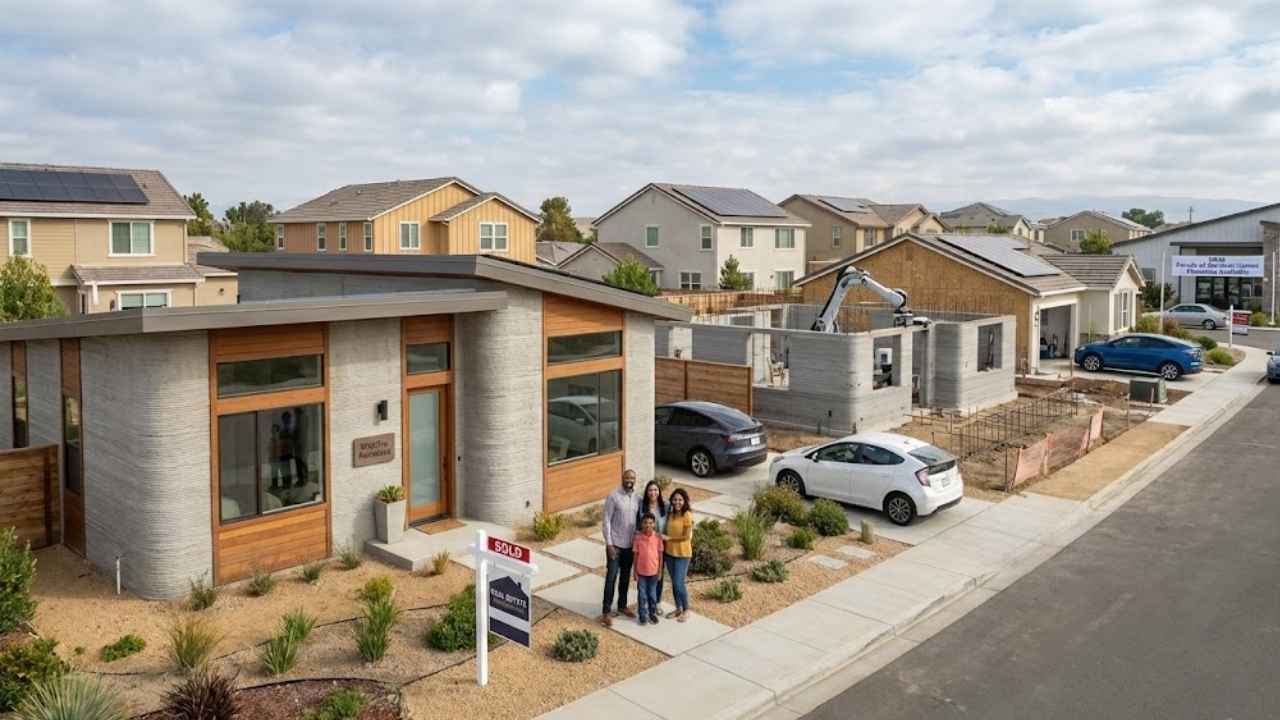
As we move through 2026, the 3D printed home is neither a miracle cure for the housing crisis nor a sci-fi gimmick. It is a maturing construction methodology with specific strengths.
- For the Cost-Driven Buyer: It is affordable if you are buying into a larger development where economies of scale are in play. If you are building a single custom home, do not expect it to be cheaper than traditional methods yet.
- For the Eco-Focused Buyer: It is eco-friendly if you prioritize waste reduction and long-term energy efficiency, and if the builder uses a responsible, lower-carbon concrete mix.
- For the Developer/Municipality: It is a game-changer for speed and durability, offering a way to build resilient housing stocks that can weather the storms of the future.
Final Thoughts
Ultimately, the true success of 3D printed housing in 2026 is that it is becoming boring. The viral videos of robotic arms are exciting, but the reality of living in one of these homes is surprisingly normal—and that is a good thing.
Once the walls are painted and the furniture is moved in, the “futuristic” aspect fades into the background. You aren’t living in a science experiment; you are living in a house that happens to be quieter, sturdier, and more energy-efficient than the one next door.
The revolution isn’t just about cheaper construction; it’s about raising the baseline for what we expect from our shelter. If 2026 is the year the technology matured, the next decade will be the era where we stop asking “How was this built?” and start enjoying the comfort of a home that was built to last.