Hypersonic missile escalation 2026 has officially transitioned from a theoretical defense concern to a kinetic reality on the European Union’s doorstep, following a series of high-velocity strikes that have redefined the boundaries of modern warfare.
Now, the global security landscape is grappling with the confirmation of Russia’s deployment of the Oreshnik hypersonic system, a weapon that struck just 60 kilometers from the Polish border, and a parallel, catastrophic escalation in the Red Sea that has left the international maritime community in a state of high alert.
While headlines initially swirled with rumors of a direct “hypersonic” hit on an EU naval vessel, a deeper dive into current military intelligence reveals a more complex and perhaps more dangerous truth: the convergence of state-actor hypersonic technology with non-state asymmetric warfare.
Key Takeaways: 2026 Hypersonic Escalation
- Verified Hypersonic Strike: On January 9–10, 2026, Russia launched an Oreshnik missile at Lviv, striking just 60km from the Polish border, the closest hypersonic event to EU/NATO territory to date.
- Naval Strike Disinformation: Reports of an EU/US naval vessel being sunk by a hypersonic strike in the Red Sea have been debunked as disinformation using Arma 3 simulation footage.
- Red Sea Sinking: The bulk carrier Magic Seas was sunk on January 7, 2026, but through kinetic saturation (drones/cruise missiles) rather than a hypersonic weapon.
- The “Zero-Reaction” Window: Mach 10 speeds reduce detection-to-impact time to less than 25 seconds, rendering traditional human-operated naval defenses largely ineffective.
- EU Defensive Pivot: The EU has accelerated the Aster 30 Block 1NT interceptor program and extended Operation Aspides to counter the rising threat of maneuvering hypersonic glide vehicles.
The Oreshnik Factor: Hypersonic Strike on the EU’s Edge
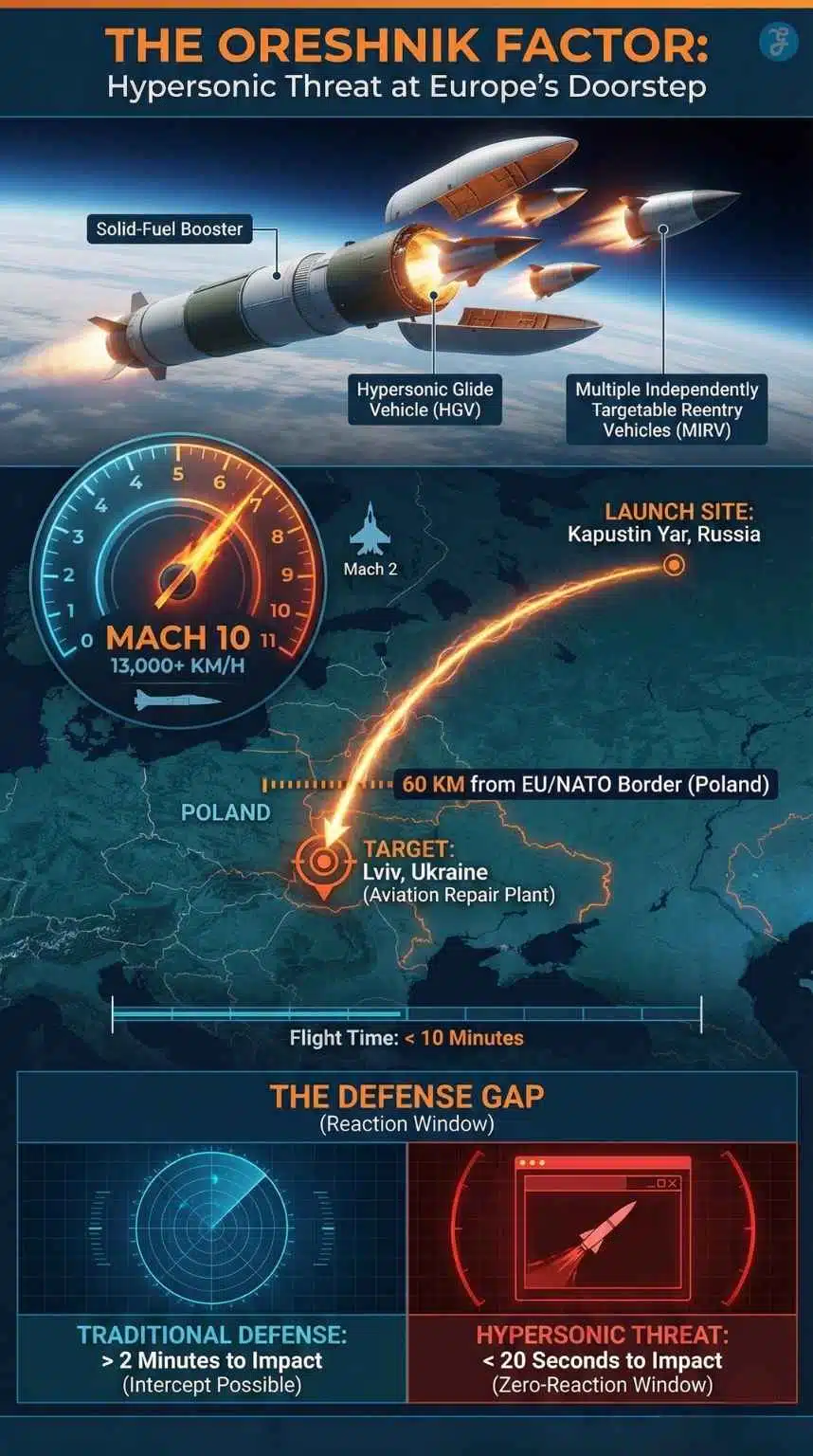
On the night of January 9, 2026, the paradigm of European air defense was shattered. Russia launched a coordinated assault involving over 240 drones and 36 missiles, the centerpiece of which was the Oreshnik, an intermediate-range ballistic missile (IRBM) capable of reaching speeds of Mach 10 (approximately 13,000 km/h).
Target Analysis: The Lviv Strike
The primary target was the Lviv State Aircraft Repair Plant, located in Western Ukraine. The significance of this location cannot be overstated; it sits a mere 60 kilometers from the border of Poland, a key EU and NATO member state.
- Impact Speed: The missile followed a ballistic trajectory at such high velocity that traditional early warning systems in the region provided less than two minutes of usable alert time.
- Destructive Power: Despite carrying a conventional warhead, the kinetic energy generated by the Oreshnik’s descent reportedly pierced through multiple levels of reinforced concrete, destroying critical aviation archives and repair infrastructure meant for Soviet-era MiG-29s and newly arrived Western F-16s.
The Signal to Brussels
Lviv Mayor Andriy Sadovyi described the attack as “unprecedented,” noting that it was a “clear signal to international partners that the war knows no borders.” By striking so close to Polish territory with a weapon that current EU interceptors cannot reliably stop, the Kremlin has successfully created a “capability gap” that EU leaders are now scrambling to fill.
The “Oreshnik” Anatomy: A Technical Warning to NATO
To understand why the hypersonic missile escalation 2026 is causing panic in Brussels, one must look at the physics of the Oreshnik. Intelligence confirms this is a solid-fueled, intermediate-range ballistic missile (IRBM) derived from the RS-26 Rubezh. Unlike traditional missiles, it utilizes a Multiple Independently Targetable Reentry Vehicle (MIRV) system, a technology previously reserved for nuclear-tipped ICBMs.
- Atmospheric Re-entry: The missile re-enters the atmosphere at speeds exceeding 13,000 km/h.
- The Kinetic Impact: In the Lviv strike, the warheads were reportedly “inert” or dummy loads. However, at Mach 10, the sheer kinetic energy of a 500kg mass is equivalent to several tons of TNT.
- The “Shadow” Trajectory: The Oreshnik’s flight path is flatter than a standard ballistic arc, staying within the upper atmosphere to exploit the “blind spots” of existing Aegis and Patriot radar arrays, which are optimized for higher-altitude interceptions.
Red Sea Chaos: The Sinking of the Magic Seas
Simultaneously, the Red Sea corridor, one of the world’s most vital trade arteries, has seen its most violent week since the shipping crisis began in late 2023. On January 7, 2026, the Greek-operated bulk carrier Magic Seas was systematically targeted and sunk by Houthi forces off the coast of Yemen.
The Anatomy of a Modern Ambush
The attack on the Magic Seas was not a single missile strike but a sophisticated, multi-domain swarm:
- Phase 1: Skiffs carrying gunmen engaged the vessel with small arms and RPGs to suppress the onboard armed security team.
- Phase 2: Four Unmanned Surface Vehicles (USVs), explosive-laden drone boats, were launched. While security teams destroyed two, the remaining two struck the port side.
- Phase 3: Anti-ship cruise missiles were fired to finalize the destruction of the engine room.
The crew was fortunately rescued by a passing merchant vessel, but the sinking of a vessel of this size (transporting iron and fertilizer) has caused a resurgence in maritime insurance premiums and forced a renewed 40% diversion of global shipping around the Cape of Good Hope.
Swarm Integration: The Real Red Sea Threat
The sinking of the Magic Seas on January 7, 2026, revealed a terrifying evolution in Houthi tactics: Kinetic Saturation. While the “hypersonic” label was widely used in viral social media posts, the vessel was actually lost to a “Multi-Domain Swarm.”
- Electronic Suppression: Houthi units used ground-based jammers to disrupt the Magic Seas’ AIS and GPS signals.
- The USV “First Wave”: Four low-profile, GPS-guided Unmanned Surface Vehicles (USVs) struck the waterline.
- The Cleanup Crew: Only after the ship was dead in the water were the anti-ship cruise missiles fired.
This proves that even without hypersonic missiles, the hypersonic missile escalation 2026 narrative is fueled by the fact that Western navies are being “saturated”, forced to spend millions on interceptors against thousands of dollars in drones.
Technical Deep-Dive: The “Zero-Reaction Window” Defense Crisis
The core of the hypersonic missile escalation 2026 lies in the physics of interception. Traditional naval defense systems, like the Aegis or the EU’s PAAMS, were designed to track and kill targets moving on predictable arcs or at subsonic/supersonic speeds.
The Interception Challenge
Hypersonic weapons like the Oreshnik or the rumored Iranian Fattah-1 (which intelligence suggests may soon reach Houthi hands) present three unique challenges:
- Maneuverability: Unlike a standard ballistic missile that follows a predictable “parabola,” hypersonic glide vehicles can change course mid-flight, making it impossible for computers to calculate an intercept point until it is too late.
- Plasma Shielding: At Mach 5+, air becomes ionized, creating a “plasma sheath” around the missile that can absorb radar waves, rendering the weapon partially “stealth” during its most critical flight phase.
- Reaction Time: From the moment a hypersonic missile clears the horizon to the moment of impact is often less than 20 seconds for a naval vessel. Human decision-making is simply too slow to manage such an engagement.
Technical Breakdown of the Interception Window
| Missile Type | Speed | Reaction Time (Detection to Impact) | Defense Status |
| Subsonic (Shahed) | 185 km/h | 15–20 Minutes | 99% Effective |
| Supersonic (Onyx) | 3,000 km/h | 2–3 Minutes | 70% Effective |
| Hypersonic (Oreshnik/Fattah) | 12,000+ km/h | < 25 Seconds | Experimental/Untested |
European Response: The “Unified Shield” and Aster 30 B1NT
In response to these threats, the EU has accelerated its “Strategic Compass” for defense. The Aster 30 Block 1NT (B1NT) is now being prioritized for deployment across French and Italian naval platforms.
The Counter-Hypersonic Toolkit
| Technology | Function | Status in 2026 |
| Aster 30 B1NT | High-altitude interceptor with Ka-band seeker for improved “hit-to-kill” accuracy. | Accelerated production; first units deployed Jan 2026. |
| SAMP/T NG | Ground-based “Next Gen” air defense system capable of tracking Mach 10 targets. | Deployed to protect major EU capitals. |
| Autonomous AI Intercept | Removing the “Human in the Loop” to allow computer-speed reactions to incoming strikes. | Under testing by EU defense agencies. |
An often-overlooked aspect of this escalation is the role of digital psychological operations. On January 13, 2026, videos began circulating on social media claiming to show a “Russian-Iranian hypersonic strike” sinking an EU frigate.
The hypersonic missile escalation of 2026 is as much about perception as it is about physics. These videos were quickly debunked as footage from the military simulator Arma 3, but not before causing a temporary 3% spike in global oil prices. For analysts, the challenge is now distinguishing between a “kinetic hit” and a “digital hallucination” intended to disrupt global markets.
Strategic Outlook: A New Doctrine for a High-Velocity World

As we move deeper into 2026, the “First Hypersonic Strike” near the EU’s borders has proven that the age of traditional deterrence is fading. To maintain security in the Red Sea and on the European continent, three shifts must occur:
- Investment in Speed: EU nations must move beyond subsonic cruise missiles and invest heavily in their own hypersonic deterrents and interceptors.
- AI Integration: Defensive systems must be granted higher levels of autonomy to handle Mach 10+ threats.
- Cross-Border Defense: The security of Lviv is now functionally the security of Warsaw and Berlin. The hypersonic missile escalation of 2026 has erased the luxury of “buffer zones.”
The sinking of the Magic Seas and the roar of the Oreshnik are two sides of the same coin: a global shift toward high-velocity, high-stakes warfare. The European Union and its allies must now adapt at the speed of sound—or risk being left in the wake of a weapon they cannot see coming.
The UN Security Council Flashpoint
On January 13, 2026, the UN Security Council held an emergency session following the Lviv strike. US Deputy Ambassador Tammy Bruce officially labeled the use of the Oreshnik a “dangerous and inexplicable escalation.” This international diplomatic friction is a key component of your analysis:
- Russia’s Stance: Moscow claims the strike was a “retaliation” for a denied drone attempt on a presidential residence.
- The EU’s Response: Foreign Policy Chief Kaja Kallas has used this event to demand a “Unified European Shield,” pushing for the immediate acceleration of the Aster 30 Block 1NT program, which is the only European interceptor designed to handle maneuvering hypersonic targets.
Final Thought: The Geopolitics of Speed
The hypersonic missile escalation of 2026 is not just a military milestone; it is a political ultimatum. From the impact site in Lviv to the burning hull of the Magic Seas, the message is clear: the era of slow-motion diplomacy is over.
If the EU naval vessels are to survive the “first confirmed hypersonic era,” they must move beyond being “shields” and become part of a proactive, integrated defense network that spans from the Baltic to the Bab-el-Mandeb.