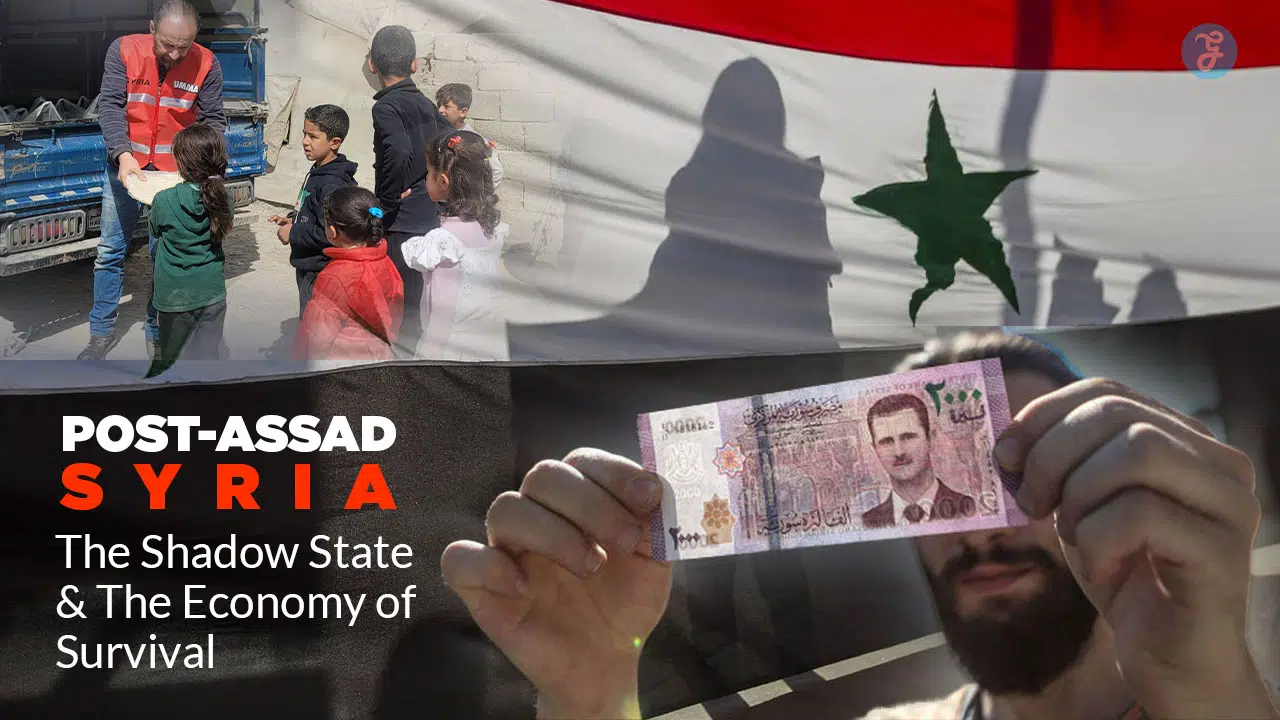
By April 2025, the smoke over Damascus had cleared. The technicals mounting heavy machine guns had largely retreated from the city center, replaced by the newly uniformed “Internal Security Forces.” To the outside observer, the “Second Syrian Republic” appeared to be stabilizing.
The checkpoints that had strangled the capital for a decade were dismantled, and for the first time in years, the highway between Aleppo and Damascus was open to civilian traffic. There was a palpable, desperate desire among the population to believe that the worst was over, that the “Transition” was real.
However, beneath this veneer of normalcy, the Post-Assad Syria Shadow state was being hollowed out. The Ba’athist party apparatus, which had functioned as the nervous system of the country for fifty years, was gone. In its place, a new nervous system was being grafted onto the state’s body, one grown in the laboratories of Idlib. The government ministries were open, the lights were on, but the decisions were being made elsewhere. This was the “Honeycomb State”: a structure that looked solid from the outside but was filled with holes, parallel institutions, and hidden pockets of power.
Key Takeaways
- The Advisor System: The real power in Damascus lies not with the ministers, but with the “Shadow Advisors” from the Idlib-based Salvation Government.
- Economic Apartheid: The country is economically split between a Turkish Lira zone (North) and a dying Syrian Pound zone (South), fueling inflation and smuggling.
- The Airport Scandal: The awarding of major reconstruction contracts to SEC-front companies proved that corruption didn’t end with Assad; it just changed beneficiaries.
- Justice Denied: The halting of the Missing Persons investigation to protect current government figures proved that the new regime chooses stability over accountability.
The Great Disappointment: From Liberation to Stagnation
The turning point came in the sweltering summer of 2025. The euphoria of the “Damascus Dash” had evaporated, replaced by a grinding reality known locally as Al-Khayba (The Disappointment). The average Syrian, having survived the barrel bombs and the chemical attacks, now faced a new enemy: a predatory bureaucracy that combined the corruption of the old regime with the ideological rigidity of the new rulers.
This second part of our analysis covers the critical six-month period from April to October 2025. It documents how the “Technocratic Government” became a mask for a “Shadow State” run by former Salvation Government (SSG) cadres. It explores the silent economic war between the Turkish Lira-dominated north and the Syrian Pound-dominated south, and it exposes the grim reality of a justice system that promised to find the missing but ended up creating new ones.
The Architecture of the Shadow State
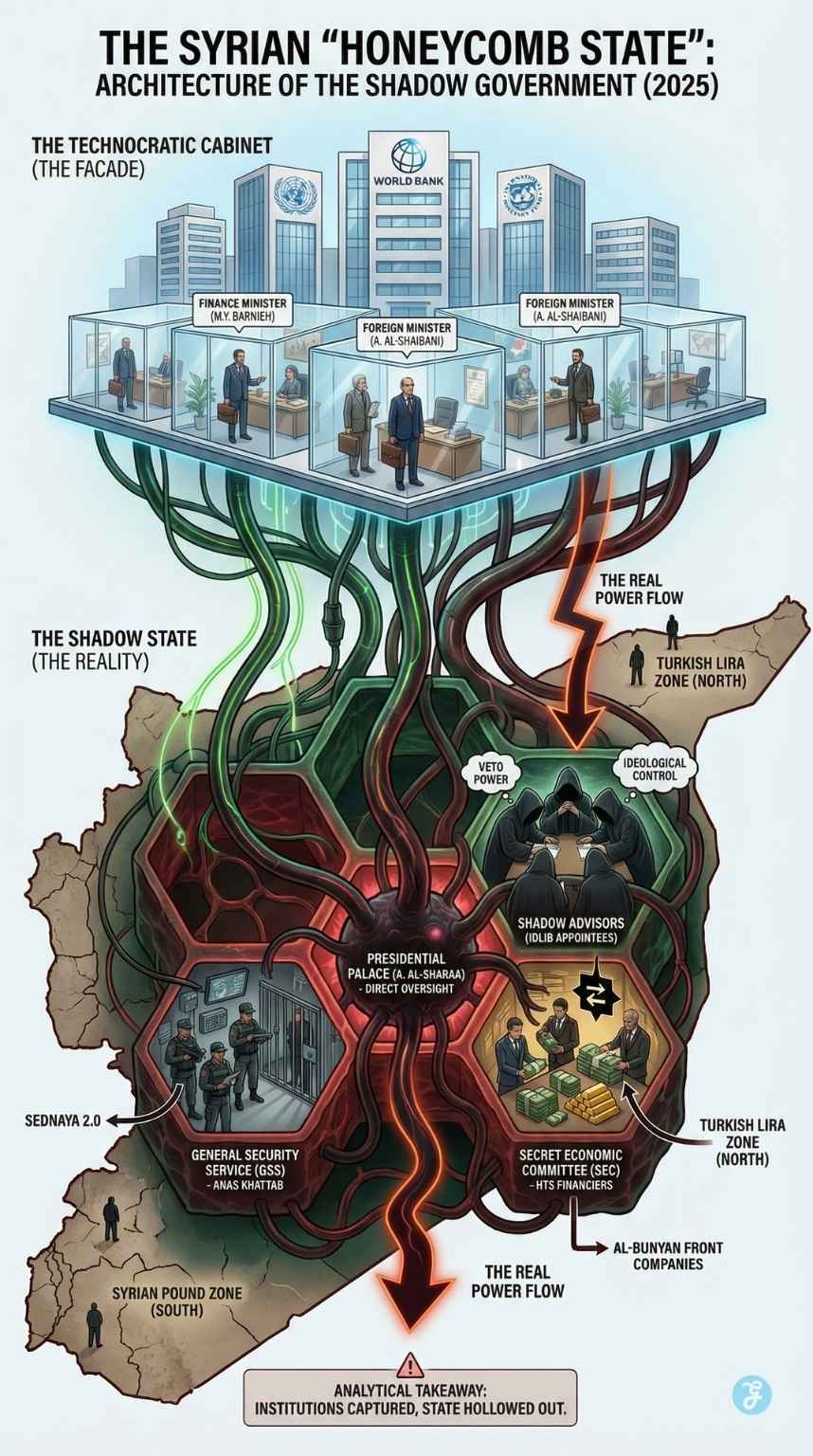
When President Ahmed al-Sharaa abolished the position of Prime Minister in March 2025, he claimed it was to “streamline decision-making.” In reality, it was the first step in institutionalizing the “Shadow State.” The governance model applied to Damascus was a direct copy-paste of the system Sharaa had perfected in Idlib, but scaled up to a national level.
The “Advisor” System
The official cabinet, filled with Western-educated technocrats like Finance Minister Mohammed Yisr Barnieh, was the face presented to the IMF and the European Union. However, inside every ministry, a parallel power structure existed.
- The Mechanism: Every technocratic minister was assigned a “Senior Advisor” (Mustashar Awwal) appointed directly by the Presidential Palace. These advisors were almost exclusively veterans of the Syrian Salvation Government (SSG)—the administrative wing of HTS in Idlib.
- The Reality: In the Ministry of Education, for example, the Minister could not sign off on a new university curriculum without the countersignature of his “Advisor,” a hardline cleric who ensured the content aligned with “conservative values.” This created a bureaucratic paralysis where the official minister held the title, but the “Shadow Advisor” held the stamp.
The “General Security Service” (GSS) Expansion
The most feared institution of the new era is the General Security Service (GSS). Originally the internal police force of Idlib, the GSS effectively swallowed the remnants of the four Ba’athist intelligence agencies. Under Interior Minister Anas Khattab, the GSS established a monopoly on violence. Unlike the chaotic militias of 2013, the GSS is disciplined, uniformed, and terrifyingly efficient.
By mid-2025, they had established a surveillance network in Damascus that rivaled the old Mukhabarat. Their mandate was ostensibly to hunt down “Assadist sleeper cells,” but by July, their target list had expanded to include secular activists, labor organizers, and critics of the Sharaa family.
Two Cities, One Capital: The Culture War
The friction between the “Conquerors” (the rural, conservative fighters from the north) and the “Conquered” (the urban, relatively liberal population of Damascus and the Coast) defined the social atmosphere of 2025.
The “Idlibification” of Damascus
Damascus has always prided itself on being the “beating heart of Arabism”—a cosmopolitan blend of sects and lifestyles. The arrival of the Idlib elite shattered this identity.
- Moral Policing: While there were no official laws banning alcohol or enforcing hijabs in the constitution, the pressure was exerted informally. Restaurants in the historic Bab Touma district found their liquor licenses “delayed” indefinitely. University students reported being stopped by GSS patrols for “immodest mingling.”
- The Friday Sermon: The symbolic takeover occurred in the Umayyad Mosque. The traditional Damascene clergy, known for their moderate Sufi leanings, were gradually sidelined. In their place, firebrand preachers from the north began delivering sermons that railed against “Western decadence” and “secular heresy.”
The Coastal Alienation
If Damascus was uncomfortable, the Alawite coast was terrified. The “Shadow State” treated Latakia and Tartus not as liberated territories, but as occupied zones.
- The “Loyalty Tests”: Civil servants in coastal cities were subjected to humiliating “re-qualification” exams to prove they were not Ba’athist loyalists. This resulted in the mass firing of thousands of teachers and doctors, solely based on their sect or geographic origin.
- The Insurgency Roots: This marginalization fueled the low-level insurgency that would erupt later in 2026. Alawite communities, feeling they had no place in Sharaa’s Syria, began hoarding weapons and forming “Neighborhood Watch” committees—the embryonic form of the resistance militias we see today.
The Battle for the Universities: “September Curriculum” Crisis
The cultural friction reached its boiling point in September 2025, just before the new academic year. The Ministry of Education, under pressure from the “Shadow Advisors,” attempted to introduce mandatory religious courses in Damascus University and segregate cafeterias by gender.
- The Backlash: This triggered the first public protests in Damascus since the fall of Assad. Students in the Faculty of Fine Arts staged a sit-in. The GSS response was restrained but firm—organizers were “summoned,” and the protests ceased, but the psychological break between the students and the state was permanent. It proved that the “Second Republic” viewed secular education as a threat, not an asset.
The Economy of Survival: A Tale of Two Currencies
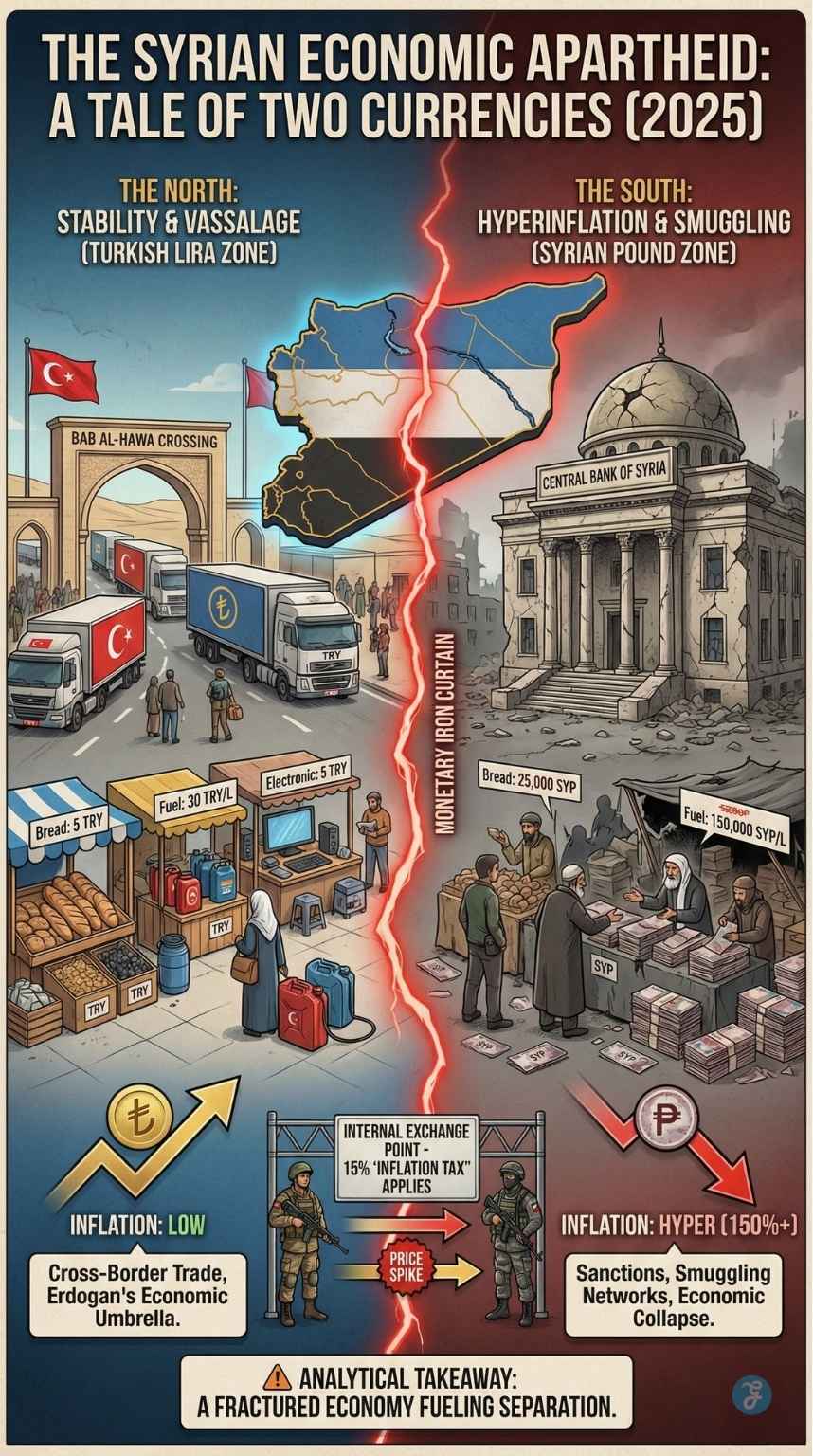
While the political drama played out in the ministries, the average Syrian was fighting a war for bread. The economic policy of the Transitional Government was a chaotic hybrid of neoliberalism and warlord cronyism.
The “Lira War” (SYP vs. TRY)
One of the most bizarre features of the post-Assad economy was the currency split.
- The North: Idlib and Northern Aleppo ran entirely on the Turkish Lira (TRY).
- The Center/South: Damascus and the Coast still used the Syrian Pound (SYP).
- The Conflict: Sharaa attempted to reimpose the Syrian Pound as the sole national currency to assert sovereignty. However, his own power base in the north refused to give up the stability of the Turkish Lira. This led to a “monetary border” north of Hama, where goods had to be repriced and currencies exchanged, adding a 15% inflation premium to basic goods reaching Damascus.
The “Secret Economic Committee”
The most damning revelation of late 2025 was the existence of the “Secret Economic Committee” (SEC).
- The Facade: Finance Minister Barnieh spent months negotiating with the World Bank for reconstruction loans, promising transparency and competitive bidding.
- The Grift: In reality, the SEC, composed of Sharaa’s brother and key HTS financiers, had first right of refusal on all major contracts.
- The Airport Scandal: In August 2025, the contract to rehabilitate Damascus International Airport was awarded to a hitherto unknown company, Al-Bunyan, registered in Turkey. Investigative journalists later revealed Al-Bunyan was a shell company owned by the SEC. This bypassed the established Damascene construction families, alienating the very business class Sharaa needed to keep the economy afloat.
The Sanctions Mirage
The partial lifting of the Caesar Act sanctions by the US and EU in June 2025 was hailed as a victory. However, the benefits never trickled down.
- Smart Sanctions: While the Central Bank was delisted, Western treasuries kept “Smart Sanctions” on individuals linked to human rights abuses. Because Sharaa refused to purge his hardline ministers (like Interior Minister Khattab), major Western banks remained “de-risked,” refusing to process transfers to Syria.
- Result: The reconstruction boom never happened. Instead, Syria became a hub for “grey market” trade, where goods were smuggled in via Turkey and Lebanon, enriching the warlords who controlled the crossings while the state treasury remained empty.
The Regional Freeze: Arab League’s “Wait and See” Strategy
While Western sanctions were the headline, the silent killer of the Syrian economy in mid-2025 was the hesitation of the Gulf states. Expecting a flood of investment from Riyadh and Abu Dhabi, Sharaa was met with a diplomatic cold shoulder. Intelligence reports suggest that the UAE demanded the removal of specific “Shadow Advisors” (former Al-Qaeda affiliates) as a precondition for investment. Sharaa refused, fearing a coup from his own hardliners.
- The Result: The “Amman Summit” in July 2025 ended without a financial aid package. This signaled to the Syrian merchant class that the new government was still a pariah in its own neighborhood.
Justice Delayed: The Missing and the New Prisoners
The most heart-wrenching failure of the Transitional Government was its handling of the “Detainee File.”
The Commission of Disappointment
In April 2025, Sharaa announced the formation of the “National Commission for the Missing” to uncover the fate of the 100,000+ people disappeared by the Assad regime.
- The Discovery: For three months, the Commission did heroic work, uncovering mass graves in Sednaya and Tadmor. Families were finally getting answers.
- The Red Line: The process came to a screeching halt in September 2025. Why? Because the investigation began to uncover evidence that some of the “Rebel Heroes” now sitting in Sharaa’s government had also run torture prisons in Idlib between 2017 and 2022.
- The Shutdown: The Commission’s budget was slashed, and its head, the respected human rights lawyer Mazen Darwish, was “advised” to resign for health reasons. The message was clear: Justice is for the old regime, not the new one.
The “General Amnesty” (That Wasn’t)
On the first anniversary of the revolution (intended to be March 2026, but pre-empted by smaller decrees in late 2025), Sharaa promised a General Amnesty.
- The Exclusion: The amnesty decree released thousands of petty criminals but specifically excluded “Crimes against the Revolution.” This vague term was used to keep political rivals, secular dissidents, and Kurdish activists behind bars.
- Sednaya Repurposed: Satellite imagery from October 2025 confirmed that the notorious Sednaya Prison was not closed as promised. It was being renovated. The GSS had simply moved in.
Brain Drain 2.0: The Second Exodus
Perhaps the most damaging metric of the Transitional Government’s failure was the “Second Exodus.” Between May and October 2025, passport issuance requests jumped by 300%. Unlike the refugee waves of 2015, this was a flight of the elite: doctors, engineers, and professors who had stayed through the war, hoping for this very moment.
The Cause: They didn’t leave because of bombs; they left because of the “Glass Ceiling.” They realized that in Sharaa’s Syria, career advancement required loyalty to the “Idlib Clique,” not professional competence. This loss of human capital crippled the health and energy sectors, making the technocratic ministers generals without armies.
Wrapping Up the Shadow State: The Gathering Storm
As October 2025 turned to November, the atmosphere in Syria was heavy with unfulfilled promises. The “Technocratic Government” was revealed to be a powerless facade. The “Economic Recovery” was a looting spree by the new elite. And the “Justice” was a selective tool for vengeance.
The “Shadow State” had successfully captured the institutions, but it had lost the street. In the north, the Kurds watched the consolidation of power with growing alarm, realizing their autonomy was next on the menu. In the south, the Druze of Suwayda began digging trenches. And on the coast, the Alawites, backed against the wall, prepared for a fight to the death.
The “Second Republic” had survived its infancy, but it was malnourished and paranoid. The internal contradictions of Sharaa’s rule, trying to be a Western ally, an Islamist leader, and a nationalist president all at once, were about to tear the country apart again.
Coming Next: In Part 03, we will analyze the explosion: Syria partition crisis, the inevitable war with the Kurds, the sectarian uprisings of January 2026, and the geopolitical chess game that will determine if Syria survives as a unified state or fractures forever.