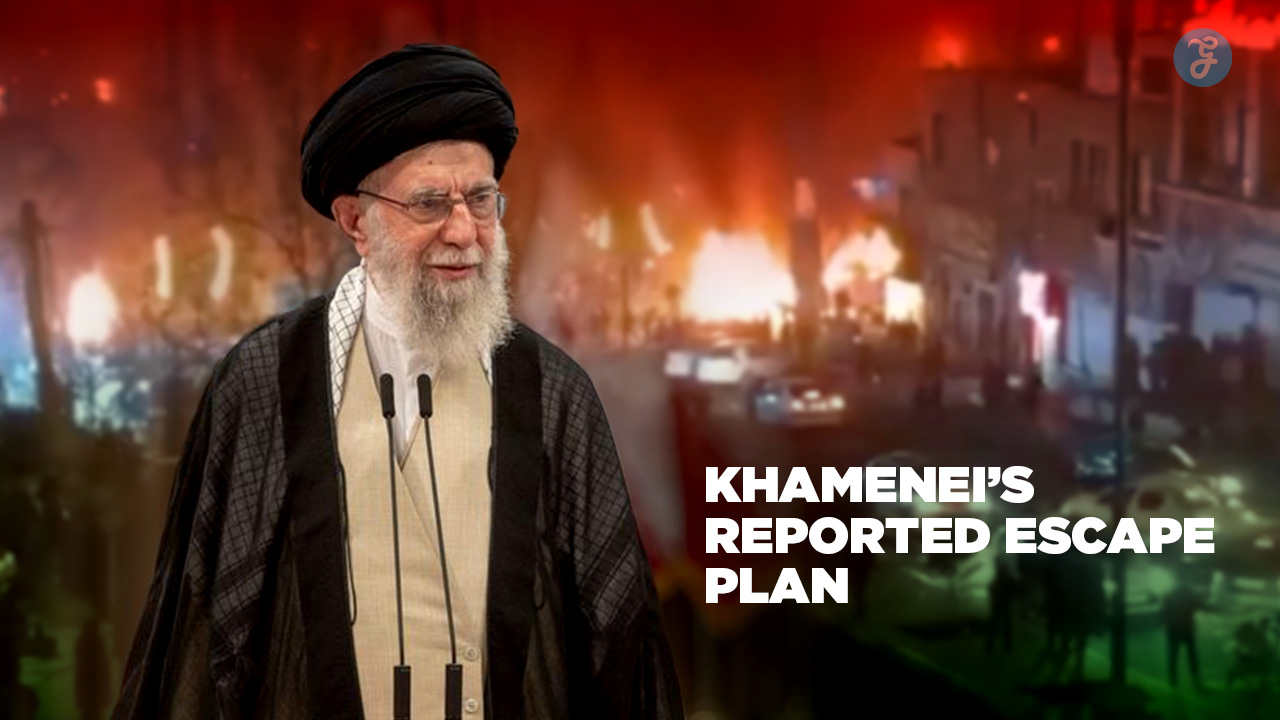
In the opening week of January 2026, intelligence reports published by Western media and corroborated by regional sources revealed a classified protocol dubbed the “Moscow Contingency.” This document reportedly outlines a logistical framework for Supreme Leader Ayatollah Ali Khamenei, his family, and a cadre of top officials to seek asylum in Russia should the Islamic Republic’s security apparatus collapse.
The revelation of the “Moscow Contingency”—a classified intelligence assessment detailing a logistical escape route for Supreme Leader Ayatollah Ali Khamenei to Russia—has landed like a ballistic missile in the heart of the Islamic Republic’s ideology. While official state media dismisses the reports as “Zionist psychological warfare,” the damage is already done. For a regime that has spent 47 years cultivating an image of “divine permanence” and martyrdom, the mere suggestion that the 86-year-old Supreme Leader has a bag packed for Moscow is not just a political scandal; it is a theological catastrophe.
This is no longer about a government fighting for its principles. As the shadow of Bashar al-Assad’s rushed departure from Damascus in late 2024 looms large over the region, Tehran finds itself staring into the same abyss. The “Moscow Contingency” suggests that the Islamic Republic has moved from the phase of “Sacred Defense” to the phase of “Asset Liquidation,” signaling to friends and foes alike that the era of the Mullahs may be entering its terminal phase.
Anatomy of the Exit: What is the “Moscow Contingency”
The leaked intelligence, which surfaced in Western and regional defense circles this week, reportedly outlines a “Continuity of Government” protocol that is, in practice, an evacuation manifest.
-
The Route: Unlike the chaotic exits of other fallen dictators, this plan reportedly utilizes a pre-secured “Caspian Corridor”—a direct air bridge from Tehran to Russian military bases north of the Caspian Sea.
-
The Passengers: The manifest allegedly prioritizes the Supreme Leader, his son and potential successor Mojtaba Khamenei, and a tight circle of roughly 20 key loyalists. Notably absent are the mid-level IRGC commanders who enforce the regime’s rule on the streets.
-
The Trigger: The plan is designed to activate not when the regime falls, but before—specifically, at the sign of “irreversible security sector fracture.”
This specific detail—planning to leave before the end—is what has terrified the regime’s base. It implies that the leadership has better intelligence on their own vulnerability than the public does.
The Assad Precedent: The Ghost of 2024
One cannot overstate how deeply the “Assad Trauma” of December 2024 sits in the Iranian psyche. For years, Qasem Soleimani and the IRGC told the Iranian people that fighting in Syria was essential to keeping the war away from Iran’s borders. They claimed Assad’s survival was proof of the “Axis of Resistance’s” invincibility.
When Assad eventually fled to Moscow in 2024, leaving his palaces to be looted by rebels, that narrative collapsed. The user-highlighted parallel is the critical lens for this crisis:
“Much like Bashar al-Assad’s reliance on Russian sanctuary in 2024, Tehran is now signaling that its survival depends on foreign powers, not domestic support.”
The “Moscow Contingency” tells the Iranian street that their Supreme Leader is not the Velayat-e Faqih (God’s Representative) who will stand and die with his people. Instead, he is viewed through the lens of a “client dictator”—another Assad, waiting for his Russian handlers to extract him when the heat gets too high.
Related Read: Protests Spread to 50 Cities Accross Iran
Economic Context: The “Maximum Pressure” Boiler Room
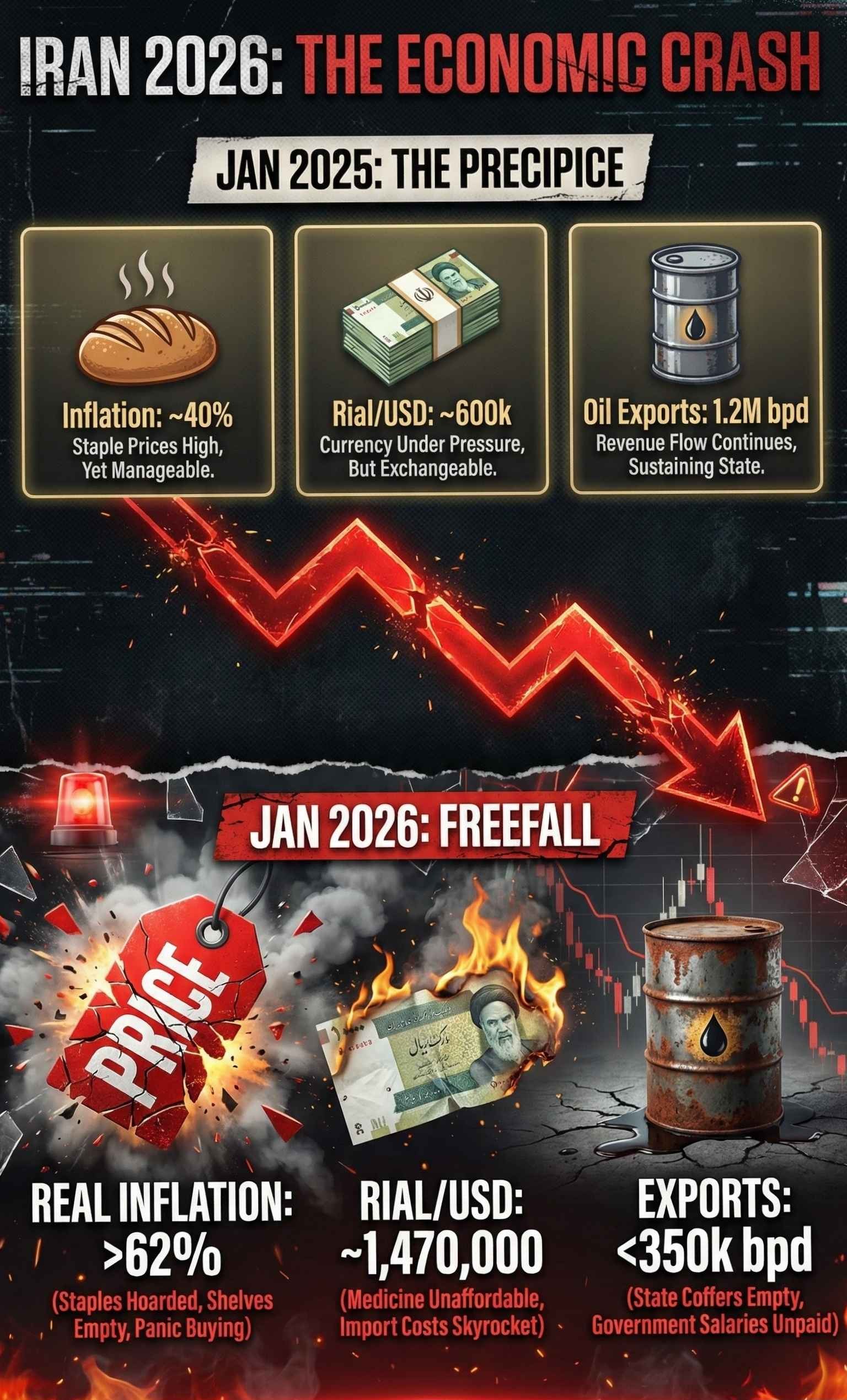
While the “Moscow Contingency” provides the political spark, the dry timber of the Iranian economy is what threatens to turn this into a conflagration. The renewed “Maximum Pressure” campaign by the U.S. has effectively severed Iran’s remaining economic lifelines.
Table 1: The Economic Cost of Survival (Jan 2025 vs. Jan 2026)
| Economic Indicator | Jan 2025 | Jan 2026 (Current) | % Change | Societal Impact |
| Real Inflation Rate | ~40% | >62% | ⬆ 55% | The middle class has evaporated; hoarding of staples is now widespread. |
| Currency (Rial/USD) | ~600,000 | ~1,470,000 | ⬇ 145% | Import-dependent medicines (insulin, cancer drugs) are virtually unobtainable. |
| Oil Exports | 1.2M bpd | <350k bpd | ⬇ 70% | The government has failed to pay pensions for three consecutive months. |
| Youth Unemployment | ~20% | >38% | ⬆ 90% | A massive demographic of military-age males has no stake in the system’s stability. |
Data Source: Aggregated estimates based on Jan 2026 market tracking and sanctions impact reports
The Vacuum Opens: The Loyalty Crisis
The most immediate danger of the “Moscow Contingency” is not the protests themselves, but the reaction of the Basij and IRGC forces tasked with crushing them.
In past uprisings (2009, 2019, 2022), security forces killed with impunity because they believed the regime was eternal. They fought to protect their own future. But if the “Captain” has a plan to leave, the calculation changes:
-
The IRGC Commander: “Why should I order my men to shoot if I’m going to be left behind to face the tribunal?”
-
The Basij Volunteer: “If the Supreme Leader flees to Russia, who will protect my family from the neighbors I oppressed?”
The “Moscow Contingency” has introduced a “Prisoner’s Dilemma” into the heart of the security apparatus. Every commander is now watching the others, wondering who will defect first to secure immunity in the post-Khamenei era.
Final Words
The Islamic Republic has weathered forty-seven years of storms by convincing its people—and its enforcers—of one immutable truth: We are inevitable. They survived the brutal war with Iraq, the Green Movement of 2009, and the Mahsa Amini uprising of 2022 because the core of the regime never doubted the Supreme Leader’s spiritual resolve to stand and die on Iranian soil.
But the “Moscow Contingency” is a bell that cannot be unrung. It has transformed the Supreme Leader from a messianic figure into a mortal politician checking the exits. For a theocracy, this is not just a scandal; it is a theological collapse. The regime is now caught in a fatal paradox: to survive, it needs the absolute loyalty of the IRGC, but the very existence of an escape plan gives those forces permission to defect.
As the winter of 2026 deepens, the silence in the halls of power is deafening. The people know, the world knows, and most dangerously, the generals know: the captain is preparing to abandon ship. The only question remaining is whether the crew will go down with the vessel or if they will mutiny to save themselves.
Coming up in Part 2: The Praetorian Guard’s Dilemma—the likelihood of an internal IRGC coup. Will the Generals sacrifice the Clerics to save the Republic, or will they fracture into warlordism?