
Unlimited plans sound simple. Pay one price and use your phone without checking your data meter. But once you start shopping, you see a confusing mix of terms like premium data, fair use, deprioritization, speed tiers, and hotspot caps.
This guide explains the Best Unlimited 5G Data Plans across the U.S., U.K., and Australia in a clear and practical way. It is designed for real people who stream, scroll, work, and travel. You will learn which plans are best for heavy use, which are best for value, and which are best for hotspot.
You will also learn how “unlimited” really works. Some plans stay fast but limit hotspot. Some plans keep hotspot high but cost more. Some plans never cut you off but may slow after a certain amount of usage.
Why Unlimited 5G Data Plans Matter in 2026
Data habits changed fast. Phones are now streaming devices, work devices, navigation tools, and payment tools. Many people also use their phone as a backup internet connection when home Wi-Fi fails. That makes “unlimited” feel less like a luxury and more like a basic need.
5G is also shaping expectations. People expect faster speeds, better video quality, and lower lag. They also expect stable performance in crowded places like malls, stadiums, and airports. Unlimited plans are often marketed as the best way to enjoy 5G fully.
But unlimited plans matter for another reason: peace of mind. When you do not worry about hitting a cap, you use your phone naturally. You do not avoid video calls, maps, or streaming. You just use your data when you need it.
At the same time, unlimited plans are not all equal. Some are “unlimited” only on your phone. Hotspot can be limited. Speed can be managed. Congestion can change your experience at busy times.
If you understand these trade-offs before buying, you can choose a plan that feels great every day. That is the real win.
Why Unlimited 5G Plans Are Popular
| What People Want | Why Unlimited Helps | Common Catch to Watch |
| Stream without worry | No monthly cap anxiety | Video quality may be managed |
| Work on the go | Reliable access to cloud tools | Busy towers can slow speeds |
| Use hotspot often | Laptop/tablet connectivity | High-speed hotspot is often capped |
| Travel and roam | Fewer interruptions | Roaming data limits are common |
| Heavy daily usage | Easy, predictable billing | “Unlimited” may still have rules |
How We Chose the Best Plans
“Best” depends on what you need. A plan that is perfect for streaming may be weak for hotspot. A plan that is cheap may have speed caps. A plan that is fast in cities may be less reliable in rural areas.
So the goal here is not to crown one global winner. The goal is to help you match a plan to your lifestyle. That is why the list includes premium options and value options across three countries.
We focus on widely available consumer plans from major carriers, plus one strong value pick in Australia. We also prioritize clarity. If a plan is confusing, it is usually harder to live with.
We also assume typical personal use. If you run a business off your phone with constant tethering and huge transfers, you should read acceptable-use rules carefully and consider business plans.
Most importantly, we focus on real-world factors people notice daily: coverage, consistency, hotspot, and the way plans behave when the network is busy.
Key Criteria We Used
A plan should feel good in daily use, not only on paper. That means stable performance, fair pricing, and clear rules. It also means a plan should match what you actually do on your phone.
We looked at how plans handle congestion. We looked at how they treat hotspot usage. We looked at whether the plan is truly unlimited or “unlimited with conditions.” We also considered how easy it is to understand the plan before you buy.
We also considered flexibility. Some people want contract freedom. Some want device deals. A great plan can be ruined by bad terms or confusing billing.
Finally, we considered value. The cheapest plan is not always the best. The best plan gives you the experience you need at a price that feels fair.
Evaluation Checklist
| Factor | What It Means | Why It Matters |
| 5G access | 5G availability and quality | Determines speed and reliability |
| Hotspot policy | High-speed tethering limits | Critical for laptop/tablet use |
| Congestion rules | Prioritization and slowdowns | Impacts busy locations and peak hours |
| Speed caps | Limits on max speed | Affects streaming and downloads |
| Fair-use terms | Rules against abnormal use | Can affect heavy tethering users |
| Total value | Price vs benefits | Determines long-term satisfaction |
What “Unlimited” Really Means
Unlimited does not always mean the same thing. In many cases, it means you will not pay overage fees and you will not be cut off. But the plan may still manage performance under certain conditions.
Some plans slow data when the network is crowded. This is common. Some plans give priority to premium customers during congestion. Some plans limit video quality. Some plans have a high-speed hotspot allowance and then reduce hotspot speed.
In Australia, “infinite data” models are common. You might get a chunk of fast data, then unlimited data at a slower speed tier. That can still be great for browsing and music. It can feel slow for large uploads or high-resolution streaming.
The key is to decide what “unlimited” should mean for you. If you mainly use your phone data on the handset, you can accept hotspot limits. If you rely on tethering for work, hotspot terms should be your top priority.
Common “Unlimited” Language
| Phrase | Typical Meaning | Best Tip |
| Unlimited data | No hard monthly cap | Check congestion rules |
| Premium data | Higher priority during congestion | Better for cities and events |
| High-speed hotspot | Fast tethering up to a limit | Read what happens after the limit |
| Fair-use policy | Rules against abnormal use | Avoid treating phone like home router |
Best Unlimited 5G Data Plans in the United States

The U.S. market is built around tiers. The big carriers often offer three levels of unlimited. The top tier usually includes more hotspot, better perks, and better treatment during congestion.
If you live in a busy metro area, congestion rules can matter as much as coverage. A cheaper plan can feel fine at home but struggle at rush hour. A premium plan can feel smoother in crowded places.
Hotspot is also a major U.S. differentiator. Many people use hotspot as a backup internet line. In the U.S., carriers often include a set amount of high-speed hotspot and then slow it after that.
Pricing in the U.S. also depends on the number of lines. A plan can feel expensive for one person but competitive for families. So “best” may change based on whether you need one line or multiple.
Below are three strong choices that cover the most common needs: maximum hotspot, premium daily use, and a balanced premium option.
1. Verizon Unlimited Ultimate
This plan is usually aimed at people who want a premium experience and heavy use freedom. Verizon often focuses on broad network coverage and premium 5G layers in many markets.
The biggest selling point for many users is hotspot. If you tether often, you want a plan that does not punish you quickly. This plan is designed for users who stream, share, and work while traveling.
This is also a plan that can feel strong in crowded settings, depending on location. For many users, the difference shows up at stadiums, downtown areas, and busy travel hubs.
The downside is simple: premium plans cost more. If you stay on Wi-Fi most of the time, you may not feel the extra value.
Best for:
- Frequent hotspot use
- Heavy streaming and travel
- Users who want premium performance
Watch-outs:
- Total cost can be high without multi-line discounts
- Hotspot is structured, not “full speed forever”
2. AT&T Unlimited Premium PL
AT&T’s premium tier is a solid choice for people who want heavy daily use without constantly thinking about limits. It is often chosen by users who stream a lot and want a stable experience across the month.
This plan is also popular with people who use hotspot occasionally but still want a meaningful allowance. Many people fall into this category: they do not tether every day, but they do need it when traveling or when Wi-Fi fails.
Another reason people choose this plan is balance. It is not always the most hyped plan, but it tends to be a reliable all-rounder. That can be more valuable than flashy marketing.
The key is to compare total cost after discounts. For families, premium plans can become much more affordable per line.
Best for:
- Balanced premium usage
- Streaming, navigation, and daily heavy data
- Occasional hotspot for travel
Watch-outs:
- Like all carriers, performance varies by area
- Promotions can change billing outcomes
3. T-Mobile Experience More
T-Mobile is known for aggressive competition, strong 5G presence in many metros, and premium plans that bundle extras. Experience More is positioned as a premium consumer option for heavy users.
If you love a feature-heavy plan, this can be appealing. Some users like the feeling of getting “more for the money.” Others prefer a cleaner bill with fewer add-ons.
Performance depends on where you live, work, and travel. In many cities, T-Mobile’s 5G experience can be excellent. In some rural areas, another carrier may feel more stable. That is why local coverage matters.
This plan can be a strong fit for people who want a modern premium plan with hotspot included and who are comfortable checking the fine print on pricing.
Best for:
- People who want a premium plan with extras
- Strong 5G performance in many metro areas
- Heavy users who also want hotspot flexibility
Watch-outs:
- Pricing and fees can vary by market and promo
- Always confirm the full monthly total
U.S. Plan Snapshot
| Plan | Best For | Hotspot Focus | Main Trade-Off |
| Verizon Unlimited Ultimate | Power users and travelers | Strong hotspot positioning | Premium pricing |
| AT&T Unlimited Premium PL | Balanced heavy use | Solid hotspot for many users | Value depends on discounts |
| T-Mobile Experience More | Premium features + 5G | Strong for many metro users | Total cost can vary |
Best Unlimited 5G Data Plans in the United Kingdom

The U.K. is one of the most competitive markets for SIM-only deals. That can be great for consumers. You can often find strong value without signing a long contract.
But “unlimited” in the U.K. still comes with terms. The biggest things to check are fair use and roaming. Roaming can be a deal-breaker for travelers, especially after policy changes in recent years.
Network experience can also vary by location. In some areas, one carrier may be excellent, while another feels weak indoors. That is why it helps to check coverage maps and ask neighbors what works.
The three picks below cover a premium-style network option, a widely available balanced option, and a value-driven “simple unlimited” choice.
4. EE Unlimited Plans
EE is often seen as a premium network choice, especially for users who care about consistency. Many people choose EE because they want strong coverage and dependable performance.
EE’s unlimited offerings can work well for everyday heavy use. Streaming, social, video calls, and music are usually smooth if you have good signal where you live.
The main thing to understand is the personal-use framing. Like many carriers, EE expects consumer plans to be used as a personal phone plan, not as a replacement home router for constant tethering.
If you plan to tether regularly, keep an eye on plan terms and consider whether a dedicated home broadband option might better fit your use.
Best for:
- People who want a premium feel
- Users who prioritize network consistency
- Heavy phone data usage
Watch-outs:
- Read terms if you plan constant hotspot use
- Roaming limits can matter for travelers
5. Vodafone UK Unlimited
Vodafone is a widely available option with a range of plan types. That can be a plus because you can often find a tier that fits your budget.
Vodafone’s unlimited options can be a good match for people who want a mainstream carrier with broad availability. Some users also like Vodafone’s extras and bundles, depending on the deal.
The key is to match the plan tier to your needs. Some unlimited tiers focus on pure data value. Others focus on add-ons. If you do not need extras, choose a simpler tier.
Also check the acceptable-use language if you plan heavy tethering. This is not unique to Vodafone. It is common across carriers.
Best for:
- Broad availability and plan variety
- Users who want a familiar carrier option
- People who like bundle-friendly deals
Watch-outs:
- Confirm roaming terms before travel
- Check fair-use and acceptable-use rules
6. Three UK Unlimited Data
Three is often chosen for value. It markets unlimited in a straightforward way and appeals to people who want simple, budget-friendly unlimited usage.
For many users, Three delivers strong value when signal is good. This is especially true for people who mainly use their phone in one city or region where Three performs well.
The smart move with Three is to test coverage where you need it most. If your home or workplace has weak indoor signal, no plan will feel good.
If your area is covered well, Three can be one of the best ways to get unlimited without paying premium prices.
Best for:
- Budget-friendly unlimited users
- People who want a simple plan
- Users who do not need premium perks
Watch-outs:
- Coverage can vary more by area
- Indoor signal differences matter
U.K. Plan Snapshot
| Plan | Best For | What Stands Out | Main Trade-Off |
| EE Unlimited | Premium feel and consistency | Strong everyday experience | Check terms for heavy tethering |
| Vodafone Unlimited | Balanced mainstream choice | Broad availability | Roaming and terms vary by tier |
| Three Unlimited | Value seekers | Simple unlimited positioning | Coverage can vary locally |
Best Unlimited 5G Data Plans in Australia
Australia often sells “unlimited-style” plans differently. Many providers offer a set amount of data at maximum speed. After that, you still get unlimited data, but at a slower speed tier.
This approach can be very practical. Most people do not need full speed all month. They need full speed sometimes. After that, a lower speed can still handle everyday browsing, messaging, and music.
The trick is understanding what those speed tiers feel like. A lower tier might be fine for email and social apps. It might struggle for 4K streaming, large video uploads, or big app downloads.
Coverage is also a major factor. Australia’s geography makes network differences feel bigger, especially outside major cities. Many people choose a carrier based on where they travel, not just where they live.
Below are four strong picks that match common Australian needs: premium coverage, flexible usage, predictable infinite data tiers, and budget 5G value.
7. Telstra Premium Mobile Plans
Telstra is often chosen for coverage. Many users prioritize Telstra because they want fewer dead zones and better reach outside city centers.
If you travel often, or if you live in a less dense area, coverage can matter more than raw speed. A “fast” plan is useless without signal.
Telstra also tends to position itself as premium. That can show up in pricing and in plan structures. If you stay mostly in a city with strong coverage from multiple carriers, you may want to compare value carefully.
Still, if your top priority is reliability, Telstra is often the first place people look.
Best for:
- Coverage-focused users
- Travelers across regions
- People who want reliability
Watch-outs:
- Premium pricing is common
- Compare inclusions carefully
8. Optus Plans With Unlimited Add-Ons
Optus can be attractive for people who do not need unlimited every day but want flexibility. Some offerings and add-ons can give you “unlimited day” style options, depending on eligibility.
This is useful if you have occasional heavy days. For example, you may need unlimited when traveling, moving homes, or working off-site.
Optus can also work well for people who want a mainstream network without always paying top-tier pricing. The best deals often come through promotions and plan bundles.
The key is to confirm terms, eligibility, and what happens during heavy usage days.
Best for:
- People who want flexible heavy-use days
- Users who do not need unlimited all month
- Deal hunters
Watch-outs:
- Add-ons may not apply to all customers
- Read “fair go” and usage terms
9. Vodafone Australia Infinite Data Plans
Vodafone’s speed-tier structure is one of the clearest in the market. You choose a plan that includes a max-speed allowance, then you continue on an infinite speed tier.
This can be perfect if you want predictable performance. You know what you are paying for. You know what speed you will have after the allowance.
It is also useful for people who mainly browse, message, and stream in standard definition. Those activities can work fine on mid-level tiers, depending on the speed.
If you are a creator uploading large files, or you need high-quality streaming daily, you should choose the tier carefully.
Best for:
- Predictable monthly experience
- People who want “never cut off” data
- Light-to-medium users after max-speed use
Watch-outs:
- Lower tiers can feel slow for large uploads
- Choose tier based on your habits
10. amaysim 5G Plans
amaysim is often chosen for value. It can be a smart pick if you want 5G access and lower pricing, and you do not need premium extras.
It is especially useful for people who stay on Wi-Fi most of the time but want strong data when out. It can also work for students or budget-minded users.
Many value plans include speed caps. That is not automatically bad. If the speed cap is still fast enough for your needs, you may never notice it.
This makes amaysim a strong “everyday value” option, especially if you care more about price than peak speed.
Best for:
- Budget 5G users
- People who want simple, lower-cost plans
- Users who do not need premium features
Watch-outs:
- Speed caps may apply on some plans
- Plan tiers matter more than branding
Australia Plan Snapshot
| Plan Type | Best For | How It Feels Day-to-Day | Main Trade-Off |
| Telstra premium | Coverage-first users | Reliable in more places | Usually costs more |
| Optus with add-ons | Flexible heavy-use days | Helpful for occasional spikes | Eligibility and terms vary |
| Vodafone Infinite tiers | Predictable usage | Always connected at set tier | Lower tier speeds limit heavy tasks |
| amaysim 5G value | Budget users | Simple, often “good enough” | Speed caps can apply |
Best Unlimited 5G Data Plans (Cross-Country Comparison)
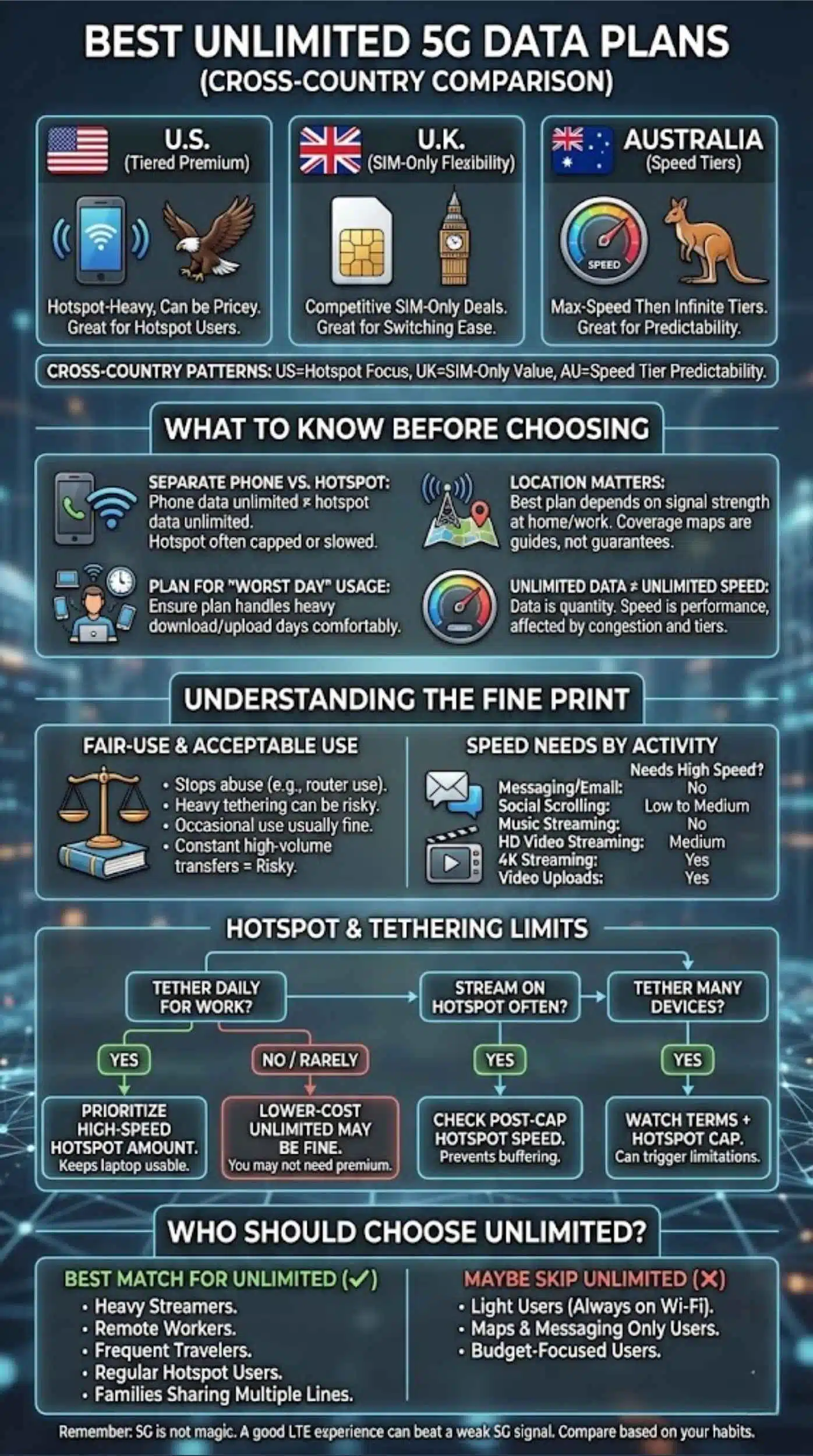
Comparing plans across countries is tricky because markets work differently. The U.S. often ties premium plans to hotspot and congestion priority. The U.K. often wins on SIM-only competition and flexibility. Australia often uses speed tiers and “infinite” data models.
So instead of forcing a single ranking, it helps to compare by what matters most: cost feel, unlimited meaning, hotspot treatment, and flexibility.
It also helps to compare your own habits. Are you mostly on your phone? Or do you tether a laptop daily? Do you travel internationally? Do you live in a place where one carrier dominates?
Once you answer those questions, the “best country” does not matter. The right plan becomes clearer.
Here are simple patterns most shoppers notice:
- U.S. plans are great for hotspot-heavy users, but can be pricey.
- U.K. plans are great for SIM-only value and switching ease.
- Australian plans are great for predictability if you accept speed tiers.
Cross-Country Comparison
| Topic | U.S. | U.K. | Australia |
| Typical plan style | Tiered premium unlimited | Competitive SIM-only deals | Max-speed then infinite tiers |
| Hotspot focus | High | Moderate | Varies a lot |
| “Unlimited” meaning | Usually no cap, managed in congestion | Often no cap with terms | Often infinite at a set speed tier |
| Best for value shoppers | Multi-line plans | SIM-only switching | Tier-based predictability |
| Best for hotspot users | Strong | Mixed | Depends on plan tier |
Things to Know Before Choosing an Unlimited 5G Plan
Many people regret a plan because they missed one detail. The good news is that most regrets are predictable. They come from hotspot limits, roaming surprises, or slow performance in busy places.
Start by separating phone data from hotspot data. Your phone data might be unlimited and fast. Your hotspot might be capped or slowed. If you depend on hotspot, treat it like a separate product.
Next, think about where you use your phone. Your best plan is not always the “best on paper.” It is the plan that works best at your home, workplace, and commute.
Also think about your “worst day” usage. If you sometimes download big files, upload videos, or stream for hours, you need a plan that stays comfortable on your heaviest days.
Finally, remember that 5G is not magic. Signal strength, tower load, and indoor coverage still matter. A good LTE experience can beat a weak 5G signal.
Fair-Use Policies and Acceptable Use
Fair-use rules exist to stop abuse. That might include using a phone SIM in a router, running constant automated downloads, or reselling service. Most normal users will never trigger these rules.
But heavy tethering can sometimes look unusual. If you tether multiple devices for long periods every day, some carriers may treat it like non-personal use.
The practical tip is simple. If you need home-internet-level usage every day, consider a dedicated home broadband plan or a dedicated mobile broadband service designed for that job.
If you are a normal user who occasionally tethers, you usually have nothing to worry about. Just know the policy exists.
Fair-Use Basics
| Usage Pattern | Usually Fine? | Why |
| Heavy streaming on phone | Yes | Common consumer behavior |
| Occasional hotspot for laptop | Yes | Typical personal use |
| Daily hotspot for work calls | Usually | Depends on how extreme it is |
| Using phone SIM in a router | Risky | Often against terms |
| Constant high-volume transfers | Risky | Can look like abuse |
Unlimited Data vs Unlimited Speed
Unlimited data is about quantity. Unlimited speed is about performance. Many plans are unlimited in quantity but not in speed all the time.
Some plans reduce speed during congestion. Some limit video quality. Some have “soft caps” where you get priority up to a point and lower priority after.
In Australia, speed tiers are very common. That means the plan is unlimited, but your speed after the fast allowance can drop to a fixed level.
The best way to decide is to match speed to tasks. Messaging and browsing need little speed. HD streaming needs more. Cloud gaming and video uploads need even more.
Speed Needs by Activity
| Activity | Needs High Speed? | Notes |
| Messaging, email | No | Works on low tiers |
| Social scrolling | Low to medium | Depends on video autoplay |
| Music streaming | No | Very forgiving |
| HD video streaming | Medium | More stable on higher tiers |
| 4K streaming | Yes | Best on premium tiers |
| Video uploads | Yes | Upload speed matters too |
Hotspot and Tethering Limits
Hotspot is the biggest difference between “good unlimited” and “great unlimited.” Many users assume unlimited means unlimited hotspot. That is rarely true.
Most premium plans include a set amount of high-speed hotspot. After that, hotspot speed is reduced. Some plans limit hotspot speed from the start.
If you tether for work, compare hotspot terms first. If you tether only sometimes, you may not need the top tier. This is where you can save money.
Also consider how many devices you tether. A single laptop is one thing. Multiple devices streaming at once is another.
Hotspot Shopping Guide
| If You… | Prioritize | Why |
| Tether daily for work | High-speed hotspot amount | Keeps laptop usable |
| Stream on hotspot often | Post-cap hotspot speed | Prevents buffering |
| Use hotspot rarely | Lower-cost unlimited | You may not need premium |
| Tether many devices | Terms + hotspot cap | Can trigger limitations |
Who Should Choose an Unlimited 5G Plan
Unlimited plans are best when they reduce friction in your life. If you constantly think about data, unlimited is worth it. If you live on Wi-Fi and rarely use mobile data, unlimited may be unnecessary.
A good rule is to look at your last three months of usage. If you regularly push high data numbers, unlimited can stop you from micromanaging. If your usage is low, a cheaper plan may be smarter.
Unlimited also makes sense for people with unpredictable schedules. Some months are light. Some months are heavy. Unlimited protects you from surprise overages and stress.
But unlimited plans should still be chosen carefully. Some “unlimited” plans feel slow in busy places because of congestion rules. Some feel great but cost more than you need.
Below are simple user profiles to help you decide.
Best match for unlimited:
- Heavy streamers
- Frequent travelers
- Remote workers
- People who use hotspot regularly
- Families sharing multiple lines
Maybe skip unlimited:
- Light users always on Wi-Fi
- People who only use maps and messaging
- Users who want the lowest monthly bill
Who Should Buy Unlimited
| User Type | Unlimited Worth It? | Why |
| Heavy streamer | Yes | Predictable, stress-free use |
| Remote worker | Often | Hotspot backup can be critical |
| Traveler | Often | Stable access away from Wi-Fi |
| Light user | Maybe not | Cheaper plans may fit better |
| Student on a budget | Depends | Value plans can be enough |
FAQs About Unlimited 5G Plans
Are unlimited 5G plans truly unlimited?
For most normal users, yes. You can use a lot of data without being cut off or charged extra. That is the practical meaning of unlimited.
But some limits still exist. Hotspot can be capped. Roaming can be limited. Speeds can be managed during congestion. Some plans use fair-use rules for extreme patterns.
The right plan depends on what kind of “unlimited” you expect. If you need unlimited hotspot at full speed, that is rare and expensive. If you just want unlimited phone data, many plans work well.
Does unlimited 5G mean unlimited speed?
Not always. Speed can vary due to signal, tower load, and plan rules. Some plans include premium priority. Some do not. Some have speed tiers after a fast allowance.
If you care about consistent speed in crowded places, premium tiers often help. If you care about always having data, speed-tier models can still be useful.
Think of it like this: unlimited speed is a goal, not a guarantee. Real-world conditions always play a role.
Which country has the best value for unlimited 5G?
The U.K. often wins on SIM-only competition and switching ease. The U.S. often wins on hotspot-heavy premium tiers. Australia often wins on predictable infinite models.
But the best value is personal. Value depends on where you live, how you use hotspot, and how much you travel.
If you want the best “deal,” look at what you actually use, not what a plan advertises.
Can unlimited 5G replace home broadband?
Sometimes, yes. Many people do it successfully. It works best if your area has strong 5G and your plan supports heavy hotspot use.
But if you have multiple people streaming, gaming, and working from home, a phone plan can struggle. Hotspot caps and fair-use terms can also be an issue.
If you want to replace home broadband, consider a dedicated home wireless product or a plan built for that role.
Are SIM-only unlimited plans better than contract plans?
SIM-only plans are often cheaper and easier to switch. They are great if you already own a phone or buy phones separately.
Contract plans can be useful if you need device financing or if you get strong bundle discounts. They can also be convenient if you want one bill for everything.
Choose SIM-only for flexibility. Choose contract if the device deal truly saves you money.
Final Thoughts on the Best Unlimited 5G Data Plans
Choosing the right plan is easier when you stop chasing marketing headlines. The words “unlimited” and “5G” look impressive, but they do not guarantee a perfect experience.
The real decision comes down to three things. First, coverage where you live and work. Second, hotspot rules if you tether even sometimes. Third, total monthly cost after discounts and fees.
If you travel often, check roaming terms early. If you attend crowded events, consider premium tiers that handle congestion better. If you mostly browse and message, you may not need the most expensive plan.
The Best Unlimited 5G Data Plans are the ones that match your real life. When your plan fits your habits, you stop thinking about your plan at all. Your phone just works.
And that is the point of paying for unlimited.