

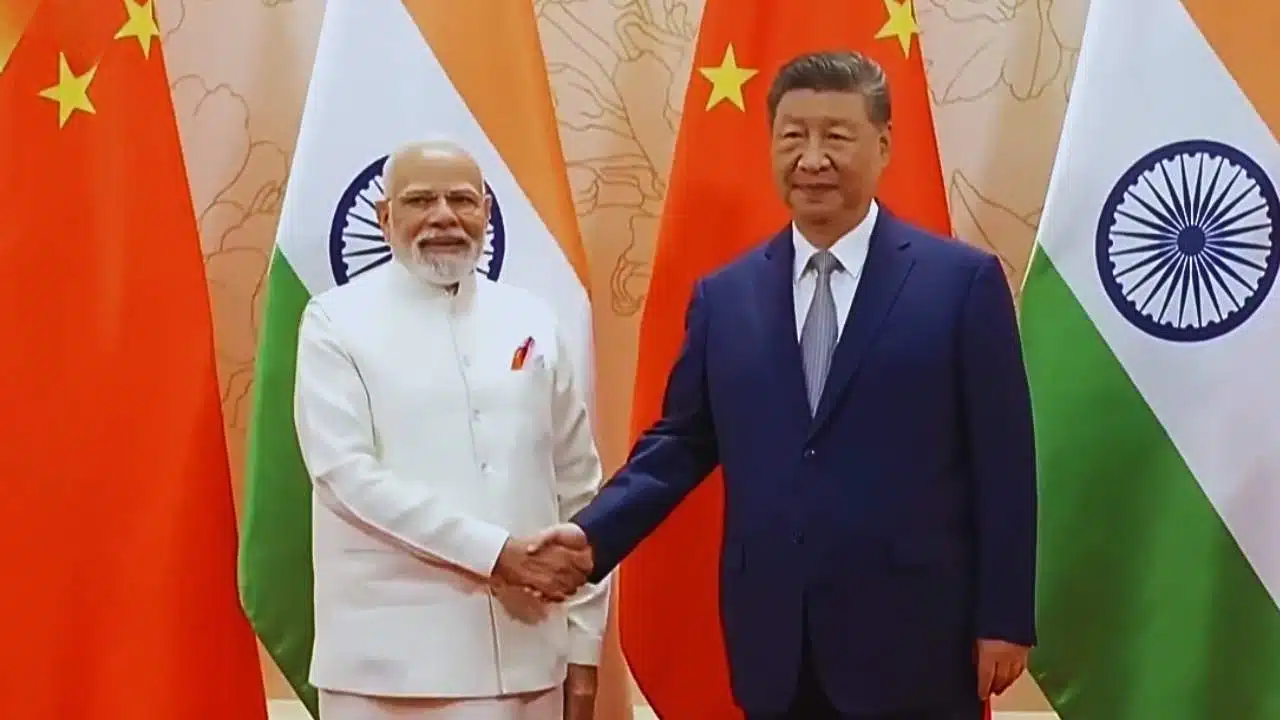
China said Dec. 25 it rejects a Pentagon claim that Beijing is easing India border tensions to blunt U.S.-India ties, calling the report distorted and saying the LAC situation is generally stable.
What happened and what each side is saying?
China’s Foreign Ministry used its regular press briefing on December 25, 2025 to push back against a U.S. Pentagon assessment about the China–India border situation.
The dispute centers on a line in the Pentagon’s annual report to the U.S. Congress that suggests China is likely trying to capitalize on decreased tensions with India along the disputed Himalayan frontier—often called the Line of Actual Control (LAC)—to stabilize relations with New Delhi and prevent deeper U.S.-India ties.
At the briefing, China rejected that framing and accused the United States of misrepresenting China’s defense policy and attempting to drive wedges between China and other countries. China also reiterated a core point it often repeats on sensitive disputes: the boundary question is a bilateral issue between China and India, not something it believes third countries should interpret or influence.
China’s spokesperson said Beijing views relations with India from a “strategic” and long-term perspective and wants to strengthen communication, increase mutual trust, expand cooperation, and manage differences. The spokesperson added that communication mechanisms between the two countries remain in place and that the border situation is “generally stable.”
The Pentagon report does not claim a formal policy announcement by Beijing. Instead, it presents U.S. analysis of China’s likely motivations, noting that India has publicly announced steps toward disengagement at remaining standoff sites and that distrust between the two Asian neighbors remains high.
At the heart of the exchange is a familiar clash between official diplomacy and strategic interpretation: Washington describes incentives and leverage; Beijing calls that “distortion” and “discord.”
What the Pentagon report says about China, India, and the LAC?
The Pentagon report is a wide-ranging annual document on China’s military and security developments. Most of it focuses on the People’s Liberation Army (PLA), modernization, regional posture, and broader security trends. But one short regional assessment about India drew unusual attention because it linked border diplomacy to great-power competition.
Key points from the report’s discussion include:
- October 2024 disengagement announcement: The report notes that Indian leaders announced an agreement with China in October 2024 to disengage from remaining standoff sites along the LAC. It connects that development to a period of high-level engagement soon afterward.
- Strategic motivation: It argues China “probably” seeks to use decreased LAC tensions to stabilize relations with India and limit the deepening of U.S.-India ties.
- Continuing distrust: It adds that India is likely to remain skeptical of China’s motives and that the relationship will continue to face constraints due to longstanding distrust and other points of friction.
The report’s phrasing matters because it treats the border not just as a bilateral dispute, but as a factor shaping India’s alignment choices—especially defense cooperation and strategic coordination with the United States.
Beyond the India angle, the Pentagon’s China report has also drawn attention in regional capitals for describing China’s interests and priorities across Asia, including how Beijing frames territorial issues it considers sensitive. Indian commentary around the report often highlights references to contested border regions and China’s relations with Pakistan, which are frequently viewed in New Delhi as a two-front security challenge.
Key terms used in border reporting (quick guide)
| Term | What it means in practice | Why it matters |
| Line of Actual Control (LAC) | The de facto boundary where forces face each other, not a mutually agreed border | The LAC is the main reference point for “incidents,” patrols, and standoffs |
| Disengagement | Pulling forces back from face-to-face positions at specific friction points | Lowers immediate risk of clashes at those sites |
| De-escalation | Reducing overall troop posture, alert levels, and forward deployments | Determines whether tension truly declines beyond a single site |
| Buffer zone | Areas where both sides limit patrols or activity to prevent confrontation | Can reduce incidents but may also affect access and perceptions of control |
The China–India border backdrop: how the standoff evolved and where it stands?
To understand why a single sentence in a U.S. report triggered an official Chinese response, you have to go back to the crisis that reshaped the relationship.
In June 2020, a deadly confrontation in the Galwan Valley area became the worst violence on the China–India frontier in decades. The clash froze trust, drove rapid troop deployments, and pushed both militaries into a prolonged, high-altitude standoff across multiple friction points in eastern Ladakh.
Over the next several years, India and China held repeated rounds of military commander-level talks and diplomatic discussions. The pattern was often incremental: pullbacks in one area, continued pressure in another, and recurring arguments over patrolling rights and infrastructure.
By 2024, both sides signaled an interest in reducing risk, and India announced a significant step in October 2024: an agreement tied to patrolling arrangements and disengagement in remaining standoff areas widely discussed as Depsang and Demchok sectors. The same period also saw a notable political signal—Prime Minister Narendra Modi and Chinese leader Xi Jinping met on the sidelines of the BRICS summit in Kazan, their first such meeting in years.
In 2025, India’s government publicly stated that the October 2024 agreement had been implemented according to agreed modalities and timelines and that talks on broader de-escalation continued through diplomatic and military channels.
Still, “disengagement” does not automatically mean “normalization.” Even when troops move back from immediate confrontation points, both sides can keep large numbers of personnel, equipment, and improved infrastructure near the frontier. That creates a situation that is less explosive than 2020–2021, but still highly sensitive.
Snapshot: major friction points often referenced in public reporting
| Area (commonly cited) | What made it sensitive | What “progress” usually refers to |
| Galwan Valley | Site linked to the 2020 deadly clash | Buffer arrangements, patrol restrictions, and risk-management measures |
| Pangong Tso | Confrontations and deployments along the lake’s northern bank | Disengagement steps and creation of buffer zones |
| Gogra–Hot Springs | Multiple negotiation rounds over pullbacks | Phased disengagement and adjusted patrol patterns |
| Depsang | Long-running patrolling/access dispute | Patrolling arrangements and disengagement measures reported in 2024 |
| Demchok | Localized standoff and access concerns | Disengagement and patrolling arrangements reported in 2024 |
This context is why China’s statement emphasized that the border is “generally stable” and that channels are working: Beijing wants the international takeaway to be “bilateral management” rather than “external leverage.”
At the same time, the Pentagon report’s point is about incentives: it argues that as tensions ease, Beijing gains room to improve ties with India and reduce India’s motivation to align even more closely with the United States on security issues.
Why the U.S.–India angle is central to this dispute?
The United States and India have significantly expanded defense and strategic cooperation over the past two decades—through military exercises, defense technology engagement, high-level dialogues, and shared language about a “free and open Indo-Pacific.” This relationship does not depend solely on China, but Beijing’s actions—especially at the border—have been a major driver of threat perception in India.
That is why U.S. strategic documents often treat China–India border dynamics as a variable affecting:
- India’s defense priorities and procurement,
- how quickly India deepens interoperability with U.S. forces,
- India’s willingness to coordinate with partners in the Indo-Pacific,
- and the broader diplomatic geometry involving Japan, Australia, and Southeast Asia.
From Beijing’s point of view, this type of analysis can look like an attempt to pull India into a U.S.-led strategy aimed at constraining China. China’s public response suggests three messages it wants heard:
- The U.S. is not a legitimate narrator of China’s motives.
- The border issue is bilateral, and outside commentary is interference.
- China wants stability with India, but on terms that do not validate U.S. framing.
From India’s point of view, the central question is practical rather than rhetorical: whether reduced incidents along the LAC can be translated into durable mechanisms that prevent surprise confrontations—and whether any “calm” comes with trade-offs such as restricted access to patrol areas.
This is also why discussions of China’s ties with Pakistan frequently re-enter the conversation. Even if the LAC stabilizes, Indian planners often assess security through the possibility of simultaneous pressure in two theaters.
What happens next and what to watch?
China’s rejection of the Pentagon’s claim does not change the facts on the ground by itself. But it sharpens the political framing around them.
The next phase will be defined less by statements and more by measurable developments in three areas:
1) Border management outcomes
If India and China continue structured talks and avoid major incidents through the winter and spring, both sides will likely argue that stability is holding. Any new flare-up—especially involving patrol confrontations—would quickly undermine the “generally stable” claim and revive worst-case assumptions.
2) Scope of normalization beyond the border
A true thaw would show up in the relationship outside the LAC: sustained diplomatic engagement, easier travel and people-to-people exchanges, and clearer rules that reduce ambiguity over patrolling. If engagement stays narrow and guarded, it signals the relationship remains “managed,” not repaired.
3) India’s strategic choices with the United States
Even if LAC tension decreases, U.S.–India cooperation has its own momentum. The open question is whether calmer borders slow down the pace of defense alignment—or whether India treats stability as temporary and continues hedging through deeper partnerships.
For now, the episode highlights an enduring reality: China–India border diplomacy is no longer just a regional story. It is routinely interpreted through the lens of global competition, and that makes every step toward disengagement—or every claim about motives—politically charged.
























