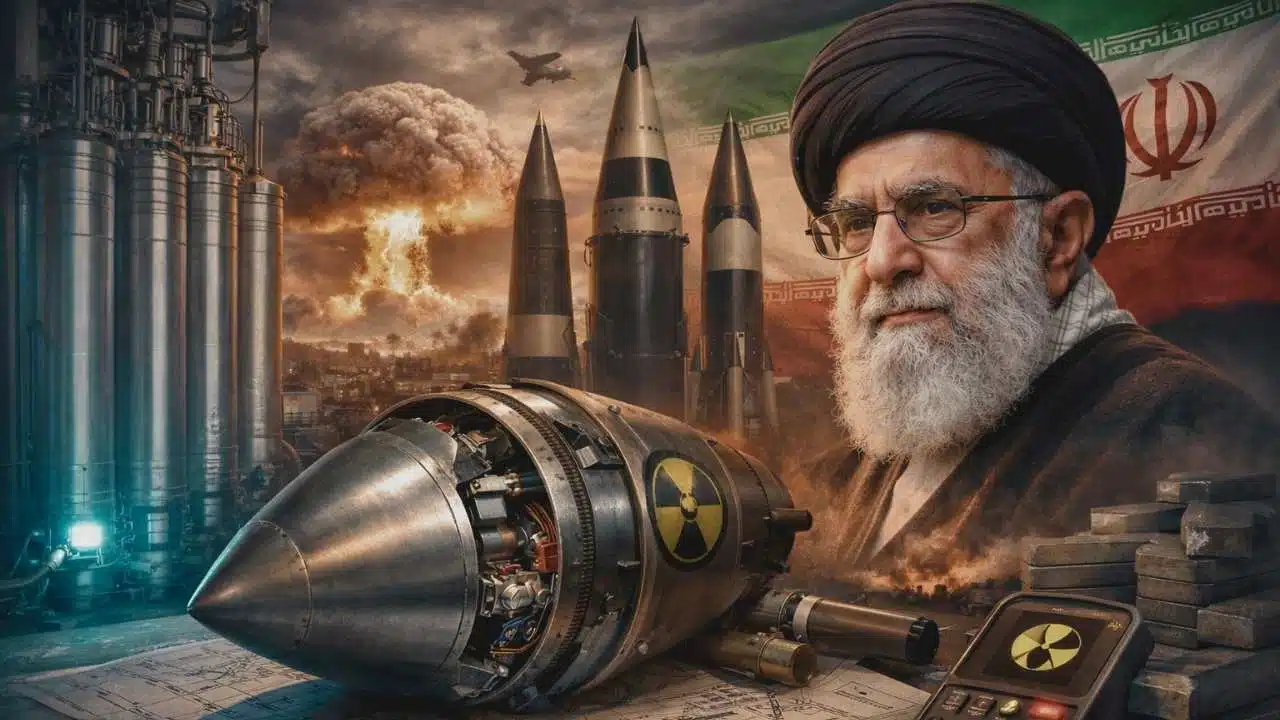
Khamenei authorized nuclear warheads, a new report claims, after the June 2025 Israel–Iran war, as inspectors still track Iran’s large stockpile of 60% enriched uranium.
The claim and what it could mean for Iran’s strategy?
A new policy report published in late December 2025 argues that Iran’s Supreme Leader, Ayatollah Ali Khamenei, approved work tied to “compact” nuclear warheads in October 2025, after the region absorbed the shock of the June 2025 Israel–Iran conflict. If accurate, the decision would be significant because the Supreme Leader has long been described by many observers as the final decision-maker on any move from nuclear “capability” to nuclear “weapons.”
The report’s core point is not that Iran has publicly crossed the threshold to produce a bomb, but that the internal barrier may be shifting—especially on the technical side of weaponization, which includes designing a warhead that can survive delivery and function reliably. In practical terms, the report suggests Iran may now be more willing to invest in the hardest part of nuclear weapon development: building a usable, deliverable warhead rather than only expanding enrichment.
That distinction matters. For years, the international debate has focused heavily on uranium enrichment levels—especially Iran’s production of uranium enriched up to 60%, which is far above typical civilian needs. But enrichment is only one part of the picture. A state can accumulate large amounts of highly enriched uranium and still lack a dependable weapon design or delivery package. The alleged authorization for compact warheads, if real, points to attention on the second piece: turning nuclear material into a missile-ready weapon.
The report also frames the June 2025 war as a turning point in Tehran’s risk calculations. It argues Iran’s leaders may have concluded that conventional deterrence—through missiles, air defenses, and regional partners—has limits when faced with sustained high-end strikes. In that interpretation, nuclear capability becomes less about prestige and more about regime survival and deterrence at the highest level, particularly against nations with superior air power.
At the same time, there is an important caution: the report’s claim rests on descriptions of internal Iranian decision-making that are not fully visible to the public. The most responsible reading is to treat the claim as a serious allegation that should be judged against observable indicators—inspection access, stockpile reporting, missile program patterns, and diplomatic choices—rather than as settled fact.
Where Iran’s nuclear program stands now: stockpiles, verification, and the post-war gap?
Public reporting from international monitoring has repeatedly highlighted two realities at once: Iran has built a large enrichment program, and yet international inspectors have also faced limits on access and verification that have grown in periods of political tension.
The headline number that keeps returning in 2025 is Iran’s inventory of uranium enriched to 60%—often described as “near weapons-grade” because weapons-grade is typically around 90%. Iran has defended its work as peaceful and within its interpretation of national needs. Many Western governments respond that 60% has no credible civilian justification on its own.
In 2025, inspectors have described a growing challenge: after the June conflict and strikes on nuclear-related infrastructure, the monitoring system faced disruptions. When inspectors cannot fully verify inventories, the world’s understanding of exact stockpiles becomes less precise. That doesn’t automatically mean diversion occurred, but it does mean uncertainty increases—and uncertainty is exactly what drives worst-case assumptions in crises.
A key point often raised in IAEA-style technical discussions is “continuity of knowledge.” If inspectors lose continuous observation of materials and equipment, they must rebuild confidence through renewed access, documentation, and verification work. When that rebuild is delayed, the monitoring gap becomes a strategic problem, not only a technical one.
Here is a simplified snapshot of the situation as it is widely discussed in late 2025:
| Issue | What it means | Why it matters |
| 60% enrichment | Uranium enriched far beyond common civilian levels | Shortens the technical distance to weapons-grade if a political decision is made |
| Large overall stockpile | Total enriched uranium has been reported at very high levels | Increases international concern about “breakout” scenarios |
| Monitoring limits | Reduced access and disrupted verification after conflict | Creates uncertainty that fuels escalation risk |
| Undeclared-site questions | Long-running disputes about past traces and locations | Undermines confidence that the full program is declared and understood |
Another factor shaping the conversation is the difference between capability and intent. Intelligence assessments made public in recent years have often stated that Iran is not assessed to be actively building a nuclear weapon, while also emphasizing that Iran’s technical capacity has grown, and that the Supreme Leader remains the key decision-maker.
In plain terms, many governments appear to hold two beliefs at once:
- Iran’s program is now advanced enough that a shift in intent could matter quickly.
- Iran still faces major practical and political hurdles before it could claim a reliable, deliverable nuclear weapon.
That’s why the new report’s alleged October 2025 authorization—focused on compact warheads—lands with such force. It implies Tehran may be concentrating more on the “deliverable weapon” end of the pathway, even if enrichment levels remain publicly discussed at 60%.
What “compact warheads” involve—and why missiles make the story more urgent?
A compact nuclear warhead is not just “a smaller bomb.” It is a complex engineering package designed for a specific delivery system—often a ballistic missile—under harsh physical conditions.
To make a nuclear weapon missile-deliverable, a country typically needs to solve several difficult problems:
- Miniaturization: fitting a warhead within strict space and weight limits.
- Structural hardening: surviving launch vibrations, acceleration, and stress.
- Reentry environment: enduring heat and forces as the payload returns through the atmosphere.
- Fuzing and arming: ensuring safe handling and reliable detonation at the intended time and place.
- Reliability without open testing: building confidence in performance when nuclear testing is politically explosive and internationally condemned.
This is why many nuclear experts treat “weaponization” and “delivery integration” as the longest poles in the tent. Highly enriched uranium can be produced with enough centrifuge capacity and time. But a dependable, compact warhead that can ride a missile is a different level of sophistication.
Missiles matter here because Iran’s missile program is widely viewed as one of the most developed pillars of its conventional deterrence. The new report argues that the June 2025 war reinforced that logic: missiles were central to Iran’s ability to signal capability and impose costs, even as Iran’s leaders may have seen weaknesses elsewhere.
If Iran were ever to pursue a nuclear deterrent, the most immediate delivery method in its existing toolbox would likely involve ballistic missiles. That is also why international scrutiny tends to spike whenever claims emerge about warhead design work, reentry vehicle testing, or unusual missile program milestones.
The report’s phrasing—compact warheads for ballistic missiles—therefore touches the most sensitive overlap: a robust missile force combined with any credible movement toward a nuclear payload.
At the same time, it is important not to jump ahead of evidence. Missile programs can evolve for conventional reasons, and enrichment can rise for leverage in negotiations. The strategic question is whether decision-makers link these elements into an integrated nuclear deterrent plan. That’s exactly what the report claims happened in October 2025.
The diplomatic and security ripple effects: Israel, the Gulf, the U.S., and “snapback” pressure
Even an unconfirmed claim about warhead authorization can reshape behavior, because national security planning often reacts to risk, not certainty.
For Israel, the threshold concern is straightforward: if Iranian leaders decide the only safe deterrent is a deliverable nuclear capability, Israel may conclude that time is shrinking and that diplomacy may not be enough. Israel’s long-standing position has emphasized preventing Iran from reaching a point where it can rapidly weaponize under cover of ambiguity.
For Gulf states, the issue is both immediate and structural. A shift toward nuclear warhead development would deepen fears of escalation, retaliation cycles, and accidental conflict. Gulf governments have also tried to balance regional de-escalation with security partnerships, and nuclear uncertainty complicates that balancing act.
For the United States and European powers, the pressure point becomes enforcement and timelines. In 2025, European parties tied to the 2015 nuclear framework have discussed the restoration of UN sanctions—commonly described as “snapback”—as a tool when they judge Iran to be in significant non-performance. Once such processes start, the political space for compromise typically narrows, because both sides become wary of looking weak.
Iran, for its part, tends to frame these mechanisms as coercive and politically motivated. Tehran has also argued that Western actions—sanctions, sabotage claims, and military strikes—prove that restraint invites attack rather than stability.
This creates a familiar spiral:
- Western states say higher enrichment and reduced cooperation demand more pressure.
- Iran says pressure proves the West is not negotiating in good faith, so Iran should harden its position.
- Each side cites the other’s actions as justification for the next step.
The alleged October 2025 authorization for compact warheads, if true, would be read internationally as escalation—even if Iran does not move immediately to 90% enrichment. It would be treated as evidence that the political barrier is weakening, and that the “latent capability” strategy may be shifting toward something more operational.
There is also the question of external assistance. Reports and speculation over the years have often raised the possibility of knowledge transfer between isolated states. Even rumors of warhead-design cooperation can trigger strong reactions. But publicly verifying such transfers is extremely difficult, and responsible reporting must distinguish between plausible pathways and proven events.
What to watch next: practical indicators that could confirm or undermine the claim?
If the claim is correct, the next phase may not be a dramatic announcement. It is more likely to be seen in patterns—especially in how Iran manages inspections, how its enrichment decisions evolve, and how its missile program signals future roles.
Here are the main indicators analysts and policymakers will likely track in 2026:
| Indicator | What it could suggest | Why it’s important |
| Changes in enrichment level | A move from 60% toward 90% would be a major escalation | Material “breakout” becomes more immediate |
| Growth rate of 60% stockpile | Steady accumulation can increase pressure and shorten timelines | Large stockpiles intensify deterrence fears |
| Verification access after strikes | Restoring full monitoring would reduce uncertainty | Uncertainty drives worst-case planning |
| Unusual missile testing patterns | Focus on payload/reentry features could imply delivery planning | Delivery integration is central to nuclear deterrence |
| Domestic messaging shifts | Rhetoric about deterrence and survival can signal policy changes | Public narrative often prepares ground for decisions |
| Diplomatic deadlines and sanctions steps | Snapback-related actions can close negotiating space | Harder pressure often produces sharper responses |
A separate, often overlooked indicator is institutional behavior. In many countries, weaponization work—if it occurs—tends to involve more secrecy, compartmentalization, and tighter control of personnel and facilities. Changes in how Iran structures sensitive programs, or in which agencies appear to lead them, could matter. But those details are also the hardest to confirm publicly.
One more point deserves emphasis: even if Iran were pursuing compact warhead design, building an operational nuclear force is not simply a sprint. It would require:
- a reliable source of fissile material at the required grade,
- a credible warhead design,
- delivery integration,
- command-and-control arrangements,
- and a political strategy for when and how to reveal capability.
Each of those steps creates opportunities for detection, pressure, sabotage, or internal debate. That is why major nuclear decisions often occur in stages—and why conflicting signals can appear at the same time.
The claim that Khamenei authorized nuclear warheads in October 2025, specifically compact designs suitable for ballistic missiles, is one of the most consequential allegations in the Iran nuclear debate in years. If confirmed, it would suggest Iran’s leadership is placing greater weight on a deliverable nuclear deterrent after the June 2025 war reshaped regional threat perceptions.
But the claim still sits in a space between reporting and proof. The most reliable way to judge it will be through observable trends: whether monitoring gaps narrow or widen, whether enrichment choices remain capped or rise, and whether missile program signals evolve toward roles that match nuclear delivery requirements.
In the coming months, the risk is not only the technical question of what Iran can do, but the political question of what others believe Iran is doing—and how quickly those beliefs translate into decisions that narrow options and raise the chance of escalation.