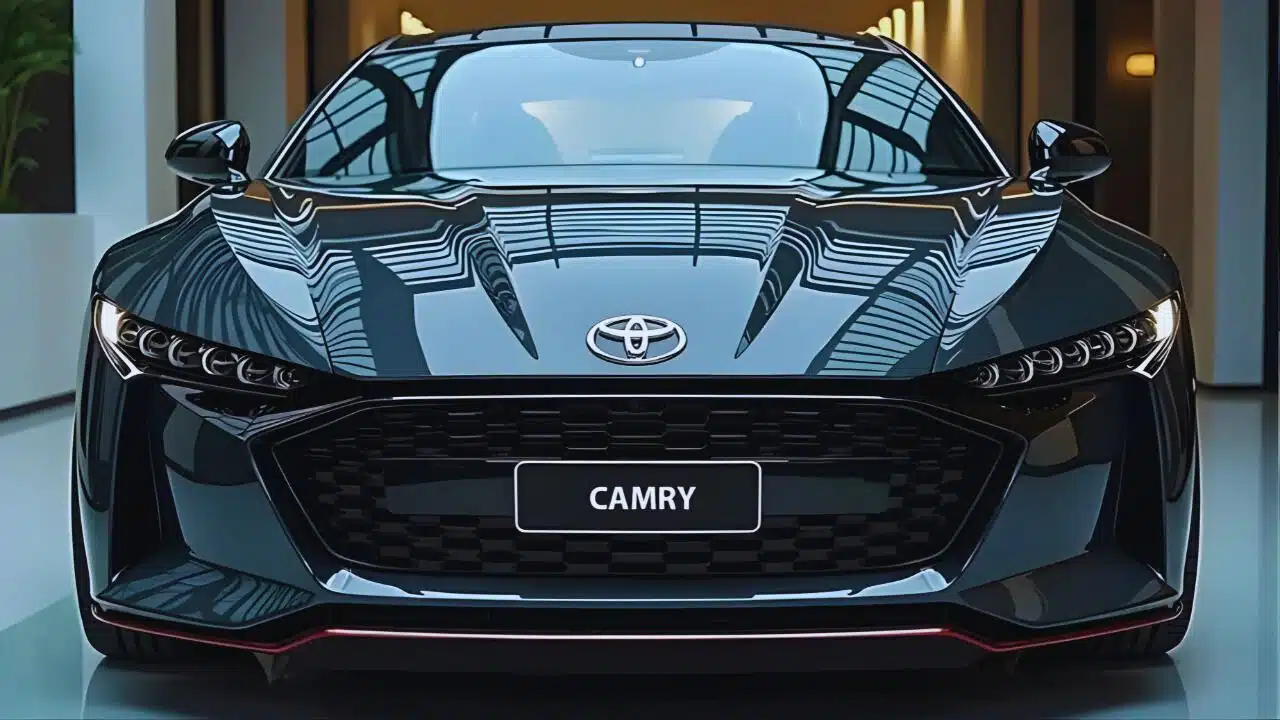
The 2026 Toyota Camry is a smarter, smoother midsize sedan that nails efficiency and everyday comfort, but its “hybrid-only” approach means you’re buying into one powertrain philosophy—whether you love it or not.
After a week of errands, commutes, and a couple of longer highway slogs, the 2026 Toyota Camry feels like Toyota took the old “safe choice” formula and finally gave it more personality—without sacrificing the calm, low-stress driving experience Camry buyers expect.
Positioning: This is a midsize sedan (now hybrid-only) aimed at commuters, small families, and anyone who wants low running costs, high predictability, and modern tech without moving up to a crossover. Toyota confirms the Camry lineup is exclusively hybrid for 2026, with FWD or AWD across the range.
Exterior Design and Practicality
| Quick Take | What to know |
| Design | Sharper “hammerhead” face and more athletic surfacing give the Camry a fresher stance. |
| Daily usability | Easy to place on the road, with sedan-friendly dimensions and a trunk that still works for real life. |
| Practicality | Ground clearance is typical sedan-low; great for aerodynamics, less great for tall curbs. |
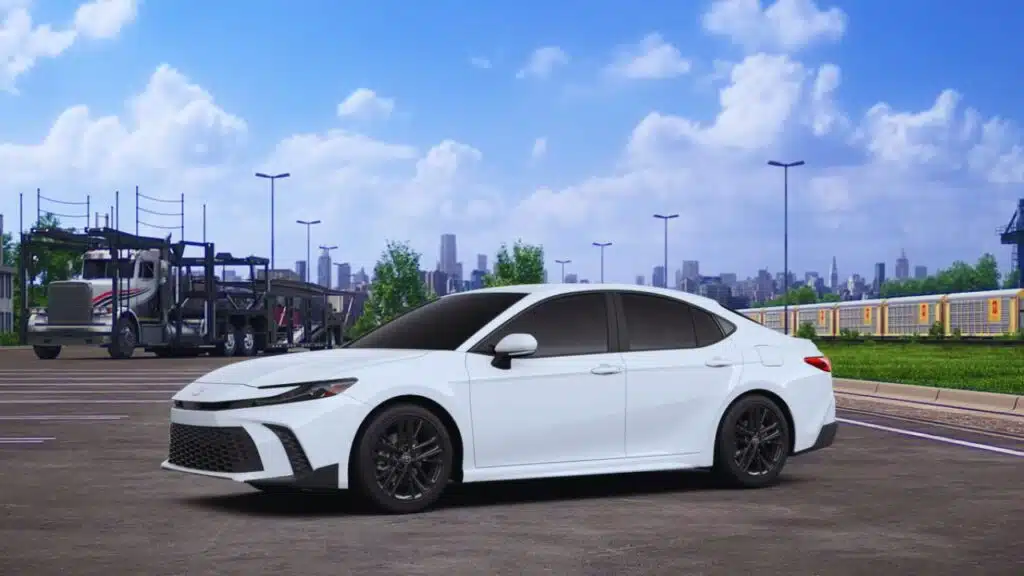
Toyota’s 2026 refresh isn’t a full reinvention—it’s a refinement that reads cleaner and more modern in person. The front-end treatment looks more purposeful, and the sportier grades add enough visual aggression that it no longer feels like the “default rental spec” by design.
Build and paint quality impressions are consistent with what you’d expect at this price: generally solid panel gaps and a finish that looks good when clean. The Nightshade edition leans hard into black accents and 19-inch wheels, which genuinely changes the vibe if you want something less anonymous.
Visibility is good for the class. The roofline is sleek, but it doesn’t punish you with cartoonishly tiny windows. In city traffic and tight parking lots, the Camry feels easy to “thread” because the hood line and body corners are intuitive. Standard driver-assist features (like a backup camera and collision tech) also reduce daily friction.
Trunk space remains one of Camry’s quiet strengths. It’s not trying to be a hatchback, but it’s wide enough and deep enough for airport luggage, a grocery run, or a folded stroller without drama.
Physical specs table
| Spec | 2026 Toyota Camry (typical trim listing) |
| Length | 194 in |
| Width (w/o mirrors) | 72 in |
| Height | 57 in |
| Wheelbase | 111 in |
| Ground clearance (min) | 5 in |
| Cargo volume (trunk) | 15 ft³ |
Interior Comfort and Technology
| Quick Take | What to know |
| Comfort | Toyota reshaped and upgraded seat cushioning; higher trims add quieter glass and more premium seating options. |
| Tech | 8-inch screen standard, 12.3-inch available; wireless CarPlay/Android Auto standard. |
| Cabin vibe | Sport trims lean sporty; XLE/XSE aim closer to near-lux comfort without going full luxury-car fussy. |
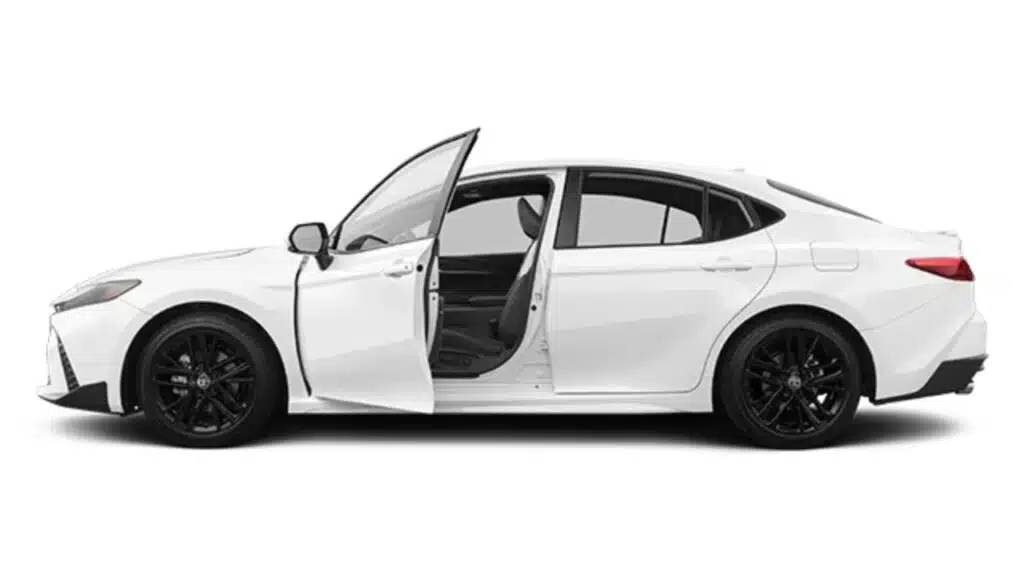
The Camry’s cabin is where the “week-long test drive” improvement shows most. Toyota specifically notes upgrades to seat cushion shape/density and cushion length, and it comes through as better long-haul support—less “flat chair” fatigue after a longer highway run.
Trim personality is more distinct than before. The SE and Nightshade use SofTex-trimmed seats with sporty accents, while the XSE goes leather-trimmed with unique perforation patterns and color choices. The XLE moves in a comfort direction with a leather/Dinamica microfiber combination.
Noise isolation is a clear “buy the right trim” moment. Toyota calls out acoustic laminated glass on XLE and XSE to reduce wind noise and harshness, which matters if you spend lots of time at highway speeds.
The infotainment experience is modern Toyota: snappy enough, logical enough, and not trying to outsmart you. You get an 8-inch touchscreen standard and a 12.3-inch available upgrade, plus wireless Apple CarPlay and Android Auto. There’s also a Qi wireless charging pad and five USB ports across all grades, which is the kind of daily-driving detail that prevents constant “whose phone is dying?” negotiations.
Interior specs table
| Spec | 2026 Toyota Camry |
| Screen size | 8-inch standard; 12.3-inch available |
| Infotainment system | Toyota Audio Multimedia; wireless CarPlay/Android Auto |
| Seating material (high level) | SofTex on SE/Nightshade; leather-trimmed on XSE; leather/Dinamica on XLE |
| Front headroom / legroom | 38 in / 42 in |
| Rear headroom / legroom | 38 in / 38 in |
Performance and Powertrain
| Quick Take | What to know |
| Powertrain strategy | Hybrid-only lineup with a 2.5L engine and Toyota’s 5th-gen hybrid system; FWD or AWD. |
| Feel | Smooth, predictable acceleration with an eCVT tuned to feel more natural under throttle. |
| Ride/handling | Sport-tuned suspension on SE/Nightshade/XSE adds sharpness, but can feel stiffer over rough roads. |
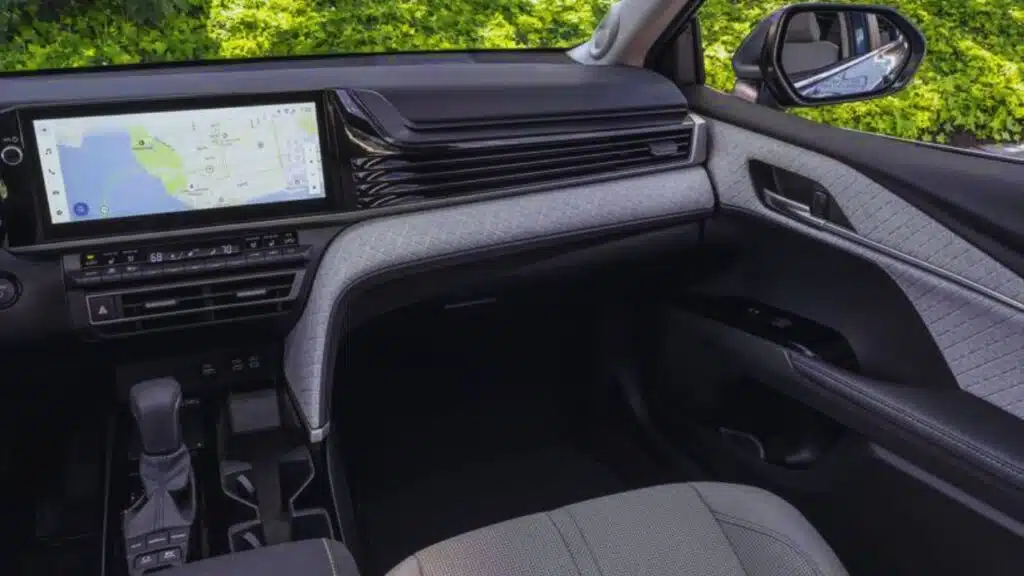
Toyota’s biggest Camry statement is simple: for 2026, it’s hybrid across the board. The powertrain pairs a 2.5-liter four-cylinder with the fifth-generation Toyota Hybrid System and an electronically controlled CVT (eCVT).
The numbers you feel from the driver’s seat are less about “sports sedan fireworks” and more about confident, low-effort momentum. Toyota quotes 225 net combined horsepower for FWD and 232 net combined horsepower for AWD-equipped models.
Around town, the Camry’s best trick is that it rarely feels like it’s working hard. Toyota says engineers tuned THS 5 for a more natural acceleration feel, aiming to reduce the typical “engine flare” sensation some hybrids can show under heavier throttle. In practice, the delivery is smooth and easy to modulate in stop-and-go traffic.
Handling is trim-dependent. Toyota notes that SE, Nightshade, and XSE get a sport-tuned setup, including changes like a larger front stabilizer bar compared to other grades. That pays off in confidence through sweepers and freeway ramps, but it’s also where you’ll notice more sharpness over broken pavement.
Performance specs table
| Spec | 2026 Toyota Camry |
| Engine / hybrid system | 2.5-liter 4-cylinder + 5th-gen Toyota Hybrid System |
| Net combined output | 225 hp (FWD) / 232 hp (AWD) |
| Torque (gas engine listing) | 163 lb-ft @ 5200 rpm |
| Transmission | eCVT |
| 0–60 mph time | Not officially published by Toyota (varies by trim/testing) |
Fuel Economy and Real-World Running Costs
| Quick Take | What to know |
| Efficiency | Camry’s hybrid-only approach delivers strong EPA numbers; the exact figure depends heavily on trim and AWD. |
| Fuel | Regular gasoline. |
| Ownership perks | ToyotaCare included for 2 years/25,000 miles; strong hybrid battery coverage. |
If you’re shopping Camry, fuel economy is probably a top-three reason. Toyota specifically highlights up to a manufacturer-estimated 51 MPG combined on the LE FWD grade, and the model remains available in both FWD and AWD.
EPA data shows how much AWD and trim can change the story. For example, a 2026 Camry HEV AWD XSE is listed at 43 mpg combined (43 city / 43 highway) on regular gasoline, with a 13.0-gallon tank.
In real-world mixed driving, the Camry’s results tend to be shaped by speed, temperature, and how often your commute allows steady-state cruising. The good news is that the Camry doesn’t require special fuel, and the hybrid system’s “quiet efficiency” is most noticeable when you’re doing lots of low-speed starts and stops.
Maintenance and ownership costs are where Toyota leans into peace-of-mind. ToyotaCare covers normal factory scheduled maintenance for 2 years or 25,000 miles, plus 2 years of 24-hour roadside assistance (unlimited miles). Hybrid-related components are covered for 8 years/100,000 miles, and the hybrid battery is covered for 10 years/150,000 miles (transferable).
Economy table
| Metric | 2026 Toyota Camry (example: HEV AWD XSE) |
| City MPG | 43 |
| Highway MPG | 43 |
| EPA combined MPG | 43 |
| Real-world MPG (mixed) | Expect to land near EPA with normal driving; varies with speed/temps |
| Fuel tank capacity | 13.0 gallons |
Safety and Driver Assistance
| Quick Take | What to know |
| Crashworthiness | IIHS ratings for 2025–26 Camry tests show “Good” results in major crash tests; some sub-notes apply. |
| ADAS | Toyota Safety Sense 3.0 standard, with a long list of everyday-use features. |
| NHTSA | EPA listing shows NHTSA results as “Not Available” for the referenced 2026 configuration. |
On the road, the Camry’s driver assistance suite feels like it was built for the daily grind: keeping you centered, helping manage distance in traffic, and stepping in when something unexpected happens.
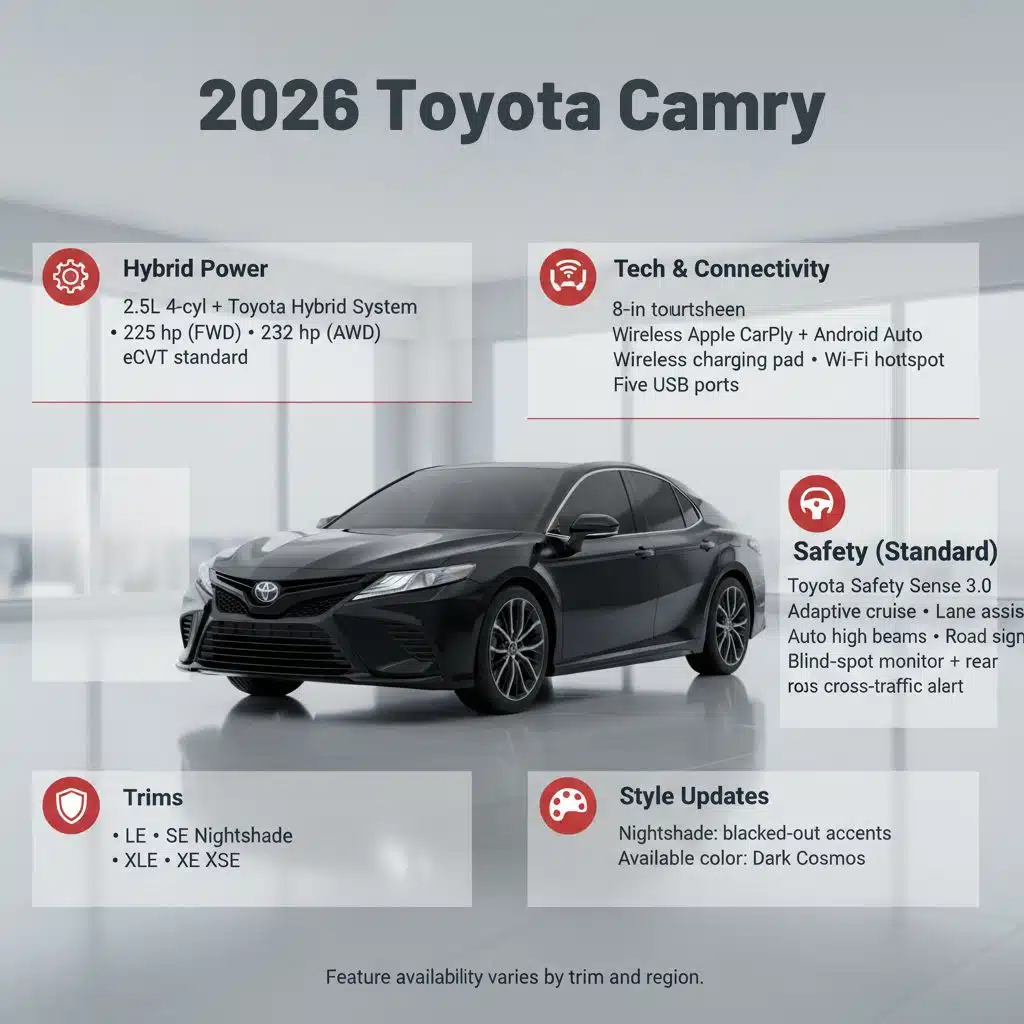
Toyota Safety Sense 3.0 is standard and includes key systems like Pre-Collision System with Pedestrian Detection, Full-Speed Range Dynamic Radar Cruise Control, Lane Departure Alert with Steering Assist, Lane Tracing Assist, Road Sign Assist, Automatic High Beams, and Proactive Driving Assist.
On the crash-testing side, the IIHS page for the 2026 Camry notes ratings apply to 2025–26 models and shows “Good” results in the major crash tests displayed (with an “Acceptable” noted in passenger restraints/dummy kinematics in the passenger-side small overlap section).
For NHTSA, the fueleconomy.gov listing shown for a 2026 Camry HEV AWD XSE indicates crash test results are “Not Available.”
Safety features table
| Category | 2026 Toyota Camry |
| IIHS crashworthiness snapshot | Major tests shown as “Good”; ratings apply to 2025–26 models |
| Standard ADAS suite | Toyota Safety Sense 3.0 (PCS w/PD, DRCC, LDA w/SA, LTA, RSA, AHB, PDA) |
| Airbag count | Not specified in Toyota press release (check window sticker/build sheet) |
| NHTSA rating | Not available (per EPA listing shown) |
2026 Toyota Camry vs. 2026 Honda Accord Hybrid
| Quick Take | What to know |
| The vibe | Camry leans “quiet confidence + lots of trims + optional AWD,” Accord leans “clean cabin + smooth hybrid + classic Honda road manners.” |
| Best for | Camry: efficiency plus AWD availability across grades. Accord: people who prefer Honda’s ergonomics and driving feel. |
| The catch | Camry is hybrid-only (take it or leave it). Accord Hybrid trims must be chosen carefully for the features you want. |
This matchup is the heart of the midsize-sedan market. The Camry’s standout differentiator is simple: Toyota offers FWD or AWD across the Camry hybrid lineup. Toyota also quotes 225 hp (FWD) or 232 hp (AWD) net combined output, depending on configuration.
In daily use, the bigger difference is how each car reduces your workload. The Camry’s cabin and tech upgrades (screen choices, standard wireless phone mirroring, lots of charging points) make it easy to live with.
For warranties, Toyota spells out the basics clearly in its press release: 3 years/36,000 miles basic, 5 years/60,000 miles powertrain, 8 years/100,000 miles hybrid components, and 10 years/150,000 miles hybrid battery, plus ToyotaCare for 2 years/25,000 miles.
Honda’s warranty coverage depends on market/terms, so you’ll want to verify your region’s booklet; Honda’s U.S. warranty overview is typically 3 years/36,000 miles basic and 5 years/60,000 miles powertrain.
Head-to-head table (high-level)
| Item | 2026 Toyota Camry | 2026 Honda Accord Hybrid |
| Price (MSRP snapshot) | Starts around $29,000 (by trim listing) | Varies by trim/market (verify local pricing) |
| Horsepower | 225 hp (FWD) / 232 hp (AWD) net combined | Varies by configuration (verify exact hybrid output for the trim you want) |
| Fuel economy | Example: 43 mpg combined (HEV AWD XSE) | Varies by trim; check EPA listings for the exact Accord Hybrid grade |
| Warranty period | 3/36 basic; 5/60 powertrain; hybrid battery 10/150 | See Honda warranty terms for your market |
Final Verdict: Is the 2026 Toyota Camry Worth Your Money?
If you want a midsize sedan that feels thoroughly updated, sips fuel, and stays easy to live with day after day, the 2026 Camry makes an extremely strong case—especially if you like the idea of hybrid power as the default, not the upgrade.
The value story works because Toyota didn’t just chase MPG headlines. It also improved the parts you touch every day: seating comfort, cabin quiet (on the right trims), and a tech stack that’s finally competitive without being annoying.
Pricing is still trim-dependent, but the market positioning is clear: this is a mainstream sedan priced to compete, with a wide spread from base LE to more feature-rich XLE/XSE.
Pros
- Hybrid-only lineup makes efficiency and smoothness the “default experience.”
- Available AWD across all grades is a real differentiator in this segment.
- Strong tech fundamentals: wireless phone mirroring, multiple screen sizes, lots of USB ports.
- Cabin materials and trim personalities are more distinct than before.
- ToyotaCare included for 2 years/25,000 miles helps reduce early ownership costs.
- Hybrid battery coverage is long and clearly stated.
Cons
- If you want a non-hybrid option, the Camry no longer offers it.
- Sport-tuned trims can trade some ride softness for sharper handling.
- Some safety ratings (like NHTSA in the referenced EPA listing) may not be available for certain 2026 configurations yet.
- Trunk is solid, but it’s still a sedan—no hatchback versatility.
Who should buy the 2026 Camry
- Commuters who want excellent fuel economy without changing driving habits.
- Buyers who want a modern cabin and strong standard tech without paying luxury-brand money.
- Anyone who values AWD availability in a sedan and wants it without jumping to an SUV.
Who should look elsewhere
- Drivers who dislike eCVT behavior and want a more traditional stepped transmission feel.
- Shoppers who prioritize maximum cargo flexibility (a hatchback or compact SUV will fit better).
- Anyone who wants a non-hybrid base engine option (this is no longer that car).
FAQs on 2026 Toyota Camry Review
Is the 2026 Camry actually quick, or just “efficient”?
It’s more “effortless” than “exciting.” The headline is up to 232 net combined horsepower with available electronic AWD, which translates to confident merging and easy passing—not sports-sedan drama.
What’s the most efficient version?
The EPA listing shows the 2026 Camry HEV LE (FWD) at 51 mpg combined (52 city / 49 highway).
Does the 2026 Camry take regular gas?
Yes—FuelEconomy.gov lists it as Regular Gasoline for the 2026 Camry hybrids shown.
Yes—both are listed as Premium Gasoline on FuelEconomy.gov, and Mercedes also notes premium fuel requirement on its specs page.
Should I cross-shop a Lexus ES 300h instead?
If your “week behind the wheel” priority is quiet luxury and cabin polish, yes. If your priority is maximum mpg-per-dollar and a lower buy-in, the Camry is the better fit.
Is AWD available on the 2026 Camry?
Yes—Toyota notes available electronic AWD, and the EPA list includes an AWD LE variant (50 mpg combined).