Hardwood floors are more than just a surface to walk on; they are a timeless investment that defines the character of a home. However, even the highest quality oak or maple planks eventually suffer from graying traffic paths, deep scratches, and sun fading. If you are noticing these signs, you are likely asking the big question: What is the cost to refinish hardwood floors in 2026?
As we move into 2026, the national average cost to refinish hardwood floors typically ranges between $3.00 and $8.00 per square foot. For a standard 500-square-foot living room, this translates to a total investment of $1,500 to $4,000. However, this wide range is influenced by specific factors such as your zip code, the condition of your subfloor, and whether you choose premium dustless sanding or eco-friendly water-based finishes.
In this guide, we will break down every penny involved in the refinishing process. We will compare prices across 10 major U.S. cities, analyze the price difference between DIY and professional work, and help you decide if restoration is the right financial move for your home this year.
Key Takeaways
-
Budgeting: Expect to pay $3 – $8 per sq. ft. for professional refinishing in 2026.
-
Geography Matters: Homeowners in NYC or San Francisco will pay nearly double what homeowners in Texas or Arizona pay.
-
Method: “Screen and Recoat” is a cheaper alternative ($1.50-$3.50) if your floors only have minor surface wear.
-
Time: Plan for 3-5 days of work plus curing time. Water-based finishes get you back in your home faster.
-
Value: Refinishing is cheaper than replacing and offers a high ROI (147%), making it one of the smartest home improvement projects for 2026.
The 2026 Hardwood Market: What to Expect Before You Budget
Before diving into the specific price tables, it is critical to understand that hardwood refinishing is not a fixed-price commodity like buying a new appliance. It is a skilled trade service where 75% of your investment goes toward labor, not materials.
In 2026, the flooring industry has seen a stabilization in lumber prices, but a rise in skilled labor rates. This means that while the cost of a gallon of polyurethane remains relatively steady, the cost to hire a seasoned professional who can operate a 200lb drum sander without gouging your floors has increased.
When reviewing the estimates below, keep in mind that the “Base Price Per Square Foot” typically covers:
-
Standard sanding: Removing the old finish and minor surface scratches.
-
Filling: Trowel-filling small gaps between boards.
-
Finishing: Applying one coat of sealer and two coats of polyurethane.
What is NOT usually included in the base rate? Deep structural repairs, staircases (often priced per tread), carpet removal, and furniture moving are almost always treated as “add-ons.” Understanding this distinction is key to reading the quotes below accurately and avoiding “sticker shock” when you receive your final bid.
2026 National Average Cost Breakdown
When budgeting for your project, it is helpful to look at the costs in tiers. Not every floor needs a full restoration; some simply need a cosmetic touch-up.
Cost Per Square Foot by Method
The cost to refinish hardwood floors depends heavily on the intensity of the labor required.
| Service Level | Cost Range (Per Sq. Ft.) | Best For |
| Screen and Recoat (Buffing) | $1.50 – $3.50 | Dull floors with minor surface scratches; no bare wood exposed. |
| Standard Sand & Refinish | $3.00 – $6.00 | Visible wear, gray patches, or light water stains. Includes sanding to raw wood. |
| Premium / Dustless Refinishing | $5.00 – $8.00 | Homes with sensitive HVAC systems or asthma concerns; includes HEPA filtration. |
| Custom / Restoration | $6.00 – $9.00+ | Bleaching, wire-brushing, hand-scraping, or extensive repair work. |
Labor vs. Materials: Where Does the Money Go?
One of the most common misconceptions is that the price is driven by the cost of the polyurethane or stain. In reality, labor accounts for 75% to 80% of your total quote.
-
Labor ($2.50 – $6.50/sq. ft.): This covers the physical exertion of hauling 200lb sanding machines, the technical skill of applying an even coat of finish without bubbles, and the time spent waiting for coats to dry.
-
Materials ($0.50 – $1.50/sq. ft.): This includes sanding belts (which wear out quickly), wood filler, stain, and the finish itself. High-end finishes like Bona Traffic HD can cost upwards of $150–$180 per gallon in 2026, driving material costs up for premium jobs.
City-by-City Cost Guide (2026 Projections)
Location is the single biggest variable in your final invoice. A contractor in Manhattan faces higher insurance premiums, parking costs, and cost-of-living expenses than a contractor in San Antonio. Below is the projected cost to refinish hardwood floors in 10 major metropolitan areas for 2026.
| City | Cost Range (Per Sq. Ft.) | Estimated Cost (500 sq. ft. Room) |
| New York, NY | $6.40 – $9.00 | $3,200 – $4,500 |
| Los Angeles, CA | $5.50 – $8.00 | $2,750 – $4,000 |
| San Francisco, CA | $5.00 – $8.50 | $2,500 – $4,250 |
| San Diego, CA | $4.30 – $7.70 | $2,150 – $3,850 |
| Philadelphia, PA | $4.00 – $7.00 | $2,000 – $3,500 |
| Chicago, IL | $3.50 – $6.00 | $1,750 – $3,000 |
| Dallas, TX | $3.00 – $4.50 | $1,500 – $2,250 |
| Houston, TX | $3.00 – $4.25 | $1,500 – $2,125 |
| San Antonio, TX | $2.80 – $4.00 | $1,400 – $2,000 |
| Phoenix, AZ | $2.70 – $4.00 | $1,350 – $2,000 |
Local Insight: In dense urban areas like NYC or Chicago, expect “hidden” surcharges for high-rise work. If the crew has to haul equipment up a walk-up or pay for daily commercial parking, those costs will be passed on to you.
Key Factors That Influence Your Price Quote
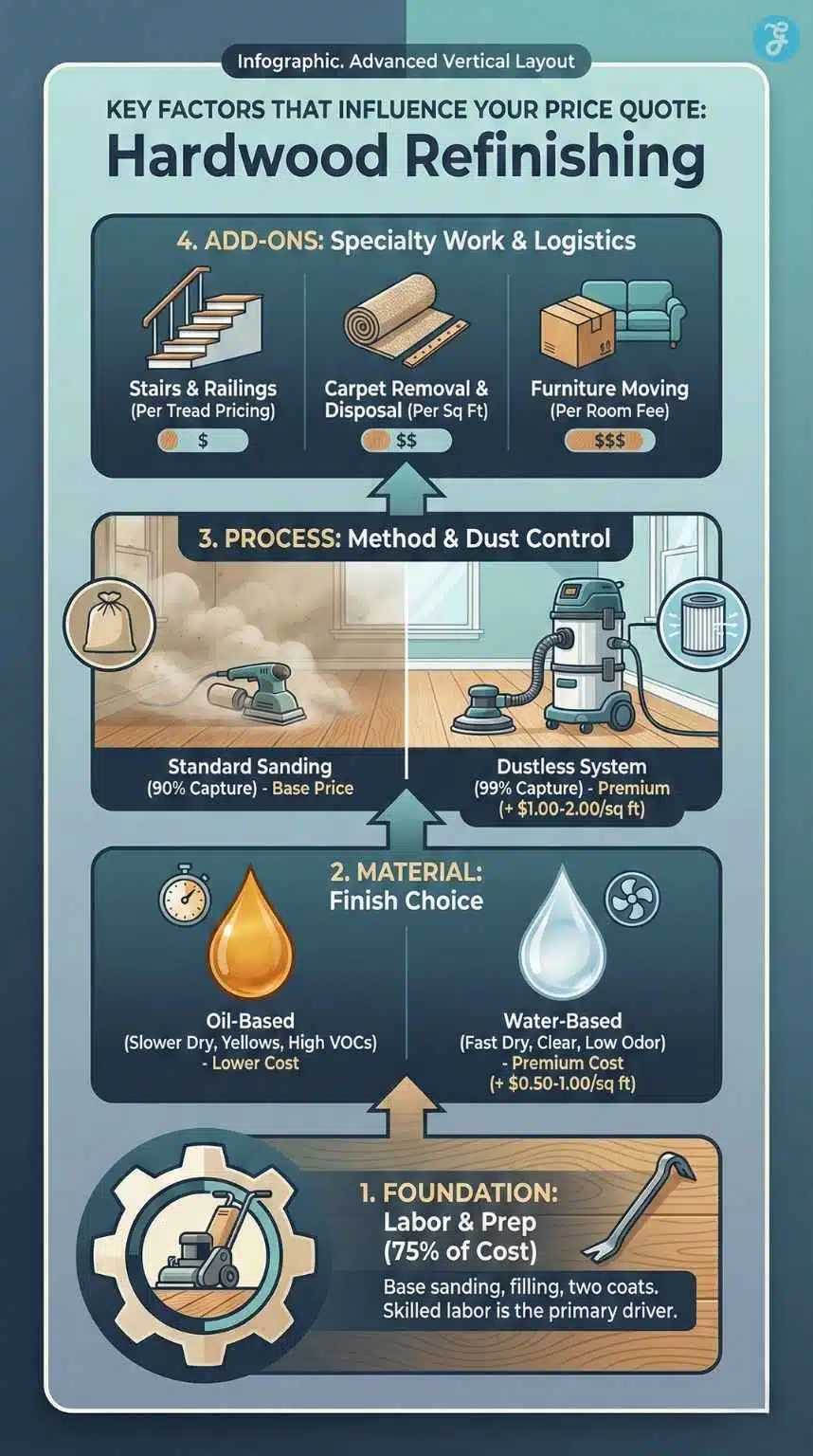
When a flooring professional visits your home for an estimate, they are looking at more than just the square footage. Here are the specific variables that will push your cost to refinish hardwood floors toward the higher or lower end of the spectrum.
1. The “Dustless” Sanding Premium
Standard sanding is notoriously messy. It generates a fine wood dust that can travel through your HVAC system and settle on every surface in your home.
-
Standard Sanding: Uses a canvas bag to collect dust. It captures about 90% of the dust, but the remaining 10% is significant.
-
Dustless Sanding: Uses a trailer-mounted industrial vacuum system with HEPA filters. This captures roughly 99% of dust.
-
Cost Impact: Expect to pay an additional $1.00 – $2.00 per square foot. For homeowners with allergies or those remaining in the home during the process, this is often considered non-negotiable.
2. Finish Type: Oil vs. Water-Based
The liquid you choose to seal your floor affects both the price and the longevity of the job.
-
Oil-Based Polyurethane: The traditional choice. It is cheaper ($30-$50/gallon) and provides a rich, amber glow. However, it takes 24 hours to dry between coats and releases high VOCs (volatile organic compounds) that smell strong.
-
Water-Based Polyurethane: The modern standard. It is more expensive ($100-$180/gallon for high-grade options like Bona Traffic HD) but dries in 2-4 hours. It is clear, non-yellowing, and has very low odor.
-
Cost Impact: Choosing a high-traffic water-based finish can add $0.50 – $1.00 per square foot to the project, but it allows you to move furniture back in sooner (often in 3 days vs. 7-14 days for oil cure time).
3. Stair Refinishing
Stairs are the most labor-intensive part of any flooring job. Sanders cannot use their large machines on treads; they must use small hand-held edgers and scrapers.
-
Cost Impact: Stair refinishing is rarely charged by the square foot. Instead, expect to pay $45 – $85 per step. If you have spindles and risers that also need sanding and painting, the cost can easily exceed $100 per step.
4. Carpet Removal
If your beautiful hardwood is currently hiding under a 1990s beige carpet, you need to factor in demolition.
-
Cost Impact: Professionals typically charge $0.50 – $1.00 per square foot to rip up carpet, remove the tack strips, and haul away the debris. You can save money by doing this yourself, but be warned: pulling up thousands of staples is back-breaking work.
5. Furniture Moving
Refinishing requires a completely empty room.
-
Cost Impact: If you cannot move the furniture yourself, flooring companies may charge $200 – $500 per room or a flat fee for the whole house. Some companies do not offer this service at all due to liability reasons, so always ask upfront.
The Hidden Costs: Repairs and Prep
The base cost to refinish hardwood floors assumes the wood is in decent structural condition. However, once the sanding begins, issues often reveal themselves.
Pet Stains and Water Damage
If you have dark black stains from pet urine or potted plants, sanding often cannot remove them because the uric acid or water has penetrated deep into the wood fibers.
-
The Fix: You will need to replace the damaged boards.
-
The Cost: Board replacement runs $10 – $20 per square foot for labor and materials, plus the difficulty of weaving new wood into old wood.
Squeak Repair
A refinishing project is the best time to fix squeaky floors. Contractors can screw down loose subflooring or inject adhesives.
-
The Cost: usually billed at an hourly rate of $75 – $125/hr.
Subfloor Preparation
If the subfloor is uneven, the sanding machine may “chatter,” leaving waves in your floor. Leveling or reinforcing the subfloor is an extra expense that is hard to predict until the carpet is removed.
Refinish vs. Replace: The 2026 Financial Verdict
In 2026, the gap between refinishing and replacing has widened. Due to supply chain variances and lumber costs, purchasing new solid hardwood has become significantly more expensive.
Refinishing
-
Total Cost: $3 – $8 per sq. ft.
-
Timeline: 3 – 5 Days.
-
Disruption: Moderate (smell, noise, no foot traffic).
-
Lifespan: Adds another 10-15 years to the floor.
Replacing (New Solid Hardwood)
-
Total Cost: $9 – $16+ per sq. ft. (Includes demolition of old floor, new materials, and installation).
-
Timeline: 7 – 14 Days.
-
Disruption: Severe (major construction zone).
-
Lifespan: 50+ years (starting from scratch).
The Verdict: Refinishing costs roughly 50% to 60% less than replacing. Unless your current floors are too thin to be sanded again (less than 1/8th inch of wear layer remaining), refinishing is almost always the smarter financial choice.
Step-by-Step: What You Are Paying For
To understand the cost to refinish hardwood floors, it helps to visualize the labor involved. You aren’t just paying for a “sanding”; you are paying for a multi-stage craftsmanship process.
-
Preparation: The room is sealed off with plastic sheeting. Vents are covered to prevent dust travel. All nails sticking up are punched down to avoid ripping the sanding belt.
-
Rough Sanding: A coarse-grit paper (36 or 40 grit) is used to strip the old finish and level the floor. This removes the deepest scratches.
-
Intermediate Sanding: The floor is sanded again with medium grit (60-80) to smooth out the scratches left by the rough sanding.
-
Filling: A wood filler trowel-fill is often applied to the entire floor to fill gaps between boards.
-
Fine Sanding: A final pass with fine grit (100-120) leaves the wood baby-smooth.
-
Staining (Optional): If you are changing the color, the stain is applied by hand or buffer. This requires “popping the grain” (wetting the wood) for dark colors, which requires more skill and time.
-
Sealing: The first coat of sealer is applied.
-
Buffing: Between coats of finish, the floor is lightly screened (buffed) to ensure the next coat adheres properly.
-
Final Coats: Two to three coats of polyurethane are applied for protection.
DIY vs. Professional: Is It Worth the Risk?
In 2026, the “YouTube University” generation is more active than ever. You might be tempted to rent a drum sander from a big-box store and save thousands. But are the savings real?
DIY Cost Breakdown (500 Sq. Ft.)
-
Equipment Rental: $300 – $500 (3-4 days for drum sander, edger, buffer).
-
Sandpaper: $150 – $250 (professionals buy in bulk; you pay retail).
-
Finish/Stain: $200 – $400 (retail price for 4-5 gallons).
-
Miscellaneous: $100 (plastic, tape, respirators, brushes).
-
Total DIY Cost: $750 – $1,250 ($1.50 – $2.50 per sq. ft.)
The Risk Factor
While you save roughly $2 per square foot, the risks are high:
-
The “Chatter” Marks: Amateur drum sanders often leave horizontal wave marks that are invisible until you apply the stain. Once stained, they are permanent.
-
The “Divot”: If you stop moving the sander for even one second while it is running, it will dig a trench in your floor that cannot be fixed.
-
Edging Issues: Blending the edges (done with a spinner) with the main floor (done with a drum) is an art form. Amateurs often leave a visible “picture frame” border around the room.
Recommendation: If the floor is in a low-visibility area (like a spare bedroom), DIY is a valid option. For your main living room or hallway, the cost to refinish hardwood floors professionally is worth the investment to avoid permanent errors.
Smart Hiring: How to Vet Your Flooring Contractor
Knowing the average cost is only half the battle; finding a reliable professional who stays within that budget is the other. In the flooring industry, the lowest bid is often the most dangerous one. A contractor cutting corners on price is likely cutting corners on sanding quality or finish grade.
Before you sign a contract in 2026, ask these five critical questions to ensure you are hiring a true craftsman.
1. “Do you have Worker’s Compensation and Liability Insurance?”
Never hire a contractor who cannot produce a current certificate of insurance.
-
Why it matters: Hardwood refinishing involves highly flammable chemicals and heavy machinery. If a worker gets injured in your home or a sander sparks a fire, you could be liable for the damages if the contractor is uninsured.
2. “How will you handle dust containment?”
Listen carefully to their answer.
-
Red Flag: “We just sweep up at the end.”
-
Green Flag: “We use a vacuum system attached to the sanders and seal off the doorways with plastic.” (Even if it’s not a full HEPA system, they must have a containment plan).
3. “Can you measure my floor’s wear layer?”
Ask this before they give you a final quote.
-
The Test: A pro will check a floor vent or pull up a transition strip to see how much wood is left on top of the tongue-and-groove.
-
Why it matters: If they promise to sand your floors without checking the thickness first, they risk sanding through the wood and ruining your floor permanently.
4. “What specific brand of finish do you use?”
Don’t settle for “a good water-based finish.” Demand the brand name.
-
The Check: If they quote you a high price but are using a cheap “big box store” finish (like Minwax or Varathane), you are overpaying. Professional-grade finishes (like Bona, Loba, or Pallmann) cost more but last 10+ years longer.
5. “Is the final coat included in the timeline?”
A common trick is to quote a 3-day job, but that only covers the sanding and first coat.
-
The Reality: You cannot walk on the floor for at least 24 hours after the final coat. Ensure their timeline includes the full curing window so you don’t end up with socks stuck to your new floor.
Return on Investment (ROI) in 2026
Real estate data for 2026 continues to show that hardwood floors are a top priority for homebuyers.
-
ROI: The National Association of Realtors (NAR) estimates that refinishing hardwood floors recovers 147% of the cost upon resale. If you spend $3,000 refinishing, you can expect your home’s value to increase by roughly $4,400.
-
Sellability: Homes with newly refinished floors spend less time on the market. It signals to buyers that the home has been well-maintained and is “move-in ready.”
Protecting Your Investment: Post-Refinishing Care
Once the crew packs up and leaves, the longevity of your beautiful new floors is entirely in your hands. A common mistake homeowners make is treating the floor as “fully cured” the moment it feels dry to the touch. In reality, the finish is still hardening for weeks.
Here is your 2026 survival guide to keeping those floors flawless.
Phase 1: The “Curing” Period (The First 30 Days)
The most critical damage usually happens in the first month.
-
First 24 Hours: Do not walk on the floor. Period.
-
Days 2–4: Socks only. Do not wear shoes and do not drag furniture.
-
Day 5: You can typically move furniture back in, but lift it—never drag it.
-
First 30 Days (Crucial): Do not put down area rugs. The finish needs oxygen to cure. If you cover it with a rug too early, the floor under the rug may turn a different shade than the rest of the room (a phenomenon called “shading”).
Phase 2: Daily Cleaning Rules
Forget what your grandmother taught you about vinegar and water. In 2026, we know that vinegar is acidic and will eventually dull modern polyurethane finishes.
-
The Tool: Use a high-quality microfiber mop. It traps dust rather than pushing it around like a traditional broom.
-
The Cleaner: Use a pH-neutral hardwood floor cleaner (brands like Bona or Pallmann are industry standards).
-
The “Never” List:
-
NEVER use a steam mop. The forced steam drives moisture between the boards, causing cupping and peeling of the finish.
-
NEVER use “glow” or “polish” products (like Mop & Glo or Murphy’s Oil Soap). They leave a waxy residue that makes it impossible to screen and recoat your floors in the future.
-
Phase 3: Preventive Defense
-
Felt Pads: Stick heavy-duty felt pads on the legs of every single chair, sofa, and table. Plastic glides will eventually scratch the finish.
-
Pet Nails: Keep dog nails trimmed. If you hear them “clicking” on the floor, they are scratching the finish.
-
Humidity Control: Hardwood is organic—it breathes. Keep your home’s humidity between 35% and 50%. If it gets too dry (winter), the boards will shrink and gap. If it gets too wet (summer), they will swell and cup.
Frequently Asked Questions (FAQ)
1. How long does it take for the smell to go away after refinishing?
If you choose oil-based polyurethane, the strong chemical smell can linger for 7 to 14 days, and you should ensure good ventilation during that time. If you choose water-based polyurethane, the smell is very mild and typically dissipates completely within 24 to 48 hours. This is a primary reason why many families in 2026 are opting for water-based finishes despite the slightly higher material cost.
2. Do I have to move all my furniture out?
Yes, the room must be completely empty. Sanding machines are large and bulky, and the floor finish needs a continuous, uninterrupted surface to dry evenly. You cannot do one half of the room and then the other without leaving a visible “lap line” in the finish. Most homeowners rent a portable storage container (POD) for their driveway during the project.
3. Can you refinish engineered hardwood floors?
It depends on the thickness of the “wear layer” (the top slice of real wood). If the wear layer is at least 3mm thick, it can usually be sanded and refinished once or twice. If it is thinner (1mm – 2mm), you risk sanding through to the plywood core, which ruins the floor. Always have a professional check a floor vent or transition strip to measure the thickness before starting.
4. How do I know if I need a full sanding or just a screening?
Try the “water test.” Pour a tablespoon of water on the most worn area of your floor.
-
If the water beads up, your finish is still intact; you might just need a thorough cleaning or a screen and recoat.
-
If the water slowly soaks in and darkens the wood, the finish is compromised, and you need a full sand and refinish.
-
If the water soaks in immediately, your wood is exposed and vulnerable; book a refinishing ASAP.
5. Is the “Dustless” option really 100% dust-free?
No system is 100% dust-free, but “dustless” systems are about 98-99% effective. The trailer-mounted vacuums are powerful enough that you won’t find a layer of dust on your countertops or curtains. In contrast, traditional sanding bags capture only about 85-90% of the dust, leaving a fine film throughout the house. For the extra $1-$2 per square foot, the dustless option saves you hours (or days) of deep cleaning.
Final Thoughts: Breathing New Life Into Your Home
Reviving your hardwood floors is one of the few home improvements that offers immediate visual gratification alongside long-term financial gain. While the upfront cost of $3.00 to $8.00 per square foot might seem significant, it pales in comparison to the hefty price tag of full replacement. In 2026, preserving the character of your original wood is not just an eco-friendly choice; it is a smart investment strategy.
Don’t let minor wear turn into structural damage. Whether you choose a simple screen-and-recoat or a full custom restoration, the result is a home that feels cleaner, brighter, and substantially more valuable. Take the time to vet your professional, choose a durable finish, and enjoy the timeless beauty of your “new” old floors.