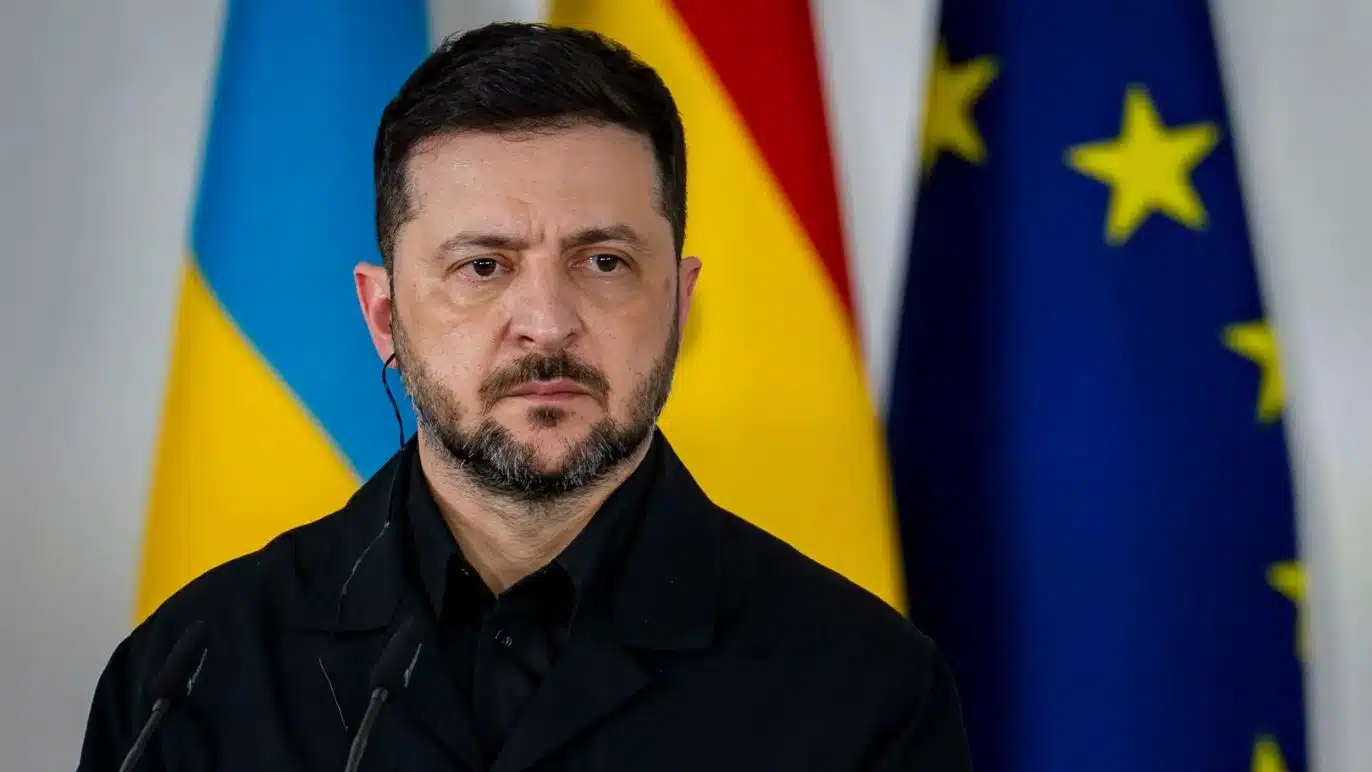
Ukrainian President Volodymyr Zelensky has warned that Russia is preparing to wage a fresh “year of war” in 2026, signaling that the Kremlin intends to prolong and possibly intensify its full‑scale invasion despite mounting diplomatic efforts to negotiate an end to the conflict. His comments, delivered in a nightly address, directly challenged narratives that Moscow is ready to compromise and instead framed recent Russian moves as a deliberate attempt to lock in a long, grinding war against Ukraine and potentially threaten wider European security.
Zelensky’s stark warning for 2026
In his evening address, Zelensky said Ukraine had “again heard signals from Moscow that they are preparing to make next year a year of war,” describing these as deliberate messages from Russian President Vladimir Putin and his military leadership. He cast these signals as more than rhetoric, arguing that they reflect real planning orders, force restructuring, and political decisions inside Russia that point toward continued large‑scale fighting.
Zelensky stressed that these warnings are not only aimed at Ukrainians but at Western partners who, he said, must recognize that any suggestion Russia “wants to end the war” is contradicted by its actions and official statements. He urged allies, especially in the United States and Europe, to understand that Moscow is trying to undermine diplomacy while preparing to escalate or at least sustain the conflict well into 2026.
Putin’s vows to ‘certainly’ achieve war aims
Zelensky’s remarks came in direct response to Putin’s latest comments at an expanded meeting of Russia’s Defense Ministry, where the Russian leader reiterated that the objectives of what Moscow still calls its “special military operation” will “certainly” be achieved. Putin signaled that Russia is increasing its offensive potential, upgrading weapons systems, and continuing to frame occupied Ukrainian territories as “historical lands” that must remain under Kremlin control.
By tying his warning to Putin’s own public language, Zelensky sought to show that Russia has no intention of scaling back territorial demands or freezing the conflict on current front lines. Moscow’s insistence on formal recognition of its land grabs remains a central obstacle in ongoing and proposed peace efforts, including U.S.‑backed initiatives that Kyiv says risk cementing Russian gains if not paired with robust security guarantees.
Signals behind the ‘year of war’ phrase
The phrase “year of war” is not just a media slogan but Zelensky’s shorthand for a set of observable decisions he says are emanating from Moscow: mobilization orders, budget choices, and defense‑industrial ramp‑up that all point to a long war strategy. Ukrainian officials argue that the Kremlin is betting it can outlast Western political will by stretching the conflict into 2026 and beyond, relying on sanctions fatigue and election cycles in key democracies.
Zelensky warned that Russia will simultaneously try to mask its intent through diplomatic language, pushing for formulas that legitimize its territorial claims while continuing to prepare for further offensive operations. He said this dual track—talking about negotiations while reinforcing the army and attacking infrastructure—is designed to confuse international opinion and weaken support for Ukraine.
Appeal to the United States and Western partners
A central target of Zelensky’s address was the United States, which he said must look past claims that Russia is supposedly open to ending the war and instead focus on the “exact opposite” signals embedded in its military planning. He urged Washington to respond with concrete decisions on long‑term military aid, financial support, and the use of frozen Russian assets to sustain Ukraine’s defense in 2025 and 2026.
European partners were also urged to “see the truth, acknowledge it, and act accordingly” by accelerating support for Kyiv and tightening measures against Moscow. Zelensky’s message dovetails with earlier appeals to Europe not to accept any settlement that would reward Russian aggression or leave Ukraine exposed to renewed assaults once Western attention drifts.
Russia’s broader ambitions beyond Ukraine
Beyond the immediate battlefield, Zelensky warned that Russia’s plans do not stop at Ukraine’s borders, suggesting Moscow may one day label other European territories as its “historical lands” and seek to seize them. He has previously argued that Putin could threaten NATO countries such as Poland or the Baltic states once sufficient forces are redeployed or built up, especially in Belarus.
In earlier comments this year, Zelensky said intelligence indicated Russia plans to deploy 15 divisions—roughly 100,000 to 150,000 troops—primarily in Belarus, a buildup he warned could be redirected either toward Ukraine or toward NATO’s eastern flank in 2026. Those remarks fed into a wider debate among European governments about how quickly they must rearm and reinforce deterrence in case the war spills over beyond Ukraine.
From hope of peace to renewed alarm
Zelensky’s latest warning marks a sobering shift from earlier, more hopeful statements in 2025 that there was a “good chance” to end the war through a U.S.‑brokered ceasefire and subsequent negotiations. At that time, Kyiv had accepted a 30‑day interim ceasefire proposal, and Moscow signaled conditional openness, raising cautious optimism that diplomatic momentum might build.
Since then, however, talks have remained fragile and deeply contested, with Russia laying out punitive terms and insisting on recognition of annexed regions, while Ukraine and many of its partners insist that any settlement cannot legitimize territorial conquest. Zelensky’s reference to a “year of war” in 2026 underscores his view that Moscow is using negotiations largely as a tool to gain time, rather than as a genuine pathway to a just peace.
War on the ground: intensifying assaults
On the battlefield, the warning about 2026 comes against the backdrop of sustained Russian military pressure, including large‑scale drone and missile barrages targeting infrastructure and cities. Ukraine’s energy grid, logistics hubs, and industrial facilities have faced repeated attacks, forcing costly repairs and increasing the burden on Western aid just to keep the economy functioning.
Recent Russian strikes have also tested Ukraine’s air defenses with massed launches of drones and cruise missiles, part of a pattern where Moscow uses winter and energy vulnerability as leverage. These operations align with Zelensky’s warning that Russia is not winding down but instead refining tactics for a prolonged campaign, one that could evolve further in 2026.
Long‑term Russian military preparations
Evidence of Russia’s long‑term planning includes higher defense spending, expanded arms production, and mobilization measures that extend well beyond a short campaign. Analysts note that Moscow has restructured parts of its armed forces, revived Soviet‑era units, and deepened military cooperation with partners like Iran and North Korea to secure drones, artillery shells, and other munitions.
These moves suggest a strategy oriented toward attrition, in which Russia seeks to grind down Ukrainian resistance and Western resolve over several years rather than achieve rapid breakthroughs. Zelensky’s warning about a 2026 “year of war” fits this picture of a Kremlin preparing for a drawn‑out confrontation that tests the endurance of all sides.
Ukraine’s push for guarantees and NATO‑grade defense
In response, Zelensky has repeatedly said that Ukraine must build a self‑sufficient army equipped to NATO standards, especially if full NATO membership is delayed or blocked. He argues that only a combination of strong domestic forces and binding security guarantees from allies can deter future Russian offensives, whether in 2026 or later.
That vision requires long‑term commitments of advanced air defenses, artillery, armored vehicles, and ammunition stocks from Western countries, as well as stable financial support to maintain troop levels and training. Zelensky frames this as an investment not only in Ukraine’s survival but in the security of Europe as a whole, given his warnings about the risk of Russian aggression spilling westward.
The role of frozen Russian assets
One of the key policy debates sharpened by Zelensky’s 2026 warning is what to do with hundreds of billions of dollars in frozen Russian state assets held in Western jurisdictions. Zelensky and several European leaders have advocated using at least a portion of these funds to support Ukraine’s reconstruction and defense, arguing that Russia should pay for the damage it has inflicted.
According to Ukrainian officials, channeling revenues or principal from frozen assets into Ukraine’s budget could provide a multi‑year financial lifeline, making it harder for Moscow to “wait out” Western parliaments and election cycles. However, some governments remain cautious over legal and financial precedent, leading to intense negotiations in European and transatlantic forums.
Diplomacy under pressure
Zelensky’s “year of war” warning lands at a moment when U.S. and European officials are refining peace proposals that they hope to present to Russia, even as Kyiv fears being pushed into a deal that falls short of its security needs. Proposals on the table involve ceasefire lines, demilitarized zones, security guarantees, and phased sanctions relief, all contentious issues given the deep mistrust between the sides.
Ukraine insists that any agreement must protect its sovereignty and provide mechanisms to prevent Russia from regrouping and attacking again in a few years, including in 2026. Zelensky’s latest comments serve as a reminder to negotiators that, in Kyiv’s view, the Kremlin is already planning for that future phase of conflict, not for a stable peace.
European security fears and NATO timelines
European leaders have increasingly echoed Zelensky’s warnings that Russia may not stop at Ukraine if it senses weakness on NATO’s eastern flank. Military and intelligence assessments in some capitals suggest Moscow could rebuild enough capacity to threaten alliance members within the next several years if it maintains its current trajectory.
This has prompted NATO countries to accelerate defense spending plans, modernize forces, and reinforce forward deployments in Eastern Europe, steps that are being justified directly in reference to the war in Ukraine and the potential for further Russian moves in the 2026–2030 period. Zelensky’s portrayal of 2026 as a critical war year underscores why European capitals increasingly see Ukraine’s defense as inseparable from their own.
Balancing public fatigue and strategic necessity
For Western governments, Zelensky’s message comes at a time of growing public fatigue with the war, high energy and defense costs, and competing domestic priorities. Leaders must convince voters that continued support for Ukraine into 2026 is a strategic necessity that prevents a larger and more costly conflict later.
Zelensky’s warning is designed, in part, to shape that debate by framing 2026 not as a distant horizon but as a critical decision point: either Russia is deterred through sustained aid and pressure, or it feels emboldened to escalate and expand the war. His call for courage among partners is a plea to resist what he sees as a dangerous temptation to accept a flawed settlement in the name of “peace.”
Looking ahead to 2026
Despite his grim assessment, Zelensky has at times expressed hope that the war could end before mid‑2026 if sanctions fully bite and military support allows Ukraine to stabilize the front and regain leverage. In May, he said that by June 2026 “we all hope that there will be no more war,” predicting that by then Russia would more acutely feel the impact of sanctions and international isolation.
The contrast between that hope and his December warning about a “year of war” highlights the uncertainty surrounding the conflict’s trajectory. Much will depend on decisions made in 2025 and early 2026 in Kyiv, Moscow, Washington, and European capitals—on sanctions, arms deliveries, negotiations, and domestic politics across multiple countries.
What Zelensky wants the world to understand
At the core of Zelensky’s message is a simple assertion: Russia is planning for war, not peace, in 2026, and the international response must be calibrated to that reality rather than to wishful thinking. He argues that only “real protection”—including military, financial, and political measures—can prevent Moscow from prolonging or expanding the conflict.
That protection, as framed from Kyiv, means sustained military aid, tougher use of sanctions and frozen assets, and a refusal to accept any diplomatic formula that legitimizes territorial conquest. As 2025 draws to a close, Zelensky’s warning about the coming “year of war” is both a forecast of what Ukraine expects from Moscow and a test of how far its partners are willing to go to prevent that forecast from coming true.