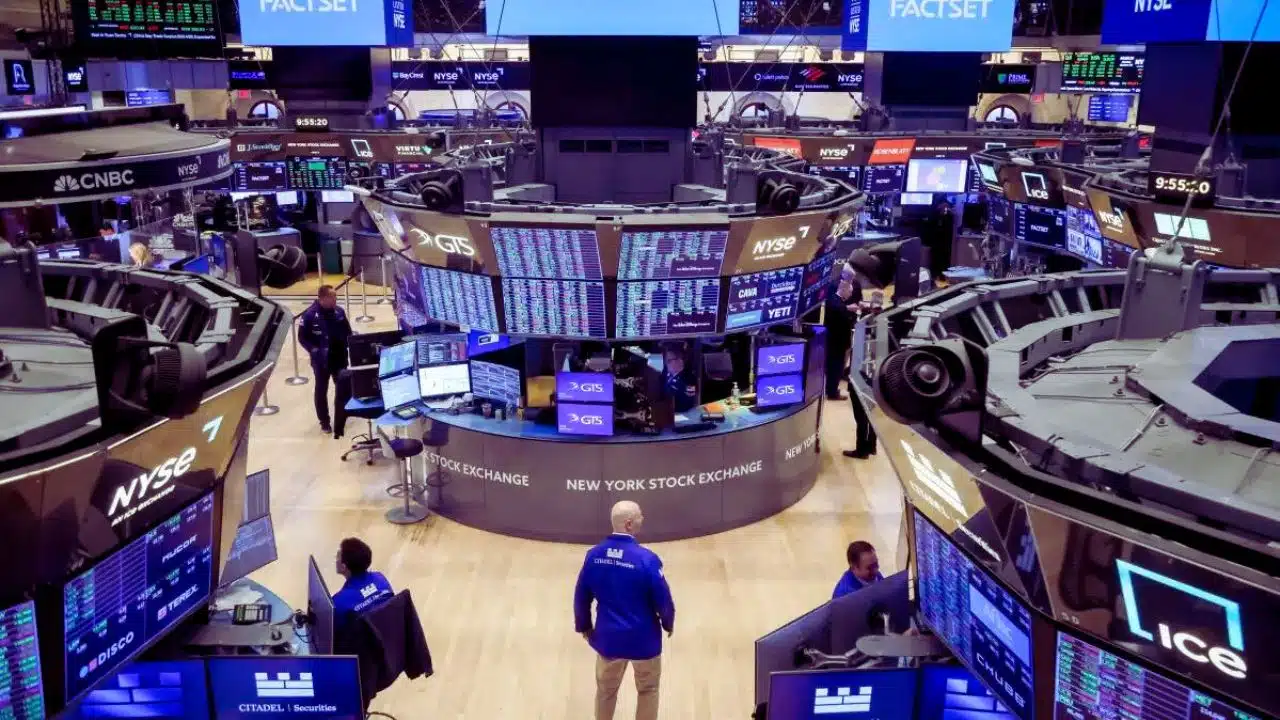
Global stock markets rallied significantly on Monday and into Tuesday morning trading, buoyed by substantive reports that a bipartisan deal in the US Senate could bring an end to the longest and most economically damaging government shutdown in American history.
The 40-day impasse, which began October 1, 2025, has halted key government services, furloughed over a million federal workers, and, according to the Congressional Budget Office (CBO), erased an estimated $18 billion from the US economy in the fourth quarter alone.
The market relief followed a crucial 60-40 procedural vote in the US Senate on Monday, November 10, advancing a stopgap funding bill to reopen the government through January 2026. The bill is expected to pass the House of Representatives by Wednesday, November 12, and head to President Donald Trump, who has signalled his support.
Key Facts: The Shutdown & Market Rebound
- Market Reaction: Global stock markets rally on the news. Asian markets (Tokyo’s Nikkei 225, Hong Kong’s Hang Seng) posted strong gains. US stock futures surged, with the tech-heavy Nasdaq-100 futures rising over 1% ahead of the US market open on Monday.
- The Deal: The US Senate advanced a bipartisan Continuing Resolution (CR) on a 60-40 vote. The deal funds the government through January 2026, restores funding for the Supplemental Nutrition Assistance Program (SNAP), and guarantees back pay for federal workers.
- Record Shutdown: At 40 days, the shutdown (which began Oct 1, 2025) is the longest in US history, surpassing the 34-day record from 2018-2019.
- Economic Cost: The nonpartisan Congressional Budget Office (CBO) estimates the shutdown has cost the US economy $18 billion in Q4 2025 GDP and shaved as much as 1.5 percentage points off annualized quarterly growth.
- Human Impact: The shutdown furloughed or forced roughly 1.4 million federal employees to work without pay and threatened food benefits for 42 million Americans reliant on SNAP.
- The Compromise: Democrats, in a split vote, agreed to the deal without an immediate extension of Affordable Care Act (ACA) health subsidies. Republicans have instead committed to a separate vote on the ACA subsidies by mid-December.
Market Relief: Global Stocks Rebound on Washington Breakthrough
Investor sentiment shifted dramatically from risk-aversion to optimism as news of the Senate compromise broke late Sunday and solidified on Monday. The shutdown had been a significant drag on markets, compounding fears over high-tech valuations and a more hawkish US Federal Reserve.
Asia and Europe Lead the Charge
The rally began in Asia on Monday, November 10. Tokyo’s Nikkei 225 index closed up 1.0%, while Hong Kong’s Hang Seng Index and Shanghai’s Composite also finished in positive territory. Markets in Sydney, Seoul, and Taipei followed suit . European bourses opened higher, with investors breathing a sigh of relief at the removal of a major source of global economic uncertainty.
“There is a growing sense of urgency to reach a compromise,” wrote Rodrigo Catril, a senior strategist at National Australia Bank, in a note on Monday. “The economic consequences are mounting”.
US Futures Signal Optimism
The clearest signal of market relief came from US futures markets. Ahead of the New York market open on Monday:
- S&P 500 futures rose between 0.6% and 1.0%.
- Nasdaq-100 futures, representing the tech-heavy index that has faced recent pressure over “AI bubble” fears, jumped by as much as 1.3% .
- Dow Jones Industrial Average futures also pointed to a positive open, adding over 110 points .
While the US market open on Monday was slightly mixed as investors digested the details, the overall trend was one of relief. The Cboe Volatility Index (VIX), often called the market’s “fear gauge,” dropped by over 3.4%.
The rally provided a much-needed reprieve from a difficult few weeks, where investor concerns over sky-high valuations in artificial intelligence, coupled with the shutdown’s “data blackout,” had fueled significant volatility.
Inside the Deal: Ending the Longest Shutdown in US History
The breakthrough ends a bitter 40-day political stalemate that began on October 1, the start of the 2025 fiscal year.
The 40-Day Standoff
The core of the dispute was a Democratic demand to extend Affordable Care Act (ACA) premium tax credits, set to expire at the end of 2025, which would cause insurance premiums to spike for millions of Americans. Republicans had refused to include this in the primary government funding bill, leading to the impasse.
As the shutdown dragged on, it surpassed the 34-day record set in 2018-2019. The economic and social consequences escalated daily, putting immense pressure on lawmakers from both parties.
The shutdown’s impact became impossible to ignore:
- The Travel Security Administration (TSA) and air traffic controllers, forced to work without pay, saw rising absences, leading to over 3,000 flight cancellations by Sunday, November 9.
- National parks were closed, and federal services from small business loan processing to scientific research were frozen.
- Crucially, the government stopped releasing key economic data, including the Consumer Price Index (CPI) and the monthly jobs report, leaving the Federal Reserve “flying blind” in its efforts to manage inflation.
The Bipartisan Compromise
The deal advanced by the Senate on Monday represents a significant, if temporary, compromise. A small group of moderate Democrats, including Senator Jeanne Shaheen, negotiated with Republicans to break the deadlock.
The stopgap bill, which passed the 60-vote procedural threshold with the support of eight Democrats, funds the government through January 2026. It immediately restores funding for critical programs like SNAP, which provides food aid to 42 million Americans, and reverses thousands of federal layoffs attempted by the Trump administration during the shutdown.
The major concession from Democrats was agreeing to decouple the ACA subsidy issue. In exchange, Republican leadership has reportedly guaranteed a standalone vote on extending the health subsidies by the second week of December.
Political Division Remains
The compromise, however, has split the Democratic party. Senate Majority Leader Chuck Schumer, despite his leadership role, voted against the procedural measure.
“This health care crisis is so severe, so urgent, so devastating for families back home that I cannot in good faith support this CR [Continuing Resolution],” Schumer stated on the Senate floor .
But negotiators argued that continuing the shutdown was no longer tenable. “Waiting another week or another month wouldn’t deliver a better outcome,” Senator Shaheen told reporters, defending the deal .
President Donald Trump, who had remained largely on the sidelines, told reporters on Sunday evening that “it looks like we’re getting close to the shutdown ending.
The Economic Scars: Counting the $18 Billion Cost
While markets celebrate the reopening of the government, economists are warning that the 40-day shutdown has inflicted permanent damage on the US economy.
“A Permanent Loss of Economic Activity”
The nonpartisan Congressional Budget Office (CBO) provided a stark assessment, estimating the shutdown had reduced US Gross Domestic Product (GDP) by $18 billion in the fourth quarter of 2025. The CBO also projected the impasse would shave up to 1.5 percentage points from annualized GDP growth for the quarter.
Even with the government reopening and federal employees receiving back pay, much of this lost economic activity is gone for good.
“Even if there is a reopening of the government in the next couple of weeks, you’re going to see a visible and permanent loss of economic activity as a result of the government shutdown,” Greg Daco, chief economist at EY-Parthenon, told CBS News.
The CBO forecasts a permanent, unrecoverable economic loss of between $7 billion and $14 billion from the 40-day ordeal.
The Human Toll: SNAP and Federal Furloughs
The economic data masks the severe impact on millions of Americans.
- Federal Workers: Approximately 700,000 federal workers were furloughed (sent home without pay), while another 730,000 were deemed “essential” and forced to work without paychecks since October 1. The CBO estimated the lost hours from these workers alone would cost the economy $14 billion if the shutdown lasted until Thanksgiving .
- Food Security: The shutdown threatened to halt November payments for the Supplemental Nutrition Assistance Program (SNAP), which 42 million low-income Americans rely on for food. This crisis was only averted after 25 states sued the administration, forcing a court to order the release of funds.
- Travel and Business: The US travel industry estimated it had lost $5 billion in travel spending as of November 5 . Furthermore, the Small Business Administration (SBA) was unable to distribute an estimated $170 million per day in federally guaranteed loans, starving small businesses of capital
What to Watch Next
The global market rally is built on the expectation of a resolution, but several steps remain.
- Final Senate Vote: The Senate must hold its final vote on the funding bill, which is expected to pass easily following the successful procedural vote.
- House Vote: The bill then moves to the House of Representatives, where Speaker Mike Johnson has urged lawmakers to return to Washington. A vote is expected by Wednesday, November 12
- Presidential Signature: Once passed, the bill goes to President Trump for his signature, which is expected.
- The Next Fiscal Fight: The market’s relief may be short-lived. The deal sets up another high-stakes fiscal deadline in mid-December over the ACA health subsidies.
- Data Dump: Investors will be bracing for a “data dump” from the Bureau of Labor Statistics and other agencies, as delayed reports on inflation (CPI) and employment are finally released, potentially resetting market and Federal Reserve expectations.
In conclusion, the 40-day political crisis in Washington has ended, providing a much-needed, if temporary, boost to global markets. However, the $18 billion in economic damage is permanent, and the fundamental political disagreements that caused the shutdown remain, promising further volatility as the new December deadline approaches.