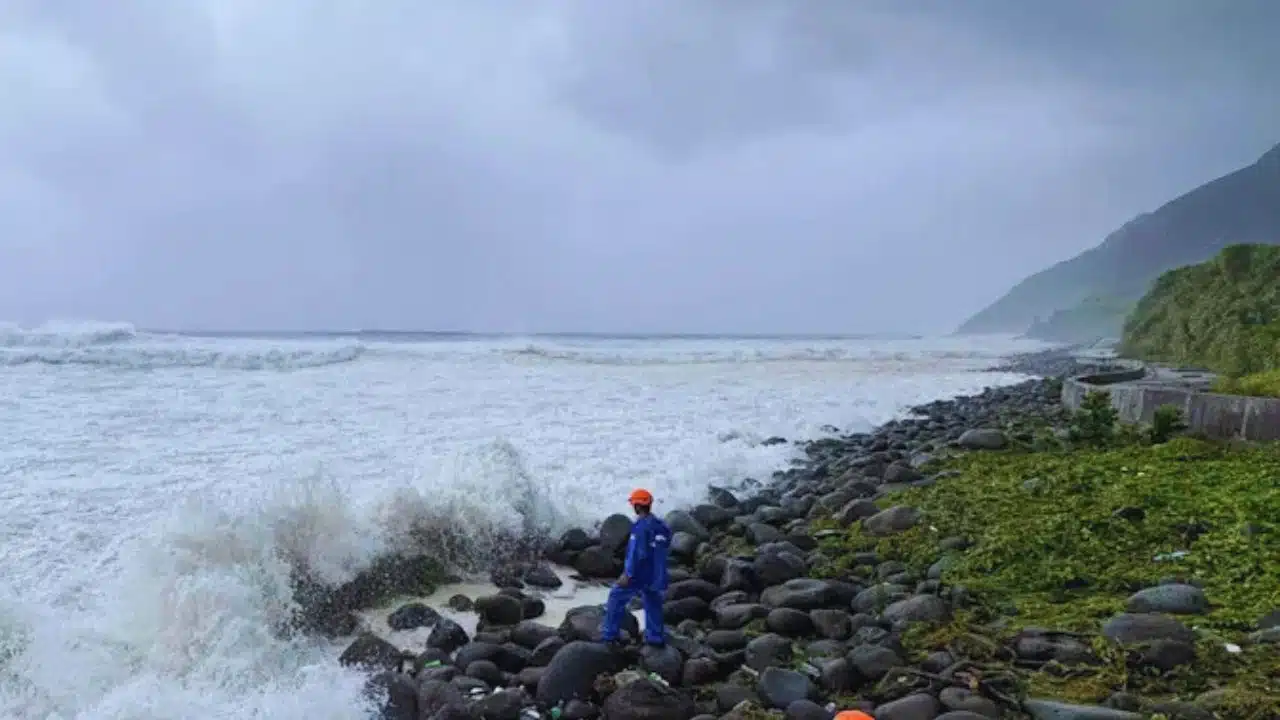
Super Typhoon Ragasa, one of the strongest storms of 2025, struck the northern Philippines on September 22. It made landfall on Panuitan Island in Calayan, part of the Babuyan Islands in Cagayan province. The Philippine weather service confirmed that at the time of landfall, the storm was packing maximum sustained winds of 215 kilometers per hour with gusts reaching up to 295 kilometers per hour. These destructive wind speeds placed Ragasa in the most severe classification of typhoons in the region.
The Babuyan Islands, which are sparsely populated, bore the brunt of the initial landfall. Power outages were immediately reported in Calayan Island and parts of nearby Apayao province. Local officials noted that infrastructure damage, especially to wooden homes and electricity poles, was already being documented in the hours after impact.
Thousands of Evacuations and Early Damage Reports
Across northern Luzon, more than 10,000 people were moved into evacuation centers such as schools, community halls, and gymnasiums before Ragasa made landfall. Government agencies prioritized evacuating families from coastal and flood-prone areas, where the threat of storm surges over three meters was forecasted. Authorities warned that communities near rivers and mountain slopes faced an increased risk of landslides and flash floods.
The Philippine disaster response council announced that work and classes had been suspended across multiple northern provinces, including Cagayan, Ilocos Norte, Ilocos Sur, Batanes, and parts of Apayao. Emergency relief supplies such as food packs, clean drinking water, and medical kits were pre-positioned in evacuation centers. Although communication lines remained intact in most areas, intermittent service outages were reported in remote island municipalities.
National and Local Government Response
President Ferdinand Marcos Jr. declared that all government agencies had been placed on the highest level of alert. The Armed Forces of the Philippines, Coast Guard, and Philippine Red Cross were mobilized to support relief operations. Trucks, helicopters, and naval vessels were placed on standby to deliver aid and carry out rescue missions in isolated communities once the storm weakened.
Local governments in Cagayan province prepared for worst-case scenarios, recalling the widespread devastation caused by earlier storms such as Typhoon Haiyan in 2013 and Typhoon Koinu in 2023. Disaster management teams were instructed to stay in evacuation sites throughout the storm to monitor conditions and coordinate immediate response efforts.
Impact Extends Beyond the Philippines
While Ragasa pounded Luzon, its storm radius of about 320 kilometers spread far beyond the Philippine coastline. The outer circulation of the typhoon began lashing parts of Taiwan’s eastern and southern regions, prompting the Central Weather Bureau to issue warnings of extremely heavy rainfall in mountainous areas. Emergency services in Taiwan started relocating residents from landslide-prone villages in Pingtung and Hualien counties. Authorities expressed concern that damage could be comparable to Typhoon Koinu two years earlier, when power poles collapsed and sheet-metal roofs were torn off by strong winds.
Mass Preparations in China

In southern China, particularly in Guangdong province, cities such as Shenzhen, Zhuhai, and Guangzhou initiated mass evacuation plans. Hundreds of thousands of people living in low-lying coastal zones were scheduled for relocation. Local governments announced the suspension of work and classes, while public transport systems including buses, ferries, and parts of the metro network prepared to halt services. Authorities highlighted that Ragasa’s intensity and size made storm surges and flooding inevitable along the Pearl River Delta.
The China Meteorological Administration issued its highest typhoon alert, stressing that rainfall totals could exceed 300 millimeters in 24 hours in some coastal areas. Fishing boats were ordered to return to ports, and maritime authorities restricted access to major shipping lanes. Preparations were described as one of the largest emergency responses in Guangdong since Super Typhoon Mangkhut in 2018.
Hong Kong to Suspend Flights
Further south, Hong Kong International Airport announced the suspension of all passenger flights for a 36-hour period from the evening of September 23 until the morning of September 25. Airlines including Qantas and Cathay Pacific confirmed flight cancellations, and the city’s Airport Authority said contingency measures were underway to protect both passengers and airport staff. While an official closure order had not been declared, most airlines expected operations to be severely disrupted by the combination of high winds, storm surges, and safety concerns for ground crews.
Warnings of Severe Flooding and Landslides
The Philippine weather service warned that the northern and eastern coasts of Luzon could experience severe flooding, made worse by the combination of torrential rain and storm surges. Mountain provinces were also identified as high risk for landslides, with warnings issued in Kalinga, Apayao, and Benguet. Authorities advised residents not to return to their homes until conditions stabilized, even if winds began to weaken, as secondary flooding and mudslides often occur after the heaviest rains.
This threat of flooding came just a day after thousands of Filipinos had staged protests against a major corruption scandal involving unfinished or poorly built flood control projects. Critics argued that the lack of proper infrastructure left communities even more vulnerable to disasters such as Ragasa.
The Larger Climate Context
The Philippines, situated along the Pacific typhoon belt, is struck by an average of 20 storms and typhoons every year. This makes the country one of the most disaster-prone nations in the world. Millions of Filipinos live in coastal or low-lying areas where poverty and lack of infrastructure make storm recovery especially difficult.
Climate scientists continue to warn that global warming is intensifying storms. Rising sea surface temperatures provide more energy to tropical cyclones, increasing both their wind speeds and rainfall intensity. Ragasa’s power underscores these warnings, arriving just weeks after scientists reported that the Pacific Ocean had reached record-high temperatures this year due to human-driven climate change.
Meteorologists forecast that Ragasa will continue moving west-northwest, threatening further landfalls or close approaches along China’s southeastern coast. The storm’s wide circulation means its effects will be felt in Taiwan, Hong Kong, and southern China for days. Authorities across Asia have emphasized that the public should remain vigilant, follow evacuation orders, and avoid unnecessary travel until the system weakens and moves away from populated areas.