

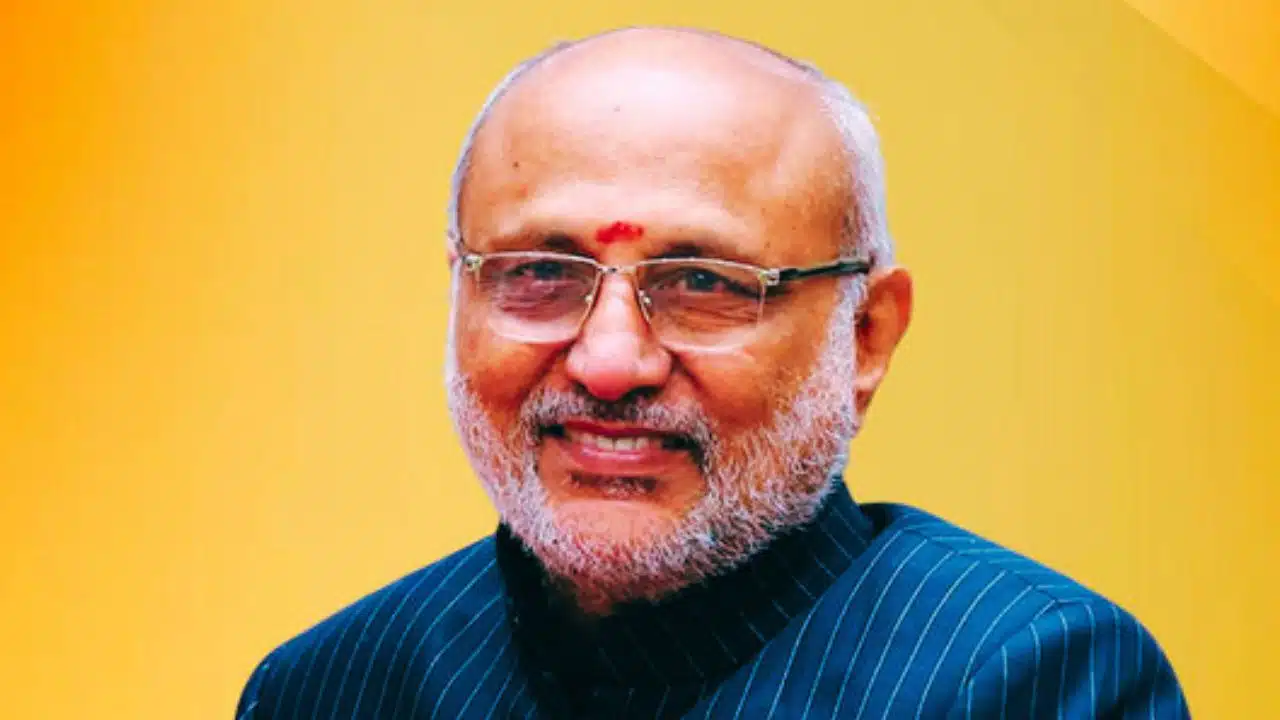
India witnessed a major political event on 12 September 2025 when Chandrapuram Ponnusamy Radhakrishnan was sworn in as the country’s 15th Vice President. The oath-taking ceremony was conducted at Rashtrapati Bhavan, New Delhi, where President Droupadi Murmu administered the oath of office. The event was attended by senior leaders, parliamentarians, dignitaries, and former Vice President Jagdeep Dhankhar. The formal ceremony began at 10:00 AM, reflecting the constitutional importance of this position as the second-highest office in the Republic of India.
Why the Election Was Held
The election for the vice presidency became necessary after the resignation of Jagdeep Dhankhar on 21 July 2025. Dhankhar had stepped down from the post unexpectedly, creating a vacancy that required urgent filling under constitutional provisions. The Election Commission of India announced the schedule soon after, and voting took place on 9 September 2025. Members of both the Lok Sabha and Rajya Sabha participated in the election process, casting their votes through a secret ballot.
The Contest and Result
The ruling alliance, the National Democratic Alliance (NDA), nominated CP Radhakrishnan as its candidate. The Opposition bloc, known as INDIA, fielded Justice B. Sudershan Reddy, a retired judge of the Supreme Court of India.
When the votes were counted, Radhakrishnan secured a decisive victory. He received 452 votes, comfortably crossing the required majority mark of 377. His rival, Sudershan Reddy, managed 300 votes. The margin of 152 votes made the NDA candidate’s win convincing and also reflected the ruling coalition’s strength in Parliament.
Reports indicated that several opposition MPs may have cross-voted in favour of Radhakrishnan, giving him more votes than the NDA’s official tally. On paper, the NDA had 427 MPs, along with the support of 11 MPs from the Yuvajana Sramika Rythu Congress Party (YSRCP) and smaller regional parties. This was already enough to ensure victory, but Radhakrishnan’s final count showed that additional MPs had gone against their bloc’s decision, highlighting divisions within the opposition.
Role of Abstentions and Invalid Votes
The election also saw 13 MPs abstain from voting. These included members from the Biju Janata Dal (BJD), Bharat Rashtra Samithi (BRS), Shiromani Akali Dal (SAD), and one Independent representative. Furthermore, 15 votes were declared invalid, reducing the effective vote count. Despite these factors, the NDA’s numerical edge combined with cross-voting gave Radhakrishnan a comfortable and symbolic victory.
Background of CP Radhakrishnan
CP Radhakrishnan, aged 67, is a seasoned political leader with a long career linked to the Rashtriya Swayamsevak Sangh (RSS) and the Bharatiya Janata Party (BJP). Born on 4 May 1957 in Tiruppur, Tamil Nadu, he entered public life through student movements and ideological work connected to the Sangh. Over the decades, he rose steadily through the ranks of the BJP, holding multiple leadership positions within Tamil Nadu.
He served two terms as a Member of Parliament from Coimbatore and became known as one of the BJP’s strong southern leaders during the 1990s and 2000s. Radhakrishnan also held the position of Governor of Jharkhand and more recently, Governor of Maharashtra. In his administrative career as governor, he was respected for maintaining neutrality in constitutional matters while also representing the central government’s policies.
Upon his election as Vice President, Radhakrishnan resigned as Maharashtra Governor on 11 September 2025. To ensure governance continuity, President Murmu appointed Gujarat Governor Acharya Devvrat to take additional charge of Maharashtra until a new appointment is made.
Importance of the Vice President’s Role
The Vice President of India is the second-highest constitutional office in the country after the President. The Vice President also functions as the ex officio Chairperson of the Rajya Sabha, presiding over its sessions and ensuring order in the upper house of Parliament. This makes the role significant not only symbolically but also functionally, as it directly impacts the legislative process.
By taking on this position, CP Radhakrishnan now becomes a key figure in national politics. His long association with the BJP and RSS indicates that his presence may further consolidate the ruling coalition’s influence in Parliament, particularly in managing debates and legislative discussions in the Rajya Sabha.
Political Implications of the Victory
Radhakrishnan’s clear win has political implications beyond the numbers. The cross-voting by opposition MPs suggests internal rifts within the INDIA bloc, which has been attempting to project itself as a united alternative to the NDA. The fact that some MPs defied their alliance’s choice indicates the challenges faced by the opposition in maintaining cohesion.
On the other hand, for the BJP and its allies, this result reinforces their parliamentary dominance. It reflects not only their majority but also their ability to attract support from outside their bloc, which could play an important role in upcoming legislative sessions.
With CP Radhakrishnan sworn in as Vice President, India now begins a new chapter in its parliamentary functioning. His decades-long political experience, his strong ideological roots, and his administrative background are expected to shape his role as the presiding officer of the Rajya Sabha.
For the NDA, his victory strengthens their constitutional presence, while for the opposition, the election has highlighted weaknesses that they may need to address ahead of the 2026 general elections.
























