Whether it’s 11:30 PM and you’ve just remembered your essay is due at midnight, or you’re simply trying to get ahead on assignments, AI-powered writing tools can be a lifesaver. Today’s AI essay generator tools are faster, smarter, and—when used ethically—actually help you become a better writer. But not all tools are created equal. Some spit out generic content, others make up sources, and a few truly support your learning process.
We’ve tested dozens of platforms and narrowed them down to five AI essay generators that deliver on speed without compromising substance. If you’re looking for a tool that balances quick output with academic credibility, this list is for you.
What Is an AI Essay Generator?
An AI essay generator is a digital writing assistant powered by artificial intelligence that helps users create structured, coherent essays based on a prompt or topic. Instead of writing from scratch, students and professionals can input a few keywords or a question, and the tool will generate paragraphs, outlines, or even full-length drafts.
These tools rely on language models trained on large datasets to predict and generate human-like text. While some focus on speed and general-purpose content (like chatbots), others—such as academic-focused platforms—aim to guide users through the writing process while maintaining clarity, originality, and academic integrity.
The best AI essay generators do more than just “write for you.” They help you brainstorm, structure arguments, paraphrase responsibly, and cite sources accurately. Whether you’re working against a tight deadline or just need help getting started, these tools can reduce stress and boost productivity—without sacrificing your unique voice or critical thinking.
1. Litero – The Smartest AI Essay Generator for Students and Educators
Let’s be clear: litero.ai isn’t just fast—it’s academically responsible. Designed specifically for students and educators, Litero supports every stage of the writing process with structure, transparency, and a unique coaching approach that keeps you in control.
Why Litero Stands Out
Unlike generic generators, Litero doesn’t flood you with a finished essay and call it a day. Instead, it uses features like:
- Instructions clarifier & idea generator: Helps clarify prompts and spark ideas before you even write.
- Scholarly source scout: Lets you search academic databases (DOI, JSTOR, Google Scholar).
- Citation tools: Generates citations in APA, MLA, Harvard and more with real traceable sources.
- Section-by-section scaffolding: Creates editable outlines for you to fill in and adapt.
- Literka coach: Offers feedback on cohesion, logic, and tone—without rewriting your work for you.
- Plagiarism & overuse scanner: Flags red flags early to help you revise ethically.
- Submission checklist: Makes sure you’re hitting formatting, word count, and style requirements.
All of this makes Litero the best AI essay generator that keeps users thinking, not just copying. It’s built to encourage learning, support real academic writing, and remain fully transparent—right down to the authorship reports instructors can review.
Best For: Students, researchers, and anyone looking for structured writing help that doesn’t cross academic lines.
2. Jasper AI – Creative Speed with Style
Jasper is one of the most well-known AI writing tools, originally built for marketing copy but increasingly used by students. It’s great for fast generation, particularly for short essays, opinion pieces, or journal-style responses.
What We Like
- Intuitive dashboard and quick generation.
- Can emulate various tones and voices.
- Supports sentence expansion and paragraph rephrasing.
What’s Missing
- No native citation support.
- Not built specifically for academic essays.
Best For: Students needing creative essays or fast brainstorming help.
3. Smodin – Speedy Generator with Citation Checker
Smodin has made a name for itself among students who want something quick and simple. It allows you to plug in a topic, choose the number of words, and get a basic draft fast.
Pros
- Includes automatic citation and plagiarism checkers.
- Clean interface with quick turnaround.
Cons
- Content quality can vary—sometimes too generic.
- Limited control over tone and structure.
Best For: Students writing short papers or outlines in a hurry.
4. Quillbot – Rewriter That Doubles as a Generator
Originally known for paraphrasing, Quillbot now includes a co-writer and summarizer, making it a semi-capable essay generator. It’s most effective when rewriting or polishing drafts rather than creating them from scratch.
Benefits
- Strong rewording and summarizing tools.
- Citation assistant included.
- Grammar and tone enhancements.
Limitations
- Essay creation tools are basic.
- No deep structure or academic coaching.
Best For: Refining rough drafts or rewording research summaries.
5. ChatGPT – Flexible but Requires Careful Editing
ChatGPT (free or premium) is one of the most flexible tools out there. Ask it to write an essay and it will, but you need to know how to guide it. Without prompts that emphasize structure, citation, and clarity, you’ll end up with fluff—or worse, fictional sources.
What Works
- Extremely fast response.
- Can be coached into writing strong outlines and sections.
- Ideal for brainstorming or idea exploration.
What Doesn’t
- Generates fake citations unless corrected.
- Can be overly wordy or off-topic.
Best For: Generating first drafts, outlines, and rewriting sections with user input.
Key Takeaways: What Sets a Great AI Essay Generator Apart?
All five of these tools serve a different purpose depending on your urgency and writing stage. However, not every platform balances speed with substance.
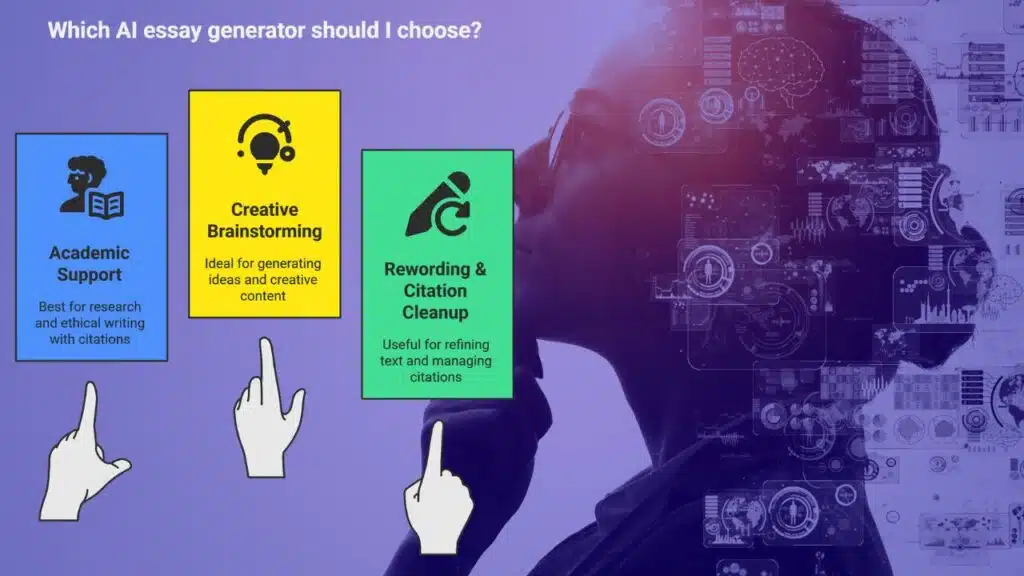
- If you want true academic support with real citations, integrated research features, and ethical safeguards, Litero is your best bet.
- If you’re looking for creative brainstorming, Jasper or ChatGPT can help kickstart ideas.
- For rewording or citation cleanup, Quillbot and Smodin offer great utility.
When choosing an AI writing assistant, think about whether you need:
- Speed or structure?
- Citations or creativity?
- Clarity or customization?
The right tool for you should offer the fastest path to a better draft, while still protecting your voice—and your grade.
FAQs: AI Essay Generators in student Use
Are the AI essay generators legal and ethical to use?
Yes when used in the right way. The use of AI tools is legal since they too can serve as writing assistants, as is the case with grammar checks or citation organize. By ethical use, it is meant that these tools should be viewed as assistants rather than ghostwriters. They are awesome to aid brainstorming, outline, paraphrase and edit. Nevertheless, submitting a complete AI-generated essay without comprehending it or revising it can be considered an infringement of your school academic honesty policy. If you are not sure, turn to your course syllabus or consult your professor.
Does AI really make me a better writer of essays?
Absolutely. With a reasonable approach to using AI, it will enhance your clarity, structure, tone of voice, and even arguments. Others (such as Litero) are not only writing-aids, but they also have training and guidance functions, citations, and live feedback. AI writing tools can be considered time-saving productivity gains since they remove the need to do redundant tasks, such as, again, busywork, giving you more time to think and research.
Are AI generators real citations?
This is where a number of tools vary. Some can even “hallucinate sources” e.i., create citations that appear genuine but which in reality do not exist (e.g., ChatGPT). Structured academic tools like Litero on the other hand offer traceable references, references of reality, of academic databases. Citations should be checked all the time and AI should never be your full-time blind bibliography builder.
Will my teacher recognize that I was using AI?
Not when you can enter generic, unedited works. Repetitive phrasing, the absence of a voice, or vaguely stated arguments may be the identifier of AI-written texts. It is always a good rule to examine, customize, and edit anything written with the help of an AI tool. It is also becoming possible to see authorship reports at a lot of platforms (e.g. Litero) which give you an overview of whether or not you were effectively involved in the writing process something that instructors can actually love.
What is the best AI tool to use to make a last-minute essay?
When a fast essay is needed, tools such as Jasper or Smodin allow very rapid generation and short setup. Nevertheless, with a deadline and demands of structure, research, and citations Litero will be the most thorough option of them all, regardless of whether you are on a deadline. It also supports you writing bit by bit, assuring you control, yet remaining fast-paced.
Is it possible to use such tools in non-academic writing?
Yes. Most of the tools such as Jasper and ChatGPT are designed to cover a wider repertoire that goes over emails, creative text, and blogs. But when it comes to the academic domain of writing essays or papers in general, a better idea would be to use a platform that was created with the particular purposes in mind.
Will these instruments help with long essays or research papers?
Some are able-some are not. The tools such as Litero are specifically created to aid the long-form writing, taking advantage of outline management, as well as source organization, and draft versioning. Another one such as Smodin or ChatGPT (free version) might not be good at coherence or structure in an essay that is longer than 1 000 words. It is always better to test your tool using a smaller work first and then using it in a big paper.
Do these platforms offer free services?
A majority of them provide a freemium structure where you can use basic functions free of charge, with the premium option enabling such features as unlimited frequency, referencing tools, or plagiarism checkers. An example of a site with an extensive free offering geared towards students is Litero, which has expanded services that, in addition to the free tier, provide the user with deeper learning opportunities. It is important to look at what is not covered before trusting a free plan.
Are AI essay tools safe in terms of maintaining my privacy?
The privacy policies differ. There are tools that store what you provide and they train subsequent models on it. Others include more academically oriented sites, where the emphasis is placed on the privacy of the student information and no keeping of the personal drafts. When you are working either on a sensitive issue (such as a college application form or thesis paper), make sure that your writing (when sent to a college or over the Internet) is stored, encrypted or sold.
Are tutoring and writing centers substitutable with such tools?
No–and they had better not. AI can be a great addition, but it lacks the same scope of benefits as human guidance, particularly with regard to subjective feedback or multifaceted arguments or personal expression. An AI essay generator should be used best in combination with instructor feedback, writing centers, or peer review.
Why the Right AI Essay Generator Matters
AI essay generators are more than just deadline panic buttons. They’ve evolved from simple automation tools into intelligent writing companions that can genuinely support the thinking process behind academic work. Whether you’re a student racing toward a midnight deadline or a learner who wants to improve the structure and clarity of their ideas, these tools can be incredibly helpful—if you choose the right one.
The difference comes down to intention. Some AI writing tools are built for speed: punch in a topic, get a few paragraphs, copy-paste, done. That may save time, but it doesn’t help you grow as a writer—or as a thinker. And in academic settings, where the goal is to demonstrate understanding, critical reasoning, and originality, shortcuts often do more harm than good.
That’s why platforms like Litero stand out. Instead of replacing your work, Litero is designed to enhance it, it helps you learn as you write. Whether you’re outlining your argument, organizing supporting evidence, working with complex material, or formatting citations, Litero acts like an academic co-pilot. It nudges you in the right direction, encourages structure, and ensures your voice stays at the center of the work.
Another critical benefit is confidence. When you’re unsure whether your structure works, whether your citations are right, or whether your argument flows logically, it’s easy to freeze or procrastinate. A smart AI tool that gives you suggestions without taking over can reduce that anxiety and keep you moving forward—especially when stakes are high.
But with great power comes… a lot of really bad tools. Many free AI generators still struggle with basic facts, hallucinate fake citations, or strip your writing of any personality. These might be fine for casual content or short assignments, but for students who care about their work (and their grades), the quality of the tool really matters.
Final Thoughts
As AI becomes more integrated into education, we’ll see a growing divide between tools that are helpful and tools that are harmful. The helpful ones will emphasize learning, provide transparency, and work within the bounds of academic integrity. The harmful ones will promote shortcuts, fake content, and a one-size-fits-all writing style that doesn’t reflect the writer at all.
In the end, writing better isn’t just about finishing faster. It’s about understanding what you’re saying—and why it matters. The best AI essay generators make that process easier, not shallower. They guide, support, and even challenge you.