
A Chinese tech company has sparked global debate after revealing plans for a humanoid pregnancy robot designed to replicate the entire process of human gestation using artificial womb technology. If successful, this innovation could fundamentally reshape reproductive healthcare, while also raising profound ethical and social questions about the future of childbirth.
The Announcement at Beijing’s 2025 World Robot Conference
The news came during the 2025 World Humanoid Robot Games and World Robot Conference in Beijing, one of the world’s largest showcases of advanced robotics and biotechnology.
Kaiwa Technology, a Guangzhou-based firm founded by entrepreneur Zhang Qifeng, introduced its ambitious project: a humanoid robot capable of carrying a fetus from conception to birth.
Unlike traditional incubators, which are only used in neonatal care for premature babies, this machine is intended to support life from the earliest stages of development through to full-term delivery.
Dr. Zhang told Chinese media that the device “is not just an incubator, but a complete artificial gestation system.”
How the Pregnancy Robot Works

The humanoid pregnancy robot is designed with a synthetic womb system placed inside its abdomen.
- Artificial Amniotic Fluid: The system replicates the fluid environment of a natural womb, protecting and cushioning the fetus.
- Nutrient-Supply Hoses: Tubes deliver essential nutrients and oxygen, mimicking the role of the placenta.
- Controlled Monitoring: Advanced sensors would track fetal growth, movements, and vital signs in real-time.
- Humanoid Form: Unlike laboratory incubators, the design gives the machine a more human-like body, intended to replicate pregnancy as closely as possible.
The company claims the robot could provide a “complete artificial gestation environment” — something previously limited to science fiction.
Prototype Timeline and Cost
Kaiwa Technology announced that a prototype is expected by 2026, giving the project less than a year before public demonstration.
The projected cost is under ¥100,000 (around US $13,900–14,000).
This figure is significantly lower than the cost of surrogacy in many countries. For example:
- In the United States, surrogacy often costs $100,000–200,000.
- Even in countries with less regulation, the expenses can be prohibitive.
If Kaiwa’s technology works as claimed, it may make artificial reproduction more affordable and accessible.
Why China Is Pursuing This Technology
China is facing a demographic crisis.
- The birth rate hit record lows in 2023 and 2024, leading to fears about population decline.
- Government incentives to encourage childbirth — including financial subsidies — have had limited impact.
- A growing number of couples are either delaying or avoiding pregnancy due to high living costs, career pressures, and lifestyle changes.
By introducing radical solutions like artificial wombs, the government could seek ways to stabilize population growth and reduce reliance on natural pregnancies.
Potential Benefits
- Support for Infertility: Couples struggling with infertility might gain access to new possibilities for having biological children.
- Safer Alternative for High-Risk Pregnancies: Women with severe health conditions or complications could avoid life-threatening risks.
- Reduced Reliance on Surrogacy: With commercial surrogacy banned in China and controversial in many other nations, artificial wombs could provide an alternative.
- Scientific Research in Reproduction: Artificial gestation systems could help scientists better understand fetal development, pregnancy complications, and birth defects.
The Ethical and Legal Storm
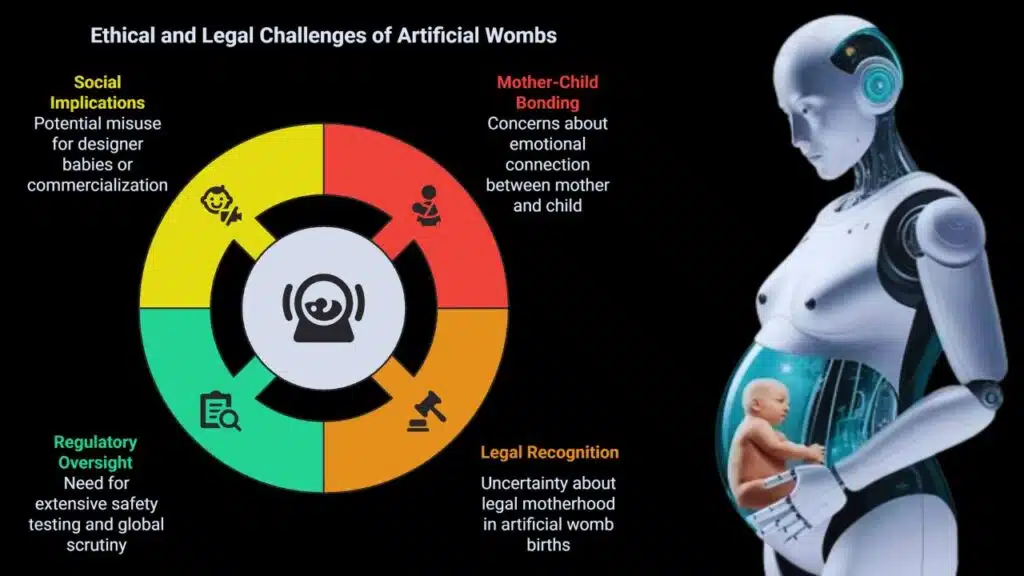
While the potential benefits are significant, the announcement has already triggered intense bioethical debate:
- Mother–Child Bonding: Pregnancy is not only biological but also psychological. Critics argue that removing gestation from the human body might weaken emotional bonds between mother and child.
- Legal Recognition: If a baby is born from an artificial womb, who will be recognized as the legal mother? Laws worldwide are not prepared for such scenarios.
- Regulatory Oversight: Medical approval for such radical technology would require years of safety testing and strict global scrutiny.
- Social Implications: The technology could be misused, for example, in creating “designer babies” or commercializing reproduction.
Kaiwa Technology has already engaged Guangdong provincial authorities, submitting proposals to address ethical, legal, and policy issues. Legislative review is reportedly underway.
Skepticism and Verification Issues
Despite the global headlines, doubts remain about the authenticity of the claims:
- Fact-checkers like Snopes reported that there is no verified record of Dr. Zhang Qifeng being affiliated with Nanyang Technological University (NTU) in Singapore, as some media outlets suggested. NTU has publicly denied any involvement in the project.
- Independent experts in reproductive medicine have pointed out that while artificial womb research has advanced in labs — for example, keeping premature lamb fetuses alive in biobags — achieving full human gestation outside the body remains unproven.
This means Kaiwa’s robot may be more of a conceptual prototype than a near-market technology.
Artificial Womb Technology: A Brief History

Artificial wombs are not a new idea:
- 1990s–2000s: Scientists began experimenting with biobags to sustain premature fetuses.
- 2017 (University of Pennsylvania): Researchers successfully kept premature lamb fetuses alive for four weeks in an artificial womb.
- Japan (2021): Scientists reported progress with rodent embryos in a rotating bottle system, mimicking early development stages.
However, no team has yet managed to carry a mammalian fetus from conception to birth outside a natural womb. If Kaiwa succeeds, it would mark a historic breakthrough.
Global Reactions
The announcement drew strong international responses:
- Supporters praised it as a possible solution to infertility and demographic challenges.
- Critics warned of “playing God” and undermining natural processes of life.
- Religious groups in particular have expressed concerns about ethical boundaries.
- Tech analysts caution that without transparent evidence, the project risks being labeled as futuristic hype.
At the same conference, other technologies like GEAIR (an AI-powered breeding robot for agriculture) also highlighted China’s determination to merge AI, robotics, and biotechnology into its long-term development strategy.
What Happens Next?
- A prototype unveiling in 2026 will be the first real test of whether Kaiwa’s claims hold scientific weight.
- Regulatory reviews in Guangdong province will determine whether pilot projects can move forward in controlled settings.
- Global medical experts and watchdogs will monitor progress, demanding proof of safety and scientific legitimacy.
Until then, the project remains one of the most controversial yet captivating developments in modern robotics and biotechnology.
Kaiwa Technology’s pregnancy robot is either a revolutionary step in human reproduction or an overhyped claim still far from reality.
If proven real, it could change the way humanity thinks about childbirth, infertility, and family planning. But if exaggerated, it serves as a reminder of how futuristic tech announcements can blur the line between science and science fiction.
One thing is certain: the debate over artificial wombs and humanoid pregnancy robots has only just begun.
Would you like me to also create a comparison table between traditional pregnancy, surrogacy, neonatal incubators, and artificial womb robots? That could make this piece even more comprehensive and SEO-friendly.
The Information is Collected from Times of India and MSN.