


Former U.S. President Donald Trump announced that Israel has accepted the necessary conditions to finalize a 60-day ceasefire agreement in Gaza. Trump made the statement in a post on his social media platform, Truth Social, suggesting that the deal is a final opportunity for peace and warning Hamas that the offer would not improve if they rejected it.
According to Trump, the United States will use this two-month window to work with all involved parties, including regional powers and international mediators, to bring an end to the ongoing war between Israel and Hamas. The proposed ceasefire is expected to include a phased plan involving the release of Israeli hostages and possibly some Palestinian detainees held in Israeli prisons. Qatar and Egypt—both of which have played crucial roles in previous mediation efforts—are expected to deliver the final terms of the agreement to Hamas leadership for review.
Despite Trump’s optimistic announcement, Israeli officials have not issued a formal confirmation of their agreement to the ceasefire conditions. Moreover, Hamas has yet to publicly respond to the proposal. This silence from both parties adds uncertainty to whether the agreement will move forward or stall once again.
Trump Set to Meet Netanyahu; Believes Israeli PM Wants to End Conflict
Donald Trump is scheduled to meet with Israeli Prime Minister Benjamin Netanyahu next week in Washington. Ahead of that meeting, Trump indicated he would take a strong stance on promoting a peaceful resolution. He expressed confidence that Netanyahu is genuinely interested in bringing an end to the hostilities in Gaza, suggesting that a ceasefire deal might be achieved during or shortly after their discussions.
In parallel diplomatic developments, Israel’s Minister of Strategic Affairs, Ron Dermer, traveled to Washington this week. Dermer is meeting with key U.S. officials including Special Envoy to the Middle East Steve Witkoff, Secretary of State Marco Rubio, and Vice President JD Vance to further the negotiation process and align both countries’ strategies in the region.
Israel Says It’s Open to a Ceasefire, But Pressure on Hamas Remains
Israel’s ambassador to the United Nations, Danny Danon, told the BBC that Israel is fully prepared to enter a ceasefire agreement. However, he emphasized that Hamas has been resisting negotiation efforts and that time is running out. Danon stated that if Hamas does not return to the negotiating table, Israel would be forced to increase military pressure in order to secure the release of hostages held in Gaza.
Israeli officials maintain that any permanent resolution must involve the dismantling of Hamas’ military capabilities and the safe return of all Israeli hostages. According to Israeli government sources, about 50 hostages are still being held in Gaza. Intelligence suggests that at least 20 of them are still alive.
Danon also stressed that for Israel, the war cannot end until every hostage is brought home. This remains a central condition in Israel’s negotiation strategy and public communication.
Hamas Remains Silent While Mediation Efforts Intensify
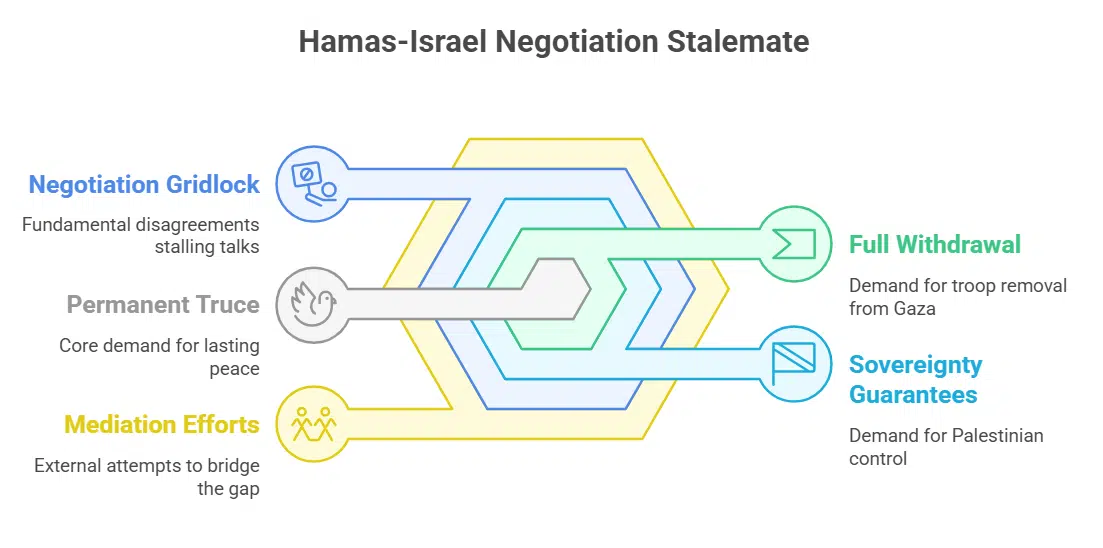
Although Hamas has not yet responded to the new ceasefire proposal, senior Hamas officials previously stated that mediators from Egypt and Qatar were increasing their efforts to find a solution. However, negotiations with Israel remain gridlocked due to fundamental disagreements. Hamas continues to demand a permanent truce, full withdrawal of Israeli troops from Gaza, and guarantees of Palestinian sovereignty over the territory. These demands have been consistently rejected by Israel.
The gap between the two sides has stalled numerous attempts at a longer-term agreement, including the most recent ceasefire deal that collapsed earlier this year after just a few days.
Civilian Death Toll Continues to Climb Amid Military Escalation
While talks are ongoing, the humanitarian crisis in Gaza continues to deteriorate. On Monday, at least 20 Palestinian civilians were killed in an Israeli airstrike that targeted a popular seafront café in Gaza City. The strike occurred during evening hours when civilians had gathered to escape the summer heat. Medical personnel and eyewitnesses confirmed the casualties, which included several women and children.
This airstrike was one of many in a recent escalation that followed renewed Israeli orders for evacuations in parts of northern Gaza. Israeli defense officials said these measures are being taken in preparation for further military operations aimed at suppressing Hamas’ remaining infrastructure in the region.
The Israeli military has justified these actions by claiming they are based on intelligence suggesting that Hamas is planning new attacks and continuing to smuggle weapons into densely populated civilian areas.
Since October 7, 2023, when Hamas launched its surprise attack on southern Israel—killing approximately 1,200 people and taking many others hostage—Israel has responded with an intensive military campaign across the Gaza Strip. According to the Hamas-run health ministry in Gaza, more than 56,600 Palestinians have been killed as a result of Israeli airstrikes and ground assaults. This figure includes thousands of children and elderly individuals, many of whom died in residential neighborhoods, refugee camps, and hospitals.
Humanitarian Concerns Mount Over Aid Distribution Violence
The humanitarian situation in Gaza has drawn international scrutiny. This week, Israel acknowledged it is investigating reports that civilians may have been injured or killed while trying to access food and supplies at aid distribution centers operated by the Gaza Humanitarian Foundation (GHF). The GHF, backed by both the U.S. and Israeli governments, was established to bypass what they describe as Hamas interference in humanitarian logistics.
However, more than 170 NGOs and aid organizations, including Oxfam and Save the Children, have called for the GHF to be shut down. These organizations argue that Israeli forces routinely open fire on Palestinians who are simply trying to collect basic necessities like food and water. Israel denies these claims and maintains that the GHF is necessary to ensure aid reaches those in need without being diverted by Hamas operatives.
Earlier Ceasefire Deals Failed to Progress Beyond Initial Stages
This latest ceasefire proposal follows the breakdown of a previous agreement earlier this year. That deal, which began on January 19, was meant to unfold in three stages. The first phase involved a temporary pause in hostilities and the partial exchange of hostages. Phase two would have established a permanent ceasefire, facilitated the return of remaining hostages, and led to a phased withdrawal of Israeli forces from Gaza. Phase three was expected to initiate broader political discussions about Gaza’s future governance.
Unfortunately, the ceasefire did not progress beyond the first phase. In March, Israel resumed airstrikes, describing them as preemptive actions based on intelligence that Hamas was preparing for renewed attacks. The return to violence effectively dismantled the agreement, and no new ceasefire had been reached—until now.
Outlook: Deal Still Hangs in Balance as Ground Realities Shift
Although Trump’s announcement signals a potential turning point, the situation on the ground remains volatile. Civilian casualties continue to mount, diplomatic positions remain entrenched, and both sides accuse each other of bad faith.
The next few days will be critical. Netanyahu’s upcoming visit to Washington and Hamas’s response to the final proposal delivered by Qatari and Egyptian mediators will determine whether the region moves toward a temporary calm or slides deeper into prolonged warfare.
Until a formal agreement is confirmed and implemented, the future of Gaza—and the thousands of lives still at risk—remains uncertain.





















