
Clio, the Canadian legaltech giant best known for transforming how law firms manage their operations, has taken a bold new step into the future of legal practice. On Monday, Clio officially announced a $1 billion cash-and-stock agreement to acquire vLex, a global legal research and data intelligence platform. This acquisition marks one of the largest deals in the legal technology space to date, with significant implications for the industry.
Founded in 2008 and headquartered in Vancouver, British Columbia, Clio started as a cloud-based platform that helped lawyers streamline daily operations—such as time tracking, case management, client intake, billing, and online payments. The platform now powers more than 150,000 legal professionals globally, primarily in small- to mid-sized law firms. With this new deal, Clio is shifting gears from purely administrative legaltech into AI-powered legal practice solutions.
vLex, the company it’s acquiring, is no ordinary database. Established in 1998, the platform offers access to a vast library of legal documents—over 1 billion in total—from more than 100 countries. These include statutes, regulations, case law, and secondary sources in multiple languages. It is considered one of the richest legal content repositories in the world. vLex’s recent innovations in legal AI, particularly its Vincent AI assistant, have positioned it as a strong competitor to established databases like LexisNexis (owned by RELX) and Westlaw (owned by Thomson Reuters).
Why Clio Is Making This Move Now
Clio’s acquisition of vLex follows a major growth milestone. Just last year, Clio raised a staggering $900 million in a private funding round, nearly doubling its valuation from $1.6 billion in 2021 to $3 billion in 2024. That round was one of the largest ever seen in the legaltech sector and signaled investor confidence in Clio’s long-term vision. This new deal takes that vision to the next level.
According to Clio CEO and founder Jack Newton, data is emerging as one of the most powerful competitive advantages in legal AI. By acquiring vLex and its massive multilingual legal corpus, Clio now possesses an unparalleled foundation to build next-generation AI tools specifically tailored to the legal profession.
While Clio has long dominated the legal operations space, it has not previously ventured into the practice of law itself. This acquisition changes that. The integration of vLex’s Vincent—an AI tool trained on global legal content—allows Clio to offer smart, AI-powered legal research, analysis, and drafting tools, thereby stepping directly into the legal services workflow.
The Deal Landscape: Missed Opportunities and Market Dynamics
Clio’s move comes after other tech players eyed vLex as a valuable asset. In 2023, the AI-driven legal tech startup Harvey, which gained recognition through its backing from OpenAI’s Startup Fund and Sequoia Capital, made an attempt to purchase vLex. However, the deal never materialized. A year later, Harvey partnered with LexisNexis instead—an indication that the battle for access to proprietary legal data is heating up across the industry.
This intense competition underscores why Clio’s acquisition is so significant. With legaltech firms increasingly turning to AI, the success of their models depends heavily on having access to high-quality, jurisdiction-specific legal data. By owning vLex, Clio isn’t just enhancing its own offerings—it’s also blocking competitors from accessing a premium legal dataset that could supercharge rival AI models.
What Is Vincent and Why It Matters
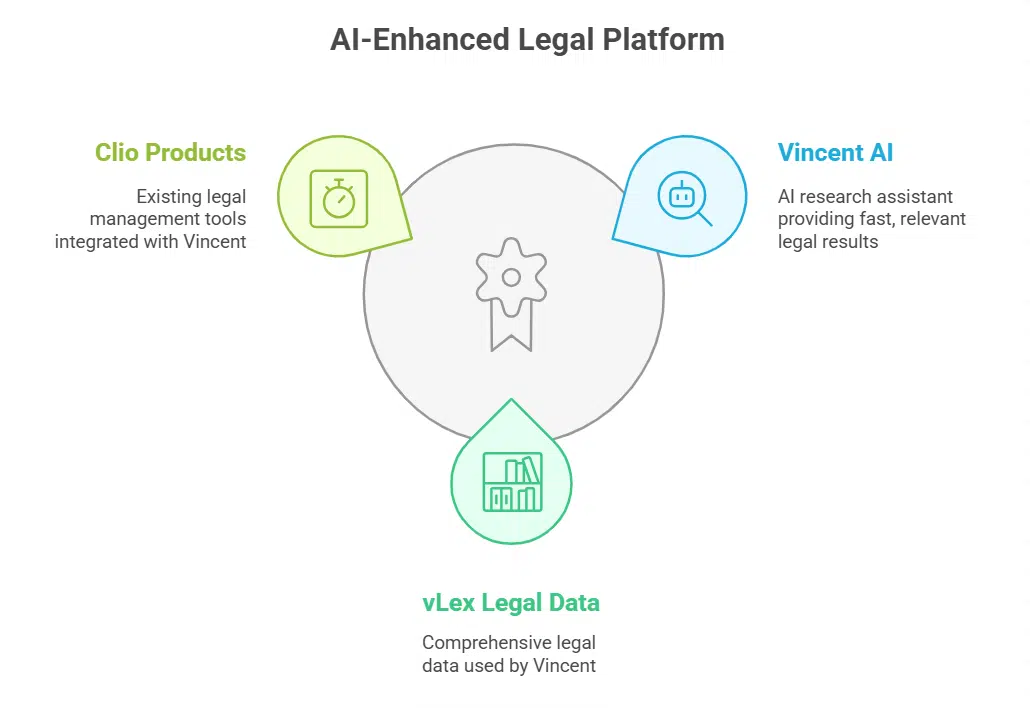
At the heart of vLex’s value is Vincent, an AI research assistant introduced in recent years. Built using vLex’s own legal data, Vincent uses advanced natural language processing to deliver fast, relevant results for legal queries. Users can input questions in plain language and receive case law, legislation, or commentary from dozens of jurisdictions.
Vincent doesn’t just provide search results—it’s capable of analyzing entire legal documents and suggesting relevant citations, identifying legal arguments, and even flagging potential inconsistencies. This makes it a major asset for small and mid-sized firms that may not have the resources for large research teams.
By combining Vincent with Clio’s existing products, lawyers will soon be able to go from case intake to billing to legal research—all within a single, AI-enhanced platform.
Clio’s Broader Growth Strategy
The vLex acquisition is part of a larger growth strategy for Clio, which has seen consistent expansion in revenue and market presence. The company recently reported $300 million in annual recurring revenue (ARR), up significantly from previous years. Its platform already handles billions of dollars in legal billing annually.
Clio has also begun expanding internationally and into the enterprise legal sector. In 2024, it acquired ShareDo, a U.K.-based case and matter management platform for large law firms. That move signaled Clio’s intent to move beyond solo practitioners and small firms into the broader legal services market.
With vLex, Clio now has global reach across over 100 jurisdictions and a growing user base of 2.8 million professionals. This acquisition effectively positions Clio as a full-spectrum provider for legal businesses of all sizes—from solo firms in North America to multinational firms needing cross-border legal research.
The Bigger Picture: Legal AI and Industry Transformation
This acquisition reflects a growing convergence in legaltech between operational tools and practice tools. Traditionally, platforms like Clio helped law firms run their business, while services like vLex or Westlaw focused on the legal work itself. But as AI continues to evolve, the lines are blurring.
AI models like Vincent—or Harvey’s GPT-4-powered tools—require access to reliable legal data to be effective. These models are being trained not just to assist with legal research, but also to automate routine drafting, summarize case files, extract insights from deposition transcripts, and even help predict case outcomes.
According to Jack Newton, this convergence is inevitable. Clio’s integration of AI will allow law firms to manage clients, handle paperwork, conduct legal research, and even prepare legal arguments in a single ecosystem. This is especially transformative for small and medium-sized firms that need efficiency but lack the massive legal teams of large firms.
What Happens Next
The deal is expected to close later in 2025, subject to customary regulatory approvals. Once completed, Clio plans to integrate vLex’s capabilities into its existing platform. Users of Clio Manage and Clio Grow will eventually have direct access to Vincent’s AI tools.
Industry analysts see this deal as a turning point in legaltech. It places Clio at the forefront of the emerging legal AI race and challenges legacy platforms like LexisNexis and Westlaw to innovate or risk falling behind.
With Clio now controlling one of the most advanced AI legal assistants and one of the richest legal data libraries in the world, the company is poised to not just support law firms—but to redefine how they operate.