In a significant escalation of the ongoing U.S.-China trade dispute, Hongkong Post has announced that it will stop handling parcels sent to or received from the United States. The move comes in response to U.S. President Donald Trump’s latest executive order, which drastically increases tariffs on lower-value international shipments — a policy shift that has drawn fierce backlash from both Hong Kong and Beijing.
Why Hongkong Post Is Halting U.S. Parcel Shipments
On Wednesday, the Hong Kong government issued a statement confirming that its public postal service, Hongkong Post, will suspend all package deliveries containing goods to and from the United States. The decision applies to both inbound and outbound shipments.
-
Sea mail deliveries have already been stopped effective immediately.
-
Air mail parcels, including those transported by aircraft, will be suspended starting April 27.
Only standard document-based postal items — such as letters and paperwork — will still be processed and sent to the U.S.
The suspension is a direct response to what Hong Kong officials described as “unreasonable, bullying and abusive” trade actions by the United States, pointing to a newly imposed tariff system targeting international shipments under $800 in value, which previously enjoyed exemption from import duties under the “de minimis” rule.
What Is the ‘De Minimis’ Exemption and Why It Matters
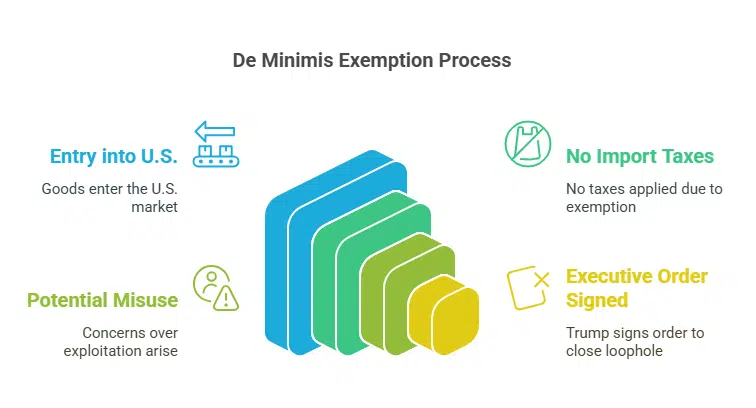
Under existing U.S. customs regulations, items valued at $800 or less — including goods purchased from Hong Kong-based e-commerce sellers — were allowed entry into the U.S. without incurring import taxes. This de minimis threshold has been widely used by overseas retailers like Temu, Shein, and other Asia-based platforms to offer low-cost products to U.S. consumers.
However, citing concerns over misuse, Trump signed an executive order earlier this month to close this perceived loophole. The administration claims that foreign sellers, especially from China and Hong Kong, were exploiting the rule to avoid customs inspections, duties, and to potentially flood the U.S. with counterfeit or restricted goods.
Key changes under the new U.S. policy:
-
The de minimis exemption for China and Hong Kong has been revoked.
-
Goods shipped from Hong Kong to the U.S. worth under $800 will now face a flat tariff.
-
Starting May 2, these parcels will be subjected to either:
-
A 30% import tariff or
-
A $100 per-item fee, whichever is higher.
-
-
On June 1, the rate increases further to a 120% import tariff or
-
A $200 per-item fee.
-
Impact on Hong Kong Residents and Businesses
The announcement by Hongkong Post means that consumers and businesses in Hong Kong will no longer be able to use the city’s low-cost public mail service for sending goods to the U.S. Instead, they must turn to private international couriers such as DHL, FedEx, or UPS, which are significantly more expensive.
This development will:
-
Drive up the cost of shipping for small businesses, startups, and independent online sellers in Hong Kong.
-
Reduce consumer options for affordable shipping to U.S.-based customers.
-
Affect individuals who rely on Hongkong Post for sending personal goods or gifts to family and friends in the United States.
Hong Kong’s government warned its citizens in the statement:
“The public in Hong Kong should be prepared to pay exorbitant and unreasonable fees due to the U.S.’s unreasonable and bullying acts.”
Hong Kong’s Historical Trade Relationship with the U.S.
For decades, Hong Kong has been recognized as a free trade port, offering minimal import taxes and no general sales tax (GST or VAT). Its economic policies helped transform it into a leading international shipping and commerce hub.
Until 2020, Hong Kong also enjoyed a special trade status with the United States, granted under the U.S.-Hong Kong Policy Act. This status allowed Hong Kong to operate independently from mainland China for customs, tariffs, and financial regulations.
However, this special status was revoked by President Trump in July 2020 following Beijing’s imposition of a sweeping National Security Law on Hong Kong, which Washington viewed as a violation of the city’s autonomy.
As a result, Hong Kong has been treated the same as mainland China in terms of trade — meaning no preferential tariffs, no streamlined customs clearance, and now, no exemption under the de minimis rule.
John Lee and Chinese Officials Respond
Hong Kong’s Chief Executive, John Lee, joined mainland Chinese authorities in criticizing Washington’s escalating trade actions. During a televised address at a national security event held on Tuesday, Lee called out the U.S. for what he described as “hegemonic behavior.”
“The United States’ reckless crackdown on China and Hong Kong has become a frenzy,” Lee said.
He added that the 145% tariff currently levied by the U.S. on goods from both China and Hong Kong exemplifies what he called “false narratives and economic coercion.”
Notably, while Beijing has retaliated by imposing 125% tariffs on American imports, Hong Kong has not matched those measures, choosing instead to take its grievance to the World Trade Organization (WTO).
WTO Complaint and International Repercussions
Both China and Hong Kong have filed complaints to the WTO over the new U.S. tariff structure. Officials argue that the U.S. is in violation of long-standing WTO rules that prohibit discriminatory tariffs and require equal treatment of member states.
However, many trade experts suggest that any resolution at the WTO may take years to conclude, especially since the WTO’s Appellate Body — the key mechanism for settling disputes — has been paralyzed due to a lack of appointed judges, a situation caused by the U.S. blocking nominations.
Despite this, the symbolic move signals that both Hong Kong and China are seeking legal recourse through global institutions, rather than retaliating with equally harsh restrictions — at least for now.
What This Means for Global Trade
The halt of Hongkong Post’s U.S.-bound package services is more than just a shipping disruption — it’s a reflection of how the global trade environment is becoming more fractured and politicized.
Key concerns moving forward include:
-
Rising costs for cross-border e-commerce
-
Disrupted supply chains for international businesses
-
Mounting pressure on global organizations like the WTO to restore order
-
Potential long-term damage to Hong Kong’s reputation as a neutral trading port
As the world watches the continued deterioration in U.S.-China trade relations, it’s clear that cities like Hong Kong — once buffered from global geopolitical rifts — are now squarely in the line of fire.