December 31 is the world’s great masquerade. On the surface, it is a night of glitz, global synchronicity, and the collective counting of seconds. It is the one moment when humanity looks at the clock together, united by the promise of a fresh start. But if you look past the pyrotechnics and the party hats, you find a day that has been ruthlessly efficient in shaping our reality.
History, it seems, prefers to work on a deadline. While the world is often distracted by celebration, the gears of geopolitics and culture have ground out some of their most irreversible shifts on this very day. It was on a cold New Year’s Eve in 1600 that a simple signature in London doomed the Indian subcontinent to centuries of economic extraction. It was on this day that Europe locked its currencies together to challenge the global financial order, and it was on this day that the modern Russian state was born in a surprise television address.
For the cultural anthropologist, December 31 is not just a calendar flip; it is a study in “midnight history”—decisions made at the eleventh hour that ripple forward for decades. From the quiet laboratories of Thomas Edison to the bustling ports of colonial Bengal, this report peels back the celebratory veneer to reveal the profound, and often somber, architecture of the world we inhabit today.
The Bangalee Sphere & Subcontinent: The Colonial Seed
In the history of the Indian subcontinent, and specifically Bengal, few dates are as quietly consequential as New Year’s Eve. While modern Bangladesh and India celebrate the coming year, history remembers this day for a signature in London that would eventually alter the destiny of millions across South Asia.
1600: The Signature That Changed South Asia
On December 31, 1600, Queen Elizabeth I granted a Royal Charter to the “Governor and Company of Merchants of London trading into the East Indies.” This birth of the British East India Company (EIC) is perhaps the single most significant corporate event in history.
At the time, it was merely a business arrangement meant to compete with Dutch spice traders. However, this charter gave the company a monopoly on English trade in the region and the right to “wage war” where necessary. This corporate entity would eventually transform from a trading outfit into an aggressive colonial power, subjugating Bengal after the Battle of Plassey in 1757 and eventually ruling the entire subcontinent. The economic drain and cultural upheaval that defined the next 350 years of Indian and Bengali history began with pen to parchment on this specific day.
Literature and Culture: The Satirist’s Birthday
The subcontinent also celebrates literary giants on this day. December 31, 1925, saw the birth of Shrilal Shukla in Uttar Pradesh, India. A premier writer of Hindi literature, Shukla is immortalized for his satirical masterpiece, Raag Darbari. The novel is a scathing, yet humorous, critique of the corruption, nepotism, and decaying values in post-independence rural Indian politics. His work remains painfully relevant today across South Asia, serving as a mirror to societal and bureaucratic absurdities.
Global Geopolitical Shifts: Power Transfers and New Eras
New Year’s Eve seems to be a favoured date for politicians and nations to make clean breaks with the past.
1999: Russia’s New Year Surprise and the Putin Era
The end of the 20th century brought a stunning political shock in Russia. On December 31, 1999, an ailing President Boris Yeltsin appeared on television to deliver his traditional New Year message. Instead of standard pleasantries, he abruptly announced his resignation, apologizing for failing to fulfill the dreams of post-Soviet democracy.
In his stead, he appointed his relatively obscure Prime Minister, a former KGB officer named Vladimir Putin, as Acting President. This moment was not just a change of guard; it was a profound pivot in Russian history. It marked the end of the chaotic, free-wheeling 1990s in Russia and the beginning of the centralized, assertive era of Putin’s dominance that continues to define global geopolitics decades later.
1999: The Panama Canal Comes Home
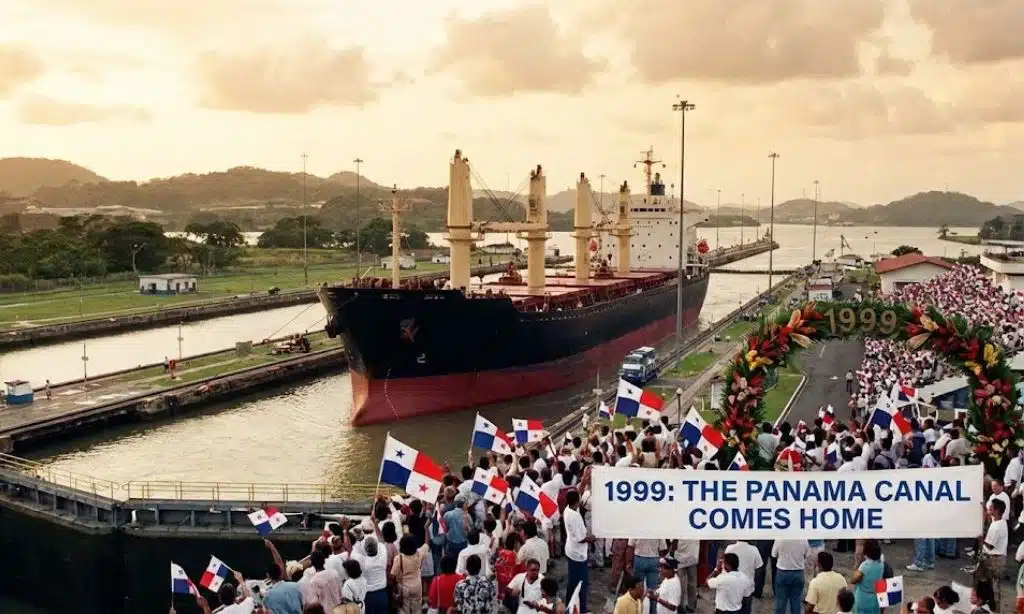
On the same day Yeltsin stepped down, a massive geopolitical shift occurred in the Americas. At noon on December 31, 1999, the United States officially handed over total control of the Panama Canal to Panama.
This transfer fulfilled the Torrijos-Carter Treaties of 1977 and ended nearly a century of American jurisdiction over the Canal Zone—a strip of land that had essentially functioned as a U.S. colony bisecting the Central American nation. For Panama, it was a moment of complete national sovereignty; for the U.S., it marked the end of an era of specific imperial reach in Latin America.
1998: The Dawn of the Euro
In Europe, New Year’s Eve 1998 was economic zero hour. The exchange rates between the currencies of 11 European Union nations (including France, Germany, Italy, and Spain) were irrevocably fixed. At the stroke of midnight, leading into January 1, 1999, the Euro (€) was officially born as an electronic currency used by banks and financial markets. While physical notes wouldn’t arrive until 2002, this was the moment historic currencies like the Franc, the Mark, and the Lira effectively ceased to exist as independent entities, realizing a decades-old dream of European economic integration.
Science, Innovation, and Crises
December 31 also serves as a marker for human ingenuity and, recently, global health challenges.
1879: Edison Illuminates the Night
Before this date, when the sun went down, the world relied on gas lamps and candles. On New Year’s Eve 1879, Thomas Edison changed that forever. He used the occasion to give the first public demonstration of his incandescent light bulb at his laboratory in Menlo Park, New Jersey. He didn’t just show off a bulb; he lit up an entire street, a laboratory, and a boarding house, proving that an electrical distribution system was viable. It was the night the 20th century truly began in terms of infrastructure.
2019: The Zero Hour of the Pandemic
In retrospect, December 31, 2019, is a chilling date. On this day, the Wuhan Municipal Health Commission in China reported a cluster of cases of “pneumonia of unknown cause” to the World Health Organization (WHO). The novel coronavirus eventually identified as SARS-CoV-2 was responsible. This alert was the first official global notification of what would become the devastating COVID-19 pandemic, which reshaped society, economies, and daily life worldwide for years to follow.
At a Glance: Historical Data Tables
To assist researchers and enthusiasts in digesting the breadth of events on this day, we have compiled detailed tables of significant milestones, births, and deaths.
Significant Historical Milestones on December 31
| Year | Region/Country | Event Summary | Historical Significance |
| 1600 | UK / India | East India Company Chartered | Queen Elizabeth I grants charter, planting the seed of British colonialism in Asia. |
| 1857 | Canada | Ottawa named Capital | Queen Victoria chooses Ottawa as the capital of the Province of Canada. |
| 1862 | USA | West Virginia Admitted | President Lincoln signs act admitting West Virginia to the Union during the Civil War. |
| 1879 | USA | Edison’s Demonstration | First public demo of the incandescent light bulb system in Menlo Park. |
| 1994 | Russia | First Chechen War Storming | Russian forces begin a disastrous New Year’s Eve assault on Grozny. |
| 1998 | Europe | Euro Currency Established | Exchange rates fixed for 11 nations; the Euro becomes a valid electronic currency. |
| 1999 | Russia | Yeltsin Resigns | Boris Yeltsin steps down; Vladimir Putin becomes Acting President. |
| 1999 | Panama / USA | Panama Canal Transfer | US hands over full control of the canal to Panama. |
| 2019 | China / Global | First COVID-19 Alert | Wuhan reports “pneumonia of unknown cause” to WHO; start of the pandemic. |
| 2020 | UK /Europe | Brexit Transition Ends | The UK formally leaves the EU single market and customs union at 11 PM GMT. |
Famous Birthdays on December 31
This date has produced a remarkable number of artists, actors, and leaders who have shaped global culture.
| Year | Name | Nationality | Profession & Legacy |
| 1869 | Henri Matisse | French | Painter. A titan of 20th-century art and leader of the Fauvism movement. |
| 1880 | George Marshall | American | Soldier/Statesman. WWII military leader and architect of the “Marshall Plan” to rebuild Europe. Nobel Peace Prize winner. |
| 1908 | Simon Wiesenthal | Austrian | Nazi Hunter. Survivor of the Holocaust who dedicated his life to bringing Nazi war criminals to justice. |
| 1925 | Shrilal Shukla | Indian | Author. Premier Hindi satirist known for Raag Darbari. |
| 1937 | Sir Anthony Hopkins | Welsh | Actor. Legendary Oscar-winner known for The Silence of the Lambs and a vast stage/screen career. |
| 1941 | Sir Alex Ferguson | Scottish | Football Manager. The most successful manager in British football history, revitalizing Manchester United. |
| 1943 | Ben Kingsley | British | Actor. Famous for his Oscar-winning portrayal of Gandhi, bridging Western cinema with Indian history. |
| 1943 | John Denver | American | Singer-Songwriter. One of the most beloved acoustic artists of the 70s (“Take Me Home, Country Roads”). |
| 1946 | Diane von Fürstenberg | Belgian | Fashion Designer. Creator of the iconic wrap dress and a powerful figure in the fashion industry. |
| 1948 | Donna Summer | American | Singer. The undisputed “Queen of Disco” who defined the sound of the late 1970s. |
| 1959 | Val Kilmer | American | Actor. Known for iconic roles in Top Gun, Tombstone, and as Batman. |
| 1977 | Psy (Park Jae-sang) | South Korean | Singer/Rapper. Global phenomenon whose “Gangnam Style” broke internet records and popularized K-Pop globally. |
Notable Deaths on December 31
As the year closes, we also remember those who took their final bows on this day.
| Year | Name | Nationality | Profession & Legacy |
| 1384 | John Wycliffe | English | Theologian. An early dissident in the Roman Catholic Church and forerunner to the Protestant Reformation. |
| 1877 | Gustave Courbet | French | Painter. Leader of the Realist movement in 19th-century French painting. |
| 1972 | Roberto Clemente | Puerto Rican | Baseball Player. Hall of Famer and humanitarian, died in a plane crash delivering aid to earthquake victims in Nicaragua. |
| 1985 | Ricky Nelson | American | Musician/Actor. A premier teen idol of the 1950s and pioneer of the country-rock sound. |
| 2015 | Natalie Cole | American | Singer. Grammy-winning R&B and jazz singer, daughter of Nat King Cole. |
| 2015 | Wayne Rogers | American | Actor. Best known for playing “Trapper John” McIntyre in the iconic TV series MAS*H. |
| 2021 | Betty White | American | Actress/Comedian. A beloved cultural icon with an 80-year career in television, dying just weeks before her 100th birthday. |
| 2022 | Pope Benedict XVI | German | Head of Catholic Church. The first Pope in six centuries to voluntarily resign from the papacy (in 2013). |
Takeaways
December 31 is more than just a party; it is a hinge upon which history swings. It is the day the blueprint for colonial India was drawn, the day electric light became a reality, and the day geopolitical giants like Vladimir Putin stepped onto the world stage. As we celebrate the incoming year, we do so standing on the profound historical foundation built on the final days of years past.