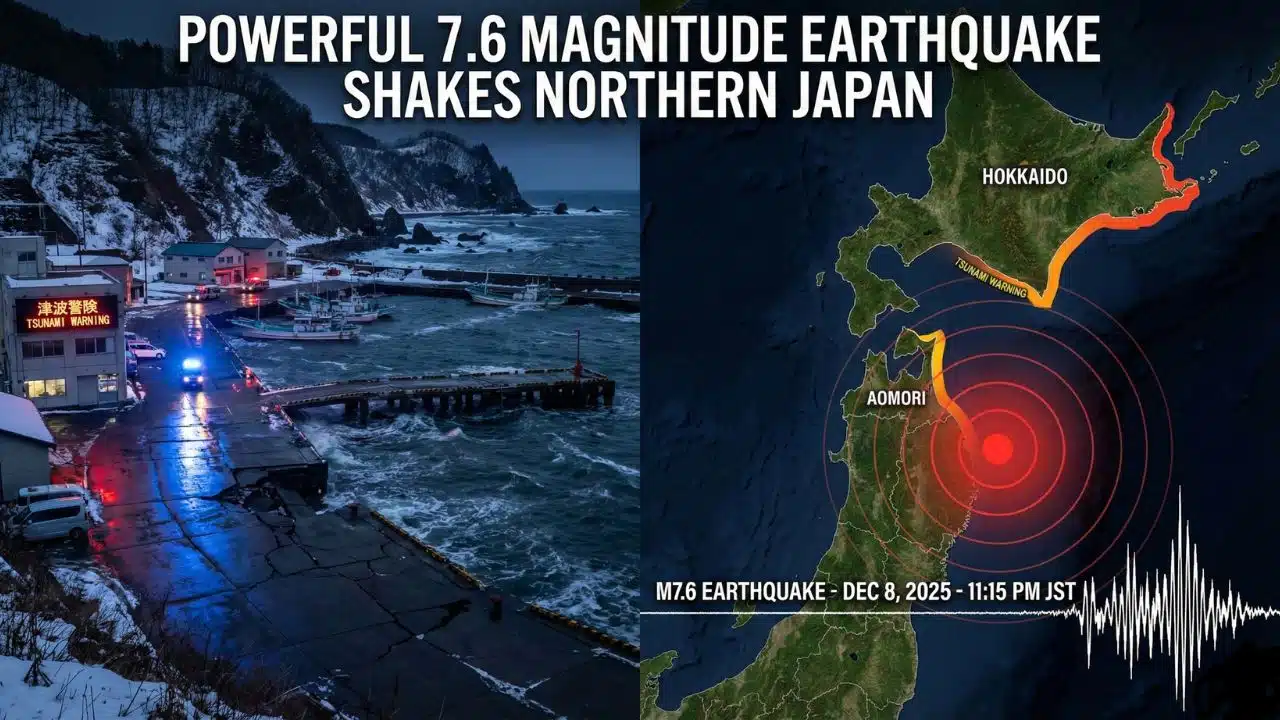
A major 7.6 magnitude earthquake struck off the coast of northern Japan late Monday night, triggering tsunami warnings, causing power outages, and prompting the government to mobilize emergency task forces.
The powerful tremor, which hit at 11:15 p.m. local time (14:15 GMT), rattled the prefectures of Hokkaido, Aomori, and Iwate, forcing residents to flee to higher ground in the darkness.
Tsunami Warnings and Coastal Impact
The Japan Meteorological Agency (JMA) immediately issued tsunami alerts for the coastal areas of Hokkaido, Aomori, and Iwate prefectures. Authorities warned of potential waves reaching as high as 3 meters (10 feet) in some areas, urging residents in low-lying zones to evacuate immediately and not to return home until the all-clear was given.
“Tsunamis will strike repeatedly. Do not leave a safe location until the warning is lifted,” the JMA cautioned in an emergency broadcast.
While the agency braced for larger surges, initial observations recorded smaller but significant waves shortly after the quake. A tsunami measuring 40 centimeters (16 inches) was observed at the town of Urakawa in Hokkaido and the port of Mutsu Ogawara in Aomori. Further south, waves of up to 50 centimeters were reported in Kuji port, Iwate Prefecture. Despite the relatively low initial wave heights, officials maintained strict warnings, noting that first waves are often not the largest and that dangerous currents could persist for hours.
Seismic Intensity and Epicenter
The earthquake’s epicenter was located approximately 80 kilometers (50 miles) off the eastern coast of Aomori prefecture, at a depth of 50 kilometers (30 miles). The shallow nature of the quake contributed to the intensity of the shaking felt across the region.
The tremors were strong enough to violently shake buildings and shatter windows in major cities. In Hokkaido, a reporter for public broadcaster NHK described intense shaking that lasted for approximately 30 seconds, making it difficult to stand without support. The JMA registered a seismic intensity of “Upper 6” on the Japanese shindo scale in the city of Hachinohe, a level at which it is impossible to remain standing and unsecured furniture is likely to topple.
Injuries and Infrastructure Damage
While there were no immediate reports of fatalities, the quake caused injuries and structural damage. NHK reported that several people were injured at a hotel in the city of Hachinohe, Aomori, where falling debris and shattered glass struck guests and staff. Live footage from the area showed glass fragments scattered across roadways and cracks appearing in pavement.
Elsewhere, a man in the town of Tohoku was reported to have sustained minor injuries when his vehicle fell into a fissure caused by the quake.
Utility companies Tohoku Electric Power and Hokkaido Electric Power confirmed that thousands of households were left without electricity following the tremor. Emergency crews were dispatched immediately to assess the grid and restore power to blacked-out neighborhoods.
Nuclear Facilities Secure
In a region still scarred by the 2011 nuclear disaster, the status of nuclear power plants was a primary concern. The Reuters news agency reported that both Tohoku Electric Power and Hokkaido Electric Power had conducted immediate safety checks at their nuclear facilities in the region.
The utilities confirmed that there were no irregularities flagged at the Onagawa Nuclear Power Plant or the Tomari Nuclear Power Plant. Radiation monitoring posts in the area showed no changes, providing a measure of relief to anxious residents.
Government Response: “Lives First”
Prime Minister Sanae Takaichi, who took office in October 2025 as Japan’s first female premier, addressed the nation swiftly. Speaking to reporters shortly after midnight, she announced the establishment of an emergency task force at the Prime Minister’s Office to assess the scale of the disaster and coordinate rescue efforts.
“We are putting people’s lives first and doing everything we can,” Prime Minister Takaichi stated. She instructed government ministries to work closely with local municipalities to ensure resident safety, prioritize the evacuation of vulnerable populations, and restore essential services as quickly as possible.
Chief Cabinet Secretary Minoru Kihara also briefed the press, reiterating the government’s call for vigilance and urging citizens to follow official evacuation orders without delay.
Japan’s Position on the ‘Ring of Fire’
This event serves as a stark reminder of Japan’s geological vulnerability. The archipelago sits on the “Pacific Ring of Fire,” a horseshoe-shaped basin in the Pacific Ocean where tectonic plates collide, leading to many of the world’s earthquakes and volcanic eruptions.
Home to approximately 125 million people, Japan experiences around 1,500 seismic events annually, accounting for roughly 18% of the world’s earthquakes of magnitude 6 or greater. The nation remains hyper-vigilant following the catastrophic magnitude-9.0 earthquake in March 2011, which triggered a massive tsunami and the Fukushima nuclear meltdown, claiming nearly 20,000 lives. The rapid response seen on Monday night reflects the stringent disaster preparedness protocols honed in the years since that tragedy.