If 2025 was the year the world held its breath, 2026 is the year we finally exhale.
Looking back, 2025 was defined by a specific kind of frantic energy. It was a year of “headlines”—shocking announcements, initial AI anxieties, rapid-fire geopolitical realignments, and the nervous friction of a global order trying to find its footing. We spent the last twelve months reacting. We reacted to tariff wars, we reacted to the flood of generative content, and we reacted to the shifting sands of the labor market.
But as the calendar turns, the atmosphere is shifting. The theme for 2026 is not disruption; it is integration. We are moving from the “Year of the Shock” to the “Year of the Result.”
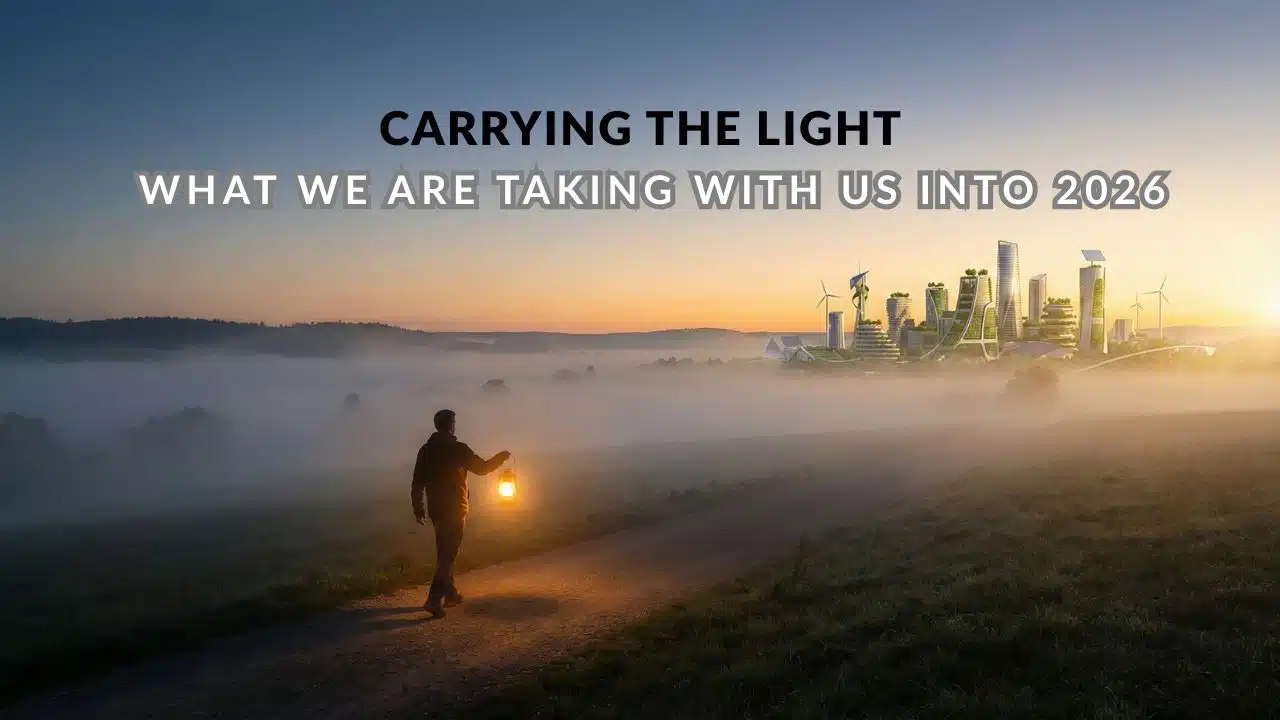
We are not taking the chaos with us. Instead, we are “Carrying the Light.” In this context, “Light” represents clarity, proven utility, and human agency. It is the ability to see through the fog of hype and identify what actually works. We are leaving behind the speculative bubbles and the paralysis of analysis. What we are bringing into 2026 are the tools, the resilience, and the hardened wisdom required to architect a new reality.
In 2026, humanity moves from being the audience of the future to being its architect. Here is what that looks like across technology, business, careers, and the global stage.
Technology: The Spark Becomes a Flame
For the past two years, the world has been obsessed with “chatting” with Artificial Intelligence. We treated AI like a very smart, very fast intern that we had to micromanage. That era is ending.
From Chatbots to Agentic AI
The single most significant technological shift we are taking into 2026 is the rise of Agentic AI.
In 2025, you might have asked a Large Language Model (LLM) to “write a travel itinerary.” In 2026, you will authorize an AI agent to “book the trip.” The difference is profound. We are moving from “Prompt Engineering” to “Outcome Management.”
Agentic AI systems do not just generate text; they have access to tools. They can browse the web, access APIs, make payments, and execute complex, multi-step workflows without human hand-holding. This shift fundamentally changes software interaction. We are no longer using apps; we are assigning tasks.
This “light” of autonomy means that in 2026, productivity isn’t about how fast you can type; it’s about how well you can orchestrate a fleet of digital agents.
The Robot Reality (Physical AI)
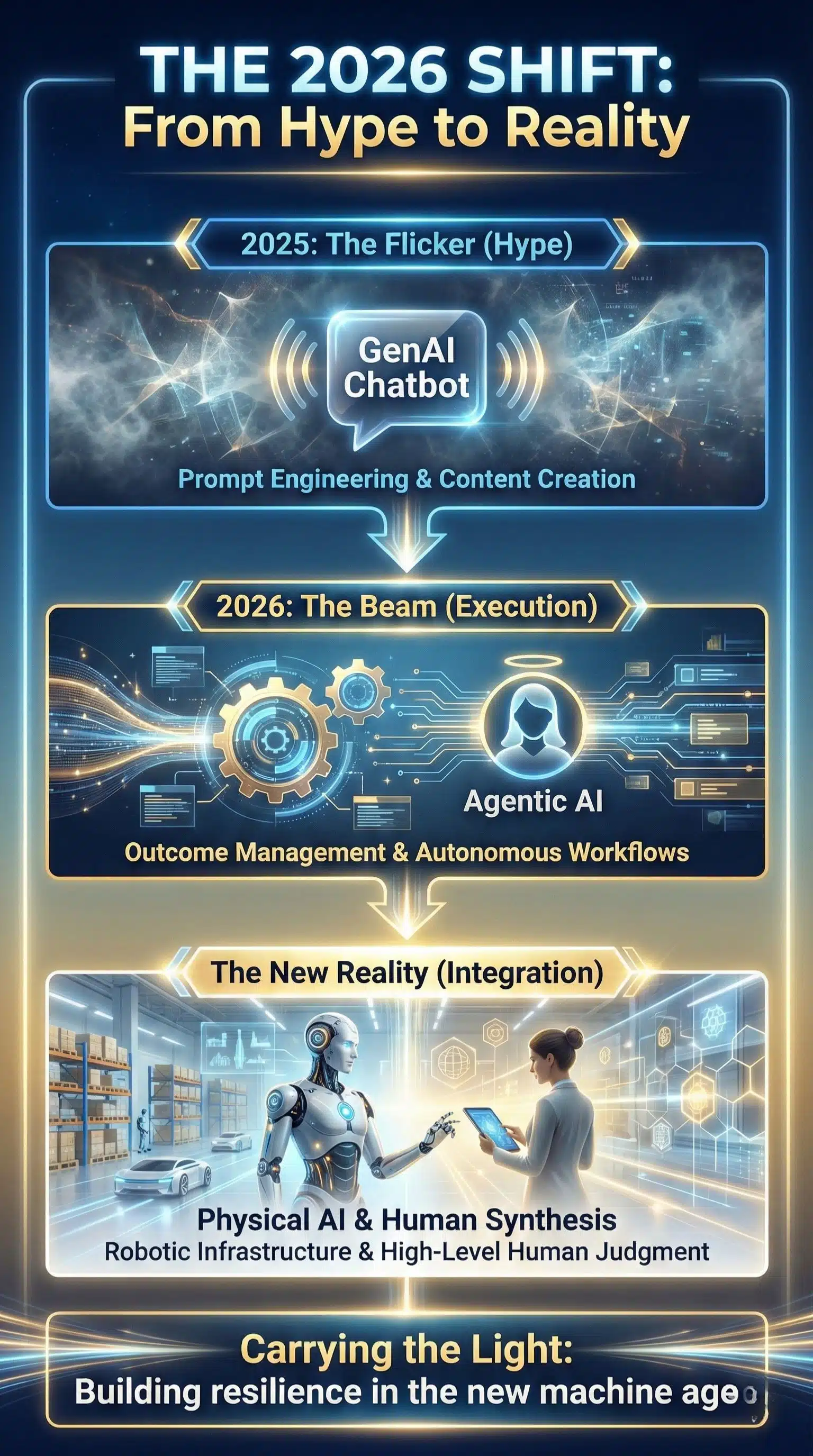
For years, robotics was “always five years away.” In 2026, AI finally leaves the screen. This is the year of physical AI.
We are seeing the deployment of humanoid and specialized robotics in “unsexy” but critical sectors: warehousing, elder care, and last-mile delivery. The breakthrough wasn’t just in hardware but in the “brains”—the same transformer models that power ChatGPT are now being used to teach robots how to navigate the physical world.
This isn’t sci-fi. It is infrastructure. In 2026, seeing an autonomous unit stocking shelves or delivering parcels will stop being a novelty and start being a background utility, much like a vending machine.
The “Unified” Tech Stack
We are leaving behind the “app fatigue” of 2025. The fragmented ecosystem—where businesses juggled 50 different SaaS (Software as a Service) subscriptions—is collapsing. 2026 is about consolidation. The winning platforms of this year are the ones that talk to each other seamlessly, creating a “digital nervous system” for businesses where data flows freely between sales, logistics, and HR without manual entry.
Economy & Business: From Hype to Harvest
If the economy of 2025 was built on promises, the economy of 2026 is built on proof. The tolerance for “growth at all costs” has evaporated, replaced by a ruthless demand for Resilience and ROI.
The Year of Results
2025 saw massive capital expenditure (CapEx) on AI infrastructure—chips, data centers, and energy grids. 2026 is the “Harvest Year.” Investors and boards are no longer asking “What is your AI strategy?” They are asking, “Where is the AI profit?”
This will force a maturity in the market. Companies that plastered “AI-powered” on mediocre products will fade, while businesses that used technology to fundamentally lower their cost of goods sold (COGS) will thrive. We are carrying the light of pragmatism into the boardroom.
Supply Chain “Geopatriation”
Globalization isn’t dead, but the old version—chasing the lowest labor cost regardless of location—is gone. We are carrying forward a philosophy of “Sovereign-shoring.”
In 2026, nations and corporations prioritize security over pure efficiency. “Just-in-Time” manufacturing has been replaced by “Just-in-Case” stockpiling. We are seeing the maturation of “friend-shoring,” where critical goods (pharmaceuticals, semiconductors, advanced batteries) are produced strictly within borders or allied nations.
This means 2026 will likely see slightly higher consumer prices for certain goods but significantly higher stability. We are trading cheapness for certainty.
The Rise of the “Middle Powers”
While the US and China continue their titanic tussle for dominance, the real economic action in 2026 belongs to the Transactional Middle.
Countries like India, Saudi Arabia, Brazil, Indonesia, and Vietnam are the new power brokers. They are refusing to pick a permanent “side,” instead leveraging their neutrality to do business with everyone. In 2026, these nations are not just emerging markets; they are the “Swing States” of the global economy. Multinational corporations are pivoting their strategies to court these regions, recognizing that the next billion consumers are not in the West.
Work & Career: Illuminating Human Value
Perhaps the most personal “light” we carry into 2026 is a renewed understanding of human value. The fear that “AI will replace us all” has evolved into a nuanced reality: AI replaces tasks, not entire jobs—unless that job was entirely robotic to begin with.
The Autonomy Exodus & Skills-First Hiring
The college degree continues its slow decline as a proxy for competence. In 2026, the resume is dead; the portfolio is king.
Employers are adopting “Skills-First Hiring” at scale. They don’t care where you learned to code, write, or manage projects—they care if you can prove you’ve done it. Micro-credentials and verifiable project histories are the new currency. This democratizes opportunity but raises the bar for entry; you can no longer hide behind a prestigious university brand.
The “Synthesist” Employee
The most valuable employee in 2026 is not the “Prompt Engineer“—that was a 2025 fad. The new archetype is the Synthesist.
A synthesist is someone who can take the raw, often average output of AI agents, apply high-level human judgment, ethics, and emotional intelligence, and synthesize it into a strategic result. They connect the dots that AI misses. They are the editors, the curators, and the strategists. In 2026, you are judged not by what you create from scratch, but by what you can finalize and approve.
The Squeeze on Middle Management
We must acknowledge the shadow alongside the light. 2026 is a dangerous year for traditional middle management. As Agentic AI takes over coordination, reporting, and scheduling, the “clipboard class” is facing an existential crisis.
Managers who only “track work” are obsolete. To survive 2026, managers must pivot to become “culture architects” and “coaches.” Their value lies in mentoring humans and removing blockers, not in passing information up and down the chain.
The Trade Renaissance
As digital entry-level jobs face compression, we are witnessing a massive cultural shift toward the skilled trades. Electricians (especially for green tech), specialized builders, and plumbers are commanding premiums. In 2026, a “blue-collar” career in specialized infrastructure is viewed with the same prestige—and often higher pay—as a mid-level marketing role.
The geopolitical landscape of 2026 is defined by “Controlled Disorder.” The 20th-century ideal of a single, unified “international community” has been retired. We are now in an era of transactional diplomacy.
Ad-Hoc Alliances
Nations are no longer looking for permanent marriages; they are looking for dates. A country might align with China on renewable energy technology, with the US on defense security, and with the EU on data privacy.
This complexity requires a new kind of diplomatic “light”—one that is flexible and realist. The binary “Us vs. Them” narrative is being replaced by a multipolar web of interests.
The Digital Fortress
We are also seeing the rise of the “Digital Firewall.” Nations are actively insulating their digital infrastructure. The internet is becoming less “World Wide” and more “Nation Wide.” Data sovereignty laws in 2026 mean that data generated in Europe stays in Europe; data in India stays in India. This fragmentation creates headaches for tech giants but offers a sense of digital security for nations tired of foreign surveillance.
Science: New Spectrums
While politics fragments, science is finding new ways to unify biology and technology.
Digital Twins in Medicine
In 2026, “digital twins” move from manufacturing to medicine. We are seeing the first scaled applications of creating a digital replica of a patient’s biology.
Doctors can now test strong courses of chemotherapy or experimental drugs on your “Digital Twin” to predict reactions before a single drop of medicine enters your actual bloodstream. This is the “light” of precision—reducing risk and tailoring healthcare to the individual genome.
Bio-Computing
As the energy demands of AI data centers became a crisis in 2025, 2026 brings the response: bio-computing. We are seeing breakthroughs in “physics-native” hardware—computers that mimic the neural structure of the human brain to process data. These systems promise to solve the climate-impact problem of AI, offering a path to high-level compute power that doesn’t boil the oceans.
Comparative Analysis: The 2025 Torch vs. The 2026 Beacon
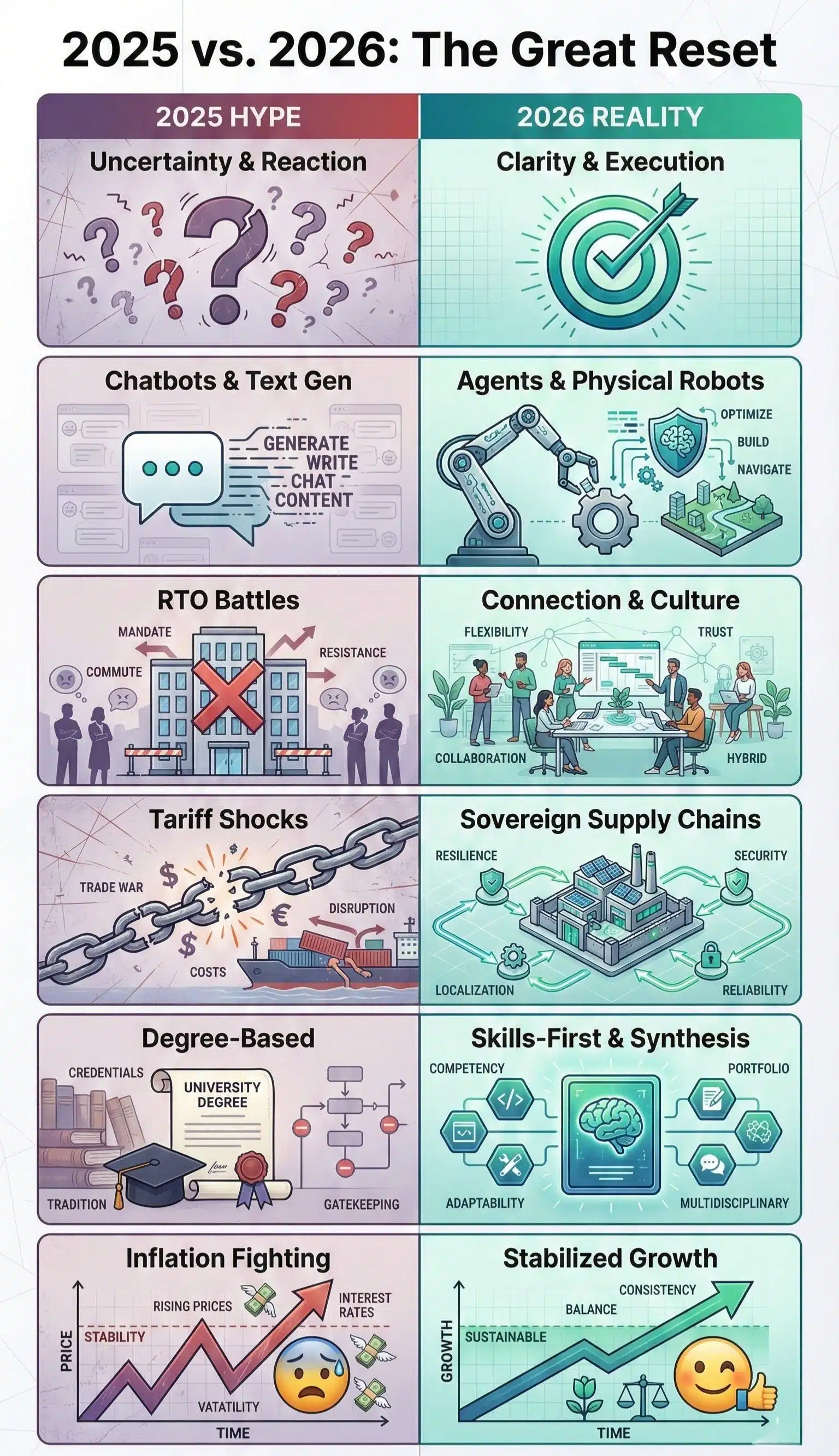
To truly understand where we are going, we must contrast it with where we have been.
| Feature | 2025 (The Flicker / The Hype) | 2026 (The Beam / The Reality) |
| Primary Vibe | Uncertainty, “Headlines,” Reaction | Clarity, “Results,” Execution |
| AI Focus | Chatbots (Generative Text) | Agents (Autonomous Action) |
| Workplace | The “Return-to-Office” Battle | The “Connection & Culture” Focus |
| Global Trade | Tariff Shocks & Trade Wars | Sovereign Supply Chains |
| Hiring | Degree-based & Tech Skills | Skills-based & “Human Synthesis” |
| Economy | Inflation Fighting | Moderate, Stabilized Growth |
| Management | Middle Managers as “Monitors” | Middle Managers as “Coaches” |
Final Words: The Light We Keep
As we step into 2026, we are not entering a utopia. The world remains complex, fractious, and competitive. But we are entering a period of lucidity.
The “light” we are carrying is the realization that technology is a tool, not a master. It is the understanding that economic resilience matters more than unrestricted growth. And most importantly, it is the recognition that in a world of automated agents and digital replicas, the distinct qualities of human judgment, empathy, and creativity are more valuable than ever.
The successful individual in 2026 isn’t the one who predicts the future perfectly—that is impossible. The winner is the one who has built the adaptability to navigate any future. We are finished with the panic of the storm; 2026 is about learning to build in the rain.
Welcome to the year of the architect.