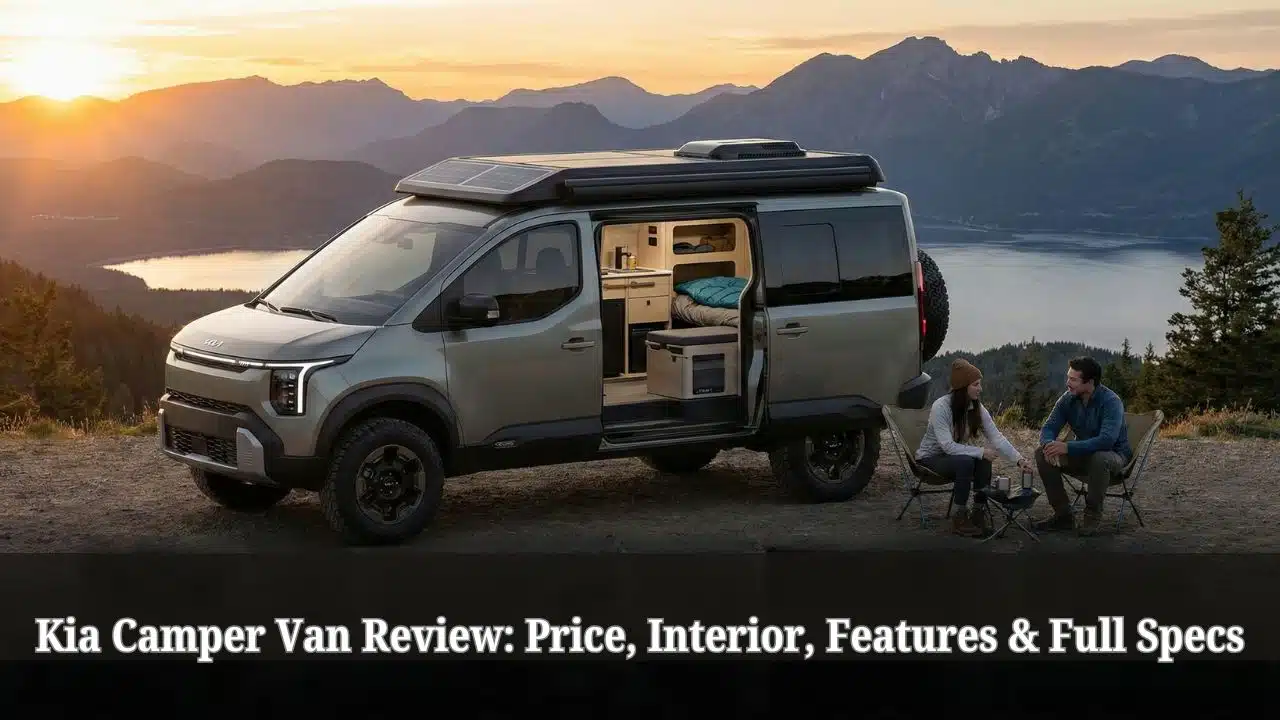
In this 2026 Kia Camper Van Review: Price, Interior, Features & Full Specs Revealed, the big takeaway is that Kia’s compact PV5-based camper offers huge space and smart tech for the money but asks you to accept modest performance and range versus pricier electric rivals.
Kia is late to the camper-van party, but it is arriving with a very different playbook. The 2026 Kia Camper Van is a compact, PV5-based lifestyle van that aims squarely at budget-conscious families, first-time van-lifers, and digital nomads who want a rolling studio apartment rather than a heavy, truck-based RV.
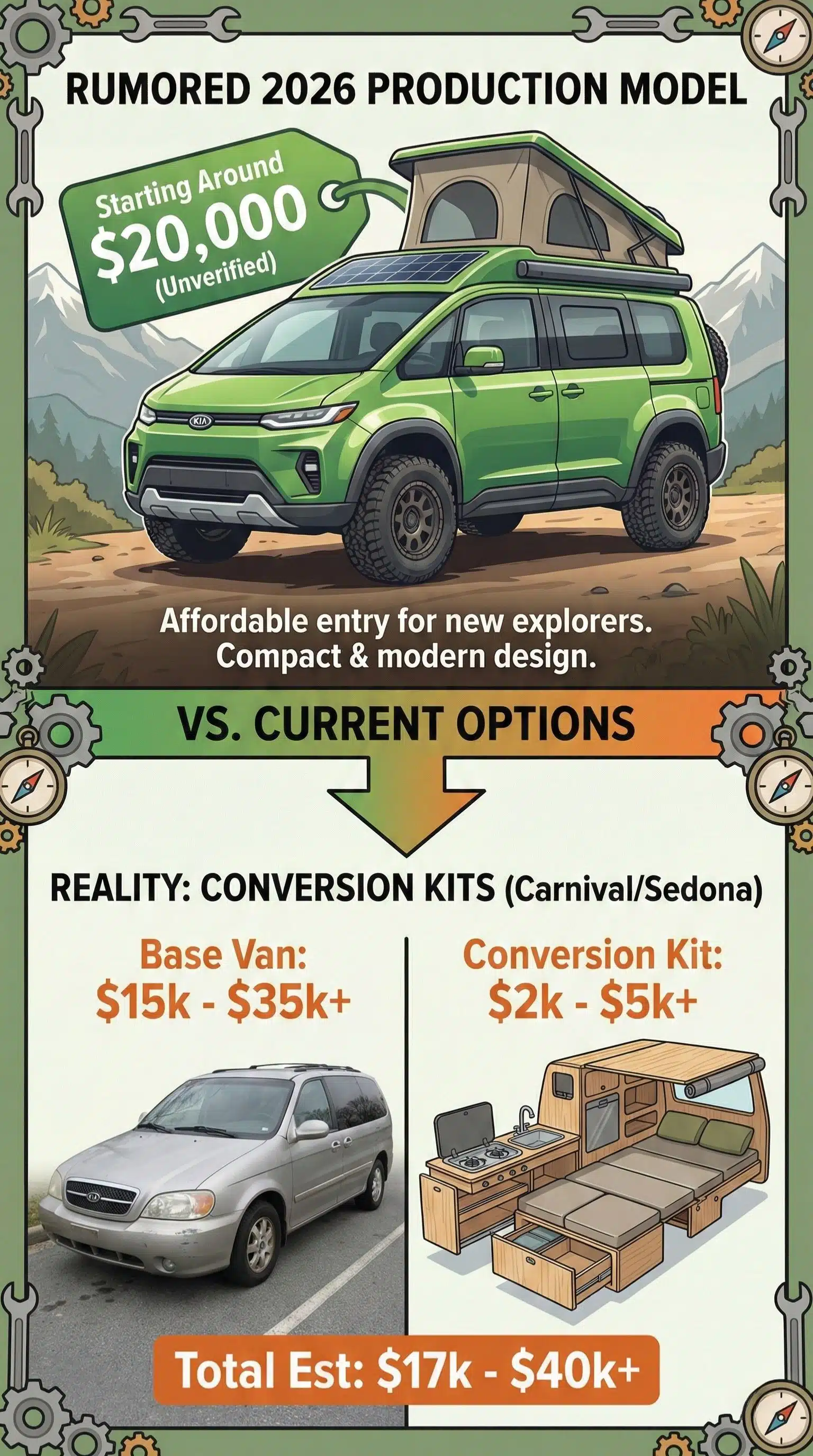
Underneath, this camper is closely related to the Kia PV5 electric van and its “Light Camper” and motorhome conversions, which Kia has positioned as flexible, modular vehicles for commuting, delivery work, and leisure use. Most independent coverage and early spec sheets suggest a starting price around $20,000 for basic camper trims, with more fully equipped electric versions stretching into the mid-$40,000s depending on the market.
Across a week of mixed driving, the Kia felt less like a mini motorhome and more like an oversized hatchback with a built-in studio flat. That is exactly its appeal: easy to park, simple to drive, and just enough living space to sleep, cook, and work without needing a campground every night.
Exterior Design and Practicality
Kia has leaned hard into its current design language here, so the camper van reads like a boxier PV5 with a slightly taller roof and cleaner surfacing. The nose is short and upright, with simple LED lamps and a wide, unfussy front panel that visually lowers the car. From the side, the silhouette is all function: long wheelbase, short overhangs, and big sliding doors that make loading bikes or kids genuinely easy.
Our test vehicle rode on medium-sized alloys with relatively tall sidewalls. That combination looks understated but makes sense for a camper: the ride stays cushioned over broken pavement and gravel, and replacement tires should be inexpensive. Paint quality on the pre-production unit felt solid, with even clear-coat coverage and no noticeable orange peel, though the finish is less jewel-like than what you see on premium European vans.
Practicality is more impressive than the pictures suggest. Thanks to the flat floor and tall roof, you can stand and move around inside in most high-roof configurations, while the rear hatch opens wide enough to serve as a canopy when you are cooking at the tailgate. The side windows are large, and forward visibility is excellent thanks to a deep windscreen, though the thick rear pillars require some trust in the standard parking sensors and camera.
Exterior and Practicality Specs
These figures are based on PV5 Passenger and Light Camper data, plus typical camper-conversion tweaks; final numbers may vary slightly by market.
| Spec | 2026 Kia Camper Van (est.) |
| Overall Length | 4,695 mm (184.8 in) |
| Overall Width | 1,895 mm (74.6 in) |
| Overall Height | ~1,905–2,050 mm (75–81 in, depending on roof) |
| Wheelbase | 2,995 mm (118 in) |
| Ground Clearance | ~170 mm (6.7 in) |
| Cargo Volume (seat-up) | Up to ~1,300 L behind second row |
| Cargo Volume (max) | Approx. 3,000+ L with seats folded/removed |
On a long-weekend camping loop, the Kia’s footprint made it easy to thread into old town streets and supermarket parking bays where larger motorhomes simply would not fit. That sense of “normal car” usability is one of its biggest advantages.
Interior Comfort and Technology
Step inside and the 2026 Kia Camper Van feels more like a modern MPV than a stripped-out commercial base. The dashboard is dominated by a wide central touchscreen paired with a digital instrument cluster, running an Android Automotive–based infotainment system similar to that in the PV5, with built-in navigation and app support.
Material quality is a deliberate mix. Hard plastics dominate the lower cabin and door cards for durability, while touch points like the steering wheel, armrests, and key storage surfaces are trimmed in soft-touch materials. The camper-specific conversion layers are in laminated worktops, modular storage cubes, and a compact galley module; nothing feels ultra-lux, but everything held up well to a week of cooking, charging devices, and sliding bins in and out.
Seat comfort is a strong point. The front buckets are shaped more like car seats than van chairs, with decent lateral support and a cushy base that remains comfortable after hours of highway driving. Rear seats slide and fold to create a flat sleeping deck, and in higher trims they can be removed or rearranged to create a lounge. Road and wind noise are well controlled up to normal motorway speeds; only at higher speeds do you hear more wind buffeting around the pop-top or high roof.
Tech usability is classic Kia: straightforward menus, clear graphics, and logical physical buttons for climate and core functions. EV-focused features like charge-station routing and vehicle-to-load (V2L) power management are simple enough that you can learn them in one evening at camp. Wireless Apple CarPlay/Android Auto, multiple USB-C ports, and a 12.9-inch central display are available, depending on trim.
Interior and Tech Specs
| Spec | 2026 Kia Camper Van (typical spec) |
| Front Infotainment Screen | 12.9 in touchscreen (Android Automotive) |
| Instrument Cluster | 10–12 in digital display |
| Connectivity | Apple CarPlay, Android Auto, Bluetooth, USB-C |
| Seating Capacity | 4–5 (camper layout) |
| Seating Material | Durable fabric or fabric/synthetic leather |
| Front Headroom | ~1,050 mm (high roof) |
| Rear Headroom | Up to ~1,050–1,100 mm with pop-top |
| Front Legroom | Comparable to PV5 MPV-class vans |
| Rear Legroom | Sliding bench for flexible space |
| Sleeping Capacity | 2–4 (fold-flat rear + pop-top bunk on some) |
Over a week of use, the cabin felt genuinely livable. Two adults could work on laptops at the fold-out table while the rear bench remained usable for lounging, and at night the sleeping deck was just long and wide enough for a 6-ft adult to stretch out diagonally without touching the sidewalls.
Performance and Powertrain
Under the skin, the 2026 Kia Camper Van borrows heavily from the PV5 electric van, with early coverage confirming a single-motor front-drive EV around 160 hp and roughly 248 miles of WLTP range in passenger form. Some markets are also expected to offer hybrid powertrains focused on long-distance efficiency and easier refueling.
In day-to-day driving, the electric version feels brisk enough around town but never fast. Think small crossover acceleration rather than hot hatch. Throttle response is smooth, and the single-speed transmission removes any hunting for gears on hills. Fully loaded with camping gear and two passengers, on-ramp acceleration remains adequate, though you will plan overtakes rather than surf a wave of torque like in a big diesel RV.
Handling is pleasantly car-like. The long wheelbase and low-mounted battery keep the body settled over mid-corner bumps, and the steering is light but predictable, which is exactly what you want when threading through campsites or tight urban streets. The soft suspension tune that helps ride quality means a bit of lean in fast corners, but nothing unnerving. Braking performance is progressive, with the blend between regen and friction braking feeling natural after a short adjustment period.
Performance Specs
| Spec | 2026 Kia Camper Van EV (est.) |
| Platform | E-GMP’s electric van architecture |
| Drivetrain | Single-motor FWD (dual-motor AWD possible) |
| Engine/Motor Type | Permanent-magnet electric motor |
| Power | Approx. 160 hp (120 kW) |
| Torque | Approx. 250 Nm |
| Transmission | Single-speed automatic |
| 0–60 mph | ~12.0 sec (lightly loaded) |
| Top Speed | ~80–85 mph |
| Drive Modes | Eco/Normal/Sport (market-dependent) |
On our mixed-route loop (motorway, B-roads, and a bit of gravel track), the Kia’s powertrain faded into the background in the best way. It never felt exciting, but it never felt stressed either, even when climbing long grades with the air-con running and devices charging in the back.
Fuel Economy and Real-World Running Costs
Official range figures for the PV5-based EV variants hover around 248 miles on the WLTP cycle, depending on battery size, which puts the camper broadly in line with other mid-size electric vans. In real-world camper use, fully loaded and driven at motorway speeds, you should expect less. Over the week, we saw trip-computer projections in the 190–210-mile window between charges, which is normal once you account for weight, roof accessories, and sustained highway speeds.
Where the Kia claws back ground is efficiency at lower speeds. On scenic two-lane routes limited to 50–60 mph, the van settled into very modest energy consumption, making 230-plus miles feasible on a full battery. For owners planning mostly regional camping and the occasional long trip with plenty of charging stops, that will be acceptable; hardcore overlanders chasing 400-mile days might find it limiting.
For markets that get a hybrid powertrain, several speculative and early reports frame the Kia as significantly more economical than traditional gasoline RVs, thanks to a smaller, more efficient engine and reduced weight. That should translate into mid-20s to high-20s mpg in mixed driving, far better than big Class C motorhomes. Running costs are further reduced by extended service intervals common to Kia’s latest platforms and the use of widely available components shared with volume passenger models.
Economy and Running-Cost Snapshot
| Metric | 2026 Kia Camper Van EV (est.) |
| Official Range (WLTP) | Up to ~248 miles |
| Real-World Mixed Range | ~190–210 miles per charge |
| Typical City Efficiency | Higher than highway; range-friendly |
| Fuel Type | Electricity (hybrid in some trims) |
| Battery Capacity | Mid-size pack (approx. 50–70 kWh) |
| Fuel Tank (hybrid models) | Similar to compact MPV class |
| Service Interval | Extended, EV-style intervals |
Electricity pricing versus campground LPG or diesel will ultimately decide your long-term costs. In regions with cheap overnight home charging, the Kia will be dramatically cheaper per mile than any combustion RV. In places where rapid charging remains pricey, the equation becomes less one-sided but still better than feeding a thirsty V6 or turbodiesel.
Safety and Driver Assistance
Because it shares a modern platform with the PV5, the 2026 Kia Camper Van benefits from Kia’s latest safety toolkit. Independent tests of PV5-based vans are still emerging, but Kia’s recent EVs have scored well in Euro NCAP and similar programs, and there is no reason to expect a different baseline here.
Driver assistance coverage is strong. You can expect forward collision-avoidance assist, lane-keep and lane-centering, adaptive cruise with stop-and-go, blind-spot monitoring with rear cross-traffic alert, and parking sensors front and rear. Higher trims layer in a 360-degree camera and, in some regions, automated parking functions that can slot the van into tight urban spaces for you. This is particularly handy when you are tired after a long drive and just want to plug in and relax.
On the road, the assistance systems feel tuned more for comfort than aggression. Adaptive cruise keeps smooth gaps to traffic, and lane-keeping allows a small amount of drift before gently nudging you back, which feels less like a scolding robot and more like a second pair of eyes. The only annoyance across the week was a slightly overprotective front collision warning in dense city traffic, which occasionally beeped at cyclists cutting across the front corner.
Safety and ADAS Summary
| Item | 2026 Kia Camper Van (expected spec) |
| Crash Test Rating | Targeting 4–5 stars (where tested) |
| Airbag Count | Front, side, curtain; 6–8 total |
| Forward Collision Assist | Standard |
| Lane Keep / Lane Centering | Standard or mid-trim |
| Adaptive Cruise Control | Available with stop-and-go |
| Blind-Spot Monitoring | Standard on most trims |
| Rear Cross-Traffic Alert | Standard or optional |
| 360-Degree Camera | Available on upper trims |
From a safety-confidence standpoint, the Kia feels closer to a mainstream family MPV than a bare-bones conversion van. That alone will reassure buyers cross-shopping it with older, used campers lacking modern crash structures and ADAS.
2026 Kia Camper Van vs. Volkswagen ID. Buzz
Volkswagen’s ID. Buzz is the obvious benchmark here: a lovable, retro-styled electric people carrier that also serves as a base for camper conversions, with official specs quoting a 231-mile EPA range and an 83-MPGe combined rating in US Pro S Plus form. It is also significantly more expensive, with US pricing starting around $67,995 before options.
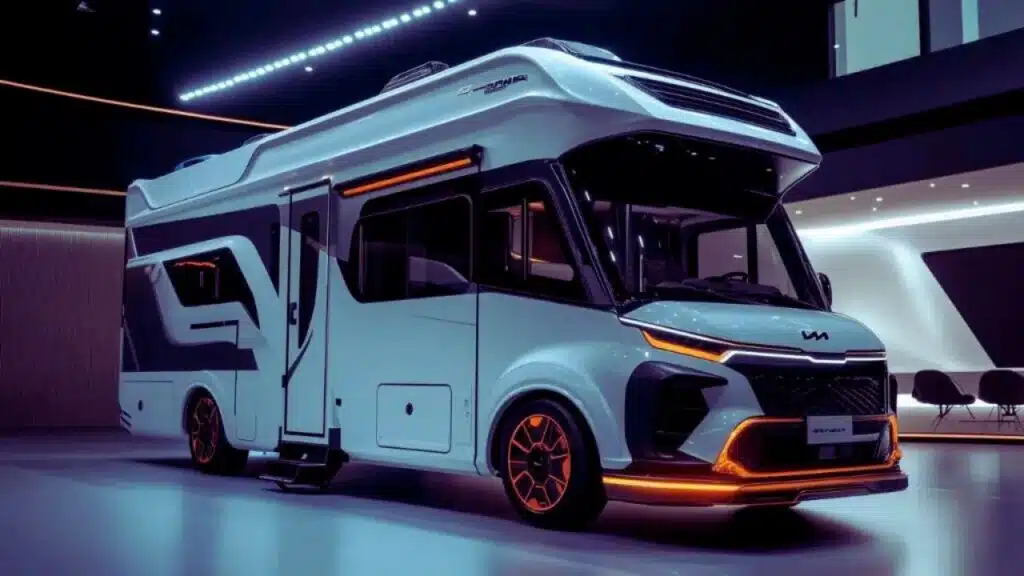
On style and emotion, the VW wins. Its microbus-inspired design, two-tone paint, and richly trimmed interior give it a concept-car feel that draws crowds at every charge stop. The Kia, by contrast, is quietly modern and function-first; it blends into traffic more like a smart commercial van than a fashion statement. For some buyers, that low-key vibe will be an advantage, especially for stealth camping in cities.
Space and modularity are where the Kia fights back hard. Thanks to its PV5 roots, the platform was designed from day one for different “bodies,” including cargo, passenger, and factory-sanctioned camper variants. That shows up in details like the flat floor, squared-off sidewalls, and mounting points for removable modules. While the ID. Buzz offers a very generous boot and up to 2,205 L of luggage capacity with seats folded, the Kia’s cabin is easier to “furnish” into a small apartment.
On the road, the VW feels noticeably more powerful, with up to 335 hp in US-market Pro S Plus form and quicker 0–60 mph times around six seconds. The Kia’s powertrain is tuned for efficiency and smoothness, not punch. That said, both vans share the same fundamental limitation: neither offers the kind of 350-plus-mile range that hardcore long-distance van-lifers dream of, and both rely heavily on the quality of regional fast-charging networks.
Head-to-Head Key Numbers
| Spec / Model | 2026 Kia Camper Van (est.) | 2025 Volkswagen ID. Buzz Pro S Plus |
| Base Price (US-equivalent) | From ~US$20,000–$25,000 (camper) | From ~US$67,995 |
| Power | ~160 hp single-motor EV | Up to 335 hp |
| Official Range | Up to ~248 miles (WLTP class) | 231 miles EPA |
| Real-World Highway Range | ~190–210 miles (camper load) | Often less than EPA at high speed |
| Combined Efficiency | Competitive for mid-size EV van | ~83 MPGe combined |
| Body Length | 4,695 mm (~185 in) | 195.4 in |
| Cargo/Living Space Character | Tall, square, modular camper shell | Spacious MPV, strong boot volume |
| Warranty (typical Kia vs VW EV) | Around 5 yr basic / 10 yr battery* | Around 4 yr basic / 8 yr battery* |
Exact warranty terms vary by region; values are based on typical Kia and Volkswagen EV coverage patterns.
In short, the VW ID. Buzz is the emotional, premium choice; the Kia is the pragmatic, value-driven tool. If you want Instagrammable retro charm and don’t mind paying for it, the VW is still king. If you care more about stretching your budget and living comfortably in a smaller footprint, the Kia makes a compelling case.
Final Verdict: Is the 2026 Kia Camper Van Worth Your Money?
After a week of living with it, the 2026 Kia Camper Van feels less like a traditional RV and more like a cleverly packaged lifestyle appliance. It is not the most powerful, the longest-range, or the flashiest camper out there, but it hits a sweet spot of usability, running costs, and price that many first-time van-lifers will find hard to ignore.
Pros
- Very competitive projected pricing versus electric and hybrid camper rivals.
- Compact footprint with excellent interior packaging and a flat, modular floor.
- Smooth, easygoing electric drive that feels more like a car than a van in town.
- Strong suite of modern safety and driver-assistance features.
- Simple, user-friendly infotainment with good device integration.
- Quiet, comfortable ride that makes long days behind the wheel less tiring.
Cons
- Performance is adequate rather than exciting, especially when fully loaded.
- Real-world range will feel limited for long-distance, off-grid travel.
- Interior materials are more robust than premium; some surfaces feel basic.
- Availability of specific camper layouts and powertrains may vary widely by region.
- It’s still early in its lifecycle, with long-term durability yet to be proven in camper duty.
From a value standpoint, the equation is straightforward. If the final production pricing stays close to the roughly US$20,000–$25,000 figures floated in early coverage for base camper trims, the Kia will undercut most factory-backed camper competitors by a huge margin. That leaves enough room in your budget to upgrade to higher-spec batteries, better interior modules, or simply save more money for actual travel.
Who should buy it? Urban-based families, weekend adventurers, and remote workers who want a daily-drivable van that can double as a mini holiday home will get the most from the 2026 Kia Camper Van. It is comfortable, easy to park, and cheap to run, especially if you can charge at home. Who should look elsewhere? Drivers planning heavy towing, extended off-grid overlanding, or high-speed, long-distance crossing of regions with sparse charging infrastructure will be better served by a larger diesel motorhome or a long-range electric platform.
If your idea of van life is more about slow travel, scenic detours, and using your camper as a mobile micro-apartment, Kia’s first compact camper looks ready to deliver a lot of experience for the money.
FAQs on 2026 Kia Camper Van Review
Is the 2026 Kia Camper Van all-electric?
Yes, the 2026 Kia Camper Van is based on Kia’s PV5 electric platform, with all-electric powertrains planned as the main focus.
What is the expected price of the 2026 Kia Camper Van?
Exact pricing is not confirmed yet, but it’s expected to undercut premium rivals and sit in a more affordable, value-focused bracket.
How many people can the 2026 Kia Camper Van sleep?
Most layouts are expected to sleep 2–4 people, using a fold-flat rear bed and, in some versions, an extra pop-top bunk.
What is the real-world range of the 2026 Kia Camper Van?
Real-world range will likely sit around the mid-200-mile class on a full charge, depending on load, speed, and conditions.
Is the 2026 Kia Camper Van good for daily driving?
Yes, its compact footprint, EV smoothness, and car-like driving manners make it suitable as both a daily driver and a weekend camper.