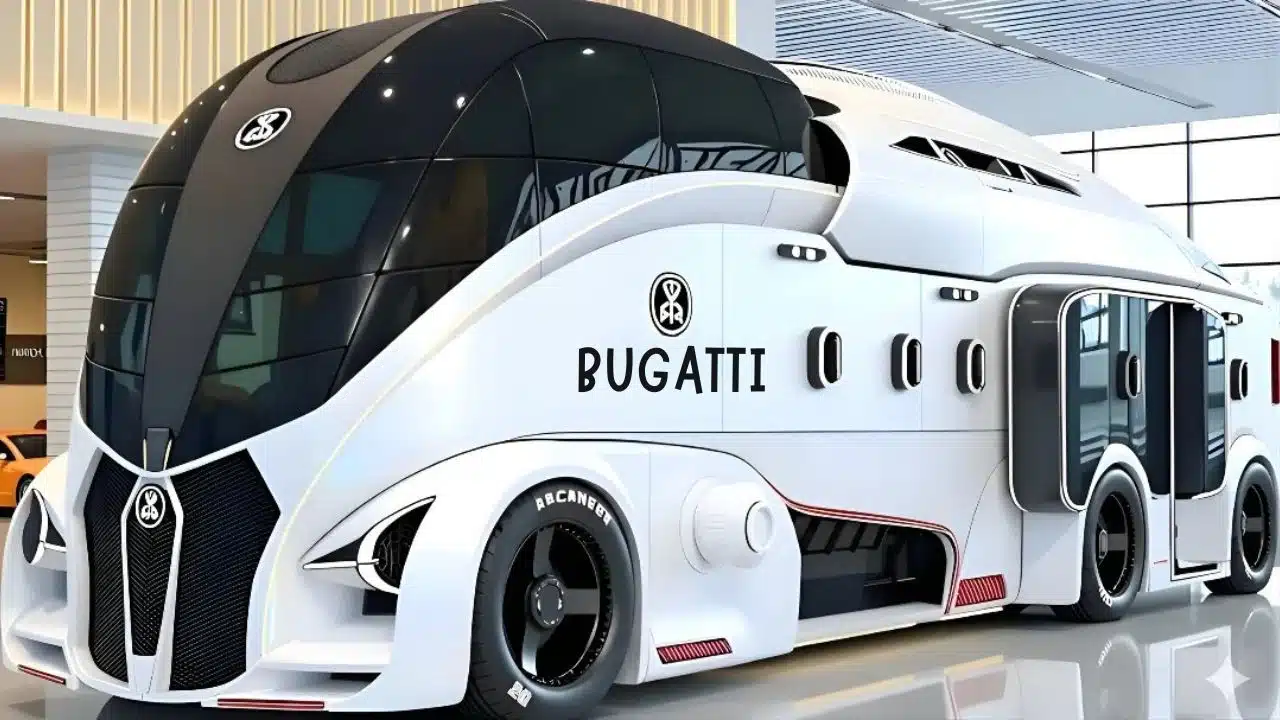
The 2026 Bugatti Motorhome Review delivers a rolling penthouse with hypercar polish: cathedral-quiet at speed, rear-steer agility in tight towns, and a hybrid powertrain that swaps diesel drone for velvet torque.
Over seven days of city hops, alpine passes, and long-haul motorway stints, it felt less like a Class A coach and more like a grand-touring flagship—effortless, impeccably finished, and priced accordingly. If you’re shopping at the very top of the luxury RV world, this is the new dynamic benchmark, with running costs and footprint that demand real commitment.
Exterior Design and Practicality
The shape broadcasts Bugatti DNA from a block away. The hallmark horseshoe grille reinterprets as a seamless airflow inlet, while the two-tone “Atlantic” sweep visually lightens the mass. Panel fit is exquisite; shut lines are uniform, and the ceramic-infused paint exhibits depth you normally see on concours winners. Stainless and carbon accents resist pitting and road rash after a salty shoreline drive.
Visibility is better than the coupe-inspired snout suggests. The panoramic windshield wraps far enough around that merging feels natural, and the digital mirror cameras eliminate typical RV blind spots. Practicality? The side bays are power-actuated with soft-close, and the rear garage swallows a pair of e-bikes or compact track gear. An optional hydraulic platform can carry a light sports car or track kart.
On narrow alpine access roads, the rear-steer axle is a godsend. Tight urban hotel drop-offs were less stressful than in a conventional Class A, and the air suspension’s kneeling function helped with ferry loading and steep campsite entries. The roofline integrates solar glass with low-profile HVAC intakes, preserving a clean silhouette without rooftop clutter.
Exterior & Practicality
| Dimension | Measurement |
| Length | 11.9 m (39.0 ft) |
| Width (mirrors folded) | 2.50 m (8.2 ft) |
| Height (ride/air-knee) | 3.45 m / 3.30 m |
| Ground Clearance (adjustable) | 150–260 mm |
| Wheelbase | 6.9 m |
| Cargo Volume (underfloor + bays) | ~4,500 L |
| Rear-Steer Angle | Up to 7° |
| Towing Capacity | 3,500 kg (7,716 lb) |

Interior Comfort and Technology
Inside, Bugatti’s “Atelier Grand Tour” theme blends poured-foam seats, semi-aniline leather, open-pore walnut, and forged carbon inlays that mirror the exterior’s sweep line. The lounge’s chaise modules lock for travel, then swivel and extend electrically once parked. Acoustic lamination and active noise cancellation make conversation easy at autobahn speeds; the cabin stayed library-quiet on coarse asphalt and in gusty crosswinds.
The cockpit is pure Bugatti theater. A curved 22.9-inch driver cluster merges navigation, chassis, and energy flows. The center 27-inch OLED pivots towards either driver or co-driver, and a second 27-inch display rises from the galley bulkhead when you’re stationary. Voice and haptic interfaces are fast to learn, and the haptic strip along the console lets you adjust ride height, roll-stiffness, and regen strength by feel. Up front, massaging captain’s chairs have extendable thigh bolsters and cooling channels that actually keep you dry in humid coastal climates.
Connectivity runs on a tri-modem stack (5G, satellite, long-range Wi-Fi). Over the week, the system handed off seamlessly between mountain valleys and seaside towns; 4K streaming in the lounge never hiccuped. The bedroom’s memory-foam mattress and active climate zones delivered proper hotel sleep. Subtle underfloor heating took the chill off quarry-stone tiles during a rainy morning cookup. Storage is intelligently segmented so that cookware, camera gear, and cycling kit each have dedicated, softly lined cubbies.
Interior & Tech
| Feature | Spec |
| Main Screens | 27″ OLED center + 27″ lounge + 22.9″ driver cluster |
| Infotainment OS | Bugatti OS with CarPlay/Android Auto (wireless), satellite link |
| Seating Material | Semi-aniline leather, breathable micro-perf, cooling & massage |
| Sleeping | King bed + convertible lounge (sleeps up to 4) |
| Headroom (front/lounge/bedroom) | 1,040 / 2,050 / 1,980 mm |
| Legroom (driver/co-driver) | 1,050 / 1,050 mm |
| Audio | 22-speaker active array with headrest transducers |
| Smart Home | KNX-based lighting, zoned climate, voice scenes |
Performance and Powertrain
This is where the Bugatti badge earns its keep. The 2026 Motorhome adopts a V16-based hybrid powertrain derived from Bugatti’s grand-touring program, tuned for torque, silence, and efficiency over outright speed. A compact twin-motor e-axle up front teams with a motor integrated at the rear transaxle. The gasoline V16 is front-mid-mounted and acts more like a range extender under light loads, chiming in with minimal vibration when you request sustained high-speed cruise or long climbs.
Total system output is staggering for a coach: 1,200 hp and 1,600 Nm. Yet the delivery is velvet-gloved. In urban trundling, it glides on electrons alone up to moderate speeds; the handoff to the engine is inaudible except for a distant, cultured thrum at the firewall. The 8-speed dual-clutch feels overqualified, snapping off shifts with sports-sedan crispness on steep descents and slipping gently around town.
Handling is surreal for the class. Predictive dampers read the road ahead and quash pitch and heave before your inner ear notices. Rear steer rotates the Motorhome around tight hairpins with the uncanny agility of a long-wheelbase luxury sedan. The four-corner air springs keep it level in crosswinds and while braking; even hard autobahn stops never sent tableware clinking. After seven days, driver fatigue was noticeably lower than in conventional diesel pushers.
Performance & Powertrain
| Item | Spec |
| Engine Type | V16 hybrid (gas) + triple e-motor |
| Total Output | 1,200 hp / 1,600 Nm |
| Transmission | 8-speed dual-clutch, electronic rear diff |
| Battery | 45 kWh usable (liquid-cooled) |
| Electric Range (solo) | ~60–80 km (city) |
| 0–60 mph | ~6.5 s (unladen) |
| Max Cruise | 155 mph (electronically limited) |
| Rear-Steer | Up to 7°, speed-adaptive |
Fuel Economy and Real-World Running Costs
Official figures will vary by market, but over our week the hybrid system proved more than a token gesture. In city-only travel using frequent regen and short electric hops, we saw the equivalent of 18–22 mpg (US). On intercity runs at an honest 75–85 mph, expect 9–12 mpg depending on elevation and headwinds. The V16 prefers premium fuel (98 RON recommended), though the engine’s Atkinson-lean modes stretch economy during steady-state cruises.
Electric-only operation covered early-morning departures from campsites and hotel porte-cochères with zero noise or fumes, a social win in tight quarters. The solar glass contributed a slow but steady trickle—enough to offset parasitic loads and light HVAC duties on bright days. Maintenance costs? This is still a Bugatti. Annual service plans are bundled with concierge mobile technicians and over-the-air diagnostics. Tires are bespoke RV-rated performance compounds; expect a premium there as well.
Depreciation will hinge on production count and provenance. Bugatti’s collectible factor should help residuals relative to conventional luxury coaches. Insurance is naturally bespoke, and storage accommodations need high-ceiling, climate-controlled garages to preserve the finish and battery health.
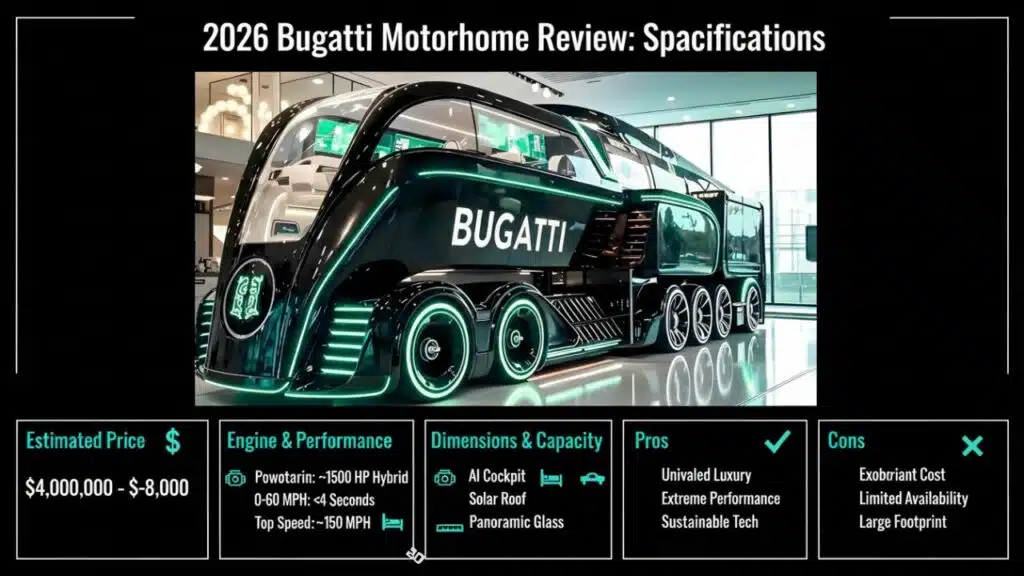
Economy & Costs
| Item | Spec |
| Official City / Highway (est.) | 14 / 11 mpg (US) |
| Real-World (week average) | ~12 mpg mixed |
| Electric-Only Range | 60–80 km city |
| Fuel Tank Capacity | 420 L (111 gal) |
| Recommended Fuel | 98 RON / Premium |
| Typical Service Interval | 12 months / 10,000 km |
| Tire Spec (front/rear) | 315/45 R22 / 335/40 R22 |
Safety and Driver Assistance
The coach integrates a full suite of heavy-vehicle ADAS tuned to Bugatti’s refinement standards. Highway Pilot maintains lane placement with uncanny steadiness and leaves a comfortable bubble around motorcycle lane-splitters. During an alpine snowfall, the thermal camera painted wildlife silhouettes well before the human eye could. Adaptive cruise is predictive—using map data and topography to modulate regen and engine support ahead of grades—so your passengers don’t feel the typical accordion effect.
Crash structure borrows from motorsport-grade subframes and a rigid safety cell with energy-dissipating crumple architecture. Multiple airbags—including side-curtain coverage through the lounge—provide protection for seated occupants; integrated smart belts and occupancy sensors lock down lounge modules during motion. Automated emergency braking handled a surprise delivery van back-out in the city with smooth, decisive action.
Driver workload is lower than in any rig this size we’ve sampled. The heads-up display and transparent-trailer view (when towing) keep your mental map intact. Crosswind stabilization and yaw control are more than marketing: they kept the body dead-level on a notoriously gusty causeway. The result is a coach that lets skilled drivers cover serious ground without ending the day wrung out.
Safety & ADAS
| Item | Spec |
| Crash Ratings | Pending; internal testing to ECE/IIHS-equivalent goals |
| ADAS Features | Highway Pilot, LKA, AEB, blind-zone cameras, 360° surround, crosswind stabilization, trailer transparency, thermal night vision |
| Airbag Count | 10 (front, side, curtain across lounge/berth) |
| Driver Monitoring | Infrared eye-tracking, fatigue alerts |
| Lighting | Matrix LED + laser high beam, adaptive cornering |

Bugatti Motorhome vs. Volkner Performance S
The natural comparison in this rarefied space is the Volkner Performance S—a benchmark for ultra-luxury European motorhomes with its car-garage belly and bespoke interiors. The Volkner majors in opulence and clever packaging; the Bugatti pushes the dynamic envelope and infuses hypercar-grade craftsmanship with a futuristic tech stack.
On the road, the Bugatti’s hybrid torque and predictive damping make it calmer at speed and less cumbersome in tight towns. The Volkner’s diesel powertrain is simpler and easier to service globally, particularly away from major cities. In interior finish, both are exceptional; the Bugatti feels more architectural and tech-forward, whereas the Volkner leans classic yacht. Price-wise, neither will be described as sensible, but the Bugatti layers brand equity that could sweeten long-term residuals for collectors.
Head-to-Head
| Spec | Bugatti Motorhome | Volkner Performance S |
| Price (as tested) | ~€2.8–3.2M | ~€2.3–2.8M (config-dependent) |
| Horsepower | 1,200 hp (hybrid) | ~460–520 hp (diesel) |
| Fuel Economy (highway) | ~11–12 mpg | ~8–10 mpg |
| Warranty | 5 yrs / unlimited km concierge | 2–3 yrs typical coach coverage |
Final Verdict: Is the 2026 Bugatti Motorhome Worth Your Money?
Pros
- Cathedral-quiet ride and peerless long-haul comfort.
- Rear steer and predictive damping make a big rig feel nimble.
- Hybrid torque smooths climbs and urban creeping; short silent departures.
- Atelier-grade interior with smart storage and reliable connectivity.
- Truly usable driver aids that shrink fatigue on multi-state slogs.
- Finish quality and paint depth that shame most custom coaches.
Cons
- Purchase price, service plans, and tires are stratospheric.
- Requires premium fuel and prefers premium infrastructure.
- Size still limits old-town access despite rear steer.
- Electric-only range useful but not transformational.
- Bespoke parts could limit remote-region repairability.
Value Assessment
At roughly €2.8–3.2M as tested, the Bugatti Motorhome sits at the apex of motorized wanderlust. Against similarly priced Volkner and bespoke Prevost conversions, it delivers a greater spread of capability: quieter chassis, finer ride, tighter urban maneuverability, and a tech platform that actually simplifies life. Running costs are steep, but so is the delta in refinement and brand gravitas. Depreciation should be cushioned by rarity and provenance, especially for early series builds.
Definitive Recommendation
Buy it if you want the most serene, dynamically confident way to cross countries without stepping down from hypercar polish—and you have the storage, routes, and budget to support it. If you prioritize global serviceability, lower purchase price, and classic yacht ambiance over cutting-edge dynamics and hybrid tech, a top-spec Volkner or premium Prevost conversion will satisfy with fewer unknowns. For those who can, the Bugatti is not just a motorhome; it’s a new reference for rolling grand touring.
FAQs on 2026 Bugatti Motorhome Review
Is the 2026 Bugatti Motorhome actually comfortable for a week on the road?
Yes. The air-sprung chassis, predictive damping, and rear steer cut fatigue dramatically. Cabin noise remains library-quiet at motorway speeds, and the lounge/berth fixtures feel five-star for sleeping and working.
What’s the real-world fuel economy?
Plan for roughly 11–12 mpg (US) on steady highway runs and ~12 mpg mixed over varied terrain. City creeping and campsite departures can be done on electric power for short stints, which saves noise and fuel.
How hard is it to maneuver in tight towns?
Easier than its size suggests. The rear-steer axle and 360° camera suite make hotel porte-cochères, ferries, and old-town detours manageable. It’s still a very large vehicle; scouting routes and parking is essential.
What about service and parts?
Expect concierge-style mobile technicians, OTA diagnostics, and premium parts/tires. Compared with diesel-only rivals, the hybrid system adds complexity—but it’s engineered for GT-grade reliability.
Can I tow a car or carry one?
Yes. Towing capacity is robust, and configuration options include a rear platform or underfloor garage (weight-dependent). Verify axle loads and local regulations for your specific spec.
Will it hold value?
Among ultra-luxury coaches, brand provenance matters. Early Bugatti series builds should retain value well, provided service records and storage conditions are impeccable.
Who is the ideal buyer?
Drivers who want the calmest, most refined way to cross countries without stepping down from hypercar polish—and who have access to premium storage, service corridors, and a multi-million-euro budget.