Zelenskyy territorial dispute is still the toughest obstacle in U.S.-led negotiations, as Ukraine says any peace plan must protect sovereignty, borders, and legally binding security guarantees.
What Zelenskyy Said, And Why It Matters Now?
Zelenskyy has drawn a hard line on territory at a moment when diplomats say several parts of a peace framework are close to completion. In public remarks in 2025, he has argued that Ukraine’s territorial question is not an optional detail that can be traded away in high-level bargaining. He has tied it directly to Ukraine’s Constitution and to the principle that decisions about Ukraine cannot be made without Ukraine.
That message has become more prominent as negotiations have moved from broad principles to draft language. When talks shift into the wording of commitments—what comes first, what is guaranteed, and what is deferred—territory becomes the point where every sentence is contested. For Kyiv, territory is about sovereignty and law. For many Ukrainians, it is also about the meaning of the war and the sacrifices made since 2014 and since the full-scale invasion began in 2022.
Zelenskyy’s repeated emphasis on constitutional limits also signals a political reality: even if a leadership team wanted to accept a “swap,” “freeze,” or “recognition” formula, it would face legal constraints and intense domestic resistance. That makes territorial language the most fragile part of any draft, and the easiest place for a near-finished plan to break down.
At the same time, Zelenskyy has continued to say Ukraine is ready for real diplomacy and for formats that can bring peace closer. In late December 2025, he described ongoing conversations with U.S. partners and said some documents were nearly ready, while “sensitive issues” still required work. In Kyiv’s messaging, the implication is clear: a framework can advance, but only if it does not undermine Ukraine’s sovereignty and constitutional order.
Where The Negotiations Stand: Geneva, London, Florida, And The Next Meetings?
Public statements from late 2025 show steady diplomatic activity and a push to align positions among Ukraine, the United States, and European partners. The picture that emerges is not of a single “big summit” producing peace, but of repeated rounds designed to narrow disagreements and finalize draft commitments.
In Geneva on November 23, U.S. and Ukrainian representatives held talks around a U.S. peace proposal. The official U.S. description emphasized constructive consultations and said an updated and refined framework was drafted, with sovereignty presented as a non-negotiable principle. The language suggested progress on structure and next steps, while leaving the most contentious points unresolved.
Soon after, Ukraine’s leadership also engaged European partners. In early December, leaders meeting in London stressed that any settlement must protect Ukraine’s territorial integrity, sovereignty, and security. This matters because Europe is not just a supporter in principle; European commitments—military aid, training, economic support, sanctions policy, reconstruction planning—shape what any peace plan can realistically deliver and enforce.
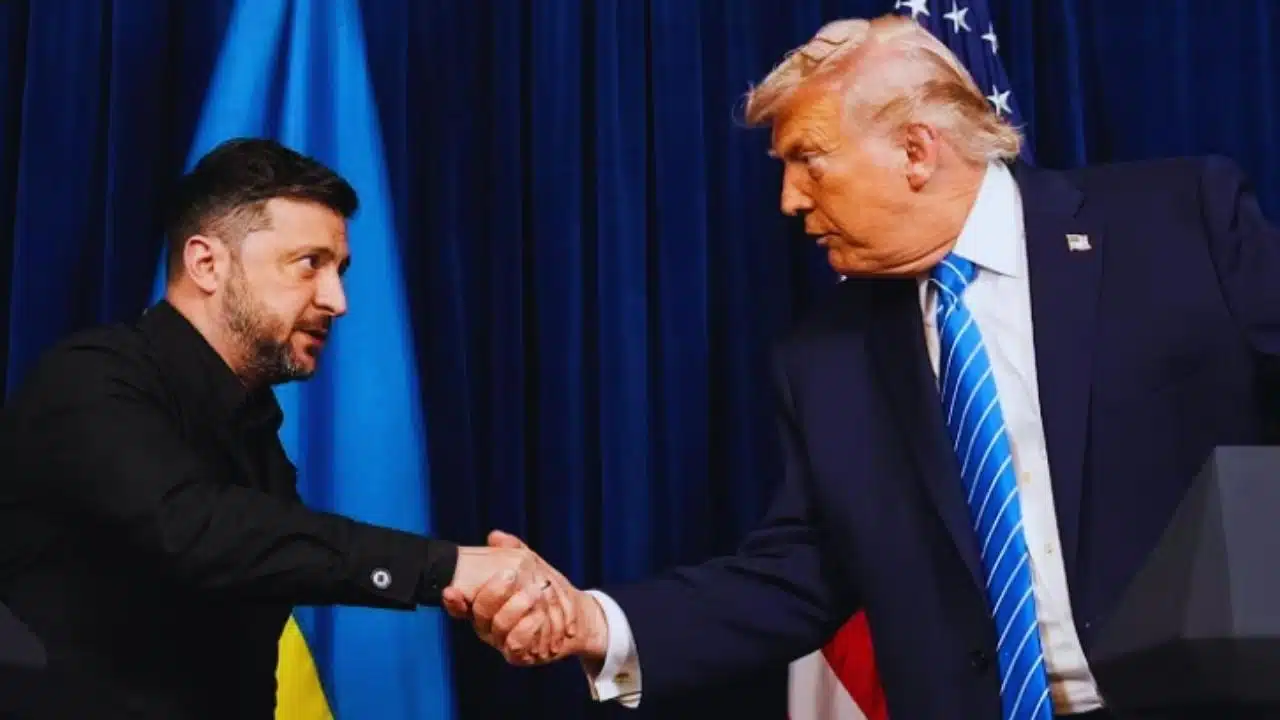
Then on December 29, Zelenskyy met U.S. President Donald Trump in Florida at Mar-a-Lago. Ukraine’s official readout described the meeting as substantive and constructive, and said negotiating teams had made progress. It indicated that some documents were fully agreed while others were being finalized. Most importantly, it framed security guarantees as the central milestone that must be achieved for a durable peace.
The Florida meeting also pointed toward what comes next: continued team-level talks and additional coordination with European leaders in Washington in January. Separate reporting around the same period described early-January meetings among Ukraine and partner countries under a “Coalition of the Willing” format, indicating that allies are actively shaping their position as talks accelerate.
Key Public Milestones (Late 2025)
| Date (2025) | Location/Format | What Was Publicly Described |
| Aug 9 | Public address | Zelenskyy links territorial question to Ukraine’s Constitution and rejects decisions made without Ukraine. |
| Nov 23 | Geneva talks | U.S. and Ukraine describe progress and drafting of an updated peace framework tied to sovereignty. |
| Dec 8 | London meeting | Leaders emphasize territorial integrity, sovereignty, and security guarantees as the foundation of any plan. |
| Dec 25 | Public address | Zelenskyy says some documents are nearly ready; “sensitive issues” still require work. |
| Dec 29 | Florida meeting | Zelenskyy–Trump meeting described as constructive; security guarantees called the key milestone; more meetings planned. |
| Early Jan 2026 | Partner meetings | Planned meetings among Ukraine and supporting partners to coordinate positions and next steps. |
This sequence suggests that negotiators are building a layered plan: political principles, legal and security guarantees, implementation steps, monitoring and enforcement, and arrangements for reconstruction and economic stability. Yet it also shows why the “final mile” is difficult. Territory, security guarantees, and enforcement mechanisms are connected. If one of them stays uncertain, the others become harder to lock in.
The Territorial Dispute: Constitutional Limits, International Law, And Political Reality
The territorial dispute is not a single question. It is a bundle of overlapping issues that affect nearly every part of a peace plan.
First is legality. Ukraine’s Constitution describes the country’s territory as indivisible and inviolable. Zelenskyy’s message has been that no Ukrainian leader can legitimately sign away land under pressure, and that Ukraine’s legal framework already answers the territorial question. In practical terms, this means any peace plan that implies formal recognition of seized territory is likely to be rejected in Kyiv—legally, politically, or both.
Second is the international principle of territorial integrity. Since 2014, many governments and international bodies have taken the position that territory cannot be acquired by force. That principle has shaped sanctions policy, diplomatic recognition, and the long-term posture of many partners. Any settlement that appears to reward annexation risks weakening that principle, making it harder for governments to defend the deal to their own citizens and parliaments.
Third is the human and civic dimension. Territorial language is not abstract for Ukrainians living under occupation, facing forced displacement, pressure on identity, or disruption of basic rights and services. It is also not abstract for families across Ukraine that have endured years of war. A plan that leaves communities under foreign control without credible protections can trigger long-term instability and resentment, even if it produces a temporary ceasefire.
Fourth is the security dimension. Territorial concessions can be interpreted by Kyiv as inviting future aggression if Russia believes force yields results. This is why Ukraine’s messaging frequently links territory to the need for strong security guarantees. From Kyiv’s perspective, a ceasefire without credible protection could freeze the conflict briefly, then reset the conditions for another escalation later.
What “Territory” Means In A Peace Framework?
| Issue Area | What Ukraine Signals | Why It Matters For A Deal |
| Legal status of occupied regions | No recognition of annexation; territory tied to constitutional order | Sets limits on what Kyiv can sign or ratify |
| Ceasefire lines vs. borders | A pause in fighting may be possible; legal borders remain unchanged | Lets talks progress without “legalizing” occupation |
| Security guarantees | Must be strong and enforceable, not symbolic | Determines whether a ceasefire is stable or fragile |
| International enforcement | Must deter violations and punish renewed aggression | Influences whether any agreement survives first shocks |
| Human rights and civilian protections | Occupation issues must not be ignored | Affects legitimacy, public acceptance, and long-term stability |
This is why territorial language often becomes the bottleneck. Negotiators can draft language about reconstruction, economic cooperation, prisoner exchanges, and monitoring missions more easily than they can draft words that change borders or imply recognition. Even small phrases—“status,” “control,” “administration,” “interim arrangements”—can become explosive because they carry legal meaning.
Security Guarantees: The Centerpiece Kyiv Keeps Prioritizing
Ukraine has consistently treated security guarantees as the essential foundation of any peace plan. In official messaging around late-December talks, security guarantees are framed as the “key milestone” for lasting peace.
The logic is straightforward. If the territorial question cannot be fully resolved quickly, then Ukraine wants a structure that prevents renewed war while diplomacy continues. A ceasefire that simply pauses fighting without enforcement can collapse. Ukraine wants guarantees that are durable, credible, and backed by real capability—whether that means long-term military support, air defense and deterrence commitments, intelligence cooperation, training pipelines, or mutual-defense-style arrangements.
Public reporting around the Florida meeting period described the United States proposing a time-limited security guarantee, while Zelenskyy preferred a longer-term commitment. Even without getting into the exact number of years, the key point is that Ukraine is pushing for guarantees that outlast a single political cycle. Kyiv’s argument is that deterrence must be permanent enough to change Moscow’s calculations.
Ukraine has also raised the idea that guarantees should be legally anchored in ways that reduce the risk of reversal. In late 2025 remarks, Zelenskyy spoke about legally binding guarantees and suggested congressional approval as one pathway. Whether that becomes part of final architecture remains uncertain, but it signals what Ukraine believes “credible” means: not just statements, but binding commitments.
How Security Guarantees Could Be Structured?
| Guarantee Type | What It Could Include | Main Advantage | Main Risk/Challenge |
| Bilateral commitments | Long-term military support, financing, training, air defense | Faster to negotiate than a full alliance treaty | Depends on political continuity |
| Multilateral framework | Coordinated commitments from multiple partners | Spreads risk and increases deterrence | Complex coordination and enforcement |
| Legal/legislative anchoring | Formal approvals, binding obligations, oversight | More durable, clearer accountability | Time-consuming and politically difficult |
| Monitoring and enforcement | Verification, reporting, penalties for violations | Helps prevent “silent erosion” of a deal | Must be credible and well-resourced |
A major point of tension is sequencing. Ukraine signals it wants guarantees first or alongside any ceasefire, not after. From Kyiv’s perspective, agreeing to halt fighting without a strong guarantee is risky because it can give the other side time to regroup, rearm, and return to war later.
Another point of tension is enforcement. A guarantee is only meaningful if violations trigger consequences. That means negotiators must define what counts as a violation, who verifies it, and what happens next. Those details are where many peace plans fail. If the enforcement mechanism is vague, deterrence collapses. If it is too rigid, parties may refuse to sign.
What Comes Next And What To Watch?
The most realistic near-term outcome implied by public statements is not a full resolution of the territorial dispute, but a framework that tries to manage it while reducing violence and building security architecture. Negotiators appear to be working on documents in parallel: some that can be finalized quickly, and others that remain sensitive and contested.
In the coming weeks, several signals will matter:
- Whether negotiating teams announce agreement on a defined security guarantee package, including enforcement steps.
- Whether European partners align publicly with U.S. draft language, especially on sovereignty and territorial integrity.
- Whether planned early-January coordination meetings produce a unified position that can withstand political pressure.
- Whether territorial language is framed as a long-term diplomatic track rather than an immediate “trade” condition.
Zelenskyy’s territorial dispute stance also suggests a key limit on what a deal can be. If any plan is interpreted as recognizing annexation or legitimizing seizure by force, it will likely fail in Kyiv. If, instead, a plan emphasizes sovereignty, keeps legal borders intact, and provides strong security guarantees while deferring the hardest territorial questions, it may have a better chance of holding—at least long enough to reduce civilian suffering and stabilize the front.
That still leaves a hard truth: peace plans do not end wars by text alone. They hold when they match political reality, legal constraints, and credible enforcement. For now, Zelenskyy’s message is that Ukraine can negotiate timing, format, and steps—but not its sovereign right to exist within internationally recognized borders.