
You may have scrolled past deep talks, and wondered who is Eric Weinstein. You feel stuck in a maze of math and finance chat. You just want a clear view of his life and work.
He got his PhD at Harvard University in 1992. He now leads research at Thiel Capital, and he hosts the portal podcast. We will break down his Geometric Unity theory, his math work, and his investor role.
You will get clear facts and simple stories. Keep reading.
Key Takeaways
- Eric Weinstein earned his PhD in Mathematics at Harvard University in 1992, studied self-dual Yang-Mills equations and Riemannian geometry, and served as a Visiting Research Fellow at Oxford’s Mathematical Institute.
- He applied gauge-theoretic methods to neo-classical economics in the early 1990s (with P. Malaney) and co-authored a 2002 paper with A. Abdulali on mortgage-backed securities risks before the financial crisis.
- Since joining Thiel Capital as managing director in San Francisco, he leads venture scouting, uses data-driven risk models, and champions “science must meet dollars” in tech investing.
- In 2013, he delivered the Special Simonyi Lectures at Oxford to introduce Geometric Unity—a theory that links Einstein’s gravity and self-dual Yang-Mills to challenge the standard model.
- He hosts The Portal Podcast, posts daily as @EricRWeinstein on Twitter, and features long-form interviews on physics, metaphysics, economics, and scientific revolutions.
Education and Academic Background
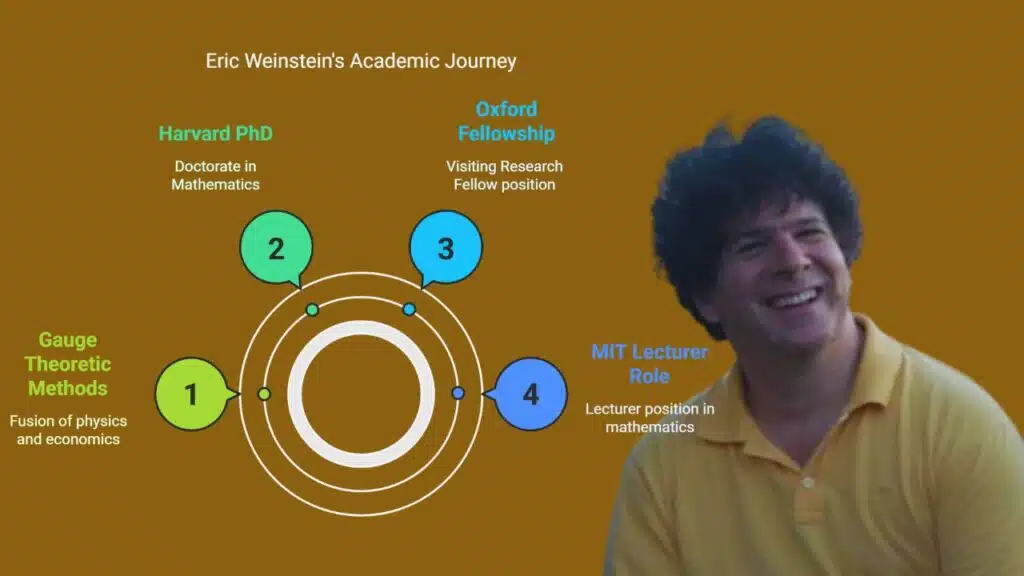
Eric Weinstein earned his PhD in Mathematics at Harvard University in 1992. His PhD dissertation tackled self-dual Yang-Mills equations and Riemannian geometry. Faculty in the Mathematics Department guided his studies in general relativity.
He then held a post as Visiting Research Fellow at the Mathematical Institute of Oxford University.
MIT offered him a lecturer role soon after Oxford. Hebrew University and Harvard University followed with positions in physics and math. He introduced Gauge Theoretic methods into neo-classical economic theory in the early 1990s.
That insight fused ideas from general relativity with labor market theory.
Career Highlights
He runs an investment firm in San Francisco and backs bold tech projects. He applies gauge theoretic methods to self-dual Yang–Mills equations and general relativity to push physics ahead.
Role at Thiel Capital
Eric Weinstein serves as managing director at Thiel Capital, in San Francisco. He leads the team that scouts big bets and new ventures. He relies on data analysis and risk models to shape deals.
Staff often hear him say, “Science must meet dollars.”.
He pushes for economic theory that meets fundamental scientific principles, like gravity or curvature. Thiel Capital taps his math flair to test market models. Guests notice his blend of humor and equations.
That mix sparks fresh ideas in finance.
Contributions to Mathematical Physics
He brought gauge theoretic methods into neo-classical economic theory. Riemannian geometry and Ehresmannian geometry feature in his work on particle models. He delivered the Special Simonyi Lectures at Oxford University in 2013, and introduced Geometric Unity.
He linked general relativity with self-dual Yang-Mills equations.
His research stirs philosophical questions about the universe. He challenges the standard model with bold geometric views. He mixes math tools like a craftsman, shaping new ideas in particle theory.
Readers glimpse fresh scientific innovation.
Geometric Unity and Scientific Contributions
Eric Weinstein calls his theory Geometric Unity. It merges curved-space math and bundle math. It links Einstein’s gravity theory and the particle physics model. Weinstein draws on gauge theoretic methods and self-dual Yang-Mills equations.
The project tries to show why the universe seems fine-tuned for life. His design targets deep questions in scientific innovation.
Critics often clash with his view on dark matter and black holes. He proposes bold math to shake fixed ideas in gravity theory and particle theory. That style blasted through old textbooks at the Mathematical Institute where he served as visiting research fellow.
His work sparks debate at Harvard University and Oxford University seminars. Fans catch him on long-form interviews that stretch across YouTube channels.
Public Engagements
Eric hosts The Portal Podcast, he chats with cosmologists, debates maths with physicists on YouTube, and jumps on video panels that spark big ideas—read on to catch his bold takes.
The Portal Podcast
The Portal Podcast in San Francisco features chats on scientific revolutions, metaphysics, and physics. Guests explore the Big Bang and multiverse theory in long-form interviews. They break down general relativity and modern particle theory.
Each session digs into geometric unity and self-dual Yang-Mills equations.
Weinstein uploads each episode as a video on YouTube. Listeners tune into YouTube interviews for fresh views on the standard model and cosmic puzzles. The show blends deep math talk with a dash of humor.
Appearances on Notable Platforms
Eric reached wide audiences on major stages. His talks sparked debate on deep theories.
- George Ellis and Eric explored Einstein’s equations, including Riemannian geometry, in a recorded session.
- Carlo Rovelli invited Eric for a deep talk on string theory, during a live stream.
- Hilary Lawson joined him on a public stage, to debate gauge theoretic methods.
- Eric took to YouTube, in long-form interviews, to push for revolutionary scientific thinking on the standard model.
Other Ventures and Interests
Weinstein pitched an Economic Manhattan Project in 2002. It aimed to upgrade economic theory with big science methods. He also proposed a Coasian market solution for immigration labor market issues that year.
A 2002 paper with A. Abdulali tackled valuation risks in mortgage backed securities. They plugged data to spot hidden threats before the financial crisis. Listeners catch these ideas on The Portal Podcast or in long-form YouTube interviews.
Influence on Economics and Technology
eric weinstein shook up economics in the early 1990s when he added Gauge Theoretic methods to neo-classical theory. He teamed up with P. Malaney to map price shifts like a physicist would chart particle motion.
Wall Street felt the rumble from this work on debt instruments and employment theory. His aim looked like an economic manhattan project, to rescue the field after the 2008 financial crisis with fresh math tools.
Driven by data, his models tackle credential bias head on, making boards and universities rethink what a PhD can prove. Listeners on The Portal podcast and experts at Thiel Capital buzz about his math driven lens on supply, demand, and risk.
He ties geometric unity ideas from physics to pricing curves and hiring methods. San Francisco firms and hedge funds have lent an ear to his vision for scientific innovation in markets.
Personal Life and Common Queries
He lives in San Francisco. Under the handle @EricRWeinstein, he posts on Twitter nearly every day. Readers see posts on economic theory, mortgage backed securities, labor market theory, and the 2008 financial crisis.
Social media also hosts his thoughts on societal issues.
Many readers ask about his life off camera. Queries point to his role as managing director at Thiel Capital and his past at the mathematics department of Harvard University. Followers also wonder how he juggles work on geometric unity with social media chats.
His replies mix humor with clear examples in long form interviews.
Takeaways
He shapes math and finance with bold ideas and candid talks. His work spans geometry theory and economic market models. Time at a top school sparked his drive for fresh research. He leads an investment firm in San Francisco and guides teams.
He hosts a science show and tweets on economy and physics. All of this shows his reach and his push for risk in science.
FAQs
1. Who is Eric Weinstein?
Eric Weinstein is a mathematical physicist and investor. He works as managing director at Thiel Capital and co-founded the Natron Group in San Francisco, he lives at the crossroads of math and markets. He studied at Harvard University and Oxford University, and he served as a visiting research fellow at the Mathematical Institute.
2. What is geometric unity?
Geometric unity is Weinstein’s bold theory that aims to blend Riemannian geometry, Ehresmannian geometry and general relativity into one grand picture. He uses gauge theoretic methods, he draws on the standard model and particle theory, and he first laid out its ideas in special Simonyi lectures.
3. What did he study in his PhD dissertation?
He wrote his PhD dissertation at the Harvard math department on self-dual Yang-Mills equations. He dove deep into rich geometries and other sciences. His work still echoes in talks on mathematical innovation.
4. How did he tackle economic ideas?
He led an “economic Manhattan Project” to explore labor market theory, he studied the roots of the financial crisis and mortgage backed securities. He often calls out academic credentialism in long-form interviews and YouTube interviews, he mixes big ideas with plain talk.
5. What is The Portal Podcast?
The Portal Podcast is his own show, where he digs into scientific innovation with top guests, he spills the tea on math, physics, finance and more. You hear deep chats on new theories, you get fresh takes on geometric unity, and you feel like you’re sitting in a cozy corner of the sciences.
6. Why call him a mathematical physicist?
He links abstract math to real-world puzzles, he stretches ideas from particle theory all the way to neo-classical theory. He weaves complex geometries into lively stories, he shows how science and markets dance together.