
AI chatbots have been the talk of the town for a few years now. They’re everywhere—on websites, in apps, even answering your mom’s questions about her online banking password (bless her heart). But after seeing chatbots in action, both as a user and as someone who helps businesses get more out of AI, I’ve realized something: chat is just the appetizer. The real main course? AI agents that actually get things done.
We’re at a turning point. Businesses are moving past the “wow, it talks!” phase and asking, “Can it do my work for me?” And with good reason. The global AI chatbot market is already worth around $15 billion and growing fast, but more and more companies are finding that chat alone isn’t enough. The next wave is here: AI agents—especially vertical AI agents—that can automate real tasks, extract valuable data, and drive actual business results.
Moving Beyond Chat: The Rise of AI Agents
I’ve watched the evolution from chatbots to AI agents up close, and the difference is night and day. A chatbot is like a friendly receptionist: it can answer questions, point you in the right direction, and maybe crack a joke if you’re lucky. But ask it to actually fill out a form, update your CRM, or pull a list of leads from a website? That’s where it hits a wall.
AI agents, on the other hand, are more like digital coworkers. They don’t just talk—they act. They can remember context, carry out multi-step workflows, and even make decisions based on your goals. For example, instead of just telling you store hours, an AI agent can process a refund, update your records, and send a follow-up email—all without you lifting a finger.
This shift from “chat” to “act” is what’s driving the next generation of business automation. Companies are hungry for tools that don’t just answer questions, but actually get things done.
What Are Vertical AI Agents and Why Do They Matter?
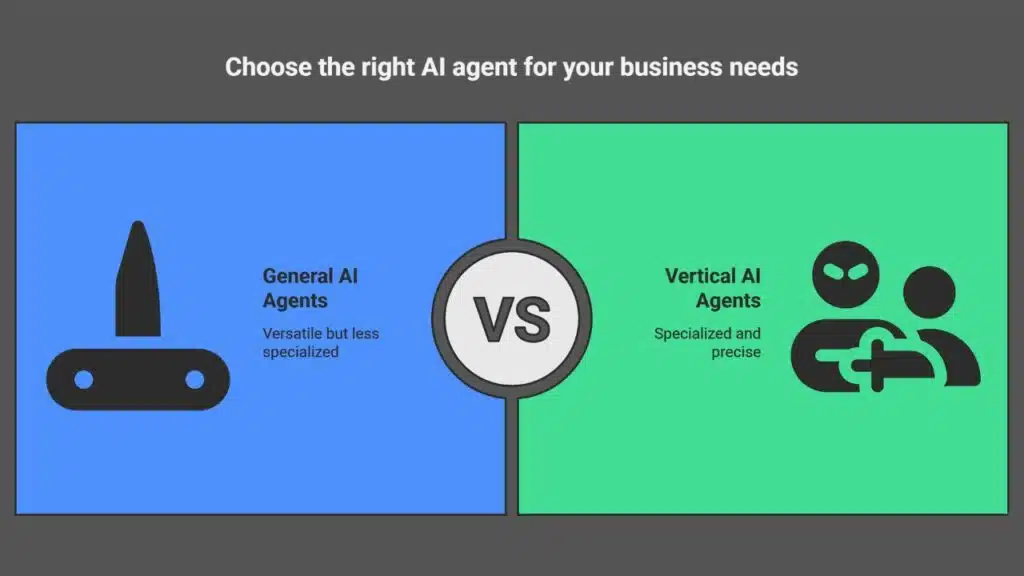
Here’s where things get really interesting. Not all AI agents are created equal. There are general AI agents—think of them as the Swiss Army knives of the AI world—and then there are vertical AI agents, which are more like a surgeon’s scalpel: built for a specific job, and really good at it.
A vertical AI agent is designed for one domain or workflow, like sales, ecommerce, or real estate. It’s trained on industry-specific data, understands the jargon, and plugs right into the tools you already use. For example, in healthcare, a vertical AI agent might transcribe doctor-patient conversations and understand HIPAA rules. In finance, it could spot fraudulent transactions and block them instantly.
Why does this matter? Because businesses don’t want a jack-of-all-trades that’s mediocre at everything. They want an expert that nails the job every time. That’s why vertical AI agents are gaining so much traction—they solve real problems, with real precision.
Vertical AI Agent vs General AI Agent: What’s the Difference?
Let’s break it down:
- General AI Agent: Great for broad tasks—writing emails, summarizing documents, answering generic questions. But when it comes to specialized work (like parsing MLS listings or tracking competitor prices), it often falls short. It lacks the context, accuracy, and integration needed for business-critical workflows.
- Vertical AI Agent: Purpose-built for a specific set of tasks or an industry. It comes loaded with domain expertise and often integrates directly with your business systems. The trade-off? It’s narrower in scope, but way deeper in capability. You might need several vertical agents for different jobs, but each one is a powerhouse in its field.
In my experience, businesses see the most ROI when they use general AI for broad tasks and vertical agents for the heavy lifting in their core workflows.
AI Web Scraper: A Powerful Example of Vertical AI Agents
Now, let’s talk about one of my favorite examples of a vertical AI agent: the AI web scraper. Data is the lifeblood of sales, ecommerce, and real estate teams. But collecting it manually? That’s a special kind of pain. I’ve seen teams spend hours (or days) copying and pasting info from websites, only to end up with messy spreadsheets and missed opportunities.
Enter the AI web scraper. Unlike old-school scrapers that break every time a website changes, AI web scrapers use machine learning and computer vision to “read” web pages like a human would. They can pull data from websites, PDFs, and even images—turning unstructured messes into clean, structured tables ready for analysis.
The impact is huge:
- Sales teams can build prospect lists with thousands of verified leads in minutes.
- Ecommerce managers can monitor competitor prices and stock levels daily, not monthly.
- Realtors can aggregate listings from Zillow, Realtor.com, and local MLS databases into a single spreadsheet—no more tab overload.
And the best part? You don’t need to be a coder. Modern AI web scrapers are built for business users, not just developers.
Thunderbit: The Data-Driven AI Agent for Business Teams
Let me introduce you to Thunderbit—a vertical AI agent I’ve seen make a real difference for sales, ecommerce, and real estate teams. Thunderbit is all about making web data extraction as easy as possible, even for folks who think “XPath” is a new yoga pose.
Here’s what sets Thunderbit apart:
- 2-Click Scraping: Just point it at a website, click “AI Suggest Fields,” and Thunderbit figures out what data to pull. It even names the columns for you.
- Multi-Source Extraction: Thunderbit doesn’t stop at websites—it can scrape data from images and PDFs, too. Got a scanned property flyer or a PDF price list? No problem.
- Subpage & Pagination Scraping: Need to pull data from multiple pages or drill down into detail pages? Thunderbit can follow links, click through pagination, and gather everything you need.
- Instant Templates: For popular sites like Amazon, Zillow, and Instagram, Thunderbit offers one-click templates. No setup required—just pick your template and go.
- Flexible Export: Export your data to Excel, Google Sheets, Airtable, or Notion. No hoops to jump through.
- Scheduling & Cloud Execution: Set up recurring scrapes and let Thunderbit do the heavy lifting in the cloud. It can handle 50 pages at a time, so even big jobs finish fast.
- AI Data Enrichment: Want to categorize, summarize, or translate your data as you scrape? Thunderbit’s got you covered.
I’ve seen teams go from spending hours on manual research to having all their data ready before their morning coffee. That’s the kind of upgrade I can get behind.
How AI Agents Are Transforming Business Workflows
The adoption of AI agents is changing the way teams work—sometimes in ways that make you wonder how we ever survived without them. Here are a few real-world scenarios I’ve come across:
- Sales Lead Generation: Before AI agents, reps would spend hours hunting for contacts and copying them into spreadsheets. Now, an AI web scraper like Thunderbit can pull thousands of leads overnight, complete with emails, phone numbers, and company info. Sales reps get to focus on closing deals, not data entry.
- Ecommerce Price Monitoring: Tracking competitor prices used to mean endless clicking and manual updates. With an AI agent, you get daily reports on every competitor’s price changes across your entire catalog. One retailer I know cut their data gathering time by 30% and started reacting to market changes in real-time.
- Real Estate Research: Realtors used to juggle dozens of tabs, copying property details from multiple sites. Now, an AI agent aggregates all the listings, open houses, and price histories into one place. Agents spend less time on grunt work and more time with clients.
The numbers back it up: businesses using vertical AI agents have seen productivity jump by 66%, with some teams achieving 5× efficiency improvements and 40–80% cost reductions in targeted areas.
From Manual to Automated: Real-World Use Cases
Let’s get specific:
1. Lead Generation (Manual vs. Automated):
- Before: Sales teams spent 8+ hours a week per rep researching and compiling leads.
- After: With Thunderbit, the process is automated. One team went from a few hundred leads a week to 2,500–3,000 qualified leads per rep per month. The reps now spend their time actually talking to prospects.
2. Competitive Price Monitoring:
- Before: E-commerce managers checked competitor sites by hand or used brittle scripts.
- After: AI agents deliver daily price reports for the entire product catalog. One retailer quickly flagged MAP violations and pricing trends, reducing profit loss and reacting to the market faster than ever.
3. Data Research and Entry:
- Before: Analysts wasted hours gathering and cleaning data.
- After: AI agents handle the collection and formatting, freeing up analysts to focus on insights and strategy. One healthcare startup saved $3,000 a month by automating provider data collection.
The Future of AI Agents: What’s Next After Chatbots?
So, where do we go from here? The trends I’m seeing (and getting pretty excited about) include:
- Hyper-Specialized Agents: We’ll see even more finely tuned vertical agents—think AI prospecting analysts, pricing strategists, or real estate market researchers. Each one trained on highly specialized data, delivering near-expert performance.
- Multi-Agent Collaboration: Imagine a team of AI agents working together—one gathers data, another analyzes it, a third drafts a strategy. It’s like having a digital pit crew for your business.
- Deeper Integration: AI agents will be built right into your business tools—living inside your CRM, ERP, or productivity suite, always ready to act on your behalf.
- Smarter Automation: Advances in AI will make agents better at reasoning, planning, and even handling abstract decision-making. The line between “software” and “AI coworker” will blur.
- Ethics & Human Collaboration: As agents get more autonomous, companies will focus on governance—setting boundaries, ensuring compliance, and keeping humans in the loop for big decisions.
The bottom line? We’re moving toward a future where AI agents are as common as spreadsheets—and a lot more fun to work with.
Choosing the Right AI Agent for Your Business
If you’re thinking about bringing an AI agent into your workflow (and honestly, why wouldn’t you?), here are a few things I always look for:
- Start with the Problem: Be clear about what you want to automate. Is it data collection, customer support, or something else?
- Vertical vs. General: If your task is industry-specific, go vertical. If you need a broad assistant, a general AI might do the trick.
- Ease of Use: Can your team use it without calling IT every five minutes? Look for no-code interfaces, natural language instructions, and helpful templates.
- Integration: Will it play nice with your existing tools? Check for export options and integrations with your favorite apps.
- Accuracy & Reliability: Ask for benchmarks, case studies, or run a pilot. You want an agent that delivers quality, not just quantity.
- Privacy & Control: Make sure your data stays secure and compliant with regulations.
- Support & Roadmap: Is the vendor responsive? Are they updating the product regularly?
- Cost vs. Value: Calculate the ROI. The best AI agents pay for themselves in time saved and new opportunities unlocked.
Key Takeaways: Why AI Agents Are the Future of Business Automation
Here’s what I’ve learned on this journey: chatbots were just the warm-up act. The real stars are AI agents—especially vertical AI agents and AI web scrapers—that don’t just talk, but act. They’re saving teams hours, reducing costs, and unlocking new levels of productivity across sales, ecommerce, real estate, and beyond.
The secret sauce? Choosing the right agent for your needs. Whether it’s Thunderbit for web data extraction or another vertical solution, the key is alignment—matching the agent’s strengths to your business goals.
So, don’t stop at chat. The future belongs to AI agents that turn talk into action. And if you’re ready to see what’s next, you’re in good company—I’m right there with you, excited to see how far these digital coworkers can take us.