In an era where software ecosystems evolve faster than most organizations can document them, questions around emerging or specialized tools are increasingly common. One such query gaining visibility across search engines and AI-powered platforms is what is immorpos35.3 software. Professionals, IT teams, and decision-makers are looking for clear, credible explanations that go beyond surface-level definitions.
This article provides a structured, professional overview of Immorpos35.3 software what it is, how it functions, where it is used, and why it matters. The goal is not speculation or hype, but clarity. Whether you encountered the term in documentation, a technical environment, or a system audit, this guide is designed to help you understand its role with confidence.
What Is Immorpos35.3 Software?
Immorpos35.3 software is best described as a versioned, modular software framework or system component used in controlled or specialized digital environments. Rather than being a mass-market application, it typically appears in enterprise systems, proprietary platforms, or internally managed software stacks.
The naming structure suggests two important characteristics. First, “Immorpos” functions as the core system or platform identifier. Second, “35.3” represents a specific release or build version, indicating iterative development, maintenance updates, or functional enhancements over earlier versions.
In practice, Immorpos35.3 software is usually not consumer-facing. It operates behind the scenes, supporting processes such as data handling, system logic execution, workflow orchestration, or environment-specific automation.
Understanding the Purpose of Immorpos35.3 Software
The primary purpose of Immorpos35.3 software is system stability and functional continuity within a larger digital ecosystem. It often acts as an intermediary layer between infrastructure and application logic, ensuring that complex processes run consistently and predictably.
Organizations rely on this type of software to standardize how certain operations are performed. Instead of rewriting logic for every application or environment, Immorpos35.3 provides a reusable and controlled framework that teams can build upon.
This approach reduces errors, improves maintainability, and allows technical teams to manage upgrades or changes without disrupting dependent systems.
Key Functional Characteristics
Immorpos35.3 software is typically designed with modularity and version control in mind. Each version reflects refinements based on operational feedback, security considerations, or performance requirements.
A defining characteristic is its configurability. Rather than enforcing rigid workflows, the software can often be adapted to suit different operational contexts while maintaining a consistent core structure.
Another important aspect is backward compatibility. Versioned software like Immorpos35.3 is commonly built to coexist with earlier releases, allowing organizations to transition gradually rather than through disruptive system overhauls.
Common Use Cases in Professional Environments
Immorpos35.3 software is most frequently encountered in environments where reliability and precision are critical. This includes enterprise IT systems, internal platforms, and sector-specific digital infrastructure.
In data-driven organizations, it may be used to manage transformation rules, validation processes, or structured data flows. In operational systems, it can support automated decision logic or workflow sequencing. Some organizations deploy it as part of a compliance-focused architecture, where traceability and version integrity are essential.
Because of its non-public nature, the exact implementation varies widely, but the underlying theme is consistency at scale.
How Immorpos35.3 Fits into a Software Stack
From a technical perspective, Immorpos35.3 software typically sits between core infrastructure and application-level features. It does not replace operating systems or end-user software, but instead complements them.
This positioning allows it to abstract complexity. Developers and system architects can rely on Immorpos35.3 to handle predefined logic or system behaviors, freeing them to focus on higher-level functionality.
Over time, this layered approach reduces technical debt and simplifies long-term system management.
Benefits of Using Immorpos35.3 Software
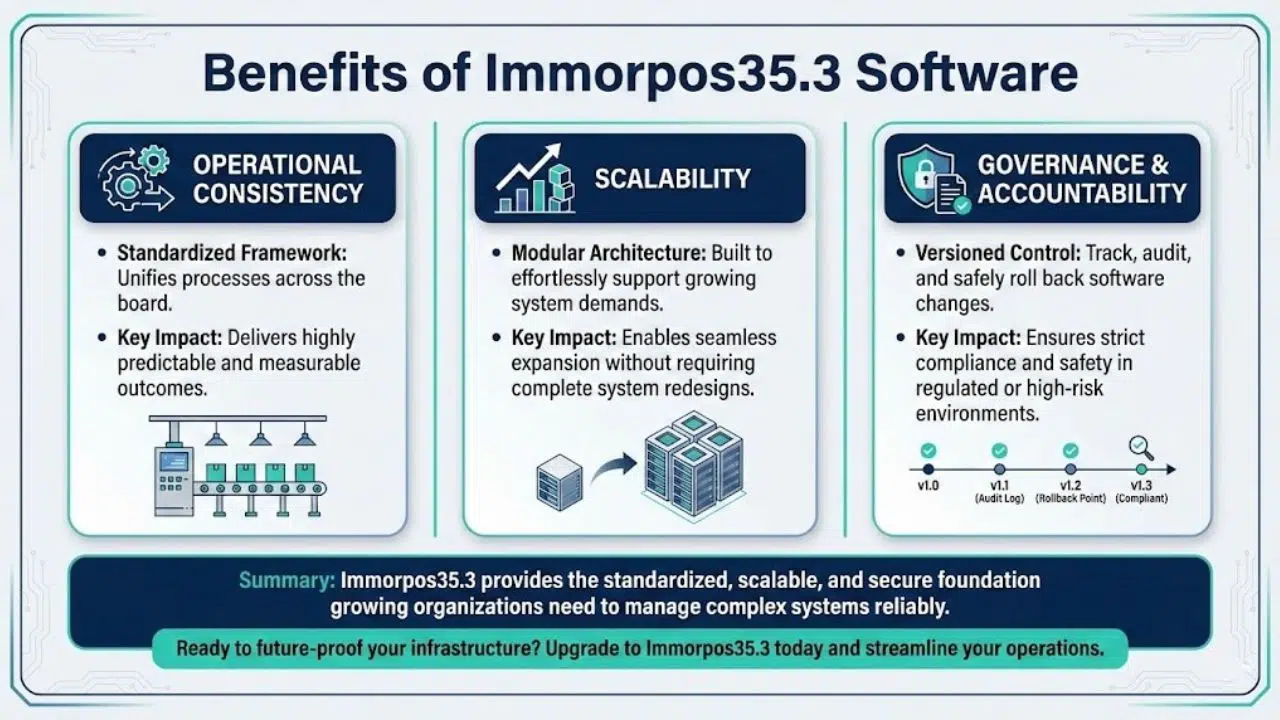
One of the most significant benefits of Immorpos35.3 software is operational consistency. When processes are standardized through a shared framework, outcomes become more predictable and measurable.
Another advantage is scalability. Because the software is designed to be modular, it can support growing system demands without requiring a complete redesign.
From a governance perspective, versioned software like Immorpos35.3 improves accountability. Changes can be tracked, audited, and rolled back if necessary, which is especially valuable in regulated or high-risk environments.
Security and Maintenance Considerations
Security is a key reason organizations rely on structured, versioned software components. Immorpos35.3 software typically incorporates predefined access controls, validation mechanisms, and update protocols.
Maintenance is equally important. The presence of a clearly defined version number indicates active lifecycle management. This allows IT teams to apply updates methodically, test changes in isolation, and maintain documentation accuracy.
Ignoring version-specific behavior can lead to compatibility issues, which is why understanding the exact release such as 35.3 is essential in professional settings.
Challenges and Limitations
Despite its advantages, Immorpos35.3 software is not without challenges. Because it is often proprietary or internally documented, onboarding new team members can require additional training.
Another limitation is visibility. Since the software operates behind the scenes, its value may be underestimated by non-technical stakeholders, even though it plays a critical role in system reliability.
These challenges can be mitigated through clear documentation, internal knowledge sharing, and regular system reviews.
FAQ
What is Immorpos35.3 software used for?
Immorpos35.3 software is used to support standardized system processes within enterprise or specialized digital environments. It helps manage logic, workflows, or data operations consistently across platforms.
Is Immorpos35.3 software a standalone application?
No. Immorpos35.3 software typically functions as a system component or framework rather than a standalone, user-facing application.
Who typically uses Immorpos35.3 software?
It is primarily used by organizations, IT teams, and system architects working in controlled or enterprise-level environments where reliability and version control are important.
Why does the version number 35.3 matter?
The version number identifies a specific release with defined features, fixes, and behaviors. Using the correct version ensures compatibility and system stability.
Is Immorpos35.3 software publicly available?
In most cases, it is not publicly distributed. It is usually part of proprietary systems, licensed platforms, or internal organizational infrastructure.
Global Applicability and Neutral Design
Immorpos35.3 software is not tied to a specific region, industry, or regulatory system by default. Its design principles modularity, versioning, and system abstraction are globally applicable.
This neutrality makes it suitable for multinational organizations and distributed teams. The software’s function remains consistent regardless of geographic location, provided it is deployed within compatible technical environments.
Understanding what is immorpos35.3 software is less about discovering a consumer product and more about recognizing the role of structured, versioned systems in modern digital architecture. Immorpos35.3 represents a class of software designed for reliability, control, and long-term operational efficiency.
For professionals evaluating system components or auditing technical environments, clarity around tools like Immorpos35.3 builds confidence and reduces risk. If your organization encounters or relies on this software, investing in proper documentation, version awareness, and strategic integration will deliver lasting value.