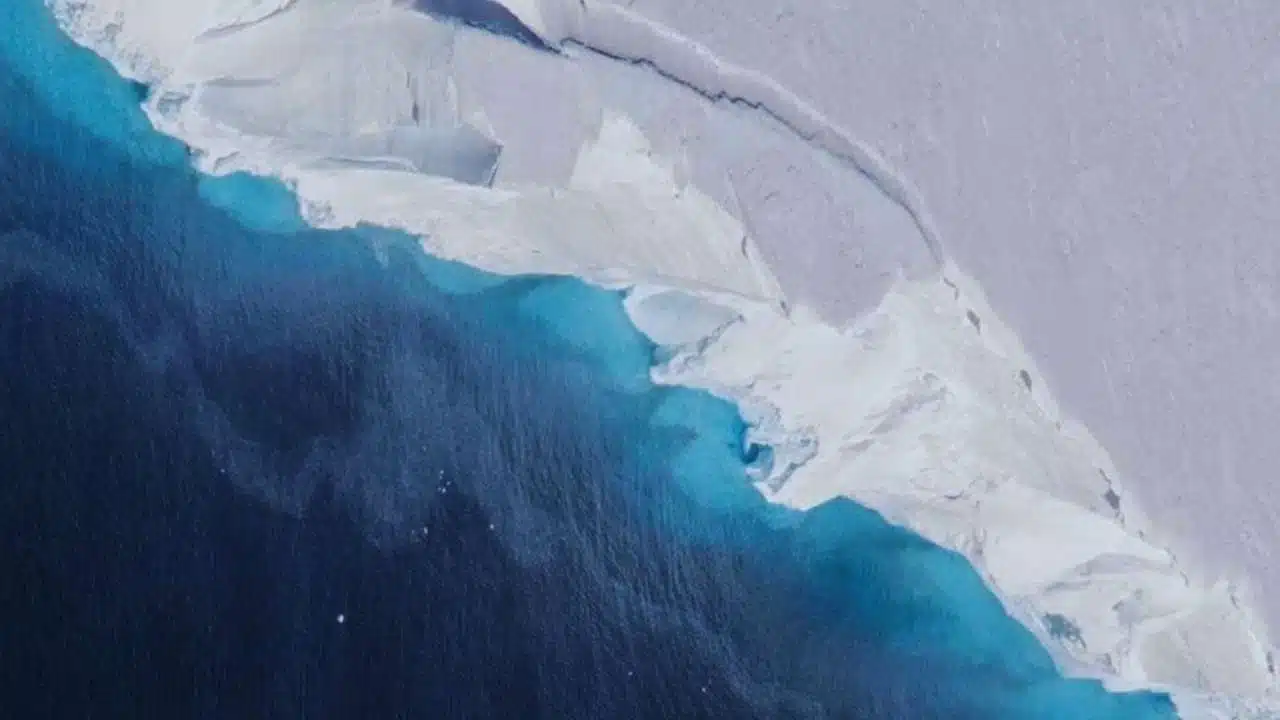
New scientific research has revealed that warm ocean currents travel beneath Antarctica’s Dotson Ice Shelf with far less cooling than previously believed, delivering concentrated heat directly to the base of the glacier. This discovery helps explain why parts of West Antarctica are melting faster than expected and why global sea levels continue to rise at an accelerating pace.
The study, led by scientists from the University of East Anglia and published in the journal Ocean Science, highlights a process that has long been suspected but never directly observed at this scale. The findings show that heat carried by deep ocean waters is reaching the grounding line—the point where the glacier lifts off the seabed and starts to float—where melting has the greatest impact on ice stability.
Heat Reaches Critical Glacial Zones With Limited Mixing
Researchers found that warm water flowing beneath the Dotson Ice Shelf remains surprisingly intact as it travels tens of kilometers under the ice. Instead of mixing upward into colder layers, the warm water moves mostly horizontally along the seafloor toward the grounding line. This allows significant heat to reach the base of the glacier, where even small increases in temperature can trigger rapid melting. According to the lead author, the warm water maintains enough heat to melt the glacier directly at its most vulnerable point.
When the grounding line erodes, the glacier can thin, retreat inland, and speed up, sending more ice into the ocean. This type of basal melting—melting from below—is now recognized as one of the main drivers of ice shelf thinning across West Antarctica. The new findings help clarify why some ice shelves are retreating faster than models predicted, emphasizing the importance of understanding ocean circulation beneath the ice.
Under-Ice Robotics Reveal Influence of Seafloor Shape
To uncover what happens in these hidden waters, the team used an autonomous underwater robot known as Boaty McBoatface, part of the Autosub Long Range fleet. The robot completed four missions beneath the ice in 2022, traveling more than 100 kilometers over about 74 hours. It collected detailed measurements of temperature, salinity, current speed, turbulence, and oxygen levels—data rarely accessible due to the extreme and remote environment. One of the most surprising findings was the influence of seafloor topography.
While scientists expected fast-moving currents to generate stronger mixing, the results showed that the steepness of the seabed mattered more. In areas where the seafloor rose sharply, warm water mixed more with colder water above. But in flatter regions, the warm water remained layered and undiluted, preserving its heat on the journey to the grounding line. This helps explain why some parts of the ice shelf melt faster than others, even when currents appear similar.
Why the Dotson Findings Matter for Global Sea Levels
The Dotson Ice Shelf has already thinned significantly, contributing measurable amounts to global sea-level rise. Between 1979 and 2017, it accounted for an estimated 0.6 millimeters of sea-level increase and has been thinning more rapidly than the regional average. The new research shows that ongoing access of warm water to the grounding line is likely to continue driving melt.
Because the wider Amundsen Sea region holds enough ice to raise sea levels substantially, understanding how heat moves beneath its ice shelves is critical for improving future sea-level predictions. This study provides essential insight into how ocean-driven melting can destabilize glaciers from below, highlighting a process that may continue even if surface temperatures remain extremely cold.