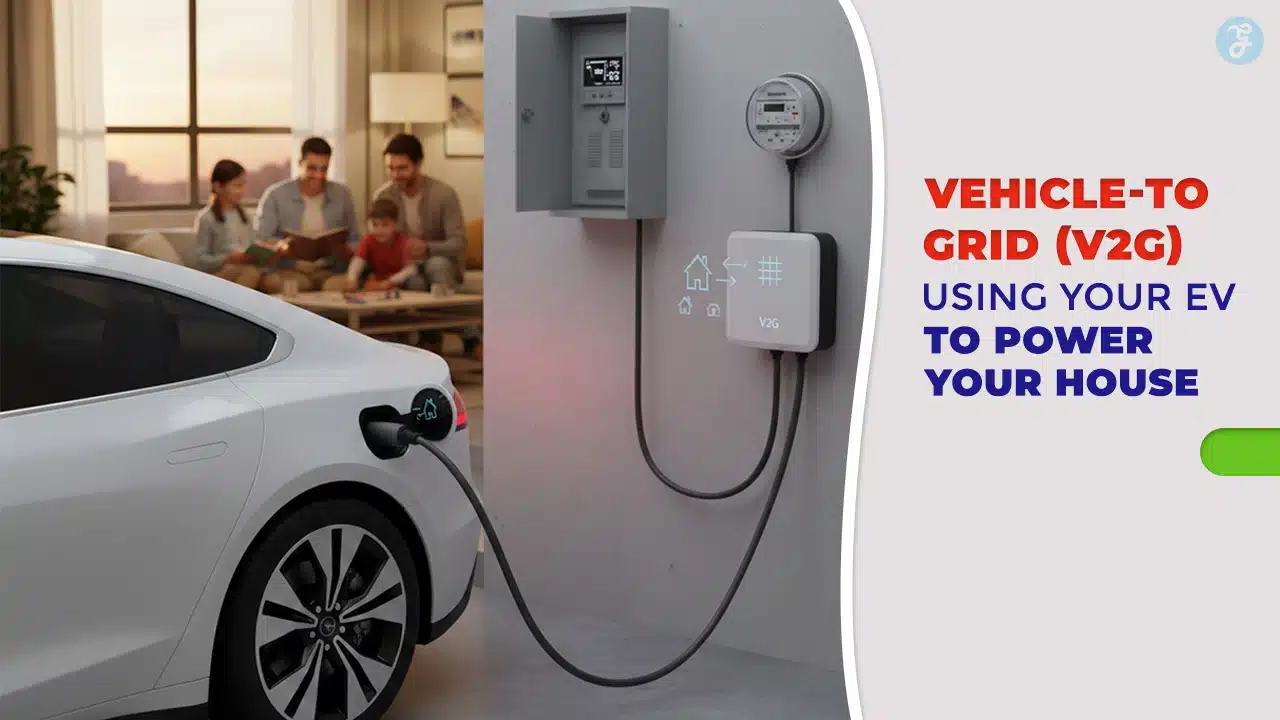
Imagine your electric vehicle (EV) not just as a car, but as a giant battery on wheels that can power your home during a blackout or even earn you money by selling electricity back to the grid. This isn’t science fiction—it’s Vehicle-to-Grid (V2G) technology, and for many homeowners, it is becoming a reality in 2025/2026.
This guide will explain exactly how V2G works, which cars can do it, the costs involved, and whether it’s a practical solution for your home today.
What Is Vehicle-to-Grid (V2G)?
Simple Explanation Of V2G Technology
At its simplest, Vehicle-to-Grid (V2G) allows electricity to flow in two directions. Most EV chargers are “one-way streets”—electricity flows from the grid into your car’s battery. V2G turns that street into a two-way highway. It allows your car to take energy from the grid when it’s cheap (like overnight) and push it back to the grid when demand is high, or power your home directly.
How V2G Differs From Traditional EV Charging
- Standard Charging (V1G): You plug in, and the car draws power until it’s full. Some “smart” V1G chargers can pause charging during peak hours, but they cannot send power back.
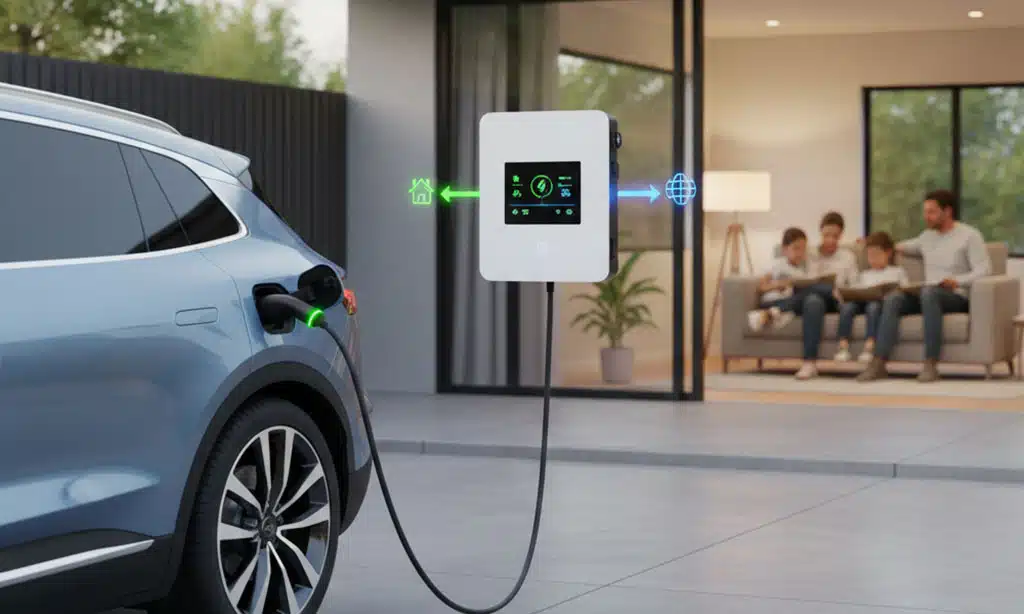
- Bidirectional Charging (V2G): Requires a specialized “bidirectional” charger. This charger can convert the AC electricity from your house to DC for the battery (charging) and convert the DC energy from the battery back to AC for your home or the grid (discharging).
How Using Your EV To Power Your House Works
Bidirectional Charging Explained
Your home runs on Alternating Current (AC), while EV batteries store energy as Direct Current (DC).
- The Inverter’s Job: A bidirectional charger contains a powerful inverter. When you want to power your house, this inverter takes the DC energy stored in your car and converts it into the precise AC voltage and frequency your home appliances need.
- Islanding: For backup power, the system must be able to “island” itself—physically disconnecting from the utility grid so your car doesn’t accidentally electrocute utility workers fixing lines down the street.
Energy Flow Between EV, Home, And Grid
- Normal Use: You charge your EV overnight when rates are low.
- Grid Support (V2G): During a hot summer afternoon when everyone is running AC, the utility company signals your charger to send power back to the grid. You get paid for this service.
- Backup Power (V2H): A storm knocks out the power lines. Your system automatically detects the outage, disconnects from the grid, and your EV starts powering your fridge, lights, and WiFi.
Required Hardware And Software
To make this work, you need three things:
- A Bidirectional-Capable EV: Not all EVs have the hardware to push power out.
- A Bidirectional Charger: A standard Level 2 charger won’t work. You need specific units like the Wallbox Quasar 2 or the Ford Charge Station Pro.
- Home Integration System: This often includes a transfer switch and a specialized energy management meter to monitor home loads.
V2G Vs V2H Vs V2L: Key Differences
It is crucial not to confuse these terms, as they offer very different capabilities.
Vehicle-to-Grid (V2G)
- Function: Sends power back to the utility grid.
- Goal: Earn money, stabilize the regional power grid.
- Requirement: Requires utility company permission and specific interconnection agreements.
Vehicle-to-Home (V2H)
- Function: Sends power only to your house.
- Goal: Backup power during outages or avoiding expensive electricity rates (peak shaving).
- Requirement: Does not necessarily require utility permission to export power, making it easier to set up.
Vehicle-to-Load (V2L)
- Function: A simple AC outlet built into the car (usually 120V).
- Goal: Powering a laptop, coffee maker, or camping gear.
- Requirement: No home installation needed; just an extension cord.
| Feature | V2L (Vehicle-to-Load) | V2H (Vehicle-to-Home) | V2G (Vehicle-to-Grid) |
| Primary Use | Camping, tailgating, single appliance | Whole-home backup, off-grid use | Selling energy, grid support |
| Power Output | Low (1.8 kW – 3.6 kW) | High (9.6 kW+) | High (9.6 kW+) |
| Installation Cost | $0 (included in car) | High ($5,000+) | High ($5,000+) |
| Grid Connection | None | Disconnects during outage | Connected & Interactive |
Benefits Of Using Your EV As A Home Power Source
Backup Power During Outages
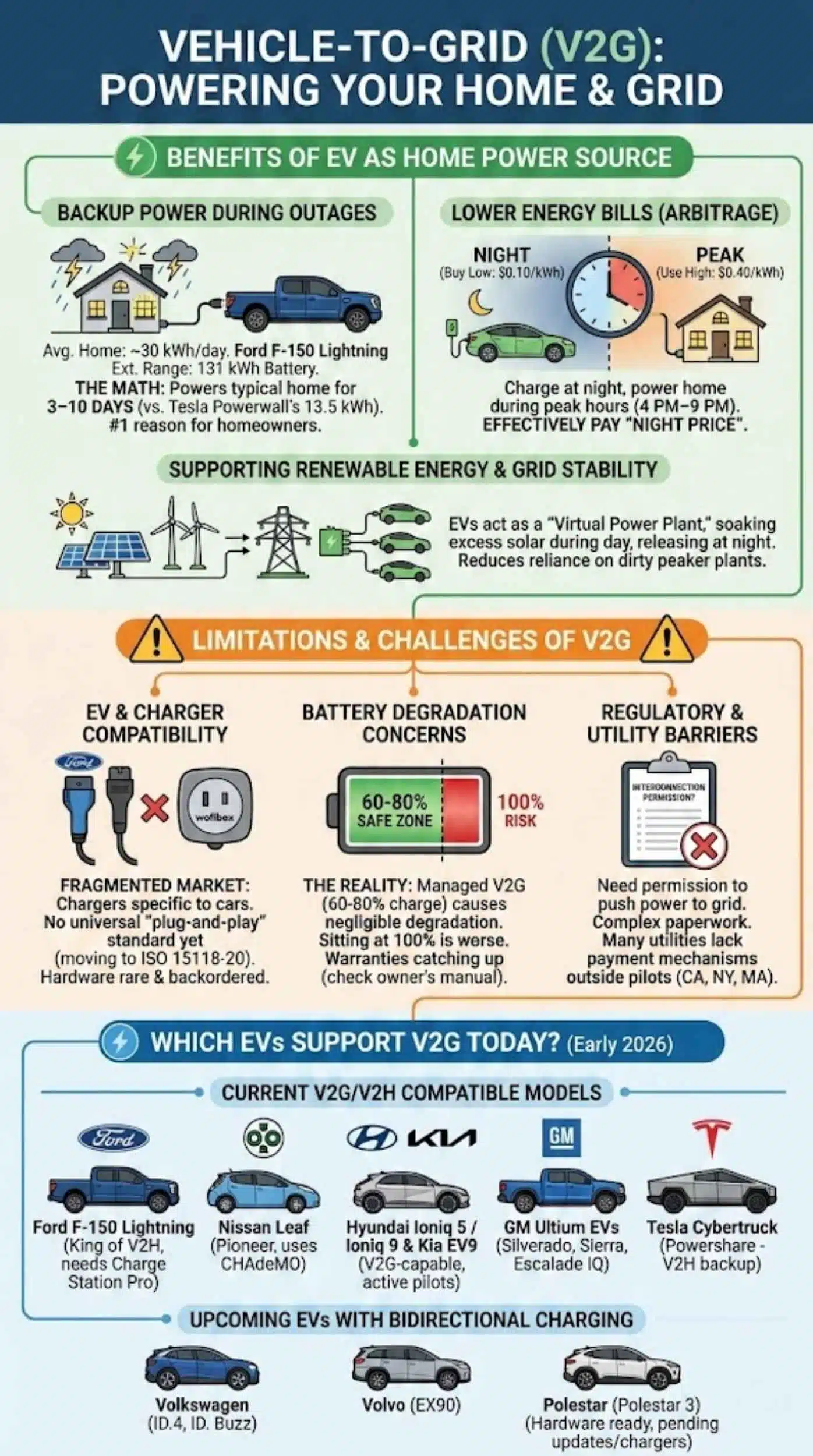
This is the #1 reason homeowners want this technology. An average American home uses about 30 kWh of electricity per day. A Ford F-150 Lightning Extended Range has a 131 kWh battery.
- The Math: That single truck could power a typical home for 3 to 10 days depending on how much energy you conserve. That is significantly more powerful than a standard Tesla Powerwall (which holds only 13.5 kWh).
Lower Energy Bills And Energy Arbitrage
If you live in an area with “Time-of-Use” (TOU) rates:
- Buy Low: Charge your EV at night for $0.10/kWh.
- Use High: Run your home off the EV battery during peak hours (4 PM–9 PM) when grid electricity costs $0.40/kWh.
- Result: You effectively pay the “night price” for all your electricity.
Supporting Renewable Energy And Grid Stability
Renewable energy like solar and wind is intermittent. By plugging in millions of EVs, we create a massive “Virtual Power Plant.” Your car can soak up excess solar power during the day (preventing it from being wasted) and release it at night, reducing the need for dirty coal or gas peaker plants.
Limitations And Challenges Of V2G
EV And Charger Compatibility
This is the biggest hurdle.
- Fragmented Market: A Ford charger works with a Ford truck. A Wallbox charger works with specific cars. There is no universal “plug-and-play” standard yet for residential V2G, though the industry is moving toward the ISO 15118-20 standard to fix this.
- Availability: True V2G hardware is still rare and often backordered.
Battery Degradation Concerns
“Will this kill my battery?” is a common fear.
- The Reality: Recent 2025 studies indicate that managed V2G (keeping the battery between 60% and 80% charge) causes negligible degradation. In fact, letting a car sit at 100% charge is far worse for the battery than cycling it gently for V2G.
- Warranties: Manufacturers are catching up. Hyundai and Ford have updated warranties to cover bidirectional use, but older Nissan Leaf warranties were vague. Always check your specific owner’s manual.
Regulatory And Utility Barriers
Just because your car can do V2G doesn’t mean your utility company allows it.
- Interconnection: You need permission to push power onto the grid. In many parts of the US, the paperwork is complex, similar to installing solar panels.
- Active Programs: While California (PG&E, SDG&E), New York, and Massachusetts have active pilots, many local utilities have no mechanism to pay you for your EV’s power yet.
Which EVs Support Vehicle-to-Grid Today?
As of early 2026, the list of vehicles with bidirectional capabilities is growing:
Current V2G/V2H Compatible Models
- Ford F-150 Lightning: The current king of V2H. Requires the “Ford Charge Station Pro” and “Home Integration System.”
- Nissan Leaf: The pioneer. Uses the CHAdeMO charging standard (different from most modern EVs) but has proven V2G capabilities.
- Hyundai Ioniq 5 / Ioniq 9 & Kia EV9: These vehicles are V2G-capable. Hyundai is actively running V2H programs in the US and V2G pilots in Europe/Korea.
- GM Ultium EVs (Silverado EV, Sierra EV, Escalade IQ): GM has committed to bidirectional charging across its entire retail EV portfolio.
- Tesla Cybertruck: Features “Powershare,” which is primarily V2H (backup) capable.
Upcoming EVs With Bidirectional Charging
Volkswagen (ID.4 and ID. Buzz), Volvo (EX90), and Polestar (Polestar 3) have announced hardware readiness for bidirectional charging, pending software updates and compatible charger availability.
How Much Power Can An EV Supply To A House?
Average EV Battery Capacity Explained
To understand the power potential, compare EV batteries to home stationary batteries:
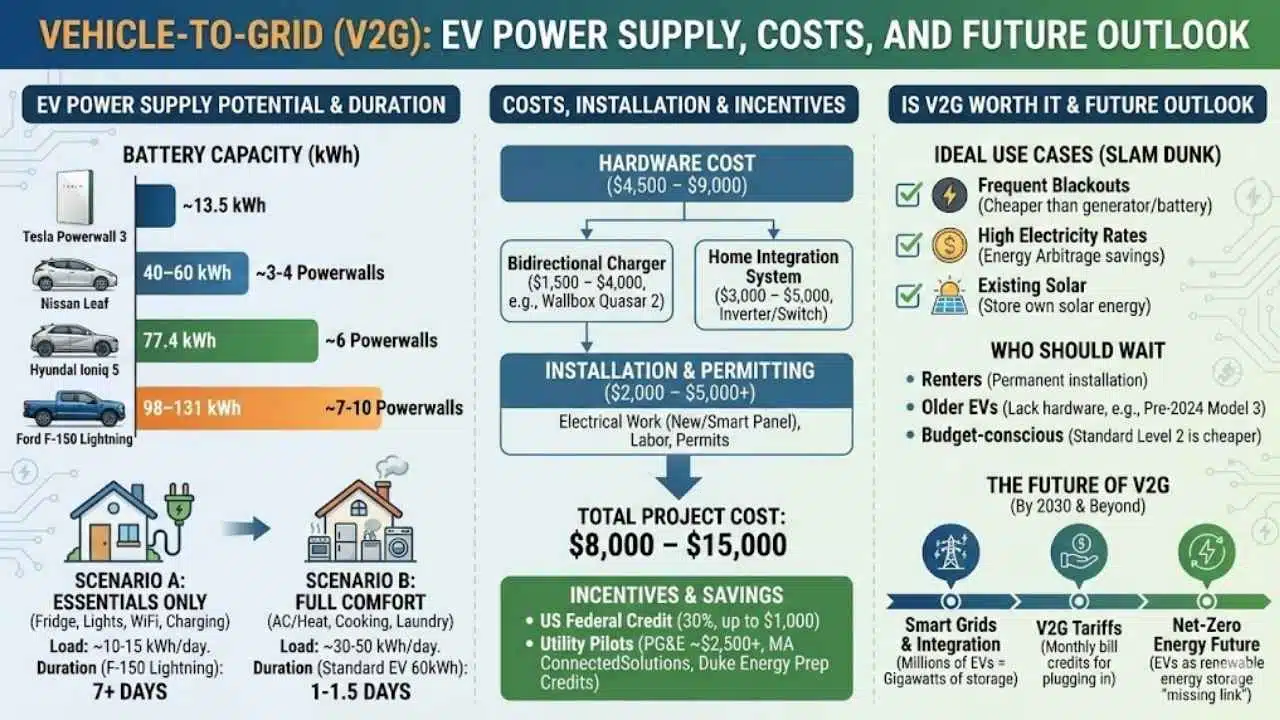
- Tesla Powerwall 3: ~13.5 kWh capacity.
- Nissan Leaf: 40–60 kWh (Equivalent to 3-4 Powerwalls).
- Hyundai Ioniq 5: 77.4 kWh (Equivalent to ~6 Powerwalls).
- Ford F-150 Lightning: 98–131 kWh (Equivalent to 7-10 Powerwalls).
How Long An EV Can Power A Typical Home
- Scenario A (Essentials Only): Fridge, lights, WiFi, device charging.
- Load: ~10-15 kWh per day.
- Duration: An F-150 Lightning could last 7+ days.
- Scenario B (Full Comfort): AC/Heat running, electric cooking, laundry.
- Load: ~30-50 kWh per day.
- Duration: A standard EV (60 kWh) would last 1-1.5 days.
Costs And Installation Considerations
Cost Of V2G Chargers And Equipment
This is not a cheap upgrade.
- Bidirectional Charger: $1,500 – $4,000 (e.g., Wallbox Quasar 2 is currently priced higher, often bundled with installation services).
- Home Integration System (Inverter/Switch): $3,000 – $5,000.
- Total Hardware Cost: Expect $4,500 – $9,000 before installation.
Installation And Permitting
- Electrical Work: You will likely need a new sub-panel or a “smart” electrical panel (like those from SPAN or Schneider Electric). Labor can range from $2,000 to $5,000 depending on your home’s age.
- Total Project Cost: Realistically, a full V2H/V2G setup costs between $8,000 and $15,000.
Incentives, Rebates, And Future Savings
- US Federal: The 30% Alternative Fuel Vehicle Refueling Property Credit (up to $1,000) may apply to the charger.
- Utility Pilots:
- PG&E (California): Offers up to $2,500+ for residential V2X participants.
- Massachusetts (ConnectedSolutions): Pays residents for battery export during peak times (applicable to V2G if approved equipment is used).
- Duke Energy: Offers “Charger Prep Credits” to lower installation costs.
Is Vehicle-to-Grid Worth It For Homeowners?
Ideal Use Cases
V2G/V2H is a “slam dunk” investment if:
- You experience frequent blackouts: It is cheaper than a whole-home generator or dedicated battery system.
- You have high electricity rates: The savings from energy arbitrage (buy low, use high) can offset the installation cost over 5-7 years.
- You already have solar: It allows you to store your own solar energy without buying a separate Powerwall.
Who Should Wait
- Renters: The installation is permanent and expensive.
- Owners of older EVs: If your car (like a Tesla Model 3 pre-2024) lacks the hardware, you cannot retrofit it.
- Budget-conscious buyers: A standard Level 2 charger ($500) is significantly cheaper if you don’t need backup power.
The Future Of Vehicle-to-Grid Technology
Smart Grids And EV Integration
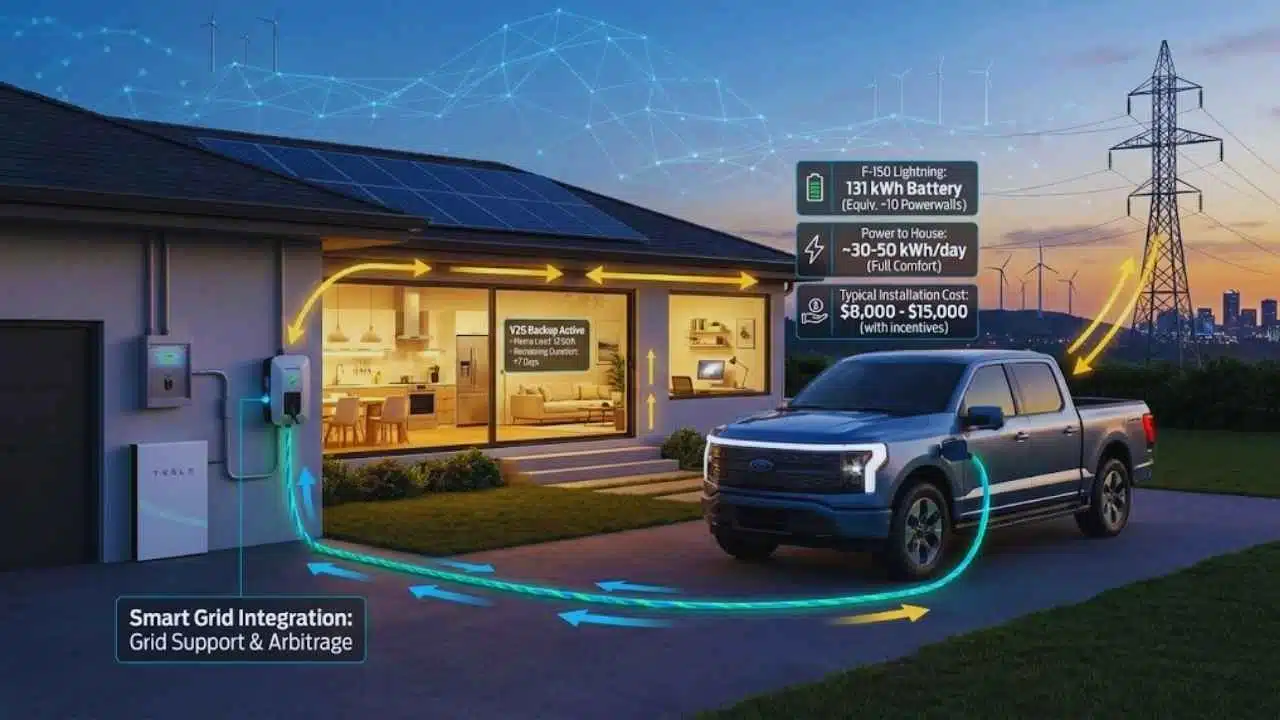
By 2030, analysts predict millions of EVs could provide gigawatts of storage capacity—more than all the stationary batteries in the world combined. Utilities will likely offer “V2G Tariffs” where you get a monthly credit on your bill just for keeping your car plugged in and available to the grid.
Role Of V2G In A Net-Zero Energy Future
V2G is the “missing link” for renewable energy. It solves the problem of “the sun doesn’t shine at night” by using the car you already own to store the sun’s energy for evening use. It transforms EV ownership from a simple mode of transport into a pillar of personal and national energy independence.
Final Thoughts
Vehicle-to-Grid (V2G) technology represents a paradigm shift in how we think about transportation and energy. It transforms your electric vehicle from a simple consumer of electricity into a dynamic energy asset that can protect your home during outages, lower your monthly bills, and support a greener, more resilient power grid.
While the upfront costs for bidirectional chargers and home integration are currently high (typically $8,000–$15,000 all-in), the value proposition is compelling—especially when compared to the cost of standalone home battery systems or fossil-fuel generators. For early adopters, particularly those with compatible vehicles like the Ford F-150 Lightning or Nissan Leaf, the future of energy independence is already here.
As we move through 2026, we can expect hardware costs to drop, more vehicle models to become V2G-compatible, and utility companies to roll out standardized incentives. V2G is not just about powering your house; it’s about empowering homeowners to be active participants in the energy ecosystem.