You spend hours making your site better, but you still don’t see much change in search rankings. You wonder if all that hard work is wasted or if there is a trick you are missing. Is Google looking at how people use your page now, or do old link-building tactics still matter most? This common question keeps website owners up at night.
Here is one thing to know: Leaked documents from Google recently confirmed that “User Signals” are a massive factor in 2026. More people click, stay longer, and interact with sites they trust. Search engines are watching these actions more closely than ever.
This guide will break down everything about user signals vs backlinks. You will learn practical tips to boost both without guesswork or fancy tools.
Search engines used to focus mainly on backlinks. Google’s PageRank, born in 1998, counted links like votes. More links meant more trust for your site and a higher ranking. Over time, things changed as search algorithms got smarter. Fake or spammy links started losing their value fast.
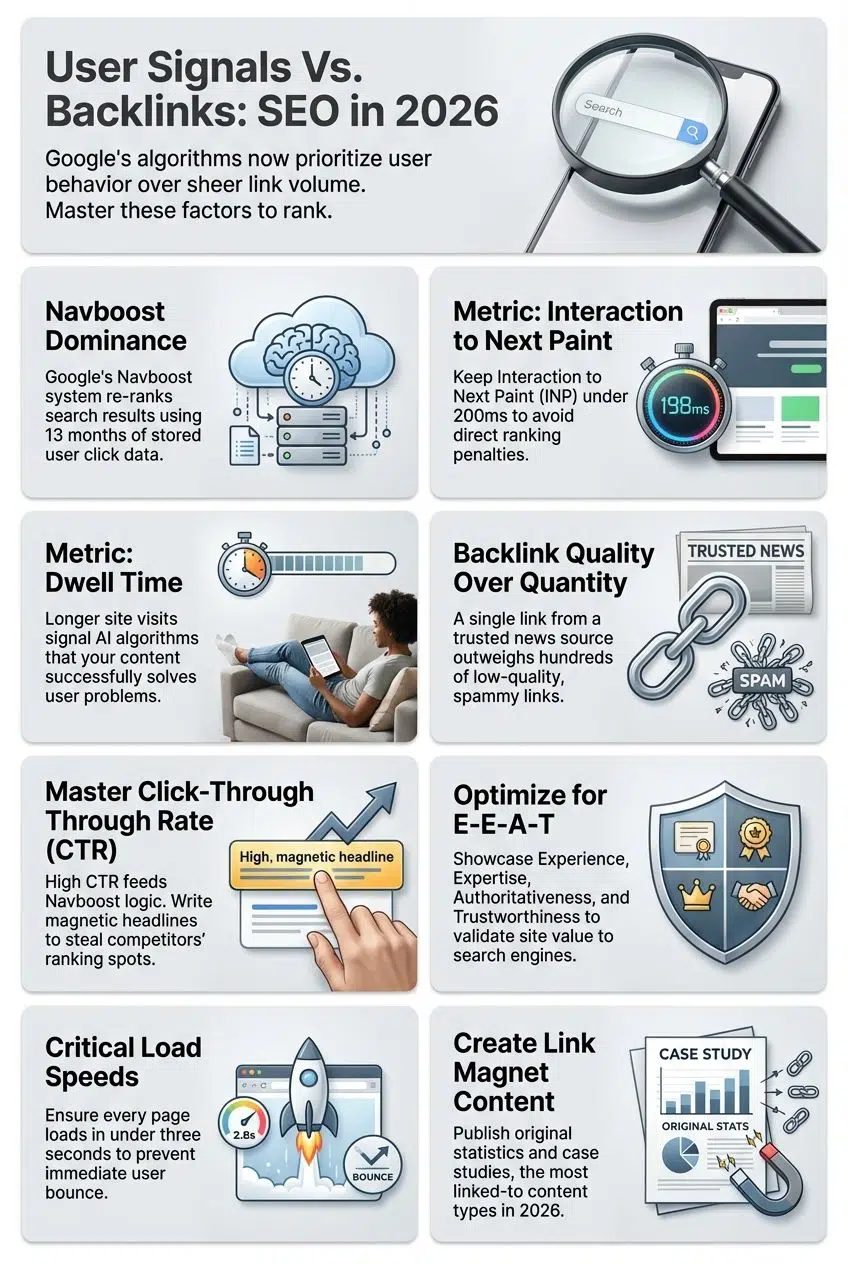
Today, user signals matter a lot more. Search engines now pay close attention to how people interact with pages. They look at things like click-through rates and whether visitors stick around instead of bouncing away.
AI tracks this behavior and helps decide who rises in the rankings. One specific system, known as Navboost, has changed the game entirely. It uses data from the past 13 months of user clicks to re-rank search results based on what people actually find helpful.
Strong content keeps users hooked. It earns solid backlinks naturally and signals authority through both behavior and quality connections.
What Are User Signals?
User signals show how people act on your site. Search engines watch these actions closely to see if your content actually solves a problem.
Definition and examples of user signals
User signals show how people act on a website. They help search engines guess if a site gives value to visitors or just wastes time. These signals include actions like clicking through from Google results, staying to read, or leaving fast without much interaction.
Navboost is the internal system Google uses to track these “votes” from users. If people consistently skip the first result to click the third one, the third one eventually moves up.
According to leaked API documentation, Google stores click and query data for 13 months. This means a long-term pattern of happy users is your best SEO asset.
Bounce rate tells us how many people leave after seeing only one page. High numbers often mean weak content or poor structure. A good example is dwell time. This shows how long someone stays before returning to Google. More time spent can mean better content and higher relevance in the eyes of search engines like Google and Bing in 2026.
Click-through rate (CTR) also matters since it tracks which links get attention compared to others on the same list of search results. If more users click your title over another, you gain favor with ranking algorithms seeking real engagement instead of just backlinks.
Key metrics: INP, Dwell Time, and Click-Through Rate
It is all about understanding what happens when people land on your page. Here is what matters most in 2026, including the new Core Web Vitals metrics:
| Metric | What It Means | Why It Matters | 2026 SEO Impact |
|---|---|---|---|
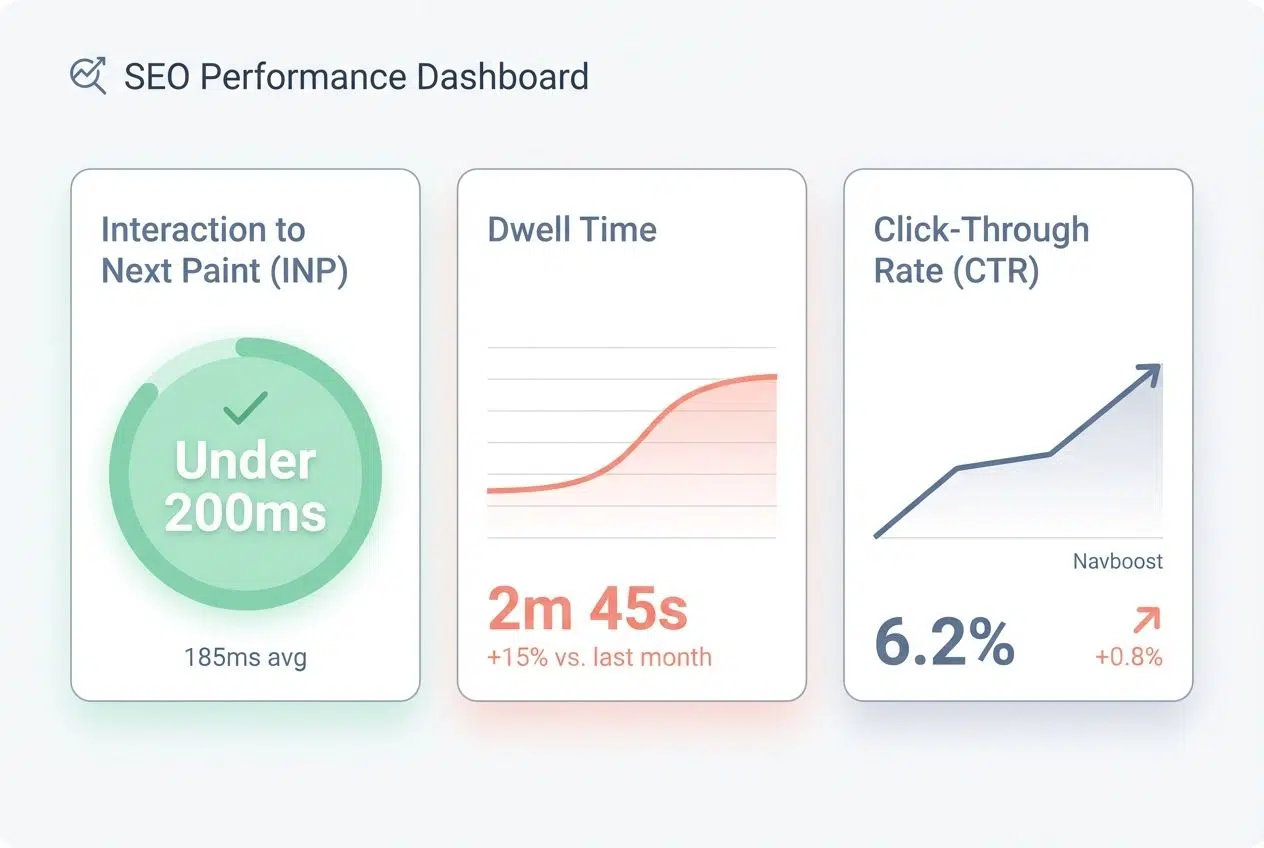
| Interaction to Next Paint (INP) | Measures how quickly a page responds after a user clicks or taps. | Replaced “FID” as a Core Web Vital. It proves your site isn’t “frozen.” | Must be under 200 milliseconds. Slow response times now directly hurt rankings because users hate waiting for buttons to work. |
| Dwell Time | How long visitors stick around after landing on search results. | Reflects engagement, depth of interest, and content quality. | Longer dwell times in 2026 tell AI-driven algorithms you are nailing user questions. Short visits mean it is time to rethink your strategy. |
| Click-Through Rate (CTR) | Percentage of people who click your link after seeing it in search results. | Measures how magnetic your title and description really are. | High CTR feeds the Navboost system. If you get more clicks than the guy above you, you will likely take his spot. |
What Are Backlinks?
Backlinks are links from other websites that point to your site, like a friend recommending your party. These votes of confidence help boost your spot in search results and give you street cred online.
Definition and importance of backlinks
Backlinks are links from other websites that point to yours. They act like votes of confidence, and search engines use them as signals for trust and authority. Quality matters far more than the sheer number of links.
For example, one link from a trusted news outlet can boost your SEO more than dozens from weak blogs or spammy pages.
Search engines check these links to decide if your content is reliable and worth showing high in rankings. A 2024 study by Ahrefs found that 96.55% of all content gets zero traffic from Google, and a lack of backlinks is a primary reason why.
Good backlinks help drive organic visibility and raise domain authority. A strong backlink profile is key to climbing up search results in 2026. A single good backlink is like gold, while hundreds of bad ones are just sand.
Quality vs. quantity in backlinks
After seeing how backlinks help boost rankings, it is time to look at what makes a backlink strong. Many think more links mean higher authority in search engines, but that idea lost steam years ago. Algorithms like Google Penguin started to catch low-quality link tricks and punish spammy sites fast.
One solid link from a trusted site brings more power than dozens of weak ones. Picture one vote from The New York Times versus a hundred from unknown blogs. The first carries more weight for organic visibility and ranking factors.
Newer SEO studies in 2025 showed top-ranking websites had fewer backlinks with high relevance and content quality compared to those with hundreds of random links. Focus on earning connections from respected, related sources. Authority wins over mass every single time now.
User Signals vs. Backlinks: A Comparative Analysis
Search engines notice both user actions and links, but each leaves its own mark on rankings. Some sites soar by winning over people, while others rise through the power of quality links.
Direct impact on search rankings
User signals like click-through rate and dwell time can change where a site appears on search engines. Sites with better user engagement often rise faster than those with just many backlinks.
In 2026, Google’s algorithms will watch how people use your page more closely. They sniff out real connections over spammy link tricks. Quality content keeps visitors reading, clicking, and exploring longer.
Backlinks still matter, but must come from sites with strong authority for the best results. A flood of low-quality links hurts rankings instead of helping them grow. Both user behavior and smart link building shape who gets to sit at the top spot on result pages.
The Cost vs. Effort Breakdown
Deciding where to put your energy often comes down to budget and time. Here is a quick comparison of what it really takes to succeed with each strategy in 2026:
| Strategy | Estimated Cost (2026) | Time to Impact | Best For |
|---|---|---|---|
| High-Quality Backlinks | $1,000 – $2,500 per link (via reputable outreach agencies like Siege Media). | Slow (3-6 months to see authority gains). | Competitive industries like Finance or Law, where trust is everything. |
| User Signal Optimization | Free – $500 (Content updates, speed fixes). | Fast (Weeks). Systems like Navboost update frequently. | Content blogs, local businesses, and e-commerce sites need quick wins. |
Search engines track clicks, scrolls, and how long a visitor stays on your page. High click-through rates show that users pick your link in search results. If people leave fast, search engines notice the high bounce rate.
A low bounce rate often means the content fits what someone wants to find. Dwell time shines as visitors hang around longer. This hints at useful info or good storytelling.
Trends in 2026: The Rise of User Signals
Search engines now have sharper eyes for every user move. AI tools study clicks, scrolls, and time spent, giving clear clues about what people enjoy most online.
AI-driven evaluation of user interactions
AI tools now watch how people act on websites. They notice every click, scroll, and pause. Google’s search algorithms get smarter each year. These systems spot real user engagement, like longer dwell time or repeat visits. For example, if users stay to read your content and explore more pages, AI marks that as quality.
SEO teams must pay attention to signals such as bounce rate and clickthrough rate in 2026. The machines learn quickly. Patterns like quick exits can lower rankings fast.
Pro Tip: Don’t panic if your bounce rate seems high. According to 2025 data from CausalFunnel, blogs normally have bounce rates of 70-90%. E-commerce sites, however, should aim for 20-45%.
Trust signals take center stage next, showing why E-E-A-T matters so much for ranking high today.
Trust Signals: The Core of Modern SEO
Trust counts more than ever as a sign of good websites. Search engines zero in on helpful content and clear authority. Think of it like a spotlight for your site’s value.
Defining E-E-A-T [Experience, Expertise, Authoritativeness, Trustworthiness]
E-E-A-T means Experience, Expertise, Authoritativeness, and Trustworthiness. Google uses these signals to judge websites. Someone who shares real stories or clear data shows experience.
A person with deep knowledge proves expertise. Sites with strong reputations in their field show authority through their content and links from respected places.
Trust comes from honest writing and a secure user experience. Safe browsing, clear sources, and privacy earn trust points fast. In 2026, E-E-A-T helps search engines pick which sites rank higher for quality topics like health or news.
Content that displays all four parts of E-E-A-T can boost rankings, visibility, and organic traffic quickly.
Authority Building Through Content and User Experience
Strong E-E-A-T sets the stage for real authority. Next up, content and user experience take center stage. Helpful articles boost trust signals fast. Pages that answer questions clearly keep visitors engaged. People share good posts, increasing organic visibility and higher search rankings.
Easy-to-read layouts matter just as much as words on the page. Fast load times build confidence with both users and search engines like Google in 2026. Interactive tools get readers to stay longer. This helps dwell time, an important signal now weighed by modern algorithms powered by AI.
Delivering valuable content makes people return again and again. This grows domain authority without begging for backlinks every chance you get.
The Role of Backlinks in 2026
Backlinks still pack a punch for websites that want to climb higher in search results. Yet, these days, only the ones from trusted sources really push your site ahead.
Why backlinks remain relevant
Search engines see backlinks as votes of confidence from other websites. A page with strong links gains more authority and better organic visibility. Google’s algorithm, even in 2026, uses quality backlinks to judge site trust and relevance. Search algorithms reward sites that earn genuine connections instead of spammy or low-value links.
A single high-quality backlink can make a big impact on ranking, much like a trusted friend recommending your work. Sites with good link building often rank above those without any references or support from others online. This signal still moves the needle for SEO and helps boost authority fast.
The diminishing returns of low-quality backlinks
Low-quality backlinks used to give sites a quick boost in rankings, but that trick wears thin fast. In 2026, search engines spot cheap link schemes with ease. Sites loaded with spammy links often drop off the first page or worse, lose organic visibility for good.
Instead of helping the authority, these weak links act like anchors pulling you down. Google’s AI-driven updates in recent years made it clear that content quality and user engagement now carry real weight for ranking factors.
Filling your backlink profile with low-value sources usually triggers filters or penalties rather than rewards. You want strength, not numbers. Every link should support trust signals and relevance for real SEO growth.
Balancing User Signals and Backlinks for SEO Success
Smart SEO is like juggling two balls: user signals and backlinks. Drop one, and the show gets dull. Nail both, and watch your site climb higher than a squirrel in a pecan tree.
How to optimize for user experience
Websites thrive on great user experience. People expect speed, clarity, and trust signals each time they visit a site.
- Fix your “Interaction to Next Paint” (INP): Google now demands this metric be under 200ms. Use tools like PageSpeed Insights to check if your buttons react instantly when clicked.
- Keep your pages loading fast: Slow websites lose visitors in seconds. Google says pages should load in under three seconds for better rankings.
- Make sure navigation is simple: Clear menus help users find what they want without confusion or wasted clicks.
- Write readable content: Use simple words and short sentences. Break ideas into small paragraphs so readers stay engaged.
- Design with mobile in mind: Over 60% of searches happen on smartphones, so mobile-friendly sites win more organic visibility.
- Show real authority through E-E-A-T: Add the author’s name, credentials, and links to expert sources for trustworthiness.
- Avoid cluttered layouts: White space helps eyes rest and highlights your main message.
- Use strong headlines: Headlines must tell readers what is inside each page or post, boosting clickthrough rate and rankings.
- Offer clear calls to action: Buttons like “Learn More” or “Get Started” guide users where you want them to go next.
- Check that all links work properly: Dead or broken links hurt both SEO ranking and credibility.
Building high-quality backlink strategies
Search engines still use backlinks to judge a site’s value. High-quality links boost authority, rankings, and organic visibility.
- Create “Link Magnet” content: Write strong, original content that others want to link to. Original statistics and case studies are the most linked-to content types in 2026.
- Get featured on trusted sites in your field: Google values these mentions for domain authority.
- Reach out to experts or blogs in your niche: Ask them to share or review your content.
- Offer guest posts for related sites: Include helpful information and a natural reference to your site.
- Share research or data: Studies attract press attention and links from other creators.
- Use social media channels to promote your articles: Shares can lead to more links over time.
- Check for broken links on other sites in your industry: Suggest your page as a replacement.
- Join local business groups online: Often, these platforms let you add your website link.
- Build connections with journalists: Use sites like Connectively (formerly HARO) to answer reporter questions and earn high-value backlinks.
- Avoid buying low-quality links: Google’s algorithms may penalize sites that do this.
Focus on Content Depth and Relevance
Clear, detailed content lets your site shine in search rankings. Rich information pulls visitors in and keeps them reading longer, which boosts user engagement scores like dwell time and clickthrough rate. People want answers fast, not just surface details. Answer their questions better than anyone else out there.
Cover topics from every angle, using facts that matter to readers. Search engines see you as an authority when your pages give more value and speak directly to what people seek right now.
Write with purpose. Give each section meaning so both users and algorithms recognize quality and relevance at a glance. Consistent, helpful information grows trust signals for long-term organic visibility.
Enhancing SEO Success via Social Media
Social media can boost your SEO by driving more people to your site. Sharing links, fun facts, or even short videos keeps users coming back for more. Engaging posts help increase clickthrough rate, and user signals that search engines notice.
Brands like Wendy’s use witty replies and trending memes, which raise engagement fast. People share content they find helpful or cool. This adds new backlinks from other sites and blogs. If a post goes viral on TikTok or Instagram in 2026, it can spark spikes in organic visibility overnight.
Thoughtful comments, polls, and story features invite feedback that helps improve user experience as well. Strong activity builds authority and trust without needing fancy tricks. It is just good old-fashioned interaction with your audience.
Final Thoughts: The Future of SEO Beyond 2026
SEO keeps changing, but user signals and backlinks will both shape your rankings in 2026. Focusing on real user engagement, like click-through rate and dwell time, makes websites stronger, while quality links still count for trust.
Smart strategies work best when they are easy to start right away. Keep content helpful and let your readers stay longer. You can grow organic visibility by mixing high-quality links with a better site experience; it works for beginners or experts alike.
Keep things simple, aim for value every step of the way, and soon enough, you might just watch your website climb higher than ever before!