
Most lawyers can list the big themes: technology, regulation, and client expectations are changing fast. But underneath the headlines, a set of underrated legal trends is quietly reshaping how legal work is done, priced, and valued.
Corporate legal departments report rising demand for support, tighter budgets, and pressure to show business impact. At the same time, surveys show that AI adoption has accelerated across law departments and law firms, even as many still struggle with fragmented systems and heavy workloads. These forces are driving new behaviors that do not always make the conference keynotes, but they are very real in day-to-day practice.
Let’s map those underrated legal trends into clear themes: technology, regulation, in-house and legal operations, litigation, and culture. The aim is practical. You will see why each shift matters, who it affects, and what you can do about it.
Why quiet trends matter now
| Driver | What is changing | Impact on legal work |
| Rising demand for law teams | More matters, same or smaller budgets | Need for smarter prioritization and tools |
| Fast AI adoption | From pilots to daily workflows | New risks, governance, and skills |
| Regulatory complexity | Overlapping rules across borders | Higher compliance and advisory demand |
| Client expectations | Pressure for value, speed, and transparency | New pricing models and service design |
How to read this guide on underrated legal trends
This guide focuses on underrated legal trends rather than obvious megatrends.
Here, “underrated” means developments that:
- Already affects strategy, risk, or revenue.
- They are not yet widely discussed outside specialist circles.
- Offer opportunities for forward-looking lawyers to differentiate themselves.
Each major section looks at one theme and breaks it into specific sub-trends with examples and practical implications. Use this as a checklist for your own planning. Which of these trends could become a new practice area, a reason to update your playbooks, or a topic for client education and thought leadership?
How to use this guide
| Section theme | Who should focus on it | Key use case |
| Tech and AI shifts | Partners, innovation, legal ops | Tool selection, AI strategy |
| Regulatory and compliance | Regulatory, corporate, ESG counsel | New advisory offerings |
| In-house and legal operations | GCs, legal ops, CFOs | Budget, staffing, and tech decisions |
| Litigation and risk | Litigators, insurers, risk managers | Dispute strategy and risk forecasting |
| People and culture | Firm leaders, HR, and bar associations | Talent, well-being, client experience |
Under-the-radar tech and AI shifts transforming legal work
Technology in law is not just about buying the latest tool. The biggest shifts are how firms and departments govern, staff, and integrate those tools into daily work.
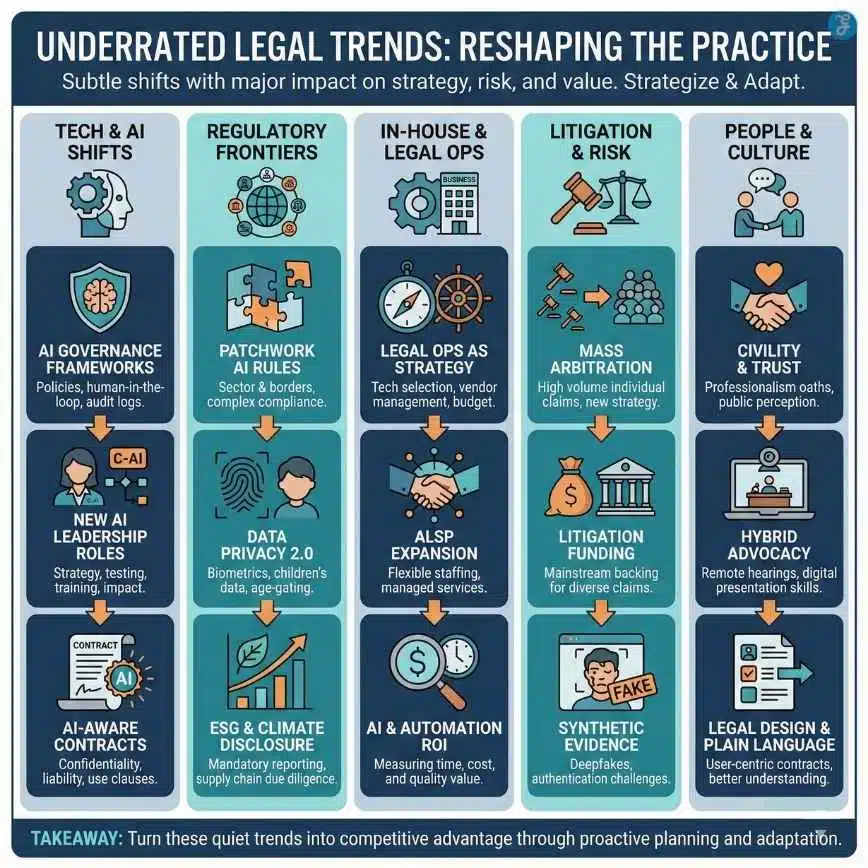
1. From AI pilots to governed, production-grade systems
Many firms have moved past experimental AI pilots. They are now building clear policies on when AI can be used, which systems are allowed, how prompts should be crafted, and how outputs must be checked.
Governance frameworks often include:
- Approved use cases, such as research, clause comparison, or drafting first passes.
- Human-in-the-loop review requirements.
- Logging and auditing of AI use for sensitive matters.
- Guidelines for client communication about AI involvement.
This shift matters because unmanaged AI can create confidentiality, bias, and accuracy risks. Managed AI can save hours on routine work while keeping standards high.
2. New AI leadership roles inside legal organizations
A growing number of law firms now appoint dedicated AI leaders such as Chief AI Officer, Head of AI Strategy, or a partner with explicit AI responsibility. Similar roles appear in corporate legal teams.
Their tasks include:
- Setting AI strategy and priorities.
- Selecting and testing tools with IT and security.
- Designing training programs for lawyers and staff.
- Measuring AI impact on time, quality, and cost.
These roles are one of the most underrated legal trends because they signal that AI is shifting from “nice to have” to core infrastructure.
3. AI clauses and AI-aware contracts
Contracts increasingly contain language about AI.
This can appear in:
- Confidentiality clauses that restrict feeding client data to public AI tools.
- Representations that no AI-generated content infringes third-party rights.
- Allocation of responsibility when an AI-assisted output turns out to be wrong.
- Engagement letters where firms explain how they use AI internally.
Lawyers who understand these issues can build new advisory services around AI-ready contracts and policies.
4. Analytics, forecasting, and end-to-end platforms
Law practices are also moving from disconnected tools to integrated platforms that cover intake, matter management, document creation, e-billing, and analytics. Litigation teams use data to forecast timelines, likely outcomes, and settlement ranges. This type of insight used to be a “nice” context; now many clients expect it.
Key tech and AI trends at a glance
| Tech trend | What is new | Why it is underrated |
| AI governance frameworks | Formal policies and review processes | Seen as admin, but central to risk |
| AI leadership roles | Chief AI Officer, AI partner roles | New power centers shaping strategy |
| AI-aware contract clauses | Explicit rules on AI use and risk | Early movers can set market standards |
| Integrated cloud platforms | Single systems instead of tool sprawl | Quietly changing profitability and data |
| Litigation analytics | Judge and outcome prediction tools | Already influencing pricing and strategy |
New regulatory and compliance frontiers clients overlook

Regulation is expanding rapidly, but not always in obvious ways. Many laws now indirectly regulate AI, data, and sustainability, even when the words “AI” or “ESG” barely appear.
5. Patchwork AI regulation across sectors and borders
Instead of one unified regime, AI is being shaped by sector-specific and national rules. Financial regulators, health regulators, and data-protection authorities all publish guidance that applies to algorithms and automated decision-making.
For cross-border businesses, this creates complex questions:
- Which regulator has authority over a particular AI-enabled product?
- Where data can be stored or processed.
- Which transparency and explainability standards apply?
Lawyers who can navigate that patchwork can build niche practices around AI risk and compliance.
6. Data privacy 2.0 – biometrics, children, and age-gating
Privacy law now goes beyond general data protection.
New rules often target:
- Biometric identifiers such as facial and voice data.
- Children’s data and online tracking.
- Age-verification for adult content and high-risk sites.
These rules create tension between safety and privacy. Collecting more data to verify age can itself create new security and liability risks. Many clients underestimate how exposed they are in this space.
7. ESG, climate disclosure, and supply-chain due diligence
Environmental, social, and governance reporting has shifted from voluntary marketing to mandatory disclosure in many regions. Companies must track carbon emissions, human-rights impacts, and supply-chain risks in far more detail than before.
Underrated legal trends in this area include:
- Climate-related claims against directors and officers.
- Greenwashing investigations into marketing statements.
- Contract clauses that require suppliers to report ESG metrics and allow audits.
8. Dupe culture, trade dress, and copycat design
“Dupe culture” – selling look-alike versions of popular products – has moved from fashion into beauty, food, and home goods. Courts and regulators now pay closer attention to the overall visual impression of packaging and product design, not just logos.
This creates new work around trade dress, false advertising, and unfair competition. Brands need packaging audits and stronger strategies to protect non-traditional marks such as colors, shapes, and store layouts.
New regulatory and compliance frontiers
| Regulatory frontier | Typical client blind spot | Legal opportunity |
| Sector-specific AI rules | Thinking only about general AI laws | Cross-border AI compliance programs |
| Data privacy 2.0 | Underestimating biometric and kids’ data | Targeted policies and DPIA reviews |
| ESG and climate disclosure | Treating ESG as marketing only | Hard-law reporting and board advisory |
| Dupe culture and trade dress | Focusing only on trademarks and patents | Broader brand protection strategies |
The overlooked evolution of in-house legal and legal operations
Some of the most powerful, underrated legal trends sit inside corporate legal departments. They change who controls the budget, technology, and outside counsel relationships.
9. Legal operations as a strategic function
Legal operations has matured from a “process” role to a core partner of the general counsel and the business. Benchmarking reports show legal ops now leads:
- Technology selection and implementation.
- Vendor management and panel reviews.
- Budget planning and performance metrics.
- Process redesign and self-service workflows.
Legal ops professionals speak both legal and business language, which positions them as natural leaders of transformation.
10. Beyond e-discovery – ALSPs and flexible staffing
Alternative legal service providers now handle far more than document review. They support contract lifecycle management, due diligence, regulatory monitoring, and project-based staffing.
For firms, this means competition on price and efficiency. For in-house teams, it means more flexible resourcing and new ways to handle spikes in demand without permanent hires.
11. Self-service portals and intake automation
To keep up with a growing workload, many departments build internal portals where business users can:
- Submit requests with standardized forms.
- Generate template documents based on playbooks.
- Track the status of matters in real time.
Done well, this improves service and reduces email chaos. Done poorly, it creates frustration and shadow systems. Governance and user-centric design are crucial.
12. Measuring AI and automation ROI
As legal teams invest in AI, document automation, and workflow tools, leadership asks simple questions:
- How much time is this really saving?
- Has it reduced outside counsel spend?
- Has it lowered risk or improved quality?
Being able to answer these with data is now a key skill. That is why measurement and reporting around AI and automation belong on any list of underrated legal trends.
In-house and legal ops shifts
| In-house trend | What is changing | Strategic takeaway |
| Legal ops leadership | From support role to strategy partner | In-house teams need ops early in decisions |
| ALSP expansion | Beyond review into full service support | Rethink what must stay in-house or in-firm |
| Self-service and intake | Standardized portals for business users | Frees lawyers for higher-value work |
| AI and automation ROI | Hard questions about value | Data skills become core for legal ops |
Emerging litigation and risk patterns beneath the surface
Litigation is also evolving in ways that are easy to miss if you only watch headline cases. Funding models, evidence types, and collective mechanisms are all changing.
13. Mass arbitration and dispute-system design
Plaintiff firms increasingly file hundreds or thousands of individual arbitrations at once, especially in consumer and employment matters. This can overwhelm companies that assumed arbitration would keep disputes small and quiet.
As a result, companies now revisit:
- Arbitration clauses and fee structures.
- Class-action waivers and notice procedures.
- Internal escalation and settlement pathways.
Dispute-system design has become a strategy topic, not just boilerplate language.
14. Third-party litigation funding goes mainstream
Litigation funding once seemed niche. Now, market research shows steady growth in global funding volumes and forecast expansion over the coming decade. Funders back commercial disputes, collective actions, and even portfolios of claims.
For claimants, this can unlock cases they could not afford. For defendants, it means facing better-resourced opponents and longer timeframes. Lawyers must understand disclosure rules, conflicts of interest, and ethical duties when funders are involved.
15. Globalization of collective and representative actions
More jurisdictions now allow some form of collective redress, especially for consumer, data-privacy, and competition claims. That means cross-border companies can face parallel actions in multiple countries based on similar allegations.
Risk assessment and crisis response plans must reflect this reality. Single incidents of data breach or misleading marketing can trigger multi-jurisdictional fallout.
16. Synthetic evidence, deepfakes, and forensic needs
As generative AI improves, forged audio, video, and documents become harder to detect. Courts and parties will increasingly rely on technical experts to:
- Authenticate or challenge digital evidence.
- Explain to judges and juries how manipulation works.
- Develop protocols for collecting and preserving trustworthy data.
Litigators who build literacy in these issues will stand out.
Emerging litigation and risk trends
| Litigation trend | Quiet change | Practical response |
| Mass arbitration | Many small claims at once | Rework arbitration clauses and strategies |
| Litigation funding | More funded commercial and group claims | Update risk assessments and disclosures |
| Collective actions abroad | U.S.-style mechanisms spread globally | Plan for multi-country litigation |
| Synthetic evidence | Deepfakes in discovery and trials | Invest in forensic expertise and training |
People, culture, and client experience changes inside law
Not all underrated legal trends are about rules and technology. Many are about how lawyers behave, how they feel at work, and how clients experience legal services.
17. Civility, professionalism, and public trust
Bar associations and courts are paying new attention to civility and respectful conduct. Moves such as annual civility oaths for lawyers show a belief that behavior in and out of court affects public trust and mental health in the profession.
This trend may seem symbolic, but it links to real questions:
- How do incivility and bullying affect case outcomes and negotiation?
- When should courts sanction abusive tactics?
- How can firms promote high standards without silencing advocacy?
18. Hybrid courts and digital advocacy skills
Remote and hybrid hearings did not disappear. Many courts still use video for certain proceedings, and remote depositions remain common.
This demands new skills:
- Managing exhibits and technology smoothly on screen.
- Reading body language over video.
- Maintaining authority and clarity when arguing remotely.
Younger lawyers who grew up online often adapt quickly, but formal training still lags behind.
19. Legal design and plain language
Regulators and consumers increasingly expect contracts, privacy policies, and terms of service to be readable. Legal design teams use visuals, layout, and simple language to make complex rights understandable.
This can reduce complaints and disputes, improve compliance, and differentiate firms that invest in user-centric documents. Yet many lawyers still treat design and clarity as secondary to legal precision.
20. Productized and subscription-based legal services
Another underrated legal trend is the move toward productized offerings.
Examples include:
- Fixed-fee startup packages for company formation and seed funding.
- Subscriptions for ongoing employment or commercial support.
- Template libraries and self-service tools backed by on-demand advice.
These models demand better scoping, process, and technology, but they can also smooth revenue and deepen client relationships.
People, culture, and client experience trends
| People and CX trend | What is changing | Why it matters |
| Civility and professionalism | New oaths and behavior guidelines | Links to trust, well-being, and outcomes |
| Hybrid courts and advocacy | Permanent use of remote hearings | Requires new communication skills |
| Legal design and plain language | Focus on readable, user-friendly documents | Improves compliance and client satisfaction |
| Productized services | Flat-fee and subscription models | Aligns pricing with client expectations |
What these underrated legal trends mean for your strategy
All of these developments connect to a simple reality: law is now a data-rich, technology-enabled, and client-experience-driven service. Firms and departments that treat these underrated legal trends as central, not peripheral, will be better placed to adapt.
For private practice, the key questions include:
- Which of these trends can become new advisory services or practice niches?
- How to use AI and analytics without compromising ethics or quality.
- How to align business models with client expectations on value and transparency.
For in-house teams, important questions are:
- Where legal ops, AI, and self-service can relieve pressure and show value.
- How to prepare for evolving regulation, ESG duties, and new litigation models.
- How to manage internal change so lawyers feel supported rather than replaced.
Strategic takeaways
| Audience | Top priorities based on trends | First practical step |
| Law firm leaders | AI, pricing, new services, client experience | Map where AI is already used and by whom |
| In-house counsel | Legal ops maturity, risk, self-service | Audit tools, processes, and outside spend |
| Legal ops teams | Data, metrics, and vendor strategy | Build a simple KPI dashboard |
| Young lawyers | Skills in tech, business, and communication | Pick one area and start structured learning |
FAQs on underrated legal trends
What are the most important underrated legal trends right now?
Some of the most impactful, underrated legal trends are the rise of AI governance and AI-focused leadership roles, the growth of legal operations as a strategic function, the spread of litigation funding and mass arbitration tactics, and the cultural shifts around civility, hybrid courts, and legal design. Together, these shape how work is allocated, how disputes are financed, and how clients judge value.
How will AI change legal jobs in practice, not just in theory?
AI is already automating parts of research, drafting, and document review. In practice, that means junior lawyers spend less time on first drafts and more time on editing, strategy, and client communication. New roles appear around AI governance, tool configuration, and quality control. Rather than removing lawyers, AI tends to rebalance tasks toward judgment, relationship management, and cross-disciplinary work.
Which underrated legal trends matter most for small and mid-sized firms?
For smaller firms, the most important trends are often cloud-based practice platforms, simple AI tools that speed up drafting, productized or subscription pricing, and basic legal design in client-facing documents. These changes have a direct effect on margins and client satisfaction without needing huge investments.
What areas of law are likely to grow because of these trends?
Expect growing demand in areas like AI and data regulation, ESG and climate disclosure, trade dress and brand protection linked to dupe culture, collective actions and litigation funding, and advisory work around legal operations, contracts automation, and legal tech selection.
How can lawyers stay ahead of these shifts without feeling overwhelmed?
The best approach is to pick a small number of themes that fit your work and go deep. That might mean learning about AI governance, taking a course in ESG reporting, joining a legal ops community, or experimenting with document design. Regularly scanning reports, surveys, and industry news will help you track how these underrated legal trends evolve over time.
Quick answers to common questions
| Question | Short answer |
| Are these trends temporary fads? | Most reflect long-term structural changes |
| Do they only affect big firms? | No, they affect solo and small practices too |
| Is AI the only thing that matters? | No, culture, pricing, and regulation matter |
| How to start responding? | Choose one theme, run a small pilot |
Bottom Line: Putting underrated legal trends to work
The legal world is changing on many fronts at once. Some shifts are loud and visible, but many of the most important changes are subtle. They appear in how in-house teams manage work, how firms hire and train, how regulators design new rules, and how disputes are funded and fought.
By taking underrated legal trends seriously, you turn them from risks into advantages. You can design smarter contracts, offer new advisory services, build better client experiences, and create healthier working environments.
You do not need to transform everything at once. Start by choosing one or two trends that intersect with your current work. Test a new process, tool, or service. Share what you learn with clients and colleagues. Over time, these small steps will compound into a strategy that keeps you ahead of changes others only notice when it is too late.
When you treat underrated legal trends as part of your core planning, you give yourself and your clients a clear edge in an increasingly complex legal landscape.