
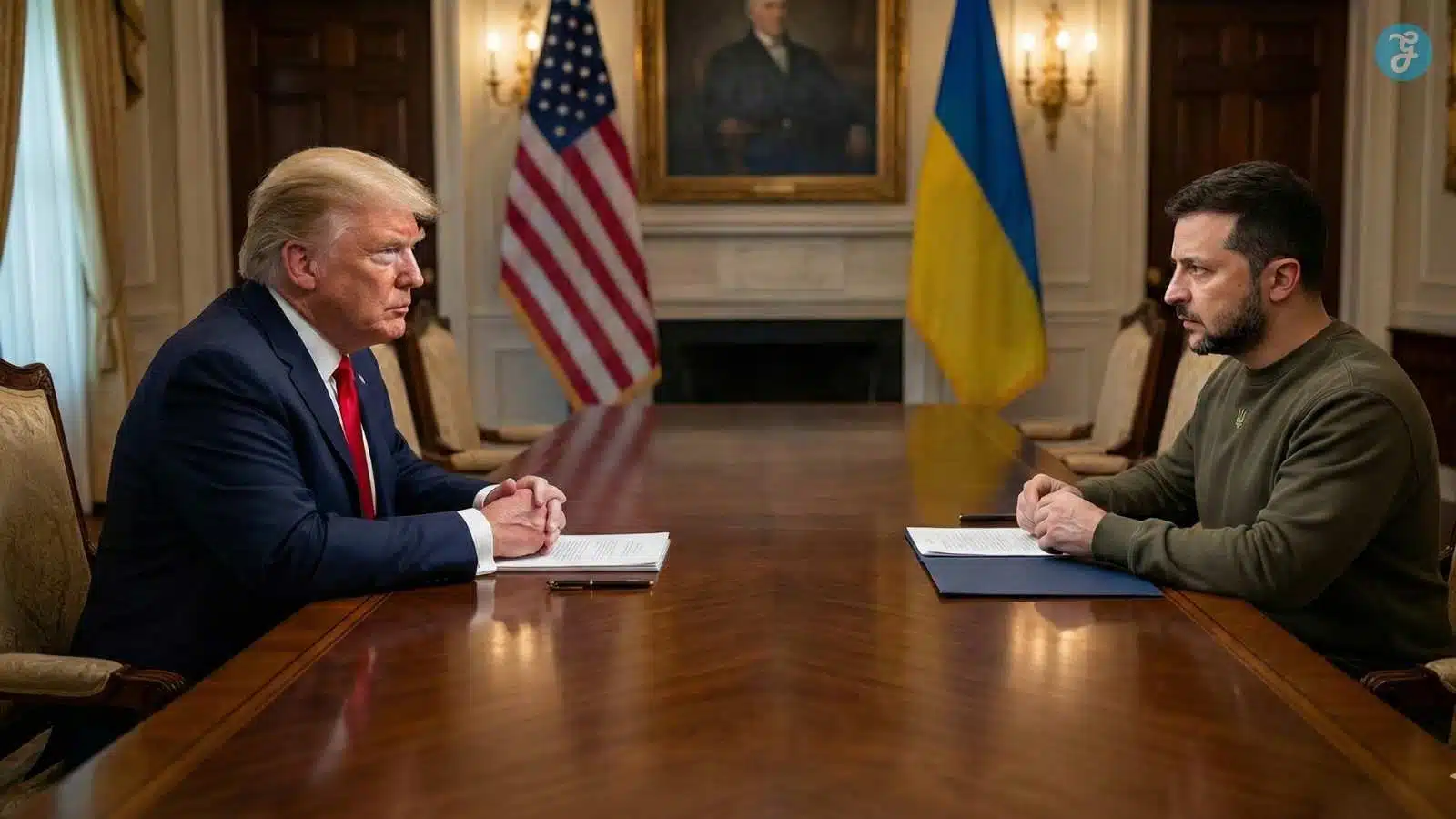
Palm Beach, FL, In a watershed moment for the nearly four-year war in Ukraine, President Donald Trump and Ukrainian President Volodymyr Zelenskyy emerged from high-stakes talks at Mar-a-Lago on Sunday to announce that a peace agreement is “90% agreed.”
The summit, held against the backdrop of intensifying Russian airstrikes on Kyiv, has produced a revised 20-point peace framework that outlines a potential end to hostilities, though significant hurdles regarding territory and nuclear safety remain.
The “Mar-a-Lago Framework”: A 20-Point Roadmap
The meeting, which President Trump characterized as “outstanding,” focused on a draft proposal that has evolved significantly from earlier versions. Unlike the initial 28-point plan, which Kyiv viewed as heavily tilted toward Moscow, this revised framework offers Ukraine robust security assurances in exchange for freezing the conflict along current battle lines.
Key Pillars of the Agreement:
-
Military Deterrence: Ukraine will maintain a peacetime standing army of 800,000 personnel. This is a critical victory for Kyiv; earlier U.S. proposals had suggested capping the force at 600,000, a limit Zelenskyy argued would leave the nation vulnerable.
-
“Article 5-Like” Guarantees: The plan includes a 15-year security pact with the United States and European allies that mirrors NATO’s Article 5 collective defense clause. If Ukraine is attacked, allies pledge a military response and the immediate reinstatement of sanctions.
-
Non-Nuclear Status: As part of the deal, Ukraine formally reaffirms its commitment to remaining a non-nuclear state under the Non-Proliferation Treaty (NPT).
The $800 Billion Reconstruction Fund
For the first time, specific details regarding the economic rehabilitation of Ukraine have been made public. The framework proposes an ambitious $800 billion reconstruction fund to rebuild Ukraine’s shattered infrastructure and economy.
-
Funding Split: Under the current proposal, the United States and Europe would each provide $100 billion in initial capital and grants. The remaining $600 billion is expected to be raised through private sector investment, debt instruments, and potentially the usage of seized Russian sovereign assets.
-
Free Trade Controversy: Point 10 of the plan calls for an accelerated Free Trade Agreement (FTA) between Ukraine and the U.S. However, friction remains: Washington has reportedly indicated a desire to offer similar trade terms to Russia as an incentive, a move Kyiv staunchly opposes.
Territorial Deadlock: “Freeze” vs. Withdrawal
While the security architecture is largely agreed upon, the territorial arrangement remains the “most difficult point,” according to President Zelenskyy.
-
The “Freeze” Zones: The plan proposes freezing the map along the current line of contact in the Donetsk, Luhansk, Zaporizhzhia, and Kherson regions.
-
Russian Withdrawals: Crucially, for the agreement to take effect, the framework demands that Russia withdraw its troops fully from any occupied pockets in the Kharkiv, Mykolaiv, Sumy, and Dnipropetrovsk regions, restoring Ukraine’s full sovereignty in these areas.
-
The Referendum Hurdle: Zelenskyy has stated that any territorial compromise—specifically the creation of “demilitarized zones” or “free economic zones” in the Donbas—would require a national referendum. He estimates this would need a 60-day ceasefire to organize.
Putin’s Response and the “Nuclear” Sticking Point
The diplomatic path is far from clear. Following a phone call with President Trump earlier on Sunday, the Kremlin signaled resistance. Russian officials, including aide Yuri Ushakov, dismissed the idea of a ceasefire for a referendum as a “pretext” to drag out the conflict and regroup Ukrainian forces.
Furthermore, the fate of the Zaporizhzhia Nuclear Power Plant (ZNPP) remains in limbo.
-
Washington’s Plan: A trilateral operation (Ukraine-U.S.-Russia) with the U.S. as the managing partner.
-
Kyiv’s Counter-Offer: A “50-50 joint venture” solely between Ukraine and the U.S., explicitly excluding Russian personnel from operational control.
Global Stakes
The summit concluded with a joint call to European leaders, including German Chancellor Friedrich Merz and French President Emmanuel Macron. With 4.4 million Ukrainian refugees currently living in the EU under “temporary protection” status, European leaders are pressing for a definitive end to the “strategic ambiguity” that has defined the conflict’s later stages.
“We are going to see—otherwise, the war is going to go on for a long time,” President Trump warned, emphasizing the human cost. “Millions of additional people are going to be killed if we don’t make a deal.“