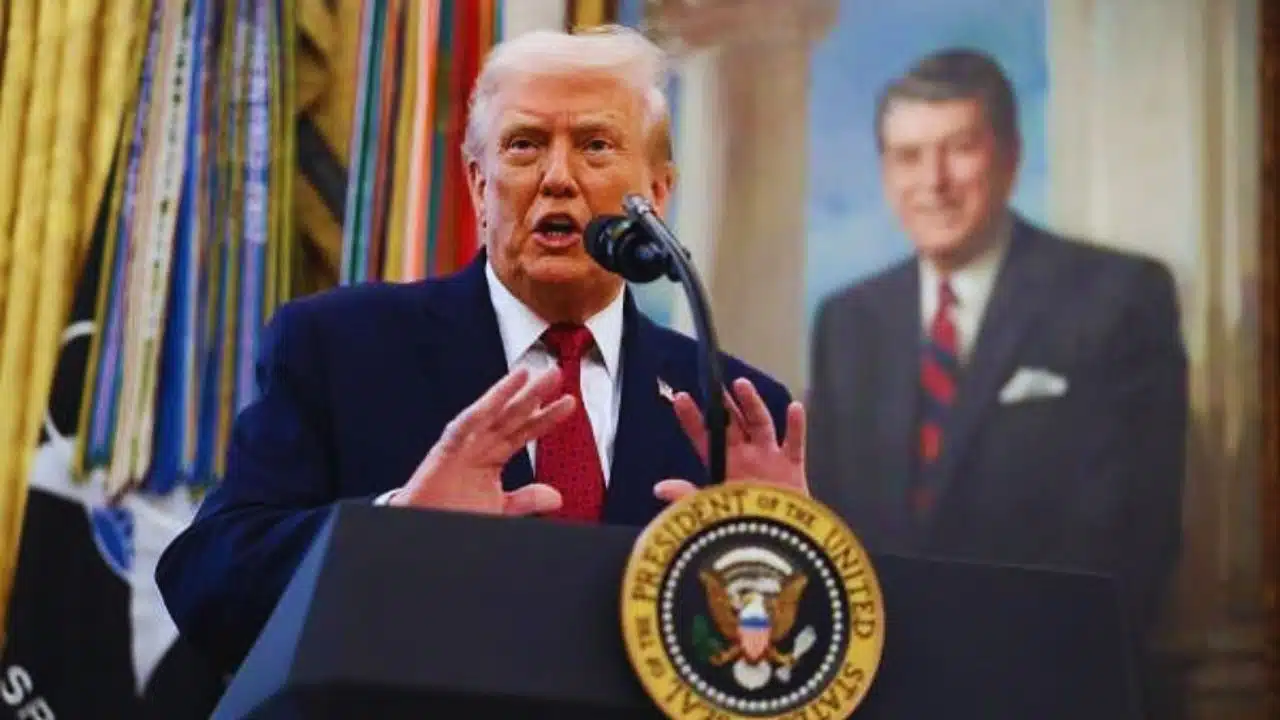
President Donald Trump is seeking up to $10 billion from the BBC, alleging a documentary edit distorted his January 6, 2021 remarks and damaged him politically and financially.
President Donald Trump has filed a lawsuit seeking up to $10 billion in damages against the BBC, accusing the UK public broadcaster of defamation and unlawful trade practices tied to an edited clip of his January 6 speech. The complaint centers on an edit in a BBC Panorama documentary that Trump’s lawyers say spliced separate portions of his Ellipse address in a way that changed its meaning for viewers.
What Trump filed and where
Trump filed the suit in the US District Court for the Southern District of Florida, according to CBS News’ reporting on the complaint. The lawsuit includes one defamation count and one count alleging a violation of a Florida trade practices law, with Trump seeking $5 billion in damages on each count for a total of $10 billion.
Trump’s legal filing describes the documentary portrayal as “false, defamatory, deceptive, disparaging, inflammatory, and malicious,” according to the complaint details cited by CBS News. The filing also argues the BBC can be sued in Florida because the Panorama documentary was available via the BritBox streaming service, even though it was not broadcast on US television.
The BBC edit at issue
The complaint targets a BBC Panorama documentary broadcast in the UK about a week before the 2024 US election, with a segment focused on Trump’s words and actions tied to January 6, 2021. Trump’s lawyers allege the BBC “spliced together” two portions of the same speech that were delivered about 55 minutes apart, omitting what they describe as his call for peace.
The edit, Trump argues, created the impression he was directly urging an attack on the US Capitol, a point CBS News notes has long been at the center of criticism over his January 6 rhetoric and his false claims of widespread 2020 election fraud. Trump has publicly disputed that framing, telling reporters he was suing the BBC for “putting words in my mouth” and suggesting the edit may have involved “AI or something,” according to CBS News.
BBC response and fallout
CBS News reports that the BBC apologized to Trump in November but declined to compensate him, while also stating it “strongly disagree[s]” that there is a basis for a defamation claim. The same reporting says BBC Director-General Tim Davie and the broadcaster’s head of news, Deborah Turness, resigned amid the editing controversy.
CBS News also reports that a BBC lawyer told Trump’s legal team the broadcaster had “no intention of misleading anyone,” and argued Trump could not show “actual malice,” the US legal standard that generally requires public figures to prove false information was published knowingly or with reckless disregard for the truth. The BBC’s counsel further argued, according to CBS News, that Trump could not sue in Florida because the documentary was not aired in the US or made available on the BBC’s website for American viewers.
Key facts at a glance
| Item | Details |
| Plaintiff | President Donald Trump |
| Defendant | BBC (British Broadcasting Corporation) |
| Court | US District Court, Southern District of Florida |
| Core allegation | Documentary edit spliced segments of Trump’s Jan. 6 speech, allegedly distorting meaning |
| Claims | Defamation; violation of Florida trade practices law (as described by CBS News) |
| Damages sought | $5B per count; total $10B |
| BBC position (as reported) | Apologized for the edit, but disputes defamation basis and argues Trump cannot meet “actual malice” standard |
| Distribution dispute | BBC argues program wasn’t aired in US; Trump argues availability via BritBox supports jurisdiction |
What happens next
In US civil litigation, a defendant typically responds with an answer or seeks early dismissal, often arguing lack of jurisdiction or failure to state a claim.
If the case proceeds beyond early motions, both sides may enter discovery and potentially seek a settlement or face trial.
For Trump, the case tests whether the edit is deemed legally defamatory under US standards for public figures and whether a Florida federal court accepts the lawsuit’s jurisdiction arguments. For the BBC, the dispute raises high-stakes questions about editorial accountability, cross-border distribution, and whether an acknowledged editing mistake can translate into a multibillion-dollar damages award in a US courtroom.
Timeline of the dispute
| Date (as reported) | Event |
| Jan. 6, 2021 | Trump delivered the Ellipse speech referenced in the lawsuit. |
| ~1 week before 2024 election | BBC Panorama documentary aired in the UK featuring the contested edit, per CBS News. |
| Nov. 2025 | BBC apologized to Trump for the episode but declined compensation, per CBS News. |
| Dec. 15, 2025 (Monday) | Trump filed the lawsuit in Southern District of Florida seeking $10B total damages, per CBS News. |