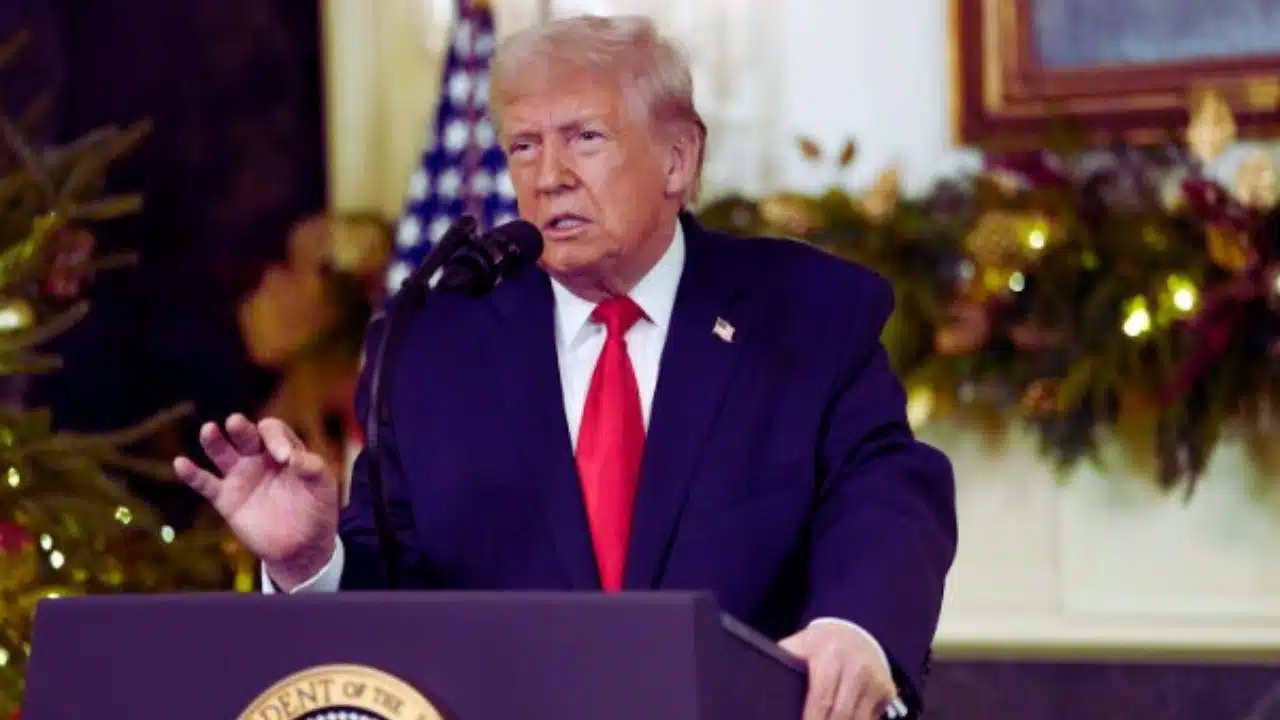
Trump signs 901B defense bill into law on Dec. 18, 2025, locking in the FY2026 defense policy package with a 3.8% troop pay raise, Golden Dome missile-defense mandates, and updated Ukraine, Europe, and border-security provisions.
President Donald Trump signed S. 1071, the National Defense Authorization Act (NDAA) for Fiscal Year 2026, on December 18, 2025, the White House said.
In his signing statement, Trump said the act authorizes FY2026 appropriations across national security agencies and supports priorities he described as “Peace Through Strength,” including homeland missile defense, defense industrial-base initiatives, and the removal of what he called “wasteful” programs.
Note: The signed White House materials repeatedly use “Department of War (DoW)” when describing the Pentagon’s functions. The act itself is the annual defense authorization law setting policy and authorizing funding for defense and related national security programs.
What the FY2026 NDAA does
The FY2026 NDAA is a sweeping authorization law that:
- Sets defense policy for the coming fiscal year,
- Authorizes (but does not itself appropriate) funding levels for major defense and related national security accounts,
- Extends or modifies authorities spanning military pay and benefits, procurement rules, foreign security assistance, homeland security-related provisions, and more.
The signed White House notice says it authorizes appropriations principally for defense programs and military construction, DOE national security programs, intelligence programs, and State Department programs—plus additional modifications touching homeland, commerce, judiciary, and other areas.
How it moved through Congress
Congress advanced the bill in mid-December after House and Senate negotiators converged on a compromise text.
Key votes and milestones
| Date (2025) | Chamber/Action | What happened |
| Dec. 10 | House passage | House approved S. 1071 312–112 |
| Dec. 17 | Senate final action | Senate agreed to concur in the House amendment 77–20 |
| Dec. 18 | Signed into law | Trump signed S. 1071 |
One procedural quirk: the S. 1071 page shows the measure originated as a different Senate bill title before the House amendment replaced the text with the NDAA language—an approach lawmakers sometimes use to move large negotiated packages quickly.
Record-size topline and what “901B” means
Public summaries describe the package as roughly $901 billion in FY2026 national defense/defense-authorization totals, while the House Armed Services joint explanatory materials also break out national defense discretionary totals within committee jurisdiction.
From the joint explanatory statement accompanying the conference agreement:
- The FY2026 request for covered national defense discretionary programs was $882.6B.
- The agreement would authorize $890.6B in FY2026, including $855.7B for DoD programs, $34.3B for DOE national security programs, and $512.4M for defense-related activities.
Key figures at a glance
| Item | Amount | Notes |
| Conference “national defense discretionary” total (FY2026) | $890.6B | Committee jurisdiction breakout |
| DoD portion of that total | $855.7B | Within the breakout |
| DOE national security portion | $34.3B | Within the breakout |
| “Other defense-related activities” | $512.4M | Within the breakout |
Troop pay and quality-of-life provisions
A centerpiece of the FY2026 NDAA is military quality-of-life funding and policy changes. The House Armed Services conference summary says the act supports a 3.8% pay raise for service members and includes expanded benefits.
The same summary highlights targeted quality-of-life investments, including:
- Over $1.5B authorized for new barracks and family housing construction, alongside requirements for plans and independent evaluations related to housing conditions and hazards.
- Over $131M authorized for new dining facilities and reforms aimed at improving access to food on base and oversight of food program budgets.
- Over $335M authorized for renovating military hospitals and building new medical facilities.
“Golden Dome,” missiles, and a push to speed procurement
Trump’s signing statement and the House Armed Services summary both emphasize the bill’s missile defense direction—especially the “Golden Dome for America” initiative.
The conference summary says the act:
- Updates national missile defense policy to reflect “Golden Dome” goals,
- Requires a plan to achieve objectives outlined in the associated executive order,
- Authorizes additional funding and full funding for procurement of key missile defense systems (including THAAD, SM-3 IIA, and Patriot).
Separately, the summary frames major acquisition reform as a core theme—aimed at reducing procurement timelines and increasing use of commercial solutions—through changes such as accelerated requirements pathways and structural shifts in how programs are managed.
It also points to scale in future-tech spending, stating the act authorizes $145.7B for research, development, testing, and evaluation (RDT&E), including work in hypersonics, AI, quantum, autonomy, directed energy, and space capabilities.
Ukraine aid, Europe posture, and allied burden-sharing
The FY2026 NDAA continues security assistance authorities for Ukraine and sets guardrails around U.S. posture in Europe.
From the joint explanatory statement:
- The act extends the Ukraine Security Assistance Initiative (USAI) through December 31, 2029, authorizing $400M for FY2026 and $400M for FY2027.
- It requires a notification to Congress within 48 hours after any decision to pause, terminate, restrict, or materially downgrade certain intelligence support to Ukraine.
- It includes policy language prohibiting the use of FY2026 funds to implement any activity recognizing Russian sovereignty over Ukraine’s internationally recognized territory.
For Europe, the explanatory statement describes a provision restricting reductions of permanently stationed or deployed U.S. forces in U.S. European Command’s area of responsibility below 76,000, unless conditions and notice requirements are met.
On allied cost-sharing, the explanatory statement also describes language enabling NATO allies to contribute to certain costs of U.S. forces deployed or rotating in another NATO country in Europe.
Homeland, border, and airspace security provisions
Trump’s signing statement points to the next three years of major U.S.-hosted events and says the act includes the SAFER SKIES Act, which he described as giving state and local law enforcement authority to address unmanned aircraft threats and creating a new felony offense for repeat violations of national defense airspace.
He also said the act provides resources tied to security at the southern border and combating transnational criminal organizations.
Oversight and separation-of-powers friction
Alongside signing, Trump issued a statement flagging constitutional concerns. He said his administration would interpret certain provisions consistent with presidential authorities in foreign affairs and as commander in chief, and would treat some reporting and information-submission requirements consistent with executive privilege and national security protections.
Final Thoughts: What to watch after enactment
- The policy is now law, but spending still needs appropriations. The NDAA authorizes programs and sets ceilings and directions; Congress must still pass separate funding bills to provide actual budget authority.
- Service members are set for a pay raise and broader quality-of-life investments, based on the conference summary.
- Missile defense and procurement speed are central themes, and agencies will now translate mandates into programs and contracts.
- Ukraine and Europe posture provisions remain embedded in U.S. defense policy, including multi-year USAI authorization and a Europe troop-level guardrail.
- Implementation disputes may surface where Congress required disclosures or constraints and the executive branch signaled constitutional objections.