The recent summit in Alaska between U.S. President Donald Trump and Russian President Vladimir Putin has triggered alarm in Kyiv and across Europe. Instead of securing the ceasefire that many hoped would provide an immediate pause in hostilities, Trump signaled a shift in American strategy. He began to frame the conflict less in terms of temporary halts in fighting and more as an opportunity for a permanent settlement — an approach that seemed to align more closely with Moscow’s long-standing position.
For Ukraine and its allies, this raised fresh concerns that Washington might be prepared to endorse conditions favorable to Russia, including territorial concessions in eastern Ukraine. Reports suggested Trump may have entertained discussions about Ukraine potentially surrendering parts of the Donbas region, though his administration has not officially confirmed this. Such a possibility alarmed Kyiv, which has consistently declared that no Ukrainian territory can be ceded as part of a peace arrangement.
Trump appeared eager to present the Alaska talks as progress, but for Ukraine, the outcome was deeply unsettling. While Putin left the summit strengthened by the optics of standing alongside the U.S. president, Zelenskyy and his allies were left scrambling to prepare for what could be a decisive turn in the conflict’s diplomacy.
Europe Moves to Support Ukraine in Washington
In response to these developments, several key European leaders quickly announced that they would travel to Washington alongside Ukrainian President Volodymyr Zelenskyy. The goal of this joint mission is to prevent Ukraine from being isolated in discussions with Trump and to demonstrate unity against potential pressure to accept unfavorable terms.
Among those heading to Washington are NATO Secretary-General Mark Rutte, European Commission President Ursula von der Leyen, British Prime Minister Keir Starmer, German Chancellor Friedrich Merz, Finnish President Alexander Stubb, French President Emmanuel Macron, and Italian Prime Minister Giorgia Meloni. Their presence underscores Europe’s determination to remain fully engaged in negotiations that could shape the continent’s security landscape for years to come.
Officials in Berlin and Paris confirmed that the agenda in Washington will include not only questions of a ceasefire but also the broader issues of security guarantees, territorial sovereignty, and economic assistance for Ukraine. For Europe, the stakes are clear: a rushed or one-sided settlement risks emboldening Moscow, weakening NATO, and leaving Ukraine vulnerable to renewed aggression.
Security Guarantees at the Center of Talks
One of the most significant elements to emerge from Alaska was the suggestion that Russia may be open to allowing the United States and European allies to extend security guarantees to Ukraine that resemble NATO’s Article 5 protections. Special U.S. envoy Steve Witkoff said Moscow had agreed in principle to language that would codify a pledge not to seek further territorial expansion once a deal is finalized.
The proposal would not grant Ukraine NATO membership, which remains a red line for Putin, but it could provide legally binding assurances that Western powers would defend Ukraine if Russia were to attack again after a peace settlement. Secretary of State Marco Rubio added that a temporary ceasefire is still under consideration, though it would need to be backed by credible guarantees to prevent Russia from using any pause in fighting to regroup.
For Kyiv, such commitments are vital. The war has demonstrated that Russia is prepared to break previous agreements and that Ukraine’s security cannot depend solely on trust. Any future peace deal must contain enforcement mechanisms strong enough to deter future aggression.
Unease in Kyiv and Frustration Among Civilians
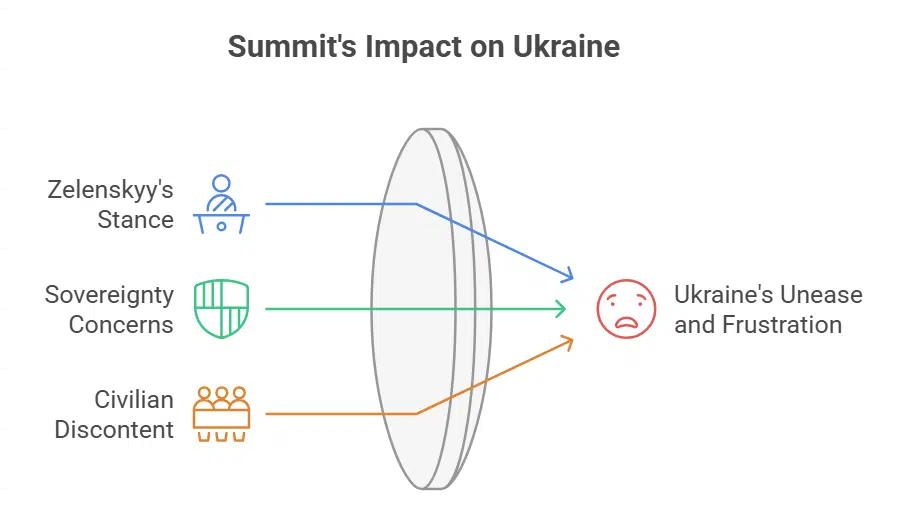
Despite these potential security discussions, the summit left Ukraine uneasy. Zelenskyy reiterated that a ceasefire remains essential before negotiations on a permanent settlement can be considered. His government stressed that concessions on sovereignty and territorial integrity are unacceptable under Ukraine’s constitution.
Among civilians, the optics of the Alaska summit caused additional frustration. Many Ukrainians saw the warm reception for Putin as a sign that the U.S. was normalizing his role on the global stage despite Russia’s ongoing attacks. In Kyiv and other cities still under bombardment, residents expressed anger that a leader accused of war crimes was given the red-carpet treatment while Ukraine continues to suffer casualties and destruction.
Balancing Diplomacy and Pressure
The Alaska meeting also underscored the difficulty of balancing diplomacy with deterrence. Trump has long portrayed himself as a dealmaker who can secure results where others have failed, but his apparent willingness to engage on Putin’s terms has unsettled Ukraine’s supporters. European leaders worry that Washington may prioritize ending the conflict quickly, even if it means Kyiv faces pressure to accept terms that compromise its sovereignty.
At the same time, Trump’s administration insists it is working on a framework that would end the war while preventing further escalation. According to U.S. officials, conversations with European partners included discussions of “NATO-like” protection for Ukraine without actual membership, a compromise that could allow both sides to claim victory. Still, the absence of clear commitments fuels uncertainty.
Next Steps in Washington
The upcoming meetings in Washington will be critical. For Zelenskyy, the goal is to ensure Ukraine does not face unilateral pressure from Trump while standing alone. By arriving with European leaders at his side, he sends a powerful signal that Ukraine’s future will not be decided without the continent’s full involvement.
The coalition of leaders will likely press Trump to clarify the U.S. position, commit to a ceasefire framework, and reaffirm that Ukraine’s sovereignty remains central to any settlement. They will also seek clarity on how U.S.-led security guarantees might work in practice, including whether American or European forces would play any role in enforcement.
A Pivotal Moment for Ukraine and Europe
The Alaska summit has shifted the diplomatic landscape of the Ukraine war. What was expected to be a push for a ceasefire has instead raised fears of a U.S. realignment toward Russia’s position. Ukraine now faces the challenge of defending its sovereignty not only on the battlefield but also at the negotiating table.
Europe’s decision to rally around Zelenskyy in Washington reflects recognition that the stakes extend beyond Ukraine’s borders. The outcome will help define whether Europe can maintain a united front in defense of international law and territorial sovereignty — or whether Moscow and Washington will shape a settlement on their own terms.
For civilians living under fire in Ukraine, the diplomatic maneuvering offers little immediate relief. Yet the meetings ahead may determine the long-term course of the war — whether Ukraine emerges with security guarantees that ensure its independence or faces renewed pressure to accept compromises it has long resisted.