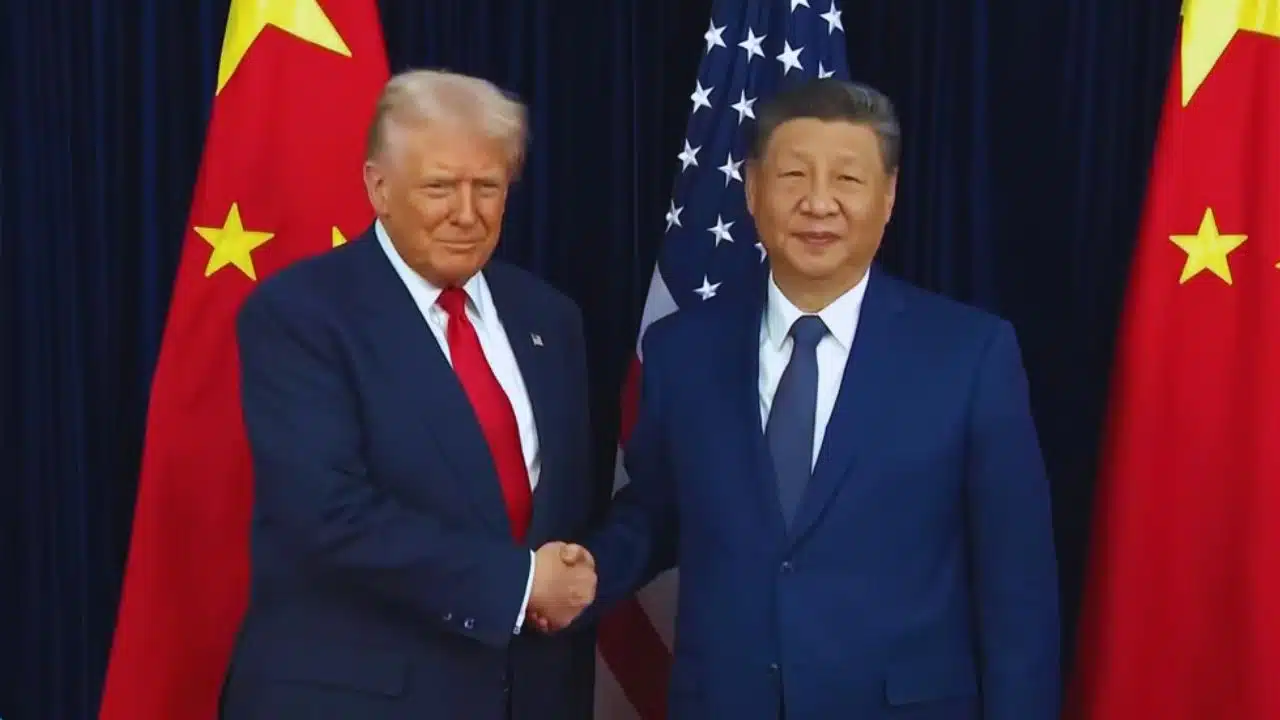
President Donald Trump announced late Wednesday he has instructed the Pentagon to “immediately” resume Trump nuclear weapons testing, shattering a 33-year-old voluntary U.S. moratorium. The stunning directive, posted on Truth Social just hours before a high-stakes meeting with Chinese President Xi Jinping, was justified as a necessary response to alleged testing programs and arsenal expansion by Russia and China.
The move signals one of the most significant shifts in U.S. nuclear policy since the end of the Cold War, threatening to upend the global arms control framework and spark a new, destabilizing arms race.
The Nuclear Shift
- Policy Ends: President Trump has ordered an immediate end to the 33-year-old U.S. voluntary moratorium on live nuclear explosive tests. The last U.S. test was in September 1992.
- The Justification: The order cites “other countries’ testing programs.” This directly references Russia’s recent tests of new strategic weapons (Poseidon torpedo) and China’s rapid arsenal expansion.
- The Timing: The announcement was made hours before President Trump’s scheduled meeting with Chinese President Xi Jinping in Busan, South Korea, dramatically raising the stakes for the talks.
- The Numbers: Trump claims the U.S. must act as China is projected to reach nuclear parity “within 5 years.” This follows a CSIS report noting China’s arsenal grew from ~300 warheads in 2020 to ~600 today.
- Immediate Reaction: Arms control experts have condemned the move as “reckless,” while congressional opponents have already pledged to introduce legislation to block it.
A ‘Department of War’ Directive
The announcement came not through an official White House or Pentagon release, but via a post on President Trump’s Truth Social platform late Wednesday evening (EST), which was early Thursday morning in South Korea where he is traveling.
The United States has more Nuclear Weapons than any other country,” Trump wrote. “Russia is second, and China is a distant third, but will be even within 5 years. Because of other countries testing programs, I have instructed the Department of War to start testing our Nuclear Weapons on an equal basis. That process will begin immediately.”
The president’s use of the archaic term “Department of War” for the Department of Defense was noted by observers, a branding he has used previously.
The directive ends a U.S. policy that has been a cornerstone of global non-proliferation efforts for over three decades. Since President George H.W. Bush halted testing in 1992, the U.S. has relied on a robust “Stockpile Stewardship Program.” This program uses sophisticated computer simulations and subcritical tests—which do not produce a nuclear chain reaction—to verify the safety and reliability of its existing arsenal.
The new order appears to cast this method aside in favor of full-scale explosive tests, which would provide live data on new warhead designs but also release radioactive fallout and shatter international norms.
A New Tri-Polar Arms Race
President Trump’s directive is not occurring in a vacuum. It is a direct response to a series of escalating moves by Moscow and Beijing, which has created a volatile, tri-polar security dynamic not seen since the Cold War.
Russia’s “Super-Weapons”
The most immediate trigger appears to be a flurry of recent activity from Russia. On October 29, 2025, Russian President Vladimir Putin announced the successful test of the Poseidon nuclear-powered “super torpedo”. Military analysts describe the Poseidon as an underwater drone capable of evading coastal defenses to deliver a multi-megaton warhead, potentially triggering radioactive tsunamis.
This followed Russia’s test of its 9M730 Burevestnik nuclear-powered cruise missile on October 21, 2025. Both weapons are part of a new generation of strategic systems designed to defeat U.S. missile defenses.
China’s Rapid Expansion
While Russia provided the immediate spark, the long-term strategic concern cited by the administration is China. U.S. intelligence and military leaders have warned for years about Beijing’s rapid and opaque nuclear buildup.
A widely cited 2025 analysis from the Center for Strategic and International Studies (CSIS) detailed this growth:
- 2020: China possessed an estimated 300 nuclear warheads.
- 2025 (Current): That number has doubled to an estimated 600 warheads.
- 2030 (Projection): The Pentagon and CSIS project China is on track to possess over 1,000 nuclear warheads, bringing it into rough parity with the deployed strategic arsenals of the U.S. and Russia.
Trump’s claim that China “will be even within 5 years” directly reflects these projections. For decades, China maintained a “minimum deterrence” posture, but its current expansion—including the construction of over 300 new missile silos—suggests a shift toward a “launch-on-warning” posture similar to that of the U.S. and Russia.
Global Reaction and Expert Analysis
The reaction from the arms control community was swift and severe, labeling the decision a catastrophic blow to global stability.
“Resuming testing is a recklessly provocative and technically unnecessary act,” said Dr. Elena Taranova, a non-proliferation expert at the Geneva Strategic Institute. The U.S. stockpile is certified as reliable by the directors of its own weapons labs every year. This move is not about safety; it’s about political signaling that will likely untie the hands of Russia and China to resume their own testing, and it gives cover for states like North Korea and Iran to advance their programs.
The decision effectively renders the Comprehensive Nuclear-Test-Ban Treaty (CTBT) powerless. The CTBT, opened for signature in 1996, bans all nuclear explosions. While the U.S. signed the treaty, it never ratified it, meaning it is not legally bound. However, its 33-year moratorium was seen as the lynchpin of the treaty’s de facto global norm.
Domestically, the move faced immediate political pushback. Representative Dina Titus, a Democrat who represents the district in Nevada that includes the U.S. nuclear test site, posted on X (formerly Twitter):
“Absolutely not. The Nevada National Security Site is not a dumping ground for a reckless arms race. I’ll be introducing legislation to put a stop to this.”
The Global Arsenals
A point of contention in the president’s announcement is his claim that the U.S. has “more Nuclear Weapons than any other country.”
According to the latest data from the International Campaign to Abolish Nuclear Weapons (ICAN), cited by sources on, the total warhead count is:
- Russia: ~5,500 total warheads (deployed and stockpiled)
- United States: ~5,044 total warheads (deployed and stockpiled)
While the U.S. has a similar number of deployed strategic warheads as Russia (around 1,600 each, limited by the New START treaty, from which Russia has suspended participation), Russia’s overall stockpile remains larger. Trump’s claim appears to conflict with consensus data from non-governmental watchdogs.
The global community is now watching for three key developments:
- The U.S. Pentagon’s Response: The Department of Defense and Department of Energy (which manages nuclear warheads) have not yet issued statements on the logistics, timeline, or scope of the new tests. It is unclear what “on an equal basis” means. Will the U.S. conduct one test as a signal, or begin a full-scale testing program?. The likely location for any test would be the Nevada National Security Site, 65 miles northwest of Las Vegas.
- The Trump-Xi Meeting: The directive completely overshadows the planned talks in South Korea. The meeting, intended to focus on trade and tariffs, is now a crisis summit. Xi’s response will be critical, as China has long called for all nuclear states to adopt “no first use” policies, which this move directly undermines.
- Russia and China’s Retaliation: The most significant fallout will be how Moscow and Beijing respond. Both nations currently adhere to the CTBT framework (though neither has ratified it). Putin could easily use Trump’s order as justification to resume Russia’s own full-scale testing. China, which last tested in 1996, may do the same, accelerating its program with live-fire data.
In one social media post, President Trump has effectively ended a multi-decade era of nuclear restraint. The coming days will determine if this is the start of a new, terrifying, and unstable Cold War.
The Information is Collected from CNN and CNBC.