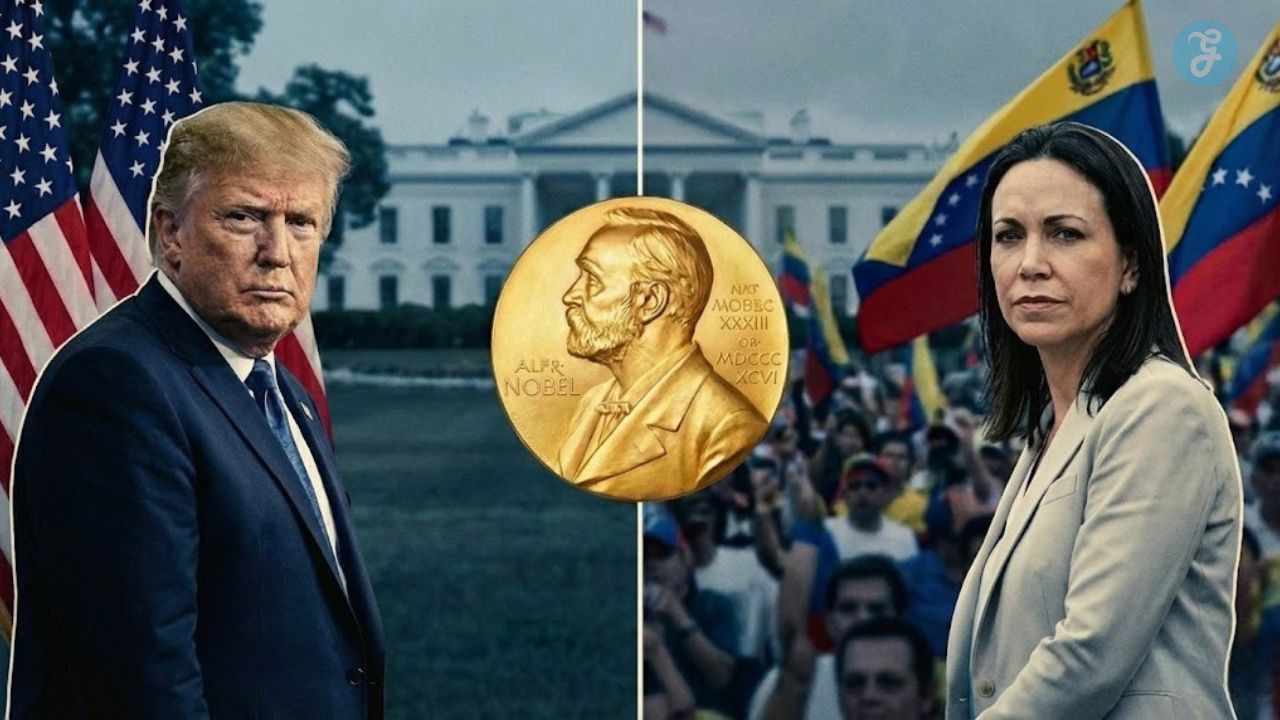
The “sharing” of a Nobel Peace Prize is technically impossible, but diplomatically brilliant. Maria Corina Machado’s offer to split her 2025 award with Donald Trump isn’t about vanity—it is a high-stakes play to save Venezuela’s transition from being hijacked by the very regime the U.S. just decapitated.
Key Takeaways
- The “Ultimate Sin”: White House insiders report President Trump’s refusal to back Machado stems from a personal grievance: he views her 2025 Nobel Peace Prize victory as a theft of the recognition he deserved for “solving” the Venezuela crisis.
- The “Delcy Option”: The U.S. is actively pivoting toward Delcy Rodríguez (Maduro’s former VP) as a “pragmatic” interim leader to ensure oil stability, sidelining the democratic opposition.
- Symbolic Diplomacy: Machado’s offer to “share” the medal is a calculated attempt to align her victory with Trump’s “courageous vision,” effectively trading prestige for political survival.
- Oil Over Ballot Boxes: The strategic priority for the U.S. has shifted from “restoring democracy” to “securing energy assets,” favoring a regime insider who controls the military over a populist reformer who threatens a purge.
The Anatomy of a Diplomatic Hail Mary
The geopolitical theater of January 2026 has produced one of the most surreal headlines in recent diplomatic history: a Nobel Peace Prize laureate offering to “share” her medallion with the President of the United States. While the legal statutes of the Nobel Foundation strictly prohibit transferring or dividing the award after it has been conferred, the political utility of Maria Corina Machado’s gesture is undeniable. It is a desperate but tactically astute survival strategy in a game where the rules are being rewritten by Washington.
To understand why Machado—a woman who has stared down tanks, torture centers, and exile—would offer to share her crowning achievement with Donald Trump, we must look beyond the absurdity of the headline. This is a story about the collision of narcissism and realpolitik, where the fate of a nation hangs on the ego of one man and the willingness of a leader to pawn her legacy for her country’s future.
Contextual Background: The Nobel That Broke the Alliance
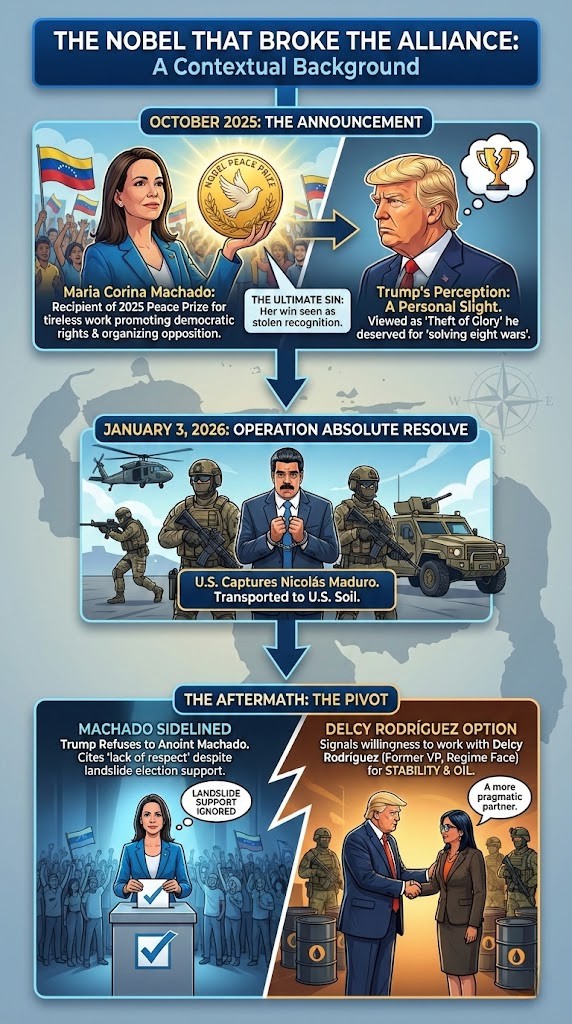
The friction began in October 2025, when the Norwegian Nobel Committee announced Maria Corina Machado as the recipient of the 2025 Peace Prize. The award recognized her “tireless work promoting democratic rights” and her role in organizing the opposition against Nicolás Maduro. For President Trump, who had reportedly lobbied for the prize following his claims of “solving eight wars” and his pressure campaign on Caracas, the announcement was perceived as a personal slight. Sources close to the White House described Machado’s acceptance of the award as the “ultimate sin”—a theft of glory he believed belonged to him.
Fast forward to January 3, 2026. U.S. forces executed Operation Absolute Resolve, a stunning extraction operation that captured Nicolás Maduro and transported him to U.S. soil. Yet, in the vacuum left behind, Trump did not anoint Machado. Instead, he signaled a willingness to work with Delcy Rodríguez, the former Vice President and face of the old regime, citing Machado’s “lack of respect” within Venezuela—a claim contradicted by her landslide support in the 2024 elections.
Core Analysis
1. The Psychology of Statecraft: The “Ultimate Sin”
The most striking element of this saga is the degree to which personal grievance has shaped U.S. foreign policy. In standard diplomatic analysis, alliances are built on shared interests: oil, security, migration control. However, the “Machado Freeze” demonstrates that for the current administration, validation is a strategic asset comparable to crude oil.
Machado’s advisors likely realized that no amount of electoral data could overcome Trump’s personal resentment. By offering to “share” the prize, Machado is attempting to retroactively rewrite the narrative of October 2025. She is reframing her Nobel win not as a competitor to Trump’s legacy, but as a derivative of it—signaling that her victory was only possible because of his pressure.
The Ego-Policy Matrix How personal grievances are translating into U.S. foreign policy decisions regarding Venezuela.
|
Policy Driver |
Trump’s Perception | Diplomatic Consequence |
|---|---|---|
| The Nobel Prize | “She stole my recognition. I did the work (sanctions/pressure); she got the medal.” | Diplomatic Freeze: Refusal to meet Machado or acknowledge her electoral mandate. |
| The Capture of Maduro | “A triumph of American strength (My strength).” | Ownership: The U.S. now claims the right to “run” Venezuela, bypassing local allies. |
| Machado’s “Sharing” Offer | Potentially viewed as “Submission” or “Respect.” | Possible Pivot: If accepted, it re-validates Machado as a “subordinate partner” rather than a rival star. |
| Delcy Rodríguez’s Stance | Compliance, flattery, and “business-first.” | Preferred Partner: Viewed as manageable and less likely to steal the spotlight. |
2. The “Delcy Deal”: Stability Over Democracy
The administration’s pivot to Delcy Rodríguez exposes a harsh truth about the “America First” doctrine in Latin America: Stability is King. The U.S. calculation is that a “soft landing” (keeping the Chavista structure without Maduro) is safer for oil markets than a “hard reset” (Machado’s promised democratization).
- The Logic: Rodríguez represents the “Deep State” of Chavismo—the military networks (Padrino López), the oil bureaucracy (PDVSA), and the security apparatus. By keeping the structure intact but changing the head, the U.S. ensures oil continues to flow and migration flows are checked.
- The Risk: Machado represents a complete dismantling of the criminal state. While morally superior, this path promises chaos, potential civil conflict, and a purge of the military leadership that could destabilize the country for years—a “Libya scenario” the U.S. is desperate to avoid.
The Candidate Comparison (U.S. Strategic Interest)
|
Feature |
Maria Corina Machado (The Democrat) | Delcy Rodríguez (The Pragmatist) |
|---|---|---|
| Legitimacy | High: Won 2024 election (de facto) & 2025 Nobel Prize. | Low: Appointed by the deposed regime; no popular mandate. |
| Military Support | Hostile: Viewed as an existential threat by the High Command. | High: Deep ties to the military elite and intelligence services. |
| Oil Strategy | Privatization: Full market opening, transparent bidding (Slow). | State-Managed: Quick deals with Chevron/US majors using existing infrastructure. |
| U.S. Alignment | Ideological: Shared values of freedom/democracy. | Transactional: Willing to trade sovereignty for survival. |
| Risk Profile | High: Risk of civil war/purge of Chavistas. | Medium: Risk of continued corruption/authoritarianism. |
Legally, Machado’s offer is null and void. The statutes of the Nobel Foundation are explicit: the prize cannot be divided post-award. However, in the world of high-stakes diplomacy, the legal reality is often secondary to the visual reality.
Machado is not asking the Norwegian Committee to reprint the diploma. She is engaging in a performative act for an audience of one. If she physically hands the gold medal to Trump at a Mar-a-Lago press conference, the image becomes the reality. It allows Trump to claim the accolade without the Committee’s consent.
Nobel Statutes vs. Political Reality
|
Nobel Statute |
Machado’s Political Maneuver | Implication |
|---|---|---|
| Indivisibility: “A prize amount may be divided between two works… but in no case may a prize be divided between more than three persons.” | Public declaration of “sharing” the honor on Fox News. | The legal reality is irrelevant; the audience is Trump’s base. |
| Independence: The Committee operates independently of government influence. | Dedicating the prize to Trump’s “courageous vision.” | Attempts to align the Committee’s choice with Trump’s brand. |
| Revocation: No appeals or revocations are permitted. | Acting as if the prize is a transferable asset. | Turns a static medal into a dynamic diplomatic currency. |
4. The Energy Imperative: It’s About the Barrels
Underpinning the political drama is the cold hard math of energy security. With global oil markets volatile, the U.S. is prioritizing the rapid restoration of Venezuela’s 300-billion-barrel reserves over democratic niceties.
Delcy Rodríguez has reportedly assured U.S. envoys that she can guarantee security for Chevron and other U.S. firms immediately. Machado, by contrast, would likely initiate a complex legal restructuring of the oil industry and a review of all “criminal contracts” signed under Maduro—a process that could freeze exports for months. The U.S. preference for Rodríguez is a preference for immediate barrels over future justice.
Venezuelan Oil Scenarios (2026-2027)
|
Scenario |
The “Delcy Path” (Status Quo +) | The “Machado Path” (Full Reform) |
|---|---|---|
| Production Speed | Fast: Uses existing (corrupt) networks to pump oil. | Slow: Stalled by legal audits and purging of PDVSA. |
| Security of Assets | Guaranteed: Military protects wells in exchange for revenue. | Uncertain: Sabotage by ousted Chavista factions is likely. |
| Foreign Investment | Limited: Western majors wary of reputational risk/sanctions. | Massive: IMF/World Bank entry & transparent bidding attracts global capital. |
| Est. Output (2027) | ~1.2 Million Barrels/Day | ~0.9 Million Barrels/Day (Dip before rise) |
Expert Perspectives
“Machado is engaging in ‘Diplomacy of the Absurd.’ She knows she cannot give him the medal. She is giving him the credit. In the Trump era, credit is the currency of the realm. If she convinces him that he is the true winner, he may let her be the true President.” — Dr. Elena Cárdenas, Senior Fellow, Latin American Geopolitics Institute
“This is a dangerous precedent. By offering to share the prize with a leader who has openly flirted with authoritarianism, Machado dilutes the meaning of the Peace Prize. It suggests that human rights honors are merely tradable commodities for political favor. However, if it stops a civil war, history may judge her kindly.” — Jonas V. Hansen, Oslo Peace Research Monitor
“The U.S. pivot to Rodríguez is pure Kissingerian realism. They want a ‘Gaddafi-free Libya’—the oil without the dictator. They fear Machado is a ‘Zelensky’—a hero who will fight a long, costly war for principles.” — Marcus Rubio, Energy Analyst, Global Risk Horizons
Future Outlook: The “Look Ahead”
The next 30 days will determine the future of Venezuela for the next 30 years.
- The Mar-a-Lago Meeting: Trump has tentatively agreed to meet Machado “next week” (mid-January 2026). This meeting is the direct result of her flattery. If she presents him with a physical symbol (a replica medal or the medal itself) and cameras capture him accepting it, the “Delcy Deal” may be dead.
- The Rhetorical Shift: Watch for a change in State Department language. If officials start referring to Rodríguez as “outgoing” rather than “interim,” Machado’s gamble has paid off.
- The European Backlash: Expect European leaders to distance themselves from Machado if she leans too heavily into the MAGA narrative. This could isolate a future Machado government from EU aid, leaving her entirely dependent on Washington.
- The Military Variable: The wild card remains the Venezuelan military (FANB). If they perceive the U.S. is backing Machado, they may launch a preemptive coup against Rodríguez to save themselves, or fracture into warlordism.
Final Thoughts
Maria Corina Machado’s offer to share her Nobel Prize is not a gaffe; it is a masterful, if cynical, reading of the room. In a world where institutions are crumbling and personality cults drive policy, she has realized that a gold medal in Oslo is worthless if it prevents her from entering Caracas. She is willing to pawn the world’s highest honor to buy her country’s freedom—proving that in 2026, the price of democracy is paid in ego.