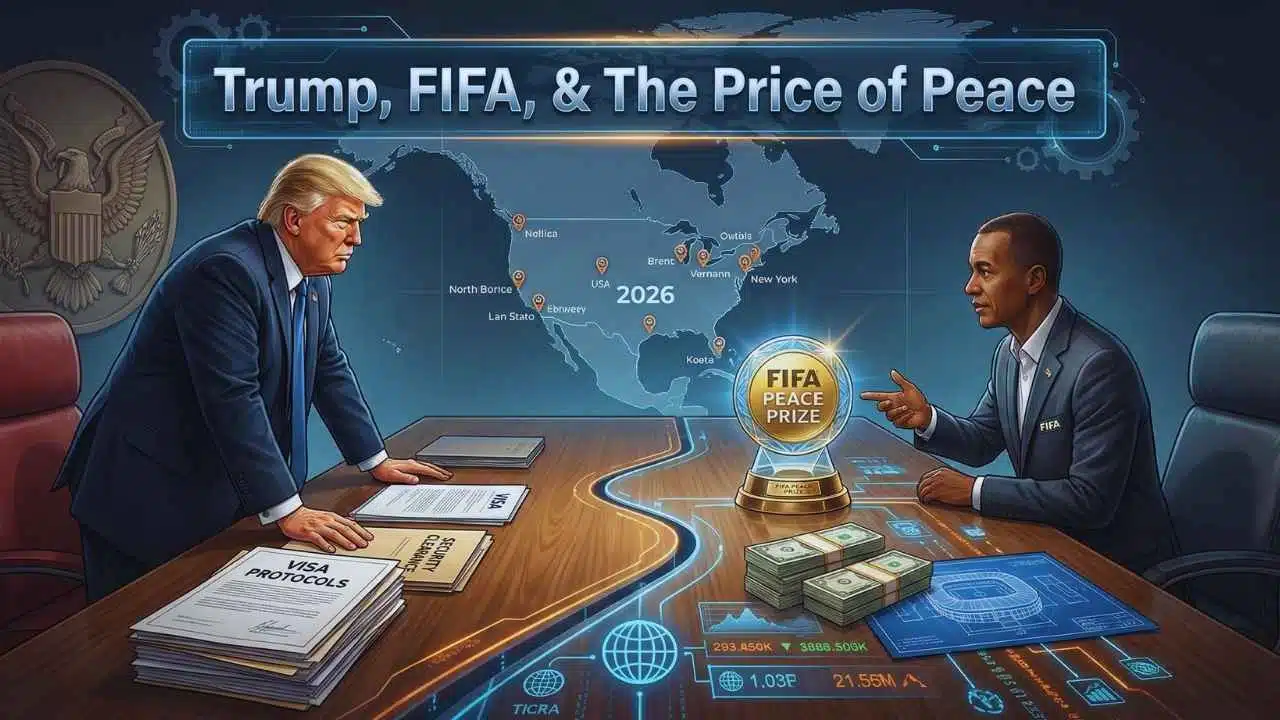
FIFA’s Trump FIFA Peace Prize arrived just as World Cup 2026 planning collides with hard politics: visas, security, and money. The award signals who FIFA needs most right now, and why “peace” is being used as leverage in global sport, not just a slogan, ahead of the biggest tournament ever.
How We Got Here: A Peace Prize Built Around Washington And 2026?
FIFA did not simply add another ceremonial trophy to its awards shelf. It created a new category of legitimacy, one that links football’s brand to diplomacy and conflict resolution. The timing matters: FIFA unveiled the FIFA Peace Prize in late 2025, then staged the first presentation around the World Cup 2026 Final Draw in Washington, D.C., turning a technical tournament milestone into a political stage.
That staging choice was never neutral. Washington is not a 2026 host city, yet it became the symbolic capital for the draw. When FIFA places a signature World Cup moment inside the orbit of a sitting U.S. president, it signals that the host state is not just a service provider. It is a strategic partner whose cooperation determines whether FIFA’s biggest product runs smoothly.
The first recipient was Donald Trump. FIFA framed the selection around “extraordinary action” toward peace, tying the award to U.S.-facilitated diplomacy between the Democratic Republic of the Congo and Rwanda. The White House signing ceremony for the Washington Accords became the narrative spine of the prize. FIFA’s message was clear: football is a global language, and the person being honored used state power to push conflict parties toward a deal.
But peace processes are not photo opportunities. They are long implementation arcs with frequent reversals, partial compliance, and contested narratives. That gap, between the symbolism of a “peace prize” and the reality of fragile agreements, is one reason the award detonated controversy instead of creating universal applause.
Criticism intensified because this was not a generic humanitarian honor. It was introduced, named, and delivered in a way that looked personally and politically tailored. When Human Rights Watch criticized the prize against the backdrop of U.S. immigration enforcement and the politics of public order, the critique was not about whether diplomacy is good. It was about the credibility cost of giving a peace-branded award to a political figure whose policies are polarizing.
A second layer of controversy came from governance questions. If FIFA wants the prize to be seen as an institution-level recognition, it needs institution-level processes: transparent criteria, independent selection, published oversight, and insulation from the personal relationships that dominate global sports politics. The early reporting around the prize suggested the opposite, with questions about who shaped the process and how quickly decisions were made.
So the “how we got here” story is not only about Trump receiving an award. It is about FIFA building a new symbolic instrument during a high-stakes tournament cycle, then debuting that instrument in a way that collapses sports ceremony into host-country politics.
Why The Trump FIFA Peace Prize Matters: FIFA’s Incentives And Host-State Leverage?
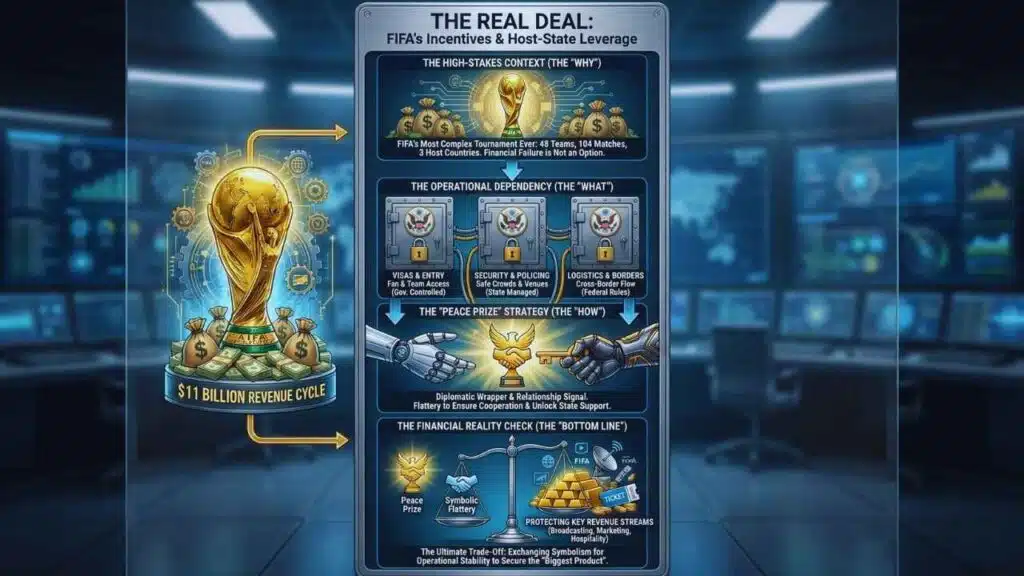
The Trump FIFA Peace Prize matters less as culture-war content and more as a business and governance signal. FIFA is entering the most complex World Cup it has ever attempted: 48 teams, 104 matches, and three host countries with different border rules, policing cultures, and political incentives. That expansion does not only add games. It multiplies points of failure.
FIFA’s operational risk is concentrated in areas only governments control. Visas and entry clearance determine whether fans can attend. Security coordination determines whether host cities can manage crowds safely. Transport and customs rules determine whether teams, broadcasters, and vendors can move equipment across borders without disruption. FIFA can plan matches and marketing, but it cannot stamp passports or deploy law enforcement.
That is why the award’s Washington choreography reads like a relationship-management strategy. The prize publicly flatters the host government, reinforces cooperation narratives, and helps FIFA anchor an expectation of exceptional state support. In this sense, “peace” becomes a diplomatic wrapper around the real ask: make the tournament run.
This is also a money story. FIFA’s four-year budget cycle depends heavily on the men’s World Cup, with broadcasting, marketing, and hospitality and ticketing as the dominant revenue engines. The 2023–2026 cycle is central because it culminates in North America, where corporate partnerships, hospitality spend, and media pricing power are enormous.
Here is the basic financial reality FIFA is protecting.
| FIFA Revenue Plan (2023–2026 Cycle) | Budget (USD, billions) | Why It Matters For 2026 |
| Broadcasting rights | 4.264 | Any disruption becomes a broadcast product crisis |
| Marketing rights | 2.693 | Sponsors pay for predictability and global goodwill |
| Hospitality and ticket sales | 3.097 | Attendance depends on visas, travel, and safety perception |
| Licensing rights | 0.669 | Brand strength drives downstream commercial sales |
| Other revenue | 0.277 | Smaller, but still sensitive to reputational shocks |
| Total | 11.000 | 2026 is the economic centerpiece of the cycle |
FIFA’s spending choices underline how much is at stake. In late 2025, FIFA approved a record financial contribution package for World Cup 2026 that lifted payouts significantly, including a winner’s share reported around $50 million and expanded team distributions across the 48 participants. Bigger payouts build buy-in among national associations, but they also increase the cost of failure. If 2026 becomes an operational mess or a reputational disaster, FIFA risks alienating the same stakeholders it is paying more than ever.
The host state, meanwhile, is treating World Cup 2026 as both an economic event and a state-capacity test. Demand indicators show extraordinary interest. FIFA and Reuters reporting described a record surge of ticket requests, far exceeding supply, as the ticketing process began. That demand gives FIFA pricing power, but it also sharpens inequality. High prices can push out traditional supporter groups and shift attendance toward wealthier travelers and corporate hospitality.
This is where visas become more than a travel detail. The U.S. introduced a priority appointment scheduling approach for ticket holders, but it also emphasized that a ticket does not guarantee entry. That posture creates an asymmetry: FIFA sells a global festival, but the host state controls who physically enters the venue geography.
For fans, the implication is simple and harsh. You can win a ticket allocation and still lose the tournament experience at the border, or never get an interview slot early enough, or face uncertainty that discourages travel planning. For FIFA, it creates a reputational vulnerability it cannot fully manage with branding.
To see the leverage clearly, compare how World Cup 2026 differs structurally from the previous tournament.
| World Cup Scale Shift | 2022 Tournament | 2026 Tournament (Planned) | What Changes In Practice |
| Teams | 32 | 48 | More delegations, more travel, more consular load |
| Matches | 64 | 104 | Longer operational window and more crowd events |
| Host footprint | One country | Three countries | Border rules become tournament rules |
| Match distribution | Compact geography | 16 cities | More flights, more security plans, more failure points |
| Timing | Winter schedule | Summer schedule | Heat and weather risks rise in many venues |
Against that background, a “peace prize” is not just a moral gesture. It is a relationship signal to the most powerful host partner. It tells the host government: FIFA values your role, FIFA wants alignment, and FIFA will amplify your preferred narrative on a global stage.
If you view the prize through this lens, the controversy becomes less surprising. Many observers are not judging the award as a humanitarian act. They are judging it as a governance act that reveals FIFA’s dependence on political power and its willingness to exchange symbolism for operational stability.
Peace As Branding Currency: Sports Diplomacy, Sportswashing, And The New Legitimacy Economy
Global sport has always intersected with politics, but the mechanism is evolving. In the past, major tournaments often claimed neutrality while benefiting from the soft power hosts received. Today, sports organizations increasingly produce explicit “values content” to manage reputational risk and justify expansion. Awards, campaigns, and social initiatives have become part of the operating system.
The FIFA Peace Prize fits this pattern. It manufactures a repeatable headline that frames FIFA as a moral actor. It creates a new institutional ritual that can be used to reward behavior FIFA wants to encourage. It also gives FIFA an annual platform to attach itself to the language of unity and reconciliation, even when the underlying tournament story is about money, governance, and political bargaining.
This is where the sports diplomacy and sportswashing debate becomes central. Supporters of diplomacy argue that sports bodies can amplify peace efforts and encourage dialogue. Critics argue that sports bodies often provide reputational cover to the powerful, especially when their selection processes lack independence and transparency.
In practice, the distinction often comes down to process. If the prize had clear criteria, an independent committee, published deliberation principles, and a record of honoring a wide range of credible peace builders, it could mature into something respected. If it stays leadership-driven and politically convenient, it will function as branding currency.
The Trump FIFA Peace Prize intensified the sportswashing critique for three reasons.
First, the award aligns with a leader’s personal interest in peace-prize symbolism. That makes the prize feel less like institutional recognition and more like narrative gifting. Second, FIFA’s own history makes observers skeptical. FIFA has spent the last decade trying to rebuild trust after governance scandals and persistent criticism about accountability. Third, the prize landed during an era when mega-events are already criticized as elite products that often exclude the very communities they claim to unite.
The inclusivity question is especially sharp in 2026. FIFA has promoted the expanded tournament as the “most inclusive” World Cup. Yet the same cycle is defined by high ticket prices, overwhelming demand, and visa constraints that disproportionately affect fans from the Global South. Inclusivity becomes rhetorical if access is functionally restricted by cost, bureaucracy, and border policy.
Here is a simple way to think about how legitimacy now works in global sport. It is not only won by good football and full stadiums. It is managed through narrative systems.
| Legitimacy Tool | What FIFA Gains | What The Public Asks In Return | Why It Matters In 2026 |
| Social impact awards | Moral framing and positive headlines | Transparent criteria and credible winners | 2026 needs trust across many countries |
| Host-government partnerships | Visas, security, state logistics | Neutrality and non-partisanship | Border policy can reshape attendance patterns |
| “Unity” messaging | Brand protection and sponsor comfort | Consistency with anti-discrimination values | Fans evaluate hypocrisy faster than ever |
| Economic impact claims | Political support from host cities | Clear methodology and honest ranges | Overpromising creates backlash after the event |
The peace prize is not automatically illegitimate. It could become meaningful if FIFA treats it as a serious institution rather than a flexible branding asset. But the first award’s controversy shows how hard that is in a polarized environment.
When FIFA ties its first peace prize to a sitting political leader, it invites a question it cannot escape: is this about peace, or is this about power?
The 2026 Stress Test: Visas, Security, Heat, Prices, And The Risk Of A “Two-Tier” World Cup
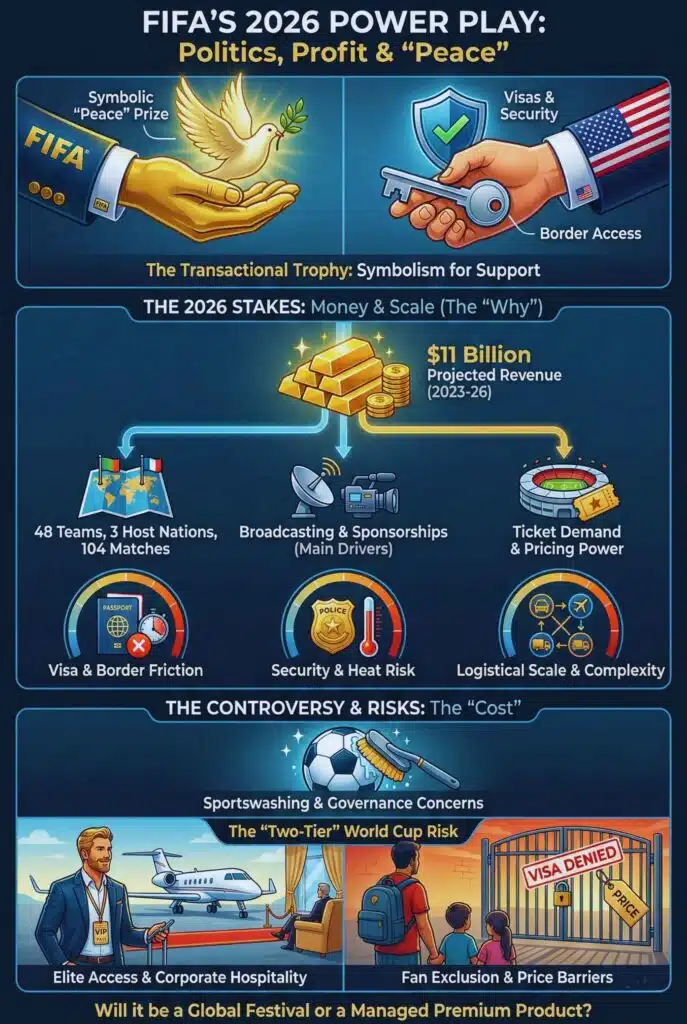
World Cup 2026 is not only a tournament. It is a logistics system spread across North America. That scale creates a different kind of vulnerability: the tournament can be “successful” in revenue terms while still feeling socially and politically broken.
Start with travel friction. The U.S. faces persistent visa backlogs in many countries. A priority scheduling program for ticket holders can help, but it does not guarantee approvals, and it does not eliminate the anxiety that comes from uncertain timelines. For many fans, especially those traveling from countries with stricter scrutiny or longer waits, uncertainty itself becomes a deterrent.
This matters because atmosphere is part of the World Cup product. Broadcasts sell the sound and emotion of a global festival. If fan composition skews heavily toward those with easy entry routes, high disposable income, and corporate access, the tournament risks feeling less like a world event and more like a premium entertainment product. That is not only a cultural issue. It can affect sponsor value, media narratives, and FIFA’s long-term brand.
Ticket pricing adds fuel. Record demand gives FIFA the ability to defend high prices as market-driven. But the World Cup is not a normal market product, because its legitimacy depends on broad global identification. When traditional supporters feel priced out, they do not just complain about cost. They claim the institution has abandoned its social contract.
Heat and scheduling also matter more than fans sometimes realize. A summer tournament across multiple U.S. regions exposes players and spectators to heat risk. Even if host cities prepare, extreme weather can disrupt match quality, raise injury risk, and create public debate about scheduling ethics. FIFA experienced heat-related criticism in recent U.S.-based tournament contexts, and 2026 will face even greater scrutiny because it is longer and larger.
Security is the final stress point. Large international tournaments are high-profile targets for disruption, and they also create domestic political flashpoints around policing. A tournament that requires visible security measures can generate negative optics, especially if enforcement looks discriminatory or overly militarized. When critics connect a peace prize to a backdrop of immigration enforcement and public order politics, they are linking symbolism to the lived reality of how states manage crowds and borders.
To capture how these pressures could produce a two-tier World Cup, consider the access funnel.
| Access Funnel For Fans | What Determines Success | Who Is Most At Risk Of Being Excluded |
| Ticket acquisition | Price, demand, lottery mechanics, payment systems | Lower-income supporters and large families |
| Visa appointment access | Consular capacity, eligibility, timing, documentation | Fans from countries with long backlogs |
| Visa approval | Risk assessments and travel history | Young travelers, limited travel history, certain nationalities |
| Border entry | Final discretionary checks | Anyone with ambiguous documentation or travel concerns |
| On-ground costs | Flights, hotels, local transport, city-to-city travel | Fans without corporate support or flexible budgets |
This is why the Trump FIFA Peace Prize resonates beyond its headline. FIFA is managing a mega-event that depends on state decisions at every stage of the fan journey. When FIFA awards a peace-branded prize to the head of the most powerful host state, many readers interpret it as FIFA acknowledging that dependency, and attempting to shape it through public symbolism.
That is also why the backlash will not disappear quickly. It connects to a broader trend: fans increasingly treat sports institutions as political actors whether the institutions want that label or not.
Here are some key statistics that show why the stakes are so high.
- The 2026 tournament expands to 48 teams and 104 matches across a three-country footprint.
- FIFA’s 2023–2026 revenue plan totals $11 billion, with broadcasting, marketing, and hospitality and ticketing as the core drivers.
- FIFA approved a record contribution package for 2026, expanding performance-based payouts and increasing the winner’s share to around $50 million.
- FIFA reported record-breaking ticket demand early in the sales cycle, with requests massively outpacing supply.
- Economic impact studies commissioned and promoted by tournament stakeholders project tens of billions in output and large job-equivalent effects, though outcomes depend heavily on travel flows and local execution.
Each of these points raises the same question in a different form: will World Cup 2026 feel like a global commons, or a managed premium product shaped by border policy, pricing, and political optics?
What Comes Next: Scenarios, Milestones, And The Long-Term Consequences For FIFA And World Sport?
The most useful way to think about “what comes next” is to separate immediate operational milestones from deeper institutional consequences.
In the near term, FIFA and the host governments must prove they can deliver access. That means visa appointment throughput, clear fan guidance, and predictable border procedures. It also means credible heat and safety planning, because summer conditions will not be negotiated by branding.
In the medium term, FIFA must decide what the Peace Prize is. Is it a serious institution with independent governance, or a flexible presidential handshake? If FIFA keeps it leadership-driven, it will generate recurring controversy that bleeds into tournament narratives. If FIFA professionalizes it, the prize could become a reputational asset rather than a liability.
There is also a longer-term geopolitical implication. If FIFA demonstrates that close alignment with the most powerful host can smooth delivery and protect revenues, other hosts and bidders will learn the lesson. Future tournaments could become more openly transactional: access and operations in exchange for symbolic recognition and global platforming. That would change how fans and civil society evaluate FIFA’s neutrality claims.
Watch these milestones closely, because each one will either validate FIFA’s strategy or deepen skepticism.
| Milestone Window (2026) | What To Watch | Why It Signals “What Comes Next” |
| January to March | Ticketing phases, pricing backlash, demand patterns | Determines whether inclusivity is real or rhetorical |
| First half of the year | Visa appointment throughput and clarity of requirements | Determines whether global fans can plan with confidence |
| Late spring | Heat mitigation and match timing debates | Signals whether FIFA prioritizes welfare over optics |
| Early summer | Security posture and city coordination | Affects sponsor comfort and fan perception of safety |
| During tournament | Border entry experiences and travel friction | The lived reality that will define headlines |
| After tournament | Audits of economic claims and legacy delivery | Determines whether governments trust FIFA projections next time |
Now, the scenarios.
Scenario one is the “managed success” outcome. Visas remain strict but predictable, ticket demand stays high, and the tournament delivers record revenue and strong broadcast performance. In this scenario, FIFA declares victory, and the peace prize becomes a recurring instrument used to maintain elite political relationships. Critics remain loud, but the business machine works.
Scenario two is the “access crisis” outcome. Visa backlogs and denials become a major story, pricing backlash grows, and fan composition skews heavily toward wealthier markets. Stadiums still fill, but the atmosphere and legitimacy narratives erode. FIFA faces heavier sponsor anxiety and more aggressive demands for governance reform. In this scenario, the peace prize is remembered as a symbol of FIFA’s misread of public sentiment.
Scenario three is the “shock event” outcome. A security incident, major heat-related controversy, or cross-border disruption forces late operational changes. The tournament becomes a case study in how mega-events are vulnerable to state policy shifts and climate realities. FIFA may become even more dependent on host-state partnership, which would make symbolic alignment more, not less, likely. But public trust could decline sharply.
Predictions should be labeled, and the honest label here is that these are informed possibilities, not certainties. Still, the signals point in a consistent direction.
Analysts suggest FIFA will continue to deepen government partnerships because 2026 is too large to manage without state capacity. Market indicators point to sustained demand, which gives FIFA financial confidence, even amid backlash. But political and human-rights scrutiny will likely intensify, not fade, because the World Cup is now a stage where border policy, pricing, and identity politics collide.
So what does the Trump FIFA Peace Prize ultimately reveal?
It reveals that FIFA is trying to run a bigger and richer World Cup while also trying to claim moral authority. It reveals that host governments hold leverage that can reshape the tournament’s inclusivity in practice. And it reveals that symbolic tools like awards are no longer harmless ceremonies. They are instruments in a legitimacy economy where fans, sponsors, and governments all negotiate what the World Cup is supposed to represent.
If FIFA wants the peace prize to survive, it must treat peace like a discipline, not a headline. That means verifiable criteria, independent selection, and long-term accountability, not just a one-night ceremony with global cameras.