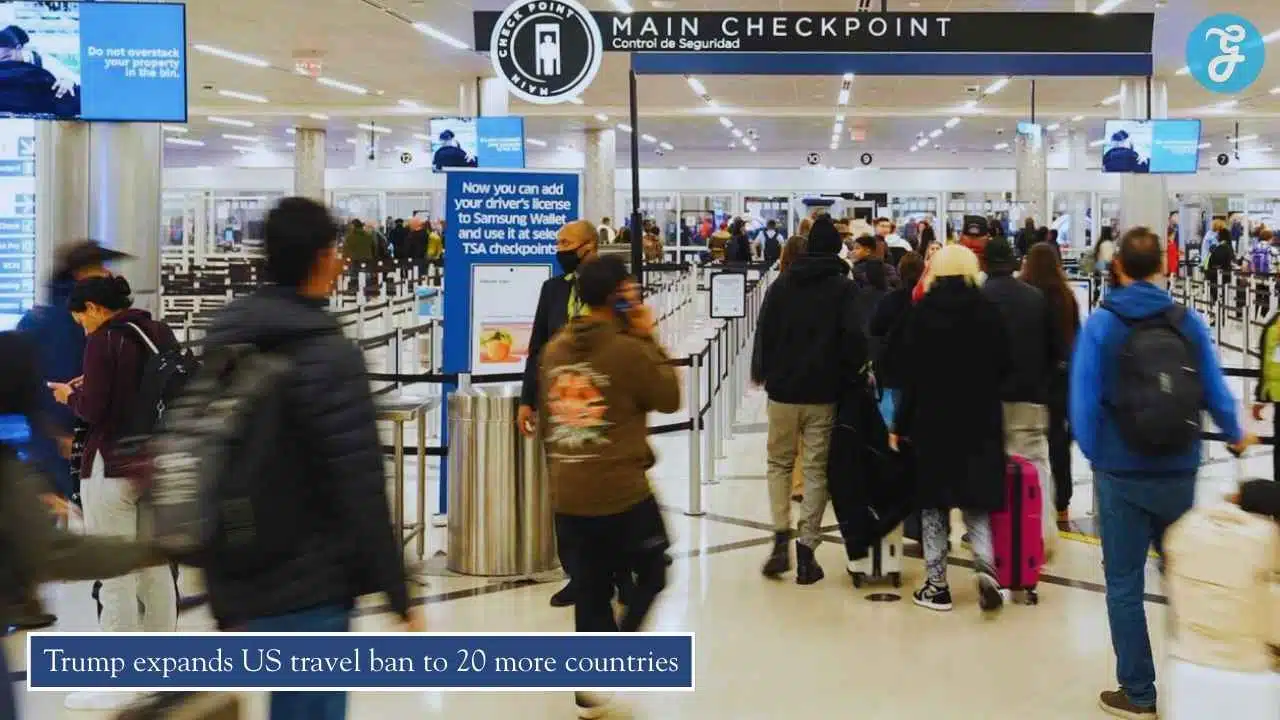
The Trump administration has announced a significant expansion of the Trump expands US travel ban policy, widening entry restrictions to cover 20 additional countries and travelers using Palestinian Authority-issued documents.
The move, finalized in mid-December 2025 and set to take effect on January 1, 2026, represents one of the most extensive changes to U.S. travel and immigration rules this year, affecting tourists, students, immigrants, and families worldwide.
What the Expanded Travel Ban Includes and When It Takes Effect?
The expanded travel ban stems from a new presidential proclamation signed on December 16, 2025. It builds on an earlier set of restrictions introduced in June 2025, which already limited entry from 19 countries under a mix of full and partial bans. The updated proclamation broadens both categories and reshapes how the United States evaluates foreign nationals seeking entry.
Under the policy, restrictions apply to both immigrant visas, which are used for permanent relocation, and nonimmigrant visas, such as those for tourism, business, study, or cultural exchange. The administration has confirmed that the new rules will come into force on January 1, 2026, giving travelers and U.S. embassies a short transition period.
The expanded framework divides countries into two main groups. Full restrictions impose the strictest limits, generally blocking most new visa issuance and entry, while partial restrictions target specific visa categories, most often short-term visitors and students. The proclamation also introduces a document-based restriction affecting individuals traveling on Palestinian Authority-issued or endorsed travel documents, regardless of their place of residence.
Countries Affected by Full and Partial Restrictions
The full-restriction category now includes a broader list of countries that the administration says present heightened security, documentation, or cooperation challenges. In addition to countries already subject to full restrictions earlier in 2025, five more nations have been added to this category: Burkina Faso, Mali, Niger, South Sudan, and Syria. These countries join a list that already included Afghanistan, Myanmar, Chad, the Republic of the Congo, Equatorial Guinea, Eritrea, Haiti, Iran, Libya, Somalia, Sudan, and Yemen.
Two countries, Laos and Sierra Leone, have been upgraded from partial to full restrictions, indicating that the administration believes conditions in those countries have worsened or failed to improve sufficiently since the earlier proclamation.
Alongside country-based bans, the administration has applied full restrictions to Palestinian Authority-issued travel documents. Officials argue that the lack of a fully functional central authority, combined with security concerns and limits on data-sharing, makes it difficult for U.S. agencies to conduct reliable background checks for travelers using these documents.
Partial restrictions have been expanded even more broadly. Fifteen additional countries are now subject to targeted limits that mainly affect visitor visas and student or exchange programs. These countries are Angola, Antigua and Barbuda, Benin, Côte d’Ivoire, Dominica, Gabon, The Gambia, Malawi, Mauritania, Nigeria, Senegal, Tanzania, Tonga, Zambia, and Zimbabwe. In these cases, the administration says the goal is not a blanket ban but tighter controls on the visa categories most associated with overstays or verification issues.
The proclamation also highlights a policy adjustment involving Turkmenistan. While immigrant visa restrictions remain in place, certain nonimmigrant limitations have been lifted following what officials describe as improved cooperation and information-sharing with U.S. authorities.
Who Is Exempt and How the Policy Will Be Applied?
Despite the broad scope of the Trump expands US travel ban expansion, the proclamation outlines several exemptions. Lawful permanent residents of the United States, commonly known as green card holders, are not subject to the new restrictions. Individuals who already hold valid U.S. visas are also generally exempt, although they may still face enhanced screening at ports of entry.
Diplomats, representatives of international organizations, and certain official travelers are excluded from the bans. The policy also allows for specific exemptions related to major sporting events or other activities deemed to be in the national interest.
A key element of the policy is the continuation of case-by-case waivers. These waivers give U.S. officials discretion to allow entry when denying a visa would cause undue hardship or when admission is considered to benefit U.S. interests. However, the administration has indicated that it is narrowing some family-based immigrant carve-outs, citing concerns about fraud and document reliability.
Implementation will largely fall to U.S. embassies, consulates, and border officials, who will assess applications and entries under the updated criteria. This means the real-world impact may vary depending on how strictly rules are interpreted and how waiver authority is used in practice.
Why the Administration Says the Travel Ban Was Expanded?
The administration has framed the expanded travel ban as a national security and public safety measure. Officials argue that the United States must be able to verify the identity and background of foreign nationals seeking entry, and that some countries do not meet minimum standards for cooperation or documentation.
Key factors cited include weak civil registration systems, unreliable birth and identity records, and widespread document fraud. In some cases, countries lack the technical capacity to share passport exemplars or criminal history data with U.S. authorities. In others, high visa overstay rates have raised concerns about compliance with U.S. immigration laws.
The proclamation also references the use of citizenship-by-investment programs in certain countries, which the administration says can obscure an individual’s true identity or background. In conflict-affected or politically unstable regions, officials argue that governance challenges and the presence of extremist groups further complicate vetting efforts.
Regarding Palestinian Authority-issued travel documents, the administration points to limitations on centralized control, inconsistent record-keeping, and security conditions that, in its view, prevent reliable screening. This document-based restriction marks a notable departure from earlier policies that focused primarily on nationality.
Broader Implications for Immigration, Travel, and Global Relations
The expansion of the Trump expands US travel ban underscores a broader shift toward stricter immigration and travel controls. For travelers, the immediate impact includes uncertainty, delays, and potential visa denials, particularly for students, tourists, and families planning reunification. Airlines, universities, and employers may also face challenges as they adjust to the new rules.
From a diplomatic perspective, the expanded ban is likely to affect U.S. relations with several countries, especially those newly added or upgraded to full restrictions. Past travel bans have drawn criticism from international organizations and human rights groups, while supporters argue they are necessary to protect U.S. security and uphold immigration laws.
Domestically, the policy is expected to remain a focal point of political debate. Supporters see it as a continuation of a tough stance on border control and vetting, while critics argue that broad restrictions risk unfairly targeting entire populations and disrupting lawful travel.
As the January 1, 2026 effective date approaches, much will depend on how the policy is implemented on the ground. Waiver decisions, embassy processing capacity, and legal challenges could all shape the practical reach of the expanded ban. What is clear is that the latest proclamation significantly reshapes who can enter the United States and under what conditions, marking a major development in U.S. immigration policy.