Newly released financial disclosure reports have revealed that United States President Donald Trump has made significant investments in the bond market since his return to the White House earlier this year. According to documents from the U.S. Office of Government Ethics (OGE), Trump has purchased more than $100 million worth of corporate and municipal bonds between January 21, 2025—the day of his inauguration—and August 1, 2025.
The disclosures offer a rare glimpse into the financial management of the billionaire president, shedding light on how his wealth is being invested during his presidency. While exact amounts are not published for each transaction, the filings show investment ranges such as $100,001–$250,000 and $1,000,001–$5,000,000, highlighting the scale of Trump’s financial activity.
Nearly 700 Bond Purchases in Six Months
The documents detail an extraordinary 700 transactions, all involving bond purchases. What stands out is the absence of any reported sales, meaning Trump has been consistently acquiring new positions without liquidating existing ones.
This buying spree includes bonds issued by major U.S. financial institutions such as:
- Wells Fargo
- Morgan Stanley
- Citigroup
It also extends to bonds from large multinational corporations and household names like:
- Meta (formerly Facebook)
- UnitedHealth Group
- T-Mobile USA
- The Home Depot
These investments are not limited to corporate debt. Trump has also been acquiring municipal bonds from across the United States. Dozens of states are represented—including Texas, Florida, New York, and California—covering a broad range of public projects. These bonds finance everything from hospitals, schools, and airports to ports, energy infrastructure, and gas facilities.
What Are Bonds and Why They Matter
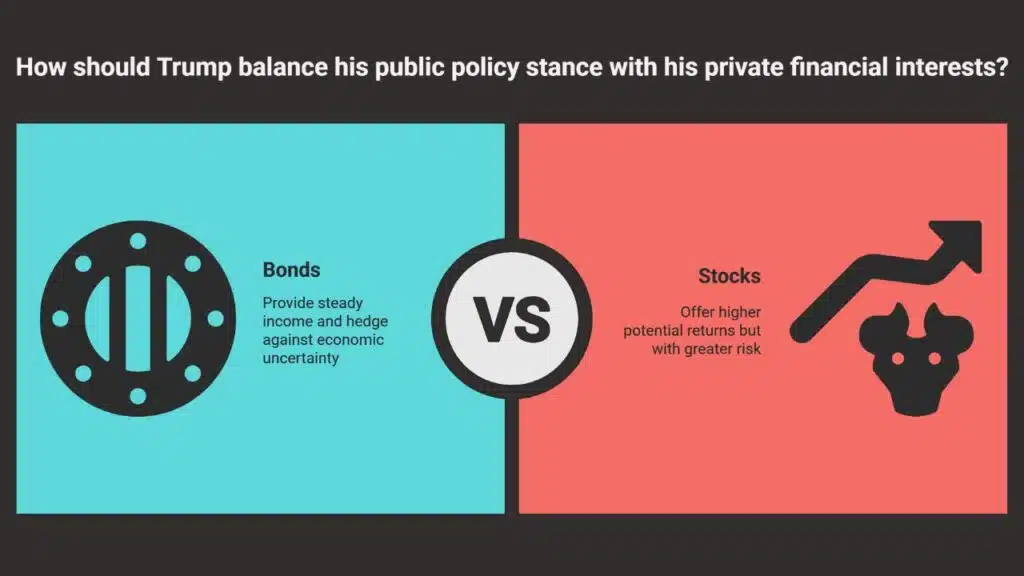
Bonds are a type of fixed-income investment. Essentially, they act as loans: investors lend money to a government authority or a corporation in exchange for regular interest payments, with the principal repaid when the bond matures.
For wealthy individuals like Trump, bonds are considered a low-to-moderate risk investment compared to stocks. They provide a steady stream of income while also serving as a hedge during times of economic uncertainty. However, the value of bonds fluctuates depending on interest rates. When rates fall, the value of bonds rises—and vice versa.
This dynamic is important, as critics note Trump has repeatedly pushed the Federal Reserve to lower interest rates. If the Fed cuts rates, Trump’s bond holdings could increase in value, raising questions about potential conflicts between his public policy stance and private financial interests.
Ethics Concerns: A Departure From Presidential Norms
Under the Ethics in Government Act of 1978, introduced after the Watergate scandal, U.S. presidents are required to disclose their finances. However, they are not required to divest from their holdings, which means they can legally continue to benefit from financial decisions while in office.
Most presidents since the law was enacted—including Jimmy Carter, Ronald Reagan, George H.W. Bush, Bill Clinton, George W. Bush, Barack Obama, and Joe Biden—chose to reduce conflicts of interest by either placing assets in a blind trust or limiting their investments to diversified mutual funds.
Trump has broken from that tradition. Instead of divesting, he passed control of his business empire into a trust managed by his children, maintaining significant exposure to his private wealth. Ethics watchdogs have argued this decision blurs the line between Trump’s role as president and his personal business interests.
Expert Commentary on the Risks
Ethics experts have long warned about the risks of a sitting president holding significant financial assets. Richard Painter, who served as the chief White House ethics lawyer under President George W. Bush, told Al Jazeera that Trump’s bond strategy could pose serious conflicts:
“When interest rates go down, bond prices go up. No wonder he’s leaning on the Fed for a rate cut.”
Painter and others argue that Trump’s public calls for lower interest rates align closely with his personal financial interests, potentially undermining public confidence in his economic policies.
The Scale of Trump’s Wealth
While Trump’s exact wealth remains uncertain, the Bloomberg Billionaires Index recently estimated his net worth at $6.4 billion. His bond purchases, though large, represent only a portion of his overall assets, which include real estate, golf courses, and business ventures.
Nonetheless, $100 million in new bond holdings in less than six months underscores just how aggressively Trump is reshaping his portfolio during his presidency. For context, most U.S. presidents have sought to limit such financial entanglements to avoid ethical scrutiny.
Why This Disclosure Matters
This wave of bond buying matters for several reasons:
- Public Trust in Governance – Financial transparency is critical for citizens to trust that policies are made in the public’s interest, not for personal gain.
- Market Signals – Trump’s choices to invest heavily in bonds—traditionally seen as “safer” investments—may reflect his or his advisers’ views on the economy.
- Conflict of Interest Debate – Trump’s unique approach to managing his wealth sets him apart from modern presidential norms, reviving debates about how closely private interests should be tied to public office.
A Summary of Trump’s Bond Purchases
| Category | Details |
| Total Investment | Over $100 million in bonds |
| Transactions | Nearly 700 separate bond purchases |
| Corporate Bonds | Issued by Meta, Citigroup, Wells Fargo, UnitedHealth, T-Mobile, Home Depot, and more |
| Municipal Bonds | Financing public projects in states like Texas, Florida, New York, and California |
| Sales Reported | None—only purchases made during the period |
| Ethics Concerns | Possible conflicts due to Fed rate policy and presidential influence |
| Net Worth | Estimated $6.4 billion (Bloomberg, July 2025) |
Trump’s $100 million bond-buying spree is not illegal, but it is unprecedented in scope for a sitting U.S. president. By maintaining such a large and active investment portfolio while also shaping national economic policy, Trump is walking a fine line between personal finance and public duty.
The disclosures reaffirm what many ethics experts have long argued: that the lack of strict rules requiring presidents to divest from personal assets leaves open the possibility for conflicts of interest. As the Federal Reserve continues to deliberate on interest rates and economic policy, Trump’s financial ties to the bond market are likely to remain a subject of intense debate in both political and financial circles.
The Information is Collected from Al jazeera and Live Mint.